Let's start the new year with some new items on the aft deck.
The steam spindle and the feed guide rollers were due for restoration.
This one is on the Balder:
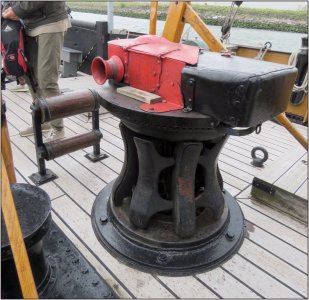
I was aware that this is not the original. This is also evident from the Amsterdam book about the first restoration:
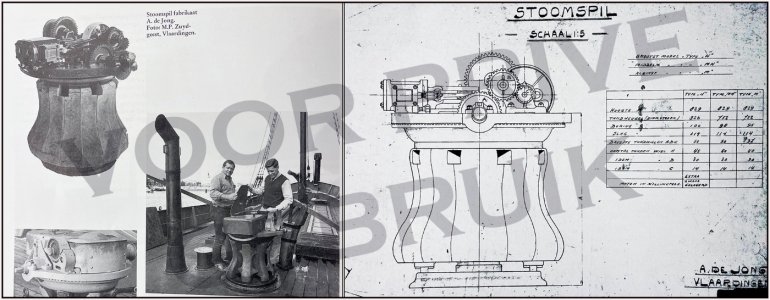
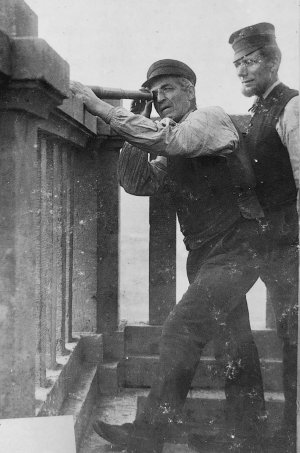
Caption of the photo on the left: "
Project leader Sybe de Jong and curator Cees Paul at the recently acquired steam spindle on the Balder." This spindle was found in England and came from a trawler. It had no wooden cladding.
On the right is a drawing of the steam spindle, from the A. de Jong shipyard. The photo is from the collection of M.P. Zuydgeest in Vlaardingen.
It's striking that the spindle also has eight square holes. If there is no steam, eight handles can be inserted into the holes to turn the spindle.
Some stages of making the spindle:
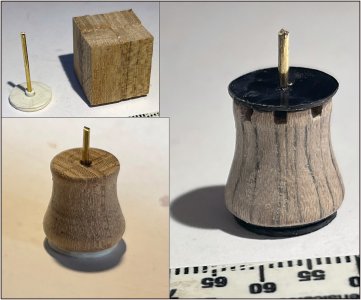
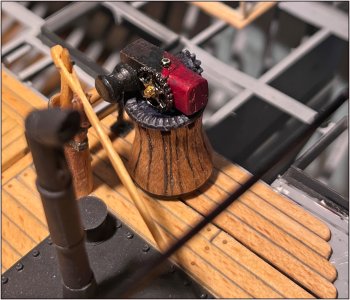
The wooden spindle rotates like a drum on a standing axle. I turned this from a 12x14 mm composite block of wood. I filed 8 square slots on top of the wood, and on top of that, a plate for the drive gear.
This is what the factory delivered:
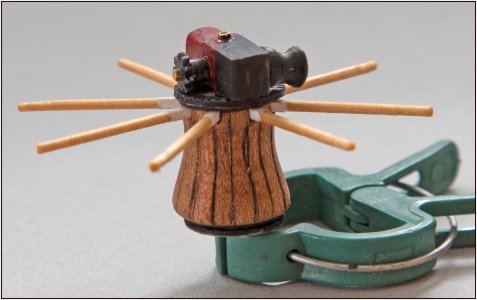
Including 8 handles.
The top housing is secured to the center axle. In the original, this contains a drive gear with a small crankshaft and two pistons.
On one side, an output shaft with a gear drives the spindle, via a rack and pinion on the cover plate on the wood.
On the other side, a small metal spindle can be driven.
The spindle together with the feed guide rollers on deck:
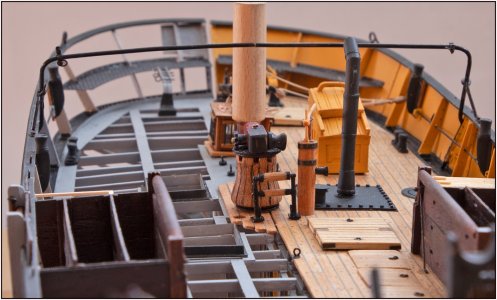
It is correct that the spindle is off-center and slightly to starboard. The feed guide rollers are slightly to port. When retrieving the rope, it goes through the hawse on the right side of the bow, slightly diagonally across the deck, and is guided between the rollers to the port side of the spindle. The spindle therefore rotates counterclockwise when retrieving.
An additional problem on my model: both are over the seam and I have to be able to release them again. They are secured to the deck with pins. An extra piece of deck has also been laid on the starboard side.
Viewed from the other side:
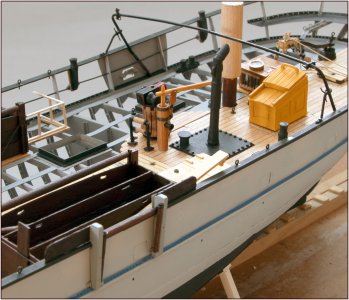
If the spindle is operated by hand and the handles, the bilge pumps must first be removed.
With some more details:
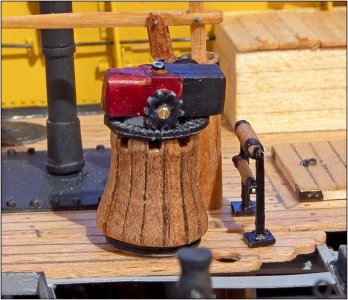
The top roller has a lock on the port side. This allows the rope to be removed from the rollers without first having to completely thread through the end. I don't have that lock. The detailing stop there .....

The rollers are 9 mm wide, the uprights are made of 1x1 mm brass, and the four bearings in which the rollers rotate are soldered to them.
The bottom roller is smaller in diameter (1.5 mm compared to 2.3 mm of the one) and is mounted behind the upright like the original.
The teeth of the gear and rack don't quite fit. It was quite a fiddly job filing all those teeth.
Oh yeah...
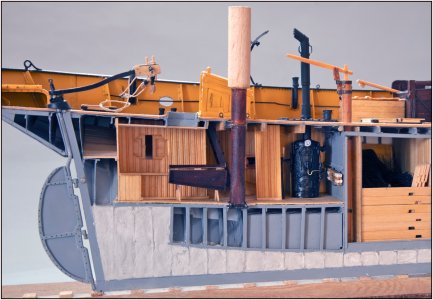
The eight handles are stored below deck on the wall near the Donkey boiler. They probably won't be used much.
Regards, Peter
















 But I stopped doing it, to keep from going crazy.