
-

SUBSCRIBE TO SHIPS IN SCALE TODAY!
The beloved Ships in Scale Magazine is back and charting a new course for 2026!
Discover new skills, new techniques, and new inspirations in every issue.
NOTE THAT OUR NEXT ISSUE WILL BE July/August 2026 -

Win a Free Custom Engraved Brass Coin!!!
As a way to introduce our brass coins to the community, we will raffle off a free coin during the month of August. Follow link ABOVE for instructions for entering.


You are using an out of date browser. It may not display this or other websites correctly.
You should upgrade or use an alternative browser.
You should upgrade or use an alternative browser.

- Joined
- Nov 24, 2025
- Messages
- 61
- Points
- 78

Here's a tool that can be used for a variety of cases where evenly spaced points are needed, such as simulating deck or ceiling planking.
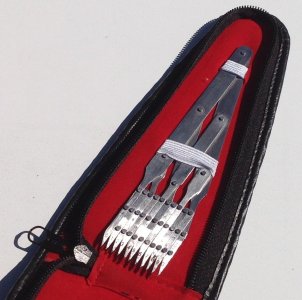
They are called 10-point dividers. (Even though there are actually eleven points.)
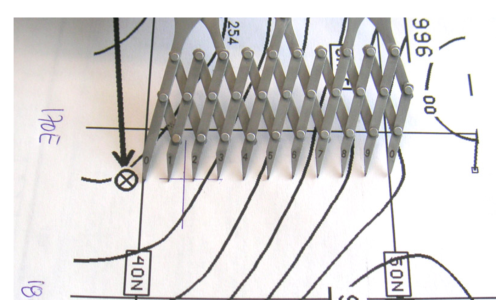
U.S. Navy acoustic operators used them in the days of paper sonar grams to figure out which squiggly lines were related to each other.
They are actually a navigation tool and can still be found on marine supply sites.
The stainless steel versions can be a bit pricey, but by shopping around you should be able to find them on-line for around the price of a U.S. paper portrait of Grant.
The ones I have are from Weems and Paeth, but the price has gone up considerably since I purchased them, (Tariffs?)
They are called 10-point dividers. (Even though there are actually eleven points.)
U.S. Navy acoustic operators used them in the days of paper sonar grams to figure out which squiggly lines were related to each other.
They are actually a navigation tool and can still be found on marine supply sites.
The stainless steel versions can be a bit pricey, but by shopping around you should be able to find them on-line for around the price of a U.S. paper portrait of Grant.
The ones I have are from Weems and Paeth, but the price has gone up considerably since I purchased them, (Tariffs?)

After posting a picture on rounding axles a member had the idea of a thread with little "how-to" items or tricks of the trade that might be of interest for both kit and scratch builders.. Hope this is of interest for one and all to contribute their little tricks.
If this subject has already been started, please let me know, I looked and could not find anything.
First up
Rounding truck axles on cannon carriages. Too many times we are relegated to having axles that are not round. To round them by hand is tedious and not consistent but I came up with a little device some years ago that is simple to make and easy to use .
Take a small piece of brass or aluminum rod and drill a hole in one end that is the diameter that is needed. Typically the width of the trucks is the same as the thickness of carriage brackets and the axle diameter is about the same as well. Once the hole is drilled, make a couple cross cuts with a hack saw which will create cutting edges in the drilled hole.
The axles were not usually square so you will feel the cutter stop when it hits the shoulder which takes a second or less in time. It may take a little cleaning up of peelings. If they are square, a little care needs to be taken not to round too far down. Marking the cutter with ink or tape as an indicator is easy and effective.
Allan
View attachment 477053
Thanks for this tip!
Saved me a bunch of aggregation on my 1:48 Blandford gun carriages
Saved me a bunch of aggregation on my 1:48 Blandford gun carriages


When we plank our models, for bending the planks many of us soak the plank. Well I wanted to come up with a way to be able to soak a pretty lengthy plank that didn't take up a lot a room and wouldn't use a lot of water but still large enough to be able to support a pretty good length of wood. I wanted something that would be upright rather than take a lot of space on the workbench or whatever surface and I found various graduated cylinders. They come in various sizes and you can get them in plastic so it eliminates the risk of broken glass and they are relatively inexpensive.
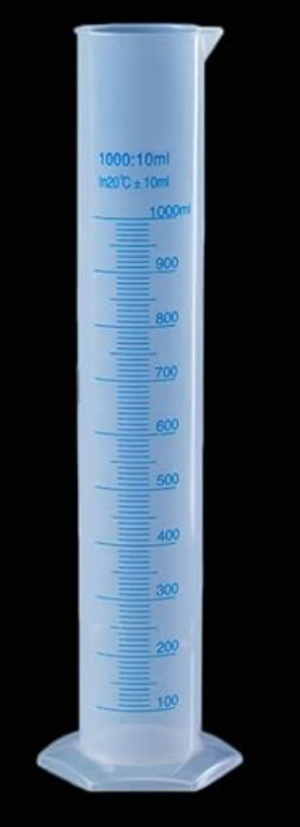
I picked up a couple of sizes. the 1000ml (the bigger of the two) is about 3" in diameter and just over 16" tall.
The 100 ml is 1.25" in diameter and just under 10" tall.
Its not a problem to get the wood out because the wood floats in the water so its going to be at the top.
Hope it helps someone.
I picked up a couple of sizes. the 1000ml (the bigger of the two) is about 3" in diameter and just over 16" tall.
The 100 ml is 1.25" in diameter and just under 10" tall.
Its not a problem to get the wood out because the wood floats in the water so its going to be at the top.
Hope it helps someone.
Last edited:


I cut a piece of PVC pipe to be a little over 24” (longest length of planks I’ve encountered so far) and glued a cap to one end. I fill it up and clamp it upright to the side of the bench. The planks float so I can use it with shorter planks too. I have another cap to put on top to keep the planks submerged.When we plank our models, for bending the planks many of us soak the plank. Well I wanted to come up with a way to be able to soak a pretty lengthy plank that didn't take up a lot a room and wouldn't use a lot of water but still large enough to be able to support a pretty good length of wood. I wanted something that would be upright rather than take a lot of space on the workbench or whatever surface and I found various graduated cylinders. They come in various sizes and you can get them in plastic so it eliminates the risk of broken glass and they are relatively inexpensive.
View attachment 571598
I picked up a couple of sizes. the 1000ml (the bigger of the two) is about 3" in diameter and just over 16" tall.
The 100 ml is 1.25" in diameter and just under 10" tall.
Its not a problem to get the wood out because the wood floats in the water so its going to be at the top.
Hope it helps someone.
Same here. I have a couple shorties and a longer tube. I sometimes attach a cap to the open end (without glue) as I have been known to knock one over, spilling water on the work bench or floor.I cut a piece of PVC pipe to be a little over 24” (longest length of planks I’ve encountered so far) and glued a cap to one end.
Allan

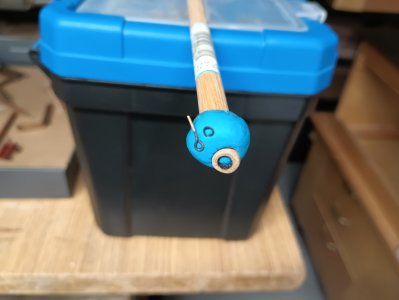
Small parts and Cheerios…One of my best tools for small parts. And it saves my knees. Play tack on a 4' dowel.
View attachment 572534

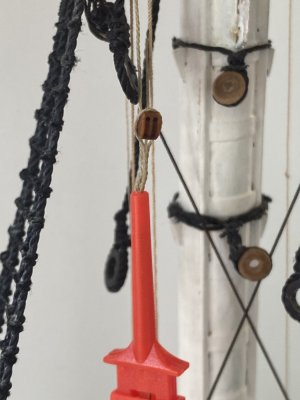
Just to add to the collection here. Under the heading of "never too many clamps" are the electric test probe clamps I have started using to put some weight on small lines or to hold them in position. They work quite well, are small and don't get in the way.
I modify clothes pins (AKA clothes pegs for our British mates) by "flipping" them over so the small end pinches together, This allows for more precise control and can also be used as a wedge when you need to push some pieces together.
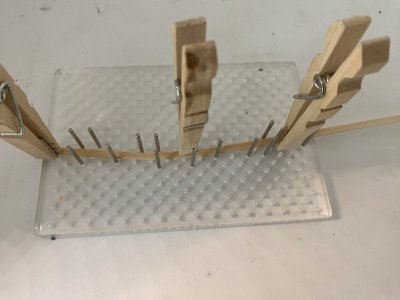
I modify clothes pins (AKA clothes pegs for our British mates) by "flipping" them over so the small end pinches together, This allows for more precise control and can also be used as a wedge when you need to push some pieces together.
Last edited:
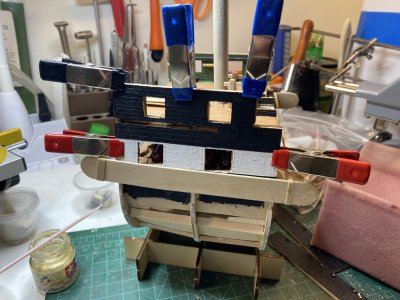
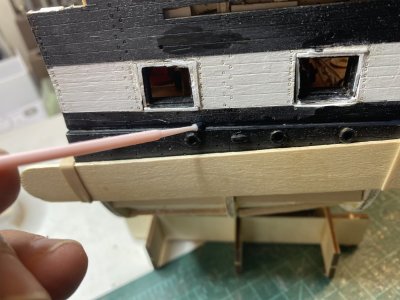
Instead of using a large bottle of PVA glue I put a smaller amount into a used paint container. It is less cumbersome. I usually apply the glue using a mall dental applicator which are very inexpensive. These applicators have a small "brush" on the end which can be removed easily if you wish. The small brush is also perfect for touch up painting of a small area.
Last edited:
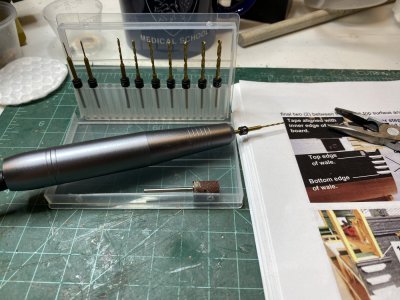
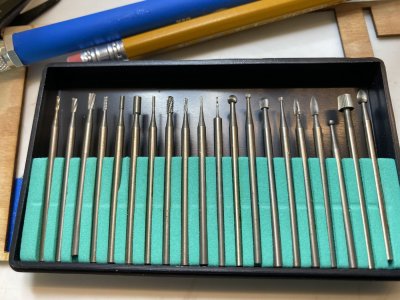
My favorite "power tool" is now a "Nail Drill" I picked up for about $12 on Amazon. It runs off the USB power bricks you use to recharge your cell phone. They also make rechargeable one for about $30. They are much lighter and easier to maneuver then a Dremel. They do not have as much torque as a Dremel and have a 3/32 shank size so Dremel attachment CAN NOT be used with them. However they come with a drum sander and replacement sandpaper any you can pick up more of various grits cheaply. they also come with different shaping bits. You can also find nice Arrorowmax drill bits that fit as well as some burrs I bought from the model expo site.

- Joined
- Mar 28, 2024
- Messages
- 313
- Points
- 138

Hi Allan, So I done my sums with the Bounty and worked out the main mast diameter is around 480mm. So, we say 0.62 of that is 298 mm which we divide by 48 (The scale I am doing the Bounty at...) and we get 6.2mm Rope for the Main? anchor. Don't seem right to me or have I got it wrong?Hi Paul,
For the anchor the following are from Lees Masting and Rigging page 188.
Sheet, best bower and bower anchor cable circumference is 0.62 X the diameter of the main mast.
Kedge anchor cable is 0.6 the size of the sheet anchor cable.
The spare cables were an inch or so smaller in circumference.
Other anchor rigging
cable messenger 0.75X main stay
Cat falls and cat head stopper 0.33X the main stay
Shank painter tail 0.4 X the main stay
fish pendant 0.5 X the main stay
fish pendant tackle 0.25 X the main stay
There are several other ropes concerning anchor handling related items as well.
Hope this is helpful.
Allan

Are you getting diameters and circumference mixed up ?Hi Allan, So I done my sums with the Bounty and worked out the main mast diameter is around 480mm. So, we say 0.62 of that is 298 mm which we divide by 48 (The scale I am doing the Bounty at...) and we get 6.2mm Rope for the Main? anchor. Don't seem right to me or have I got it wrong?
Hi Gary,6.2mm Rope for the Main? anchor. Don't seem right to me or have I got it wrong?
Are you looking at diameter or circumference? I ran the numbers again and looked up the anchor cable size for Bounty on AI and they are pretty much a match. The AI search called out circumferences of 11.6"-12,5" (6.2mm X48)/25.4=11.7"
Allan
- Joined
- Mar 28, 2024
- Messages
- 313
- Points
- 138
No guys, look at what is written and stated here on the next line as written:Are you getting diameters and circumference mixed up ?
"For the anchor the following are from Lees Masting and Rigging page 188.
Sheet, best bower and bower anchor cable circumference is 0.62 X the diameter of the main mast."
So the diameter - not the circumference is what's included in the formula.
So the diameter of the main mast is 480 or nearly 19", and you divide or multiply by 0.62 (as it works out the same) then divide by 48 - being the scale. If it was the circumference, then 480x 3.142 or 19 inches x 3.142 =1508 mm or 59.5", then multiply or divide by 0.62 = 932mm or 37 inch circumference ( Rounded off) and then I divide by 48 which gives me 31.5 mm circumference or 11.7" circumference then to find out what sized rope (diameter) I have just divide by 3.142 (Pye)=10mm or in inches - 3. 750 inches. (All measurements are rounded off.)
I can only see what I see and then do the maths. What I see is not comparable to the ship I am building, or could you lay out the formula, what is really meant by 0.62 the diameter of the mast for me, please? I am really stumped.

A scaled rope with a circumference of 6.2 mm has a diameter of 2 mm which should be just about right...
Or maybe I'm missing something?
Or maybe I'm missing something?
The circumference of a circle is Pi x D (or 3.14 x diameter) so a rope with a circumference of 6.2mm would have a diameter of 1.97mm so 2 is perfect!A scaled rope with a circumference of 6.2 mm has a diameter of 2 mm which should be just about right...
Or maybe I'm missing something?
Rob