• Win a Free Custom Engraved Brass Coin!!!
    As a way to introduce our brass coins to the community, we will raffle off a free coin during the month of August. Follow link ABOVE for instructions for entering.

Tricks of the trade

That has never happened to me, not even once,,,,,,,,,, in the past 11 days. Cleaned up the shop area a week and a half ago and put things in order which was a big mistake. Now that it is a bit of a mess again, I found what was missing and all is well. :)

I envy (hate) seeing those posted photos of an immaculate shop. I take solace in a comment from one of my old work partners that was responsible for the machining part of our own factory. He used to say that other than in an operating room if you go into a work area and there are no little bits and pieces and such laying around, they don't have many customers.

Allan
I've worked in two exceptions. A jewellery workshop where losing a diamond could cost you your job, and an organ pipe workshop where lead is used extensively and the whole place had to be cleaned every evening for H&S.

My own ship building area at home alternates between being incredibly tidy and incredibly messy :)
 
Last edited:
Tuna fish cans: FabricatIng tiny brass 1:96 scale parts, a week’s work can disappear in an instant to either never be found or discovered after you have spent another week building a replacement.

A simple solution is a tuna fish can kept on my workbench. These are wide relative to their depth so don’t knock over quite as easily as other containers. After spending way too much looking for lost parts, I have trained myself to keep needed parts in the can. When working on a part and say needing another tool, don’t put the part down on the workbench; put it in the can! It’s amazing how easy it is to flick a part laying on the bench into oblivion.

Roger
 
Tuna fish cans: FabricatIng tiny brass 1:96 scale parts, a week’s work can disappear in an instant to either never be found or discovered after you have spent another week building a replacement.

A simple solution is a tuna fish can kept on my workbench. These are wide relative to their depth so don’t knock over quite as easily as other containers. After spending way too much looking for lost parts, I have trained myself to keep needed parts in the can. When working on a part and say needing another tool, don’t put the part down on the workbench; put it in the can! It’s amazing how easy it is to flick a part laying on the bench into oblivion.

Roger
Excellent.
 
Sounds like a great idea. I will be having a tuna sandwich tomorrow and cleaning out the can then moving it to the work bench (the can, not the sandwich.) Thanks for the idea:)
Here, tuna comes in ring pull cans. Beware the sharp edges all round. I run a scraper sharpener around to safe edge them, or just the shaft of a chunky screwdriver if in a rush. They make good paint pots too, because the sharp edge is good for wiping off excess paint from your brush.

J
 
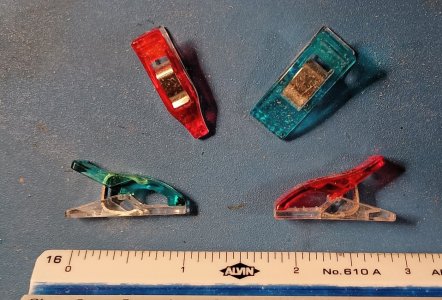
Need clips for small, hard to reach places ?
Sewing suppliers have small plastic clips used to hold cloth seams together until they can be sewed. (The clips don't mind being used to hold model parts together.)
Out of the package, the clips have small bumps on the jaws that grip fabric. The bumps can easily be removed using a flat needle file.
The lower jaw is flat while the upper jaw has an arch, giving the modeler choices on how best to grip parts.

sewing clips.jpg
 
TREENAILS -
There are multiple ways to make treenails successfully. The things I try to keep in mind:
Subtle color
Scale
Strength
Cost
Time
Tools needed

Regarding diameters the following shows typical diameters needed at different scales. I have never tried to make wooden treenails smaller than 0.016" diameter but if someone has done this with success, I for one would love to see how to do this. Dimensions are in inches.

--------------------------- Full size ------------1:98------------------ 1:72----------------1:64--------------- 1:48

Hull--------------------------1.5-2--------- 0.016 - 0.02---------0.02 -0.028 ------ 0.023-0.031------ 0.031-0.04

Deck nail covers-------------1.5-----------------0.016---------------- 0.02--------------- 0.023------------0.031

Based on information from Peter Goodwins, The Construction and Fitting of the British Man of War, pp 60-61, decks were often spiked, not trennaled but then covered with a 1/2" thick 1.5"diameter round (or diamond shape) wooden cover. For the models trennals no larger than 1.5 inch diameter would have the appearance of the wooden covers. When wooden trennals were used on the decks rather than iron spikes they would have been about 1 inch diameter.

The photos are various methods I have seen used and there are probably more, with their own benefits and flaws. My preference is the last description. If anyone has more methods that they have used with success, it would be great to see these.
Allan

1.) Toothpicks.
View attachment 484690
2.) Made with hypodermic needle
View attachment 484691

View attachment 484692
Draw plate with bamboo, my favorite method
Start with any bamboo skewers. They are cheap and go a long way.
Slit the skewer with a hobby knife such as an Xacto or Swann Morton, et al. I slit these into as many strips as possible as they need to get down to some small diameters and the largest hole on my draw plate is 0,059 inches. When running the piece through the draw plate it is good to pull at a slight angle and the pass it through the same hole two or three times. I cannot speak for the first two methods but I can produce about 200 trennals down to the smallest diameters in about an hour. Large diameters take less time with subsequent increased output.
View attachment 484970
View attachment 484971
View attachment 484973
View attachment 484974
View attachment 484975
--

Charles Davis recomends keeping your treenails warm and dry until just prior to use. He worked on full-size wooden ship construction before taking up wooden model ships.
 
I've worked in two exceptions. A jewellery workshop where losing a diamond could cost you your job, and an organ pipe workshop where lead is used extensively and the whole place had to be cleaned every evening for H&S.

My own ship building area at home alternates between being incredibly tidy and incredibly messy :)
Hey Richard,

That's how I see it too! Just like life... Sometimes things go according to plan and sometimes they don't! Sometimes it's chaotic and sometimes it's not! And yet, we can handle both situations! Either way... ;)
 
Hey Shipmates,

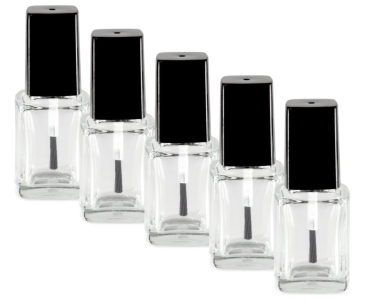
For example, when I need superglue over a longer period of time, I use nail polish bottles. These also have a plastic brush. This makes it easy to apply the right amount and also easy to apply with the brush They are also not easily knocked over. In addition, they are heavy and easy to transport...
look the foto....

1764184369506.png
 
I try to keep a neat workbench, putting tools away when I’m done with them. I have noticed, however, when something that I’m doing goes wrong I will get one or more different tools out to try a different approach. Soon my bench top is littered with tools and other stuff.

I now realize that when I am taking tools out and not putting them away It’t time to quit for the day.

Roger
 
I try to keep a neat workbench, putting tools away when I’m done with them.

My master boat builder mentor taught me that tools should always be well organized and laid out on the bench or in a toolbox when working on a boat, "like a surgeon does with surgical instruments in an operating room." His reasoning, which was dead-on accurate, was that on a cluttered bench you spend a lot of time looking for tools you just laid down or "were here just a minute ago." That time is wasted, and in the trades, wasted time is wasted money. While not as monetarily costly in the case of a hobby, it certainly does speed up a build and reduce the incidental frustrations of chasing tools.
 
Hey Shipmates,

Perhaps you're familiar with this problem: you need to glue something in a place that you can't reach with a nozzle and glue opening. So you take a little glue from a container and then use a toothpick or a metal object to glue the piece of wood, plastic, etc.

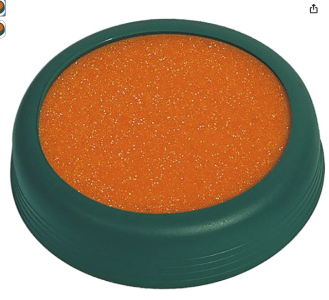
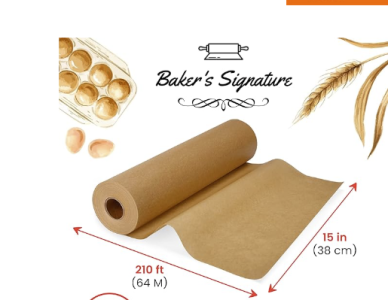
I had the idea of using a moistener and placing baking paper over it. The foam in the moistener holds the baking paper in place and prevents it from slipping.

The advantage is that

the superglue does not dry and does not stick to the paper. It is easy to portion and remove.

I also use baking paper as a base when I need to glue strips, as it is coated. Here, too, the strips can be easily removed from the baking paper...

Perhaps you are familiar with this. I just wanted to point it out. :D Thumbsup

1764238602276.png1764238858013.png
 
Hey Shipmates,

Perhaps you're familiar with this problem: you need to glue something in a place that you can't reach with a nozzle and glue opening. So you take a little glue from a container and then use a toothpick or a metal object to glue the piece of wood, plastic, etc.

I had the idea of using a moistener and placing baking paper over it. The foam in the moistener holds the baking paper in place and prevents it from slipping.

The advantage is that

the superglue does not dry and does not stick to the paper. It is easy to portion and remove.

I also use baking paper as a base when I need to glue strips, as it is coated. Here, too, the strips can be easily removed from the baking paper...

Perhaps you are familiar with this. I just wanted to point it out. :D Thumbsup

View attachment 559865View attachment 559866

Great idea. I used to use something to prevent acrylic paints drying too quickly. It's a tray with greaseproof paper that has a barely damp piece of kitchen towel underneath it. I never though of using it for water based glue.

Here is a commercial version, but it is so easy to make your own

https://www.amazon.co.uk/Daler-Rown...lpcontext&ref_=fplfs&smid=A3P5ROKL5A1OLE&th=1
 
Hey Shipmates,

Perhaps you're familiar with this problem: you need to glue something in a place that you can't reach with a nozzle and glue opening. So you take a little glue from a container and then use a toothpick or a metal object to glue the piece of wood, plastic, etc.

I had the idea of using a moistener and placing baking paper over it. The foam in the moistener holds the baking paper in place and prevents it from slipping.

The advantage is that

the superglue does not dry and does not stick to the paper. It is easy to portion and remove.

I also use baking paper as a base when I need to glue strips, as it is coated. Here, too, the strips can be easily removed from the baking paper...

Perhaps you are familiar with this. I just wanted to point it out. :D Thumbsup

View attachment 559865View attachment 559866
It’s called a wet pallette. Figure painters working with acrylic paints use the same technique to keep paints from drying out. I have used this when weathering plastic models with acrylics.
 
On the subject of keeping your bench tidy -

IMG_2602.jpeg

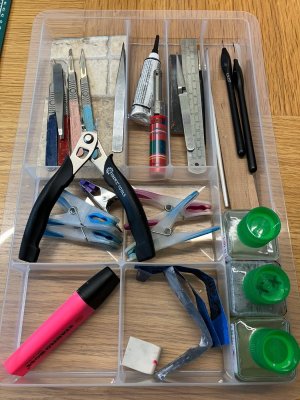
I use a partition tray for the things that I know I am going to be using almost every day. I am training myself to put my scalpel and tweezers back into the tray rather than putting them down on the bench. I’m not perfect yet but eight times out of 10 when I need a tool I know exactly where it’s going to be. And at the end of the session, I can put them all away on the shelf in one go.

IMG_2641.jpeg

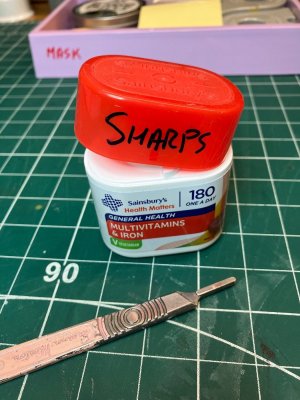
When I change my scalpel blades, I drop the old ones into a vitamin container for safety and later disposal.
 
Back
Top