



That’s a lot of nails! Did the actual ship have that many? And what were they nailed to?

 |
The beloved Ships in Scale Magazine is back and charting a new course for 2026! Discover new skills, new techniques, and new inspirations in every issue. NOTE THAT OUR NEXT ISSUE WILL BE July/August 2026 |
|
 |
As a way to introduce our brass coins to the community, we will raffle off a free coin during the month of August. Follow link ABOVE for instructions for entering. |
|

Well, that's what the picture showsThat’s a lot of nails! Did the actual ship have that many? And what were they nailed to?
 . I assume the nails were holding the two layers of the gun port together - though the French do seem to place design ahead of essential function.


Besides the visit of some Olympic event sites, I also visited your site, Paul. Nice repetitive work with structured patterns.Progress has been slow because I am addicted to watching the Winter Olympics...
But we have also had some unseasonably warm weather this past week, so I took advantage of that by getting some work done in my garage (loud and messy tools are all relegated to the garage).
Here are the deck beams for the 2nd and 3rd decks along with the ledges for the second deck:
View attachment 578413
Before it warmed up, I also added the nails that hold the two layers of the gun port covers together:
View attachment 578411
View attachment 578412
I'll be keeping all the gun ports closed on this particular model.
Thanks for taking some time during your holiday to check in, Peter. Yes... repetitive work...Besides the visit of some Olympic event sites, I also visited your site, Paul. Nice repetitive work with structured patterns.
Regards, Peter
 But I think if I focus on the end goal I can keep chipping away. But that is what typically makes me jump ship, pun intended, to another project for a reprieve. Although sometimes that reprieve turns into a vacation!
A really great post, Dean. As I reflect on what you have said it occurs to me that I CANNOT focus on the end - it simply makes the build feel overwhelming. I almost have to forget the end and just work on the problem in front of me.But I think if I focus on the end goal I can keep chipping away.

Sometimes the repetitive nature leads to boredom on my end, because I feel like I’m working at a factory!
Gentlemen, there is something very therapeutic to me when I consider your statements. I am not the only one who experiences these thoughts/feelings.As I reflect on what you have said it occurs to me that I CANNOT focus on the end - it simply makes the build feel overwhelming.

How do you eat an elephant? One bite at a time!work on the problem in front of me.

Oh yes, true words, Oliver. I was speaking more about the emotions of building rather than the act of building what is in front of me correctly.How do you eat an elephant? One bite at a time!
I completely agree on working on the detail in front of me… Most of the time. It has happened that not looking ahead causes challenges down the road.


Had to look that one upWhen I see that many nails it makes me think of a beloved acronym: YGFSM!
Respect, Paul. Respect.
.Thanks, Tony.Incredible Paul ! The accuracy and clean joinery. Mind blown.
I have also noticed this difference (along with many others I am confident you have observed as well). If I were to plank the inboard face of the hull then these would be less noticeable (flush with the planking - but not with the frames). I have seen this shelf on pretty much every period French ship model posted on the forums I frequent - but I am hardly an authority.Hi Paul,
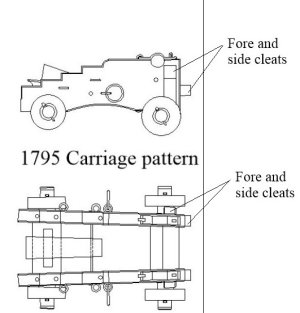
I really enjoy seeing the difference between English ships and other nations's vessels. The lower port sills are flush with the inboard side of the frames on English ships so seeing them forming a shelf is new for me. It is almost like an alternative to having cleats/bumpers on the fore end of the carriages like those used on Blomefield carriages around 1800.
Allan

It seems likely that this internal port sill part was intended to help distribute stresses from the cannon carriage and recoil forces, as well as provide a solid edge for finishing trim. But this detail is not usually described explicitly in high-level ship design histories, and references to it tend to come from specialised construction notes and model ship building sources rather than mainstream naval history texts.Hi Paul,
I really enjoy seeing the difference between English ships and other nations's vessels. The lower port sills are flush with the inboard side of the frames on English ships so seeing them forming a shelf is new for me. It is almost like an alternative to having cleats/bumpers on the fore end of the carriages like those used on Blomefield carriages around 1800.
Allan
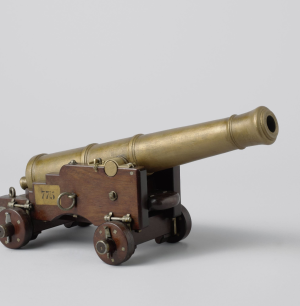
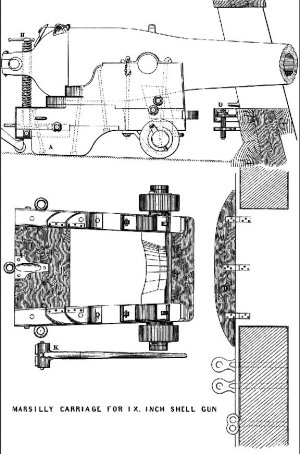
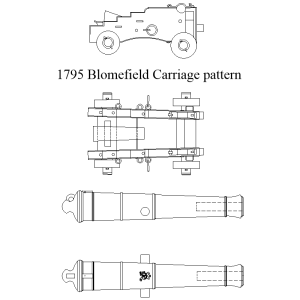
Yes, Alan, I agree. However, the schematic top (side) view appears to differ from the lower top view. I don’t see the “bumper” indicated there. Perhaps I’m simply misinterpreting the drawing.Thanks Jimsky. Not too different than the English with the first orders coming out 30 September 1795. The breast ended preventer cleated carriages are later described by Congreves in 1811 and are shown in a later painting, Death of Nelson by Irish artist Daniel Maclise. As an aside, this painting is full of great information including women on board during Trafalgar which I never knew until recently and should be of interest to anyone building Victory.
Allan
the schematic top (side) view appears to differ from the lower top view.


 .
.