• Win a Free Custom Engraved Brass Coin!!!
    As a way to introduce our brass coins to the community, we will raffle off a free coin during the month of August. Follow link ABOVE for instructions for entering.
  • SUBSCRIBE TO SHIPS IN SCALE TODAY!

    The beloved Ships in Scale Magazine is back and charting a new course for 2026!
    Discover new skills, new techniques, and new inspirations in every issue.

    NOTE THAT OUR NEXT ISSUE WILL BE MARCH/APRIL 2026

BALDER, Vlaardingen Herring Lugger from 1912, scratch build scale 1:50 Plate-On-Frame

Stunning model Peter! You have the end in sight but still plenty to do to do. I agree about rigging the masts off the ship it makes life much better. I am really struggling with my rigging at the moment (far too much of it!) - I wish I was rigging a nice fore and aft!
Thanks, Dom. Just 'only the rigging and the sails' ......... The advantage of rigging is that you do it rope by rope. In a order that is logical ............ ;)
Regards, Peter
 
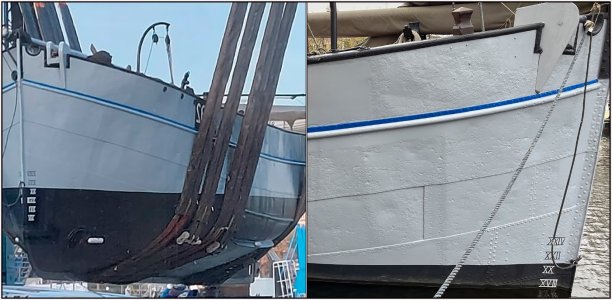
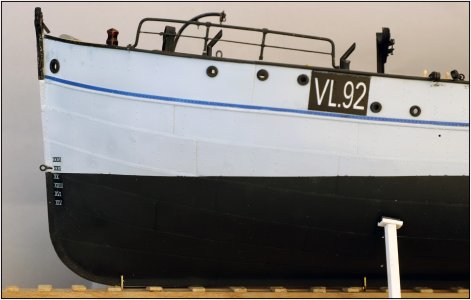
There was just one thing left to do on the hull: the draft markings. The Balder only has these at the front.
When in the water, only 2 markings are visible above and below the waterline:
1038 Nummers.jpg
But fortunately, a volunteer still had a photo of when she was taken out of the water for inspection the last time. So, 4 markings below the waterline.

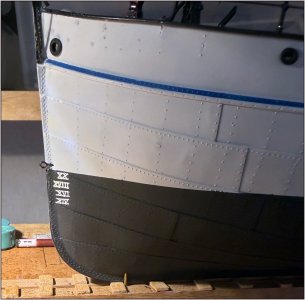
Get to work with thinly cut tape:
1039 Nummers.jpg
Yak ......That is much too coarse.:(

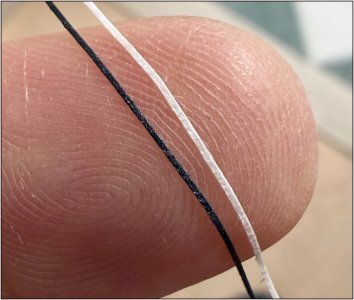
Using a new scalpel blade that I sharpened on a razor strop, I cut it as thin as possible:
1040 Nummers.jpg
The white one is the old thickness, the blackened one is the new one. As tin as a papillary line of my index finger …….. ;)

With this as the result:
1041 Nummers.jpg
Mmmmmm ....... Slightly more acceptable, but still too coarse in my opinion. From a distance it's still okay, but with grazing light and macro ......;)

Started drawing in Photoshop and grabbed the sheet for waterslide decals. That required some serious thinking and reasoning about what was going wrong.
Because the white ink didn't transfer to the transparent versions. A quick test with a black frame and white letters showed that the white letters were masked out in the black.
So, in 2 steps:
-the black letter above the waterline on transparent decal.
-the white letters with a black frame on white decal.
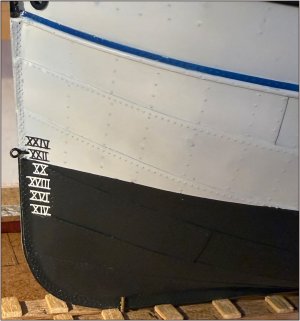
1042 Nummers.jpg
The result after cutting and pasting. The decal is a slightly different black than the hull, and from a certain angle, a glare is also visible. Once it is completely dry, I will touch up the black paint on the hull a bit.
Regards, Peter
 
Last edited:
I am working on various parts on and around the mizzenmast. However, I can only assemble and finish them once I have seen the necessary details on the Balder. But the boom, gaff, and sail are currently still covered with protective canvas.

Started measuring and assembling the shrouds. Some compiled information from the Amsterdam restoration specifications and the old ‘original’ specifications:
“The foremast is stayed by 3 main ropes (side stays) on each side, a forestay, and two bak-stays. For the main rigging, steel cable with a steel core and a diameter of 22 mm was used during the restoration. Although this construction did not yet exist in 1912, this was not a major issue because the cables would be completely covered with tarred rigging twine anyway.
The mizzenmast is supported by 3 main ropes on each side. The forward 2 are made of a single steel cable with a braided loop that has been passed around the masthead and rests on the boom. The aft main rope consists of a cable with a spliced loop at the top. They are finished in the same way as the main ropes of the foremast. The mizzenmast has no bak-stays. There is a tackle hanging from the front of the boom which can be used as a stay or halyard.


That's the theory. On the Balder, the single ropes with the spliced loops are set as the forward main ropes. And at the front there are also 2 'bak'-stays, which are secured at the top to the 2nd band above the boom and at the bottom to the bulwark.

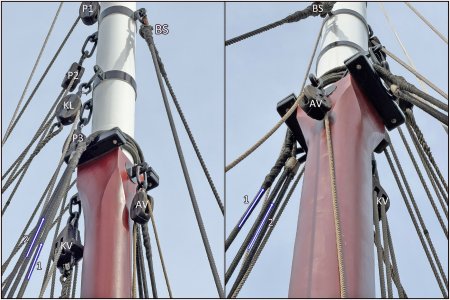
A number of parts or terms have already been mentioned by me a few posts or pages earlier. The whole thing is already clear to me, but I can imagine that you really don't have everything ‘in the picture’. Therefore, here are a few photos to clarify things.
1043 Bezaan.jpg
At the front:
AV = Aapval = ‘Monkey’ halyard, a type of jib in the middle in front of the mast.
BS = Bakstag (stay) = ‘Bak’ is not ‘back’ but more like container / hull / bin.
At the sides:
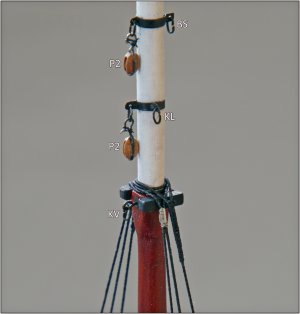
KL = Kraanlijn = topping lifts to the aft end of the mizzen boom.
Blue arrow 1 = single shroud with tied-off eye splice.
Blue arrow 2 = double shroud rope composed of a single line with lashing at the boom.
At the rear:
P1, P2, P3 = Piekenval = Peak halyard.
KV = Klauwval = throat halyard

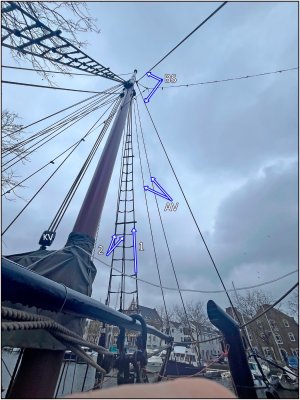
Viewed from the deck in wide angle and with the same letters:
1044 Bezaan.jpg
I cannot clearly indicate the topping lifts and peak halyard in this photo. I show them later.
I suspect that the shroud ropes were swapped when the new masts were installed and the rigging was re-rigged. I am maintaining the current situation.

A shroud rope with covering is 25 mm thick on the Balder. That will be 0.5 mm on my model.
If I tighten the shroud ropes, the model will certainly deform. The Evergreen construction has become quite sturdy, but it will definitely deform somewhat. And the shrouds on the starboard side must be made divisible.
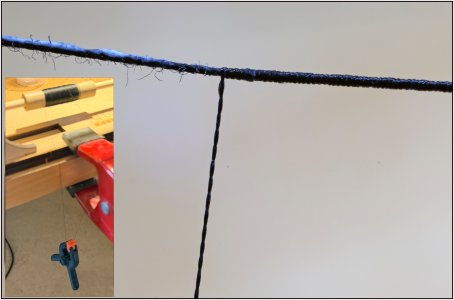
I am going to treat the shrouds with diluted Lineco PVA so that the ropes gain more inherent strength. When covering, I coat the core line first with the diluted Lineco:
1045 Bekleden.jpg
This line is a bit frayed, but that all disappears during the covering process.
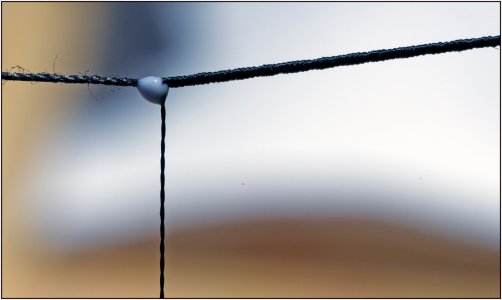
Due to the tension on the covering line (the Serafil 120/2) to be applied, the diluted glue is automatically pushed up by the windings, creating a thin film between the core and the covering. The drop of glue runs automatically to the left:
1046 Bekleden.jpg
When I have finished a small section, I apply some more glue to the outside and distribute it further along the line with some water.

Once stretched around the mast to dry, it holds its shape quite well:
1047 Bekleden.jpg
I will work on the ratlines in the same way later. Then I hope to achieve the desired strength.

The 2x3 shrouds attached to the mast and hung next to the bulwark with some weight:
1048 Bekleden.jpg
The double rope just below the 'hommer' fitted with the binding:
1049 Bekleden.jpg
The single rope with the spliced loop with the extra covering in front of it.
Regards, Peter
 
Last edited:
Looking incredible!

It will be a definite balancing act between too much/little tension on the shrouds and deforming the hull. Your idea of temporary tension and applying diluted glue should give you nice straight shrouds, without too much permanent tension on the hull.

Your faithful recreation of all the details, garnered from your frequent visits and photos of the original, is superb!!

Thanks for sharing!
 
I am working on various parts on and around the mizzenmast. However, I can only assemble and finish them once I have seen the necessary details on the Balder. But the boom, gaff, and sail are currently still covered with protective canvas.

Started measuring and assembling the shrouds. Some compiled information from the Amsterdam restoration specifications and the old ‘original’ specifications:
“The foremast is stayed by 3 main ropes (side stays) on each side, a forestay, and two backstays. For the main rigging, steel cable with a steel core and a diameter of 22 mm was used during the restoration. Although this construction did not yet exist in 1912, this was not a major issue because the cables would be completely covered with tarred rigging twine anyway.
The mizzenmast is supported by 3 main ropes on each side. The forward 2 are made of a single steel cable with a braided loop that has been passed around the masthead and rests on the boom. The aft main rope consists of a cable with a spliced loop at the top. They are finished in the same way as the main ropes of the foremast. The mizzenmast has no backstays. There is a tackle hanging from the front of the boom which can be used as a stay or halyard.


That's the theory. On the Balder, the single ropes with the spliced loops are set as the forward main ropes. And at the front there are also 2 'bak'-stays, which are secured at the top to the 2nd band above the boom and at the bottom to the bulwark.

A number of parts or terms have already been mentioned by me a few posts or pages earlier. The whole thing is already clear to me, but I can imagine that you really don't have everything ‘in the picture’. Therefore, here are a few photos to clarify things.
View attachment 592452
At the front:
AV = Aapval = ‘Monkey’ halyard, a type of jib in the middle in front of the mast.
BS = Bakstag (stay) = ‘Bak’ is not ‘back’ but more like container / hull / bin.
At the sides:
KL = Kraanlijn = topping lifts to the aft end of the mizzen boom.
Blue arrow 1 = single shroud with tied-off eye splice.
Blue arrow 2 = double shroud rope composed of a single line with lashing at the boom.
At the rear:
P1, P2, P3 = Piekenval = Peak halyard.
KV = Klauwval = throat halyard

Viewed from the deck in wide angle and with the same letters:
View attachment 592453
I cannot clearly indicate the topping lifts and peak halyard in this photo. I show them later.
I suspect that the shroud ropes were swapped when the new masts were installed and the rigging was re-rigged. I am maintaining the current situation.

A shroud rope with covering is 25 mm thick on the Balder. That will be 0.5 mm on my model.
If I tighten the shroud ropes, the model will certainly deform. The Evergreen construction has become quite sturdy, but it will definitely deform somewhat. And the shrouds on the starboard side must be made divisible.
I am going to treat the shrouds with diluted Lineco PVA so that the ropes gain more inherent strength. When covering, I coat the core line first with the diluted Lineco:
View attachment 592454
This line is a bit frayed, but that all disappears during the covering process.
Due to the tension on the covering line (the Serafil 120/2) to be applied, the diluted glue is automatically pushed up by the windings, creating a thin film between the core and the covering. The drop of glue runs automatically to the left:
View attachment 592455
When I have finished a small section, I apply some more glue to the outside and distribute it further along the line with some water.

Once stretched around the mast to dry, it holds its shape quite well:
View attachment 592456
I will work on the weaving lines in the same way later. Then I hope to achieve the desired strength.

The 2x3 shrouds attached to the mast and hung next to the bulwark with some weight:
View attachment 592457
The double rope just below the 'hommer' fitted with the binding:
View attachment 592458
The single rope with the spliced loop with the extra covering in front of it.
Regards, Peter

Hi Peter,

Very fine detailed blocks, are these from Zoly?
 
Looking incredible!

It will be a definite balancing act between too much/little tension on the shrouds and deforming the hull. Your idea of temporary tension and applying diluted glue should give you nice straight shrouds, without too much permanent tension on the hull.

Your faithful recreation of all the details, garnered from your frequent visits and photos of the original, is superb!!

Thanks for sharing!
Thanks , Brad. The idea of the ‘internal gluing’ was just a brainwave. And the automatic going ‘sidewalk’ of the drop of glue was a nice coincided.
Regards, Peter
 
Hi Peter,
The decals were definitely the way to go on the numbers at the bow. Your rigging looks excellent, and the ship as a whole is absolutely amazing. Love the detail and execution.
Thanks, Dean. It sometimes takes a few iterations, but usually a version that meets the 'desired standard' is eventually produced.
Thanks to my regular presence on the Balder, I have plenty of time to measure the parts. With some forward thinking, I have enough time to work out the components.

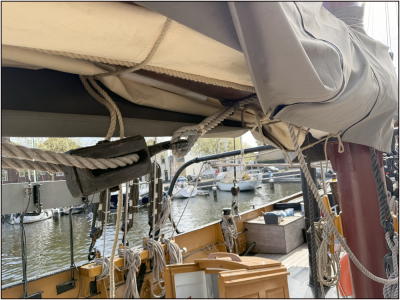
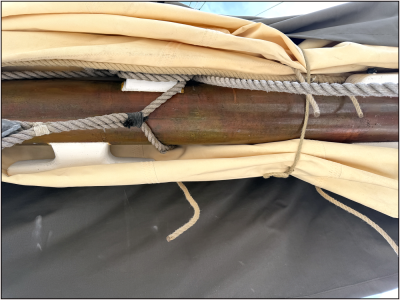
Yesterdays on the Balder I partially cleared the mizzen boom, gaff and sail, measured various parts, and took several pictures. One of them:
1776415930423.png
1776415827875.png
Ropes, hook blocks etc etc
I can start finishing those now as well. In the meantime, I've also been experimenting a bit with the mizzen sail made of thick Japanese paper and thin fabric. All of that then needs to come together on the mizzen mast.
Regards, Peter
 
Last edited:
And then it was time to close another chapter: Installing all the equipment on the deck and the bulwark.
First, 2 detail photos of last-minute adjustments:
I had made a mistake with the size of the belaying pins. I had made them 10 mm, which is 50 cm as the original.
View attachment 588857
But they are 40 cm, and that is a factor too large. On the left, on the outside, is the oversized one. In between are the correct ones, with a full belaying pin rack on the right.

An observant volunteer on the Balder drew my attention to the 'standing 'geestrollen' / hoist rollers' being too short. These need to reach the top of the uprights to be able to haul in the nets properly.
View attachment 588858
Removed the top eyes, made longer rollers, and secured everything again. (Right is wrong, left is good) 'It's all in the details!'

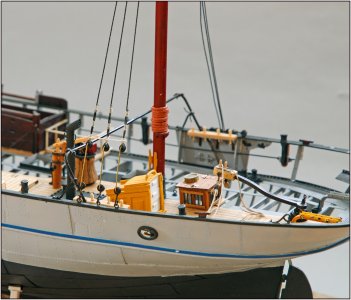
It was beautifully calm and cloudy, so diffuse light. Time to capture outside how the Balder looks now with everything on and around the deck and bulwark.
This will be the setup I will continue with:
View attachment 588859
View attachment 588860

A slightly better view of the deck:
View attachment 588861
View attachment 588862

From front and back:
View attachment 588863
View attachment 588864

Zoomed in on the fore and aft decks:
View attachment 588865
View attachment 588866

Now it is time for the rigging. First up is the mizzen mast with the mizzen sail. Just like with my Bluenose, I rig the entire mast, allowing me to place the mast in the vise and on my workbench. The components include:
-cutting and covering shrouds;
-making the boom and gaff;
-making the sail and attaching it to the boom, mast hoops, and gaff;
-all the other rigging involved.
They will be presented piece by piece with further explanation. I am looking forward to the rigging, now that I am there after more than 2.5 years can get to work on.
That works out well, because the rigging and sails on the original Balder are now being fixed up as well.
Regards, Peter

How beautyful! On that scale. Congrats! Looks like the real ship
 
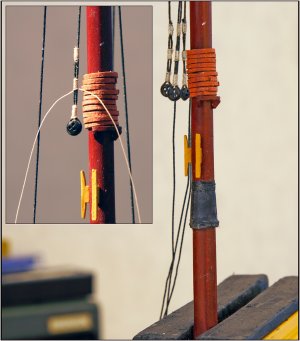
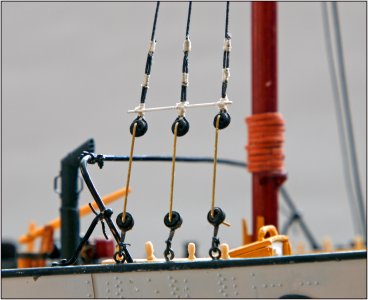
With the shrouds next to the bulwark, I was able to determine the height at which the upper deadeyes had to be tied into the shrouds, based on the distance between the two deadeyes:
1050 Inkorten.jpg
The mast was then removed and placed in my small vise. Now I had plenty of room to make the 3 lashings without having to pay attention to all the protruding parts on the model.
After that, I also tied in the other 2 deadeyes.

The mast was put back in place and 3 spacers were made:
1051 Speilat.jpg
In the old specifications: "Directly above the 3 deadeyes a round iron spreader bar is lashed; above that run weave (rat) lines in the rigging up to the hommer. The weave lines are made of 12 millimeter three-strand tarred manila."
On the Blader the spreader bar (sheer pole) is white and lays above the bottom lashing. On the old drawings it's on the bottom lashing.

Maintained the old specifications:
1052 Speilat.jpg
With the unforgiving macro ....... :rolleyes:
I can't get started with the ratlines yet. I just ordered the right size. On to the boom and gaff.
Regards, Peter
 
In the old specifications: "Directly above the 3 deadeyes a round iron spreader bar is lashed; above that run weave (rat) lines in the rigging up to the hommer. The weave lines are made of 12 millimeter three-strand tarred manila."
Beautiful job as always Peter. I an curious about something though - I have seen it stated many times on this forum that maritime line sizes were always stated as the circumference rather than the diameter. Certainly the ratlines wouldn't have been 4mm diam. line, so I wonder if that rule of thumb only applies to certain countries?
 
Back
Top