


- Joined
- Oct 23, 2018
- Messages
- 1,002
- Points
- 443

My thoughts

 |
The beloved Ships in Scale Magazine is back and charting a new course for 2026! Discover new skills, new techniques, and new inspirations in every issue. NOTE THAT OUR NEXT ISSUE WILL BE July/August 2026 |
|
 |
As a way to introduce our brass coins to the community, we will raffle off a free coin during the month of August. Follow link ABOVE for instructions for entering. |
|

First thought, mm Peter missed to take images from what he did so he took some from the real ship ....
Haha,My thoughts
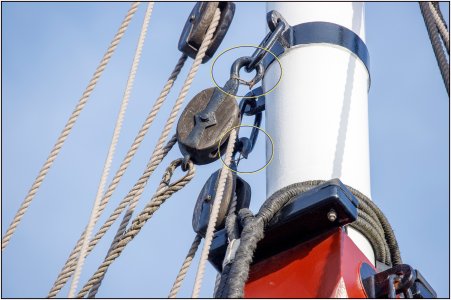
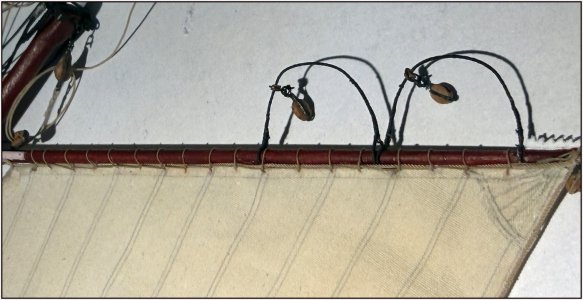
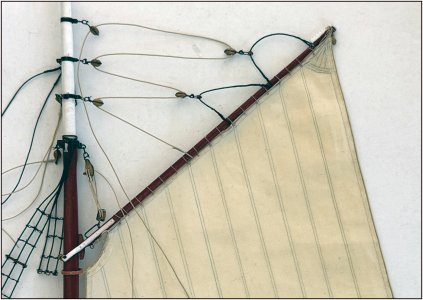
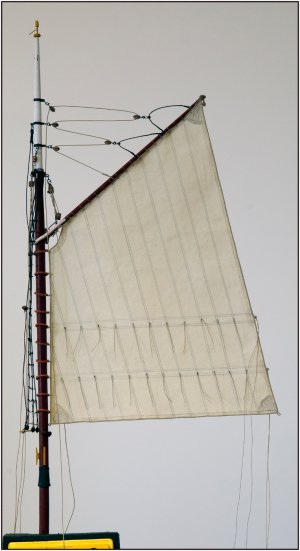

Thanks for this (quick) replay, Paul. Then they were doing in the old days a good job.Rope sizes look perfect, Peter. As I mentioned previously: every detail attended to...
 I 'only' converted the indicated diameter of 22 mm of the main ropes currently set. That is 0.44 mm in 1:50 scale. I used the 0.45 mm from Ropes of Scale instead. I think no one will see that 0,01 mm difference ......

The navara looks great Peter, good choice.
Thanks, Maarten en Stephan. Yes, the Navarra is also very nice to work with. Next test is the main sail. If a full sail can be fold correctly in scale.The navara looks indeed good, even with the pencil details.
Of course I can …..You know you can make these beads in wood?
 But in this case: why do it difficult when it can be done easy.... A little box with many little buggers and some paint …..
Good morning Peter. Fabulously detailed as always within scale too- awesome. Cheers GrantFor the next steps, I laid the mast flat on the workbench.
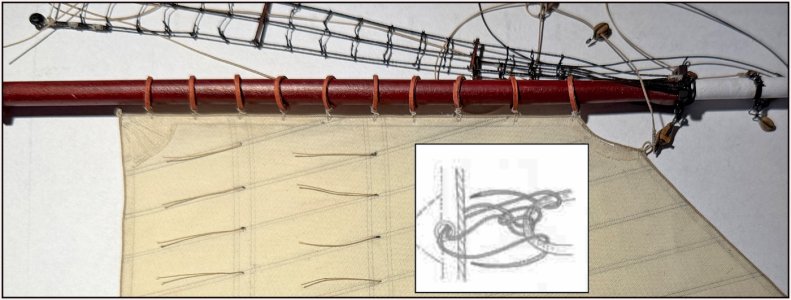
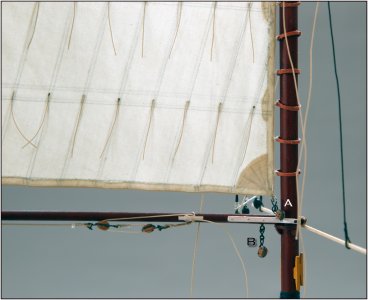
The leading edge of the sail was tied to the 10 mast hoops:
View attachment 609403
The lashing was made as much as possible using the knot shown on the insert. However, my line started in the eye of the sail and then went around the hoop.
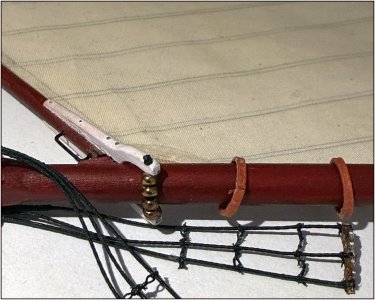
First, I attached the gaff to the mast using the line with the pearl beads:
View attachment 609404
I will paint this matte black to remove the shine.
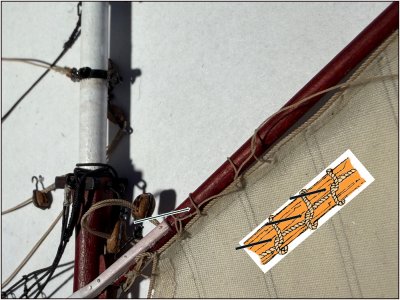
Next, it was the sail's turn to the gaff:
View attachment 609405
This was secured to the gaff with Marline hitches. Pay close attention: once the line has been wrapped around the gaff and pulled forward through the eyelet in the hem behind the leech line, the line must first go over the horizontal line and only then underneath. When tightening the line, it locks itself in place.
PS: the first 2 went well, but I made a mistake on the 3rd one. But you notice that immediately when tightening: the line does not clamp itself.
View attachment 609406
And after an hour of knotting, this is the result.
Also on the flat: Claw and Peak Halyard. In the old specifications, these are called 'Bezaanbinnenval' and 'Bezaannokkeval':
View attachment 609407
Claw Halyard: I have already described the upper block with 0,45 mm line. The lower block is a 4 mm 2-sheave hook block. The hook opening is lashed shut.
In the old specifications: "The lower block (with the hook perpendicular to the axis) was hooked from starboard to port into a longitudinally elongated bracket on top of the claw.
The halyard was rigged in such a way that the hauling part on the starboard side came down from the forward (the innermost, the one closest to the mast) sheave and was secured to a cleat in the cleat rack on the starboard side (secured with the sun)."
Peak halyard: I have already described the 3 blocks at the rear of the mast. As well as the 2 slings and 2 timbles. The fixed end of the 0,45 mm line is secured with a lashed loop approximately in the middle of the gaff.
The 2 brackets around the slings got there 4 mm single-sheave hook block. The hook opening is lashed shut.
In the old specifications: "In each of the 2 brackets, a sheave hook block (hook perpendicular to the bead) was hooked in from bottom to top; with a lying gaff, from front to back, so that the opening of the hook with a standing gaff was directed slightly upwards/backwards.
On the inside, the halyard was spliced into a wide loop. The halyard was spliced around the gaff just before the middle with this loop, ran upwards and from front to back through the lower upper block; downwards and from front to back through the lower lower block. Then again upwards and from front to back through the middle upper block, downwards and from front to back through the upper lower block. Again upwards and from back to front through the upper upper block on which the hauling part was secured to the bead rack in the port side."
Ps: the 'from front to back' should be interpreted with the upper blocks hanging downwards.
With the provisionally secured gaff, the mast could be placed back in the vise:
View attachment 609408
The halyard lines are already settling a bit, but later I will set them all into their natural shape.
The next step is to fit the mizzen boom with the lashed blocks and lines.
Regards, Peter


Good morning Peter. Fabulously detailed as always within scale too- awesome. Cheers Grant
I have no idea what I'm looking at, but I like it alot!
Thanks for the compliments and nice words, Grant, Richard and Bill.Hello Peter,
You are doing beautiful work on your rigging.
Bill
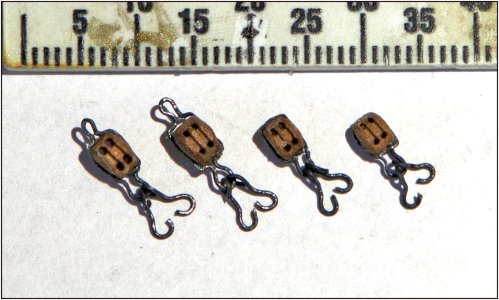
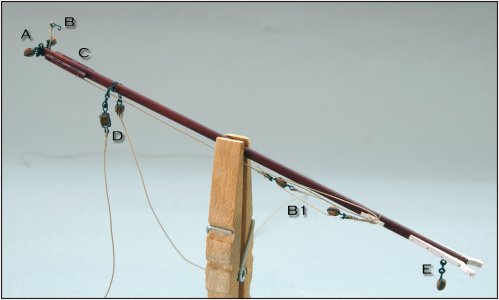
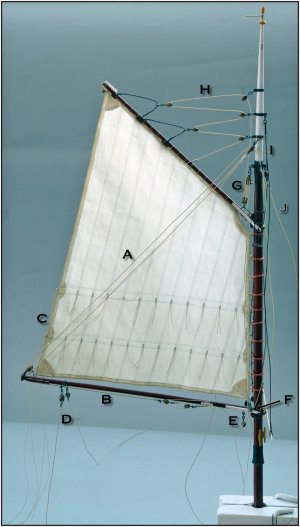 1 hook in, 2nd in, 1st out, 1st in, 2nd out ...... ggggrrrr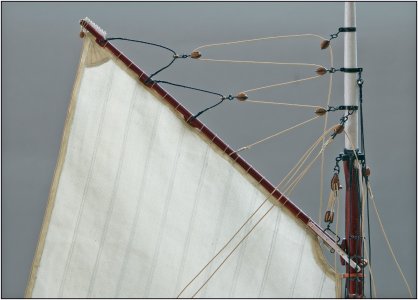
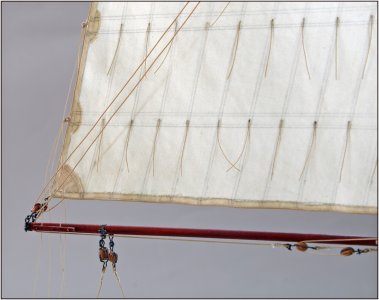
Thanks for the compliment, Paul.Nicely done, Peter. I'm looking forward to seeing the lines tightened up one day. This is going to be pretty special!

Thanks for asking, Peter. Back to work, tomorrow. The owner doesn't take time off for injury or illness unless it's really seriousHow is the thumb? You can do your job?
.
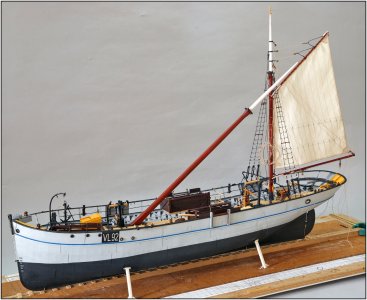
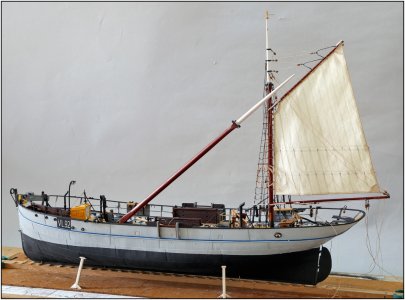
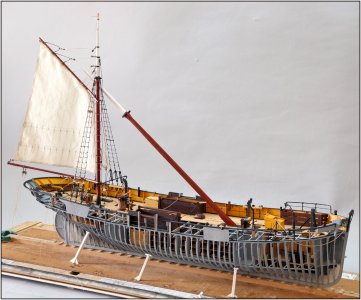


Hello Peter,
Your work continues to be amazing.
Bill
Thanks for the compliments, Bill and Dirk.Wow ... so nice!