



• SUBSCRIBE TO SHIPS IN SCALE TODAY!

    The beloved Ships in Scale Magazine is back and charting a new course for 2026!
    Discover new skills, new techniques, and new inspirations in every issue.

    NOTE THAT OUR NEXT ISSUE WILL BE July/August 2026
  • Win a Free Custom Engraved Brass Coin!!!
    As a way to introduce our brass coins to the community, we will raffle off a free coin during the month of August. Follow link ABOVE for instructions for entering.

Bluenose Model Shipways 1:64 Beautiful ship

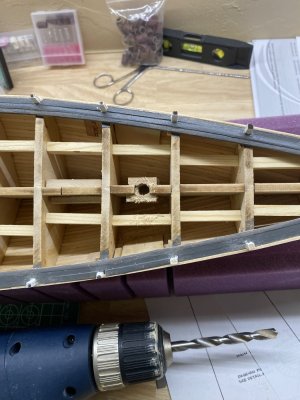
Getting ready to install the deck, I used a series of dill bits to turn the rectangular slots where the mast are to be placed into 5/16" round holes. I made sure the mast dowels would fit into each snugly.

IMG_2244.jpeg

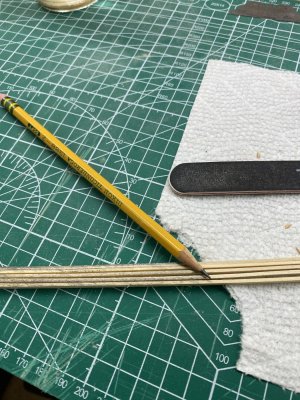
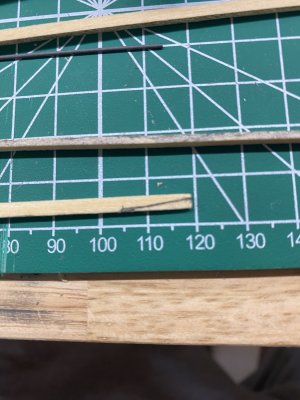
The deck planking is 1/16 x 3/32" strip. In order to give them the look of being caulked, I took them and used a pencil to darken the edges. I this this by stacking them in groups of 5, holding them together with a clamp and darkening the edges. I found this process about as interesting as rat lining.

IMG_2252.jpeg
 
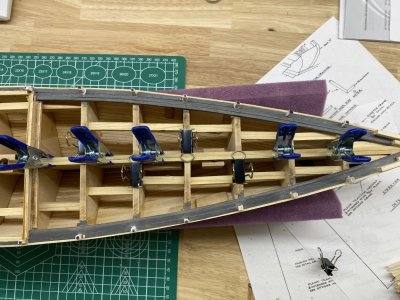
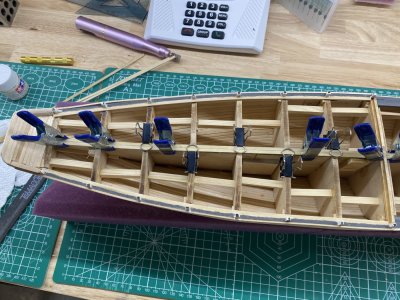
There are two ways to start the deck. You can start by putting one deck plank down the middle or you can put 2 down the middle side by side. Build logs I have seen do it both ways. I decided to do 2 alongside each other. The 2 along side each other basically perfectly cover the spine of the keel, making it easy to center.
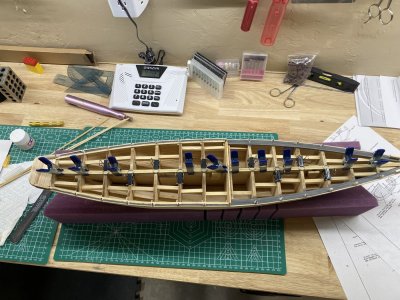
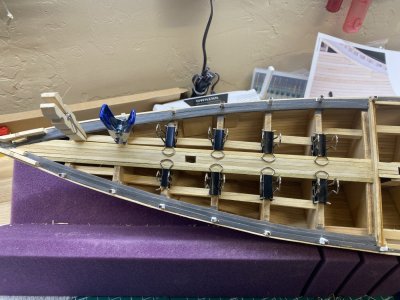
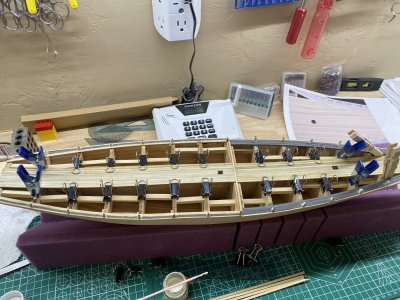
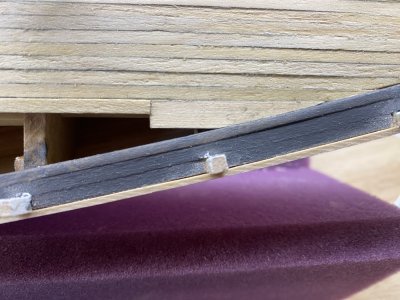
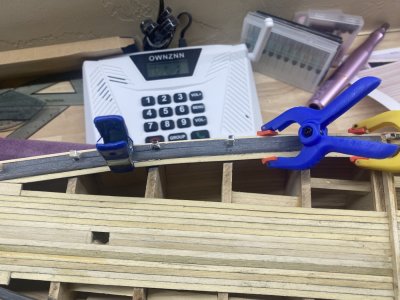
I cut the ends of two of the edge darkened strips to make them fit exactly in the bow. (this is not really necessary as the bow is covered later on, but why not do it.) I cut the other end just a bit longer than the edge of the great beam so I could do a light sanding to get an exact fit. The spine was a covered with PVA glue and the strips held in place with modified binder clips and some clamps.IMG_2298.jpeg

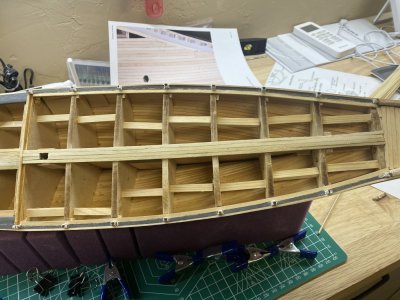
Each strip is long enough to cover the foredeck and quarterdeck. I figured since I have these cut decking strips why not do the quarterdeck also. I

will start tapering them as needed after the 2 full strips. So I fitted the quarterdeck deck planks the same way as the foredeck.

IMG_2299.jpeg

IMG_2300.jpeg
 
The deck planking continues slowly. I am not pleased with the quality of the wood strips that are supplied for the decking. These strips have uneven thickness and a rougher finish. The strips used for the hull planks were definitely of better quality. I have started to minimally taper the quarterdeck planks. In his you tube video series Gary Brinker did not taper his planks at all and things, at least to my eyes looked well. We will see what occurs.

IMG_2303.jpeg

IMG_2302.jpeg

PVA glue is being used. i apply iy to the bulkheads and to the adjacent plank that has already been glued into place.
 
After the 6th board from the center in the foredeck a double wide piece of planking is placed. This is supposingly because the heavy windless machinery will be placed there.
IMG_2304.jpeg

IMG_2305.jpeg

After this the last plank covers the double wide plank the next decking plank is supposed to be nibbed. I will have to curve a nibbing strake next to the waterways.
 
Last edited:
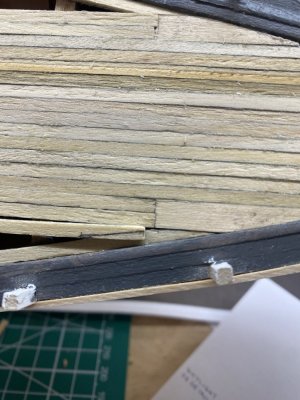
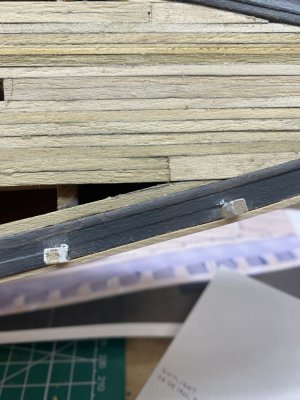
Now comes the nibbing. I looked at several build logs and Gary Brinkers you tube videos. I have started it and it (so far) is actually going easier than I thought. I installed the nibbing strake by soaking it clamping it in place, allowing it to dry then trimming and going into place.

IMG_2308.jpeg

The first deck plan to be nibbed required a very small notch. I fitted the board onto the nibbing strake and made a dot when it overlapped the strake. I
then drew a line from to connect the two dots.

IMG_2310.jpeg

I cut this area and sanded it smooth. I then places this agains the nibbing strake to see when the strake had to be trimmed. I marked that area on the strake.

IMG_2311.jpeg

IMG_2312.jpeg

IMG_2313.jpeg

I then trimmed the rear in the strake, cut the decking plank to length and fitted it.

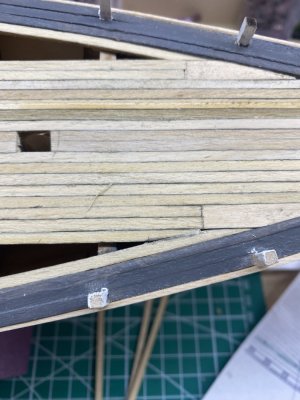
Successive deck planks require a larger "notch" These I cut out using an x-acto blade and finished off with a small file.

IMG_2314.jpeg
 
In order to give them the look of being caulked, I took them and used a pencil to darken the edges. I this this by stacking them in groups of 5, holding them together with a clamp and darkening the edges. I found this process about as interesting as rat lining.
Rob, I had to laugh at this one - and so true! Your BN is looking great! :cool: And I can certainly appreciate/relate to many of your experiences. :p
 
In his build Gary Brinker used 1/4 X 1/16" planks for his garboard. He actually used 2 rows of these bigger boards. I think I will do one for the Garboard and then go back to the 1/8 X 1/16 planks. The plans show the garboard extending from the sternpost to almost the E bulkhead. I have some 1/16" sheet and I cut out 2 planks from it.
Rob, I had to go back and mention your post. Not only did I miss Gary's build but I apparently didn't learn much from my Dory/Pram builds! My BN planking transition at the keel was challenging and required some rework. Lesson learned!

Once again, your BN is Looking great!
 
Last edited:
Rob, I had to go back and mentioin your post. Not only did I miss Gary's build but I apparently didn't learn much from my Dory/Pram builds! My BN planking transition at the keel was challenging and required some rework. Lesson learned!

Once again, your BN is Looking great!
Bill thank you for your kind comments! What I have been impressed about is that reading and looking at all the various build logs is that each is done a bit differently. I have learned from all of them. I have been following your log also and I have to say your ship looks great!

As I have mentioned in the beginning this is an on and off again project for me. I work on the Bluenose when I am visiting in Tucson. I will be watching your build as you go ahead. I am certain I will be using some of your techniques!

Rob
 
The decking continues. Once you get the hang of the nibbing, it is just as easy as regular decking, and I think it looks much better. However, to be honest, I doubt it will be noticed by most people looking at the ship. The area not covered by decking is shrinking, I will soon not be able to use the binder clips and will resort to using the clothes pins as wedges to hold the planking as it dries. Additionally I actually tapered about 4 sets of deck strakes. I do not think tapering the deck is actually required at all when doing the Bluenose.

IMG_2324.jpeg
 
I finished the last Strakes on the foredeck. The last 2 fit tightly and had to be sanded down a bit.

IMG_2336.jpeg

IMG_2337.jpeg

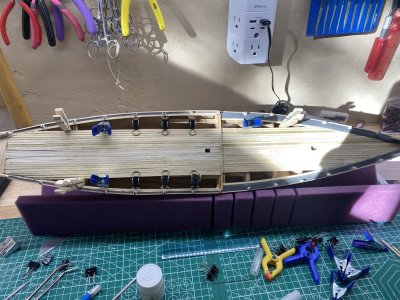
Decking of the foredeck is finished.

IMG_2338.jpeg

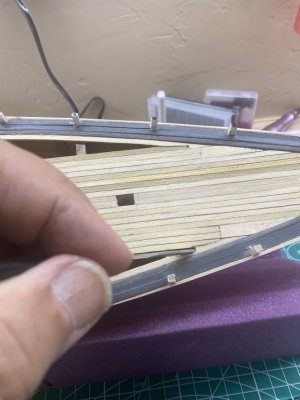
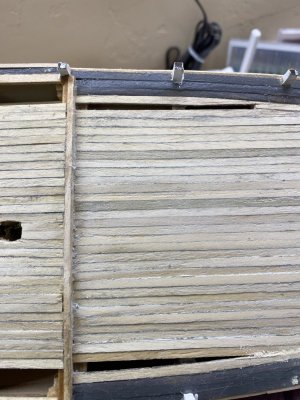
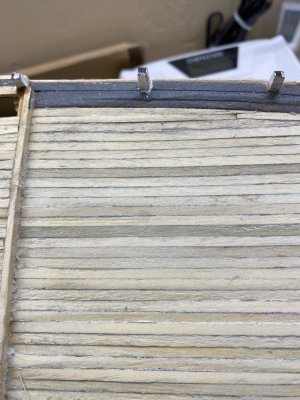
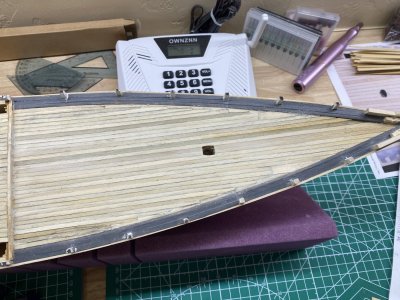
As you can see from the previous pictures the deck itself is very rough. The planking is certainly not as well planed as the hull strakes were. I do not know if this is because the strips are so narrow or just poorer quality wood. It will require a lot of TLC to get nice and smooth.
 
I finished the last Strakes on the foredeck. The last 2 fit tightly and had to be sanded down a bit.

View attachment 616276

View attachment 616277

Decking of the foredeck is finished.

View attachment 616278

As you can see from the previous pictures the deck itself is very rough. The planking is certainly not as well planed as the hull strakes were. I do not know if this is because the strips are so narrow or just poorer quality wood. It will require a lot of TLC to get nice and smooth.
A nice closure of the deck, Rob. And with ‘some’ sanding the deck will come alive.
Regards, Peter
 
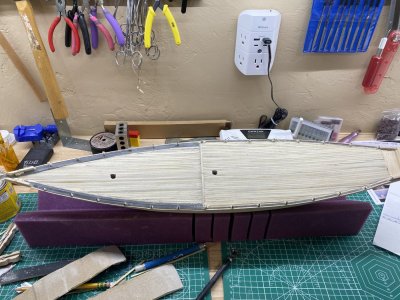
The quarterdeck was finished. I forgot to take pictures. The last plank on each side was just slightly narrower than the with of the plank. I sanded them slowly to insure they fit snugly and glued them into place.

I then started some beginning sanding using 150 grit paper, rubber cemented onto foam board. Small openings were covered with a wood glue/sawdust mixture, allowed to dry and then sanded. At last the deck is starting to appear as nice was others I have seen in building logs.

I am still happy I have not yet done the bulwarks and stanchions, This has given me a lot more space to sand without bumping into things,

IMG_2347.jpeg
 
Last edited:
Back
Top