

• Ships of Scale has incorportated an extra level of security when you log In. Please follow on-screen prompts to acknowledge that you are not a robot via a "Check Box" or a "Pictorial Check Box Puzzle". This is needed due to higher level of AI Activity Security.
  • SUBSCRIBE TO SHIPS IN SCALE TODAY!

    The beloved Ships in Scale Magazine is back and charting a new course for 2026!
    Discover new skills, new techniques, and new inspirations in every issue.

    NOTE THAT OUR NEXT ISSUE WILL BE July/August 2026
  • Win a Free Custom Engraved Brass Coin!!!
    As a way to introduce our brass coins to the community, we will raffle off a free coin during the month of August. Follow link ABOVE for instructions for entering.

USS Constitution - Model Shipways

I have been reading some theory about rope making and came across a parameter called lay pitch which is the axial distance for one complete revolution of a strand. I guess I was wondering if there is some established norm for rigging rope in terms of lay pitch and how does it affect the stability of the rope?
I am thinking that too small of a lay pitch and the rope may be too stiff. SImilarly too large of a lay pitch and the rope will not hold together as well.

Surely the rope makers of the times must have some guidelines that they used. Anyways, just thought that I would ask...
 
I have been reading some theory about rope making and came across a parameter called lay pitch which is the axial distance for one complete revolution of a strand. I guess I was wondering if there is some established norm for rigging rope in terms of lay pitch and how does it affect the stability of the rope?
I am thinking that too small of a lay pitch and the rope may be too stiff. SImilarly too large of a lay pitch and the rope will not hold together as well.

Surely the rope makers of the times must have some guidelines that they used. Anyways, just thought that I would ask...
Mark,

There is a major thread on rope making here


There are also multiple you tube videos available.

I am hopefully going to try it myself. I have just printed up a rope walk designed by one of our members Kedennis who also made available his waterline marker that i printed up and intend to use.


Rob
 
Mark,

There is a major thread on rope making here


There are also multiple you tube videos available.

I am hopefully going to try it myself. I have just printed up a rope walk designed by one of our members Kedennis who also made available his waterline marker that i printed up and intend to use.


Rob
thanks! I'll have a look
 
i am using a planetary gear rope walking machine. I have control of the direction and speed of rotation as well as the speed of the takeup pulley.
I am just trying to figure out the lay pitch for each application ,example stay, running rigging, I can imagine you would want the stays to be more tightly wound so that they are stronger and more stable. Anyways I know this is really going overboard, but for me I want to experiment with this a little bit.
 
It appears that for the setup I have more making ropes, that I should be trying to control the lay length of the rope. The lay length is the distance along the rope from one complete repeat of the strand pattern to the next. I equate this to measuring the diameter of a rope using a pencil. You measure the length of say 10 loops then divide by 10. So you are actually calculating the length per pitch. Since I can adjust the rotation of the planetary head and the advancement of the takeup pulley, I can get a value for the lay length and use that as my rope design parameter. I will have to figure this out manually as I was unable to find any reference to this parameter but I know it has to be important. It affects the stability of the rope. Maybe I need to look up rope making for ships. I don't know yet.
 
Last edited:
Well, now that you mention it… I had a planetary ropewalk at one time and found it didn’t offer the level of precision you are looking for right now. I wish you better luck than I had.
it's a different machine than the one you are referring too. but I heavily modified it too.
 
it's a different machine than the one you are referring too. but I heavily modified it too.
All I can do is use a tach to determine the head rotation and manually measure the takeup pulley advancement. Then see if the lay length is repeatable.
The thing is I have to get the right tension otherwise that will affect the repeatability. Fortunately there are these tensioners on each of the strand rotators, if I can call that.

Theoretically, lay pitch is the ratio between the strand feed speed(from the takeup pulley) and the rotation speed of the planetary head. So, more rotation per unit of feed gives a shorter pitch and thus a tighter rope). Less rotation per unit feed gives a longer lay pitch and thus a a looser rope. Right now I see standing rigging with a short pitch and running rigging with a longer pitch. Maybe that's all I need to do. But, for sake of interest I will see if I can find more detailed information on rigging function versus lay pitch.

One caviate:
If the take-up spool rotates at a fixed RPM, then the feedrate will increase as the spool fills up. This is because the diameter of the spool is getting larger

V= πDN
  • V = feedrate
  • D = effective winding diameter = Dcore+2(wound thread thickness)
  • N = spool RPM
 
Last edited:
I found a number of tables that give me the information that I am looking for. The problem is that it is through Copilot and no sources are referenced. I am a little weary to use that data so I think I will keep looking.
I believe I have hit a snag. The tables that I found are for hemp rope and not poly(obviously). I don't think I can correlate that information to what poly would give. So I will have to give my best guess at "soft wound" "medium wound" and "tightly wound" for poly. I think that is all I am going to do. I suppose I could try to source hemp thread, but I have all this poly at home so I am not wasting it...
 
Last edited:
For model ship work, here are the recommended parameters to start with:

1. Strand diameter
I am using the tex number, and poly thread to calculate this

2. Number of strands
I am using 3

3. Target finished diameter
For 3 strand rope, D=2d
D is rope diameter and d is strand diameter

4. Target lay pitch
Lay pitch p = linear take-up distance / number of head rotations
More rotation per unit of feed gives a shorter lay pitch
Less rotation per unit feed gives a longer lay pitch

The helix angle θ is determined by lay pitch p and rope diameter D: tan⁡(θ)=πD/p,

Short lay pitch(shrouds, stays) -> low helix angle -> low torsion -> high stability
Longer lay pitch (sheets, halyards, braces) -> high helix angle -> high torsion -> lower stability
Light running rigging(signal halyards, buntlines)

5. Lay pitch Ratio=Lay pitch/Rope Diameter
This ratio tells you how tight or loose the rope is twisted.

A rope with a low lay pitch ratio (short lay pitch relative to diameter):
Is tightly laid
Feels stiffer
Has less stretch
Was common in standing rigging (tarred hemp shrouds, stays)

A rope with a high lay pitch ratio (long lay pitch relative to diameter):
Is loosely laid
Feels more flexible
Has more stretch
Was common in running rigging (sheets, halyards)


I have all kinds of information on hemp ropes, but nothing on poly so I will have to experiment with this recipe.


​

 
Last edited:
How to use this in practice:

I am getting mixed information about the lay ratio. I'll start with this table.

Typical 3-strand polyester lay ratio

Rope constructionTypical lay ratio
Very tight / stiff2.5–3.0 : 1
Normal 3-strand polyester3.0–3.5 : 1
Typical working line3.2–3.6 : 1
Loose / soft3.6–4.0 : 1

I also know the rope diameter, so I can now calculate the lay pitch and feed rate
lay pitch = lay ratio*Diameter = 1/TPM, where TPM is twists per meter
twist rate(TPM) = RPM/(feed rate,m/min)
So feed rate = RPM / TPM or if you want, feedrate = RPM * lay ratio*D

I should mention that the planetary head motor controller gives percentages and not absolute RPM's so I will have to devise a calibration curve for that. Shouldn't be too hard.

As I mentioned in a previous post,
If the take-up spool rotates at a fixed RPM, then the feedrate will increase as the spool fills up. This is because the diameter of the spool is getting larger

V= πDeffN
  • V = feedrate
  • Deff = effective winding diameter = Dcore+2(wound thread thickness). For this I would just use a caliper to measure the diameter.
  • N = spool RPM
So if I want to maintain a constant feedrate, I will have to reduce the spool RPM as the spool fills up to maintain the desire lay length.

How to measure lay length
Mark a segment of 100 mm long on the machine's board.
After setting the RPM, and feedrate, let the rope run for about 30 seconds to let the machine achieve steady state.
Stop the machine and measure the number of twists in the 100 mm segment.

lay length = 100 mm / #twists in the segment

How to measure the feedrate

Put a mark on the rope just before it loops around the takeup spool.
Let the machine run for a minute.
Measure how much rope was fed onto the takeup spool in that minute.

feed rate = length of rope / time in minutes.

I guess the question is how much does a "small" change in feedrate affect the lay length. Just to complicate things, as I seem to be good at that, here is what I would need to do for performing a sensitivity analysis.

I am going to start by making 2% changes in the feedrate then measure the lay length for each change.
so given v0 and vi and L0 and Li, I can then calculate the ratio of (Li-L0)/(vi-v0) which I am going to call the sensitivity.

two things i can look at. one is the graph of v versus L and v versus the sensitivity. I hope the sensitivity graph shows linear behavior. If it doesn't then I may have slippage of the spool occuring or, the rope is not tightly wound around the spool or the motor control isn't linear, which is possible.

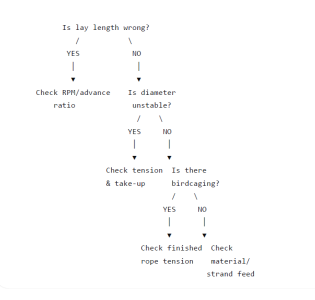
There are two sorts of tension influence in this machine. There is the rope tension, primarily controlled by the takeup spool, and the strand tension, controlled by the individual strand tensioners.

The question that I have is how do you know if the rope is being affected by the feedrate or the tension:

Observable symptoms of feedrate influence
Join point walks forward or backward steadily

Twist angle changes uniformly along the rope

Diameter changes slightly but predictably

Sudden strand imbalance


Observable symptoms of tension influence
Local lay irregularities

Diameter fluctuation

Birdcaging or micro gapping. Primarily caused by not enough tension on the rope

1789566568656.png
And that's all I am saying about that.
 
Last edited:
I received my bluejacket constitution plans and book today. I'll start by looking at the masts since that is where I am at on this project. I took a rope break because I was waiting for the plans. I was able to build a troubleshooting guide for the planetary ropewalk machine that I purchased. THe previous post is a summary of that.
 
Last edited:
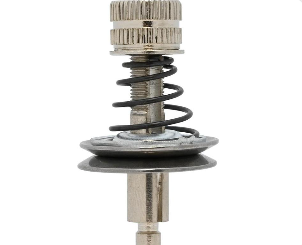
concept for takeup spool brake. The idea is like a clutch. As long as the two rubber washers have enough friction between each other, the spool will turn properly I believe.

This is what I want to install to allow better control of the rope tension. RIght now it's all or nothing and is only controlled by feedrate. The idea is to control feedrate with the feedrate knob and the tension with a separate brake.

Screenshot 2026-09-15 223030.png
 
Last edited:
I'm late to the discussion of ropewalks here, Jack. As I'm just about ready to dive (reluctantly) into the real rigging of my Conny, I've been contemplating getting my own ropewalk, so I'm not constantly buying (and waiting for delivery of) rope from Ropes of Scale. For the little I've done so far in my build, I'm realizing that I'll be using much more rope than anticipated on my first couple of rounds of purchases. It would be nice to have the ability to make what I need on the spot. I can't wait for you to post your own You-Tube video on rope making - specifically tailored to those required on the USS Constitution.

And if you get up and running soon, count on me as being your first customer? ROTFROTFROTF


P.S. I wonder why I'm not getting notifications from your build log? I've got you tagged as someone I "follow". And I do get notifications when you comment on my and other's build logs. But I've gotten zilch from this build log directly. Hence, my late arrival to the ropewalk discussion..

P.P.S. Hey Geoff, maybe you can help Jack out, since you yourself taught a course in rope making, if I'm not mistaken?
 
Last edited:
I must have edited a couple of those posts a number of times. I wonder if that is why. Maybe you aren't getting notified because it is an existing post?
I am just speculating of course.

SO far I have been sidetracked by theory but I think I have that dialed in. Once I make that brake mod, then I will start experimenting with ropemaking. Hopefully I covered all bases.
 
IF anyone knows where I can purchase fine hemp thread that would be great. I looked and can't find any. all i see is hemp yarn and coarse thread. Maybe they don't make the stuff fine enough for model ship rope making...
 
Back
Top