
-

Win a Free Custom Engraved Brass Coin!!!
As a way to introduce our brass coins to the community, we will raffle off a free coin during the month of August. Follow link ABOVE for instructions for entering. -

SUBSCRIBE TO SHIPS IN SCALE TODAY!
The beloved Ships in Scale Magazine is back and charting a new course for 2026!
Discover new skills, new techniques, and new inspirations in every issue.
NOTE THAT OUR NEXT ISSUE WILL BE MARCH/APRIL 2026
You are using an out of date browser. It may not display this or other websites correctly.
You should upgrade or use an alternative browser.
You should upgrade or use an alternative browser.
Santìsima Trinidad 1:84 by Artesania Latina - Build log


- Joined
- Oct 9, 2020
- Messages
- 2,316
- Points
- 488

very impressive build. congratulations

- Joined
- Dec 15, 2023
- Messages
- 68
- Points
- 88

HI, I am building the Santisimi Trinidad from Art Lat and dealing with the cannon rigging. I see that you followed the instructions way of rigging, but I was investigating it and found that the Spanish used a different scheme. Also, in the instructions they have you drill four holes in the bulkhead, and I haven't figured out what they are for.. the cannons the way they rig uses only two of the four holes, what are the other two for, I have looked ahead at the instructions and have not found any reason for them. Anyway, other cannon rigging schemes use four holes in the bulkhead. Any info appreciated.


I actually started building the cannons because I couldn't continue with the hull construction, and I followed the instructions provided. However, I realized that the blocks weren't sized to scale, so I finished building and assembling the four sets of cannons and carronades, but sospended the rigging. I'm now continuing with the hull, and I'll think about installing the cannons at the appropriate time. I'm therefore unable to respond to your valid observations, but I'll certainly take them into account and explore the topic further in the future.

The two sets of holes, one lower and one upper. The lower set takes the large rope that goes through the tackle around the back of the cannon and back to the hull on the other side.
The second set is upper and on each side of the cannon there is a rope harness(smaller rope) with blocks that attach to the hull. The large rope was used to prevent the cannon from flying backwards across the deck. The main ropes were for putting the cannon back in place after it was packed and ready for fire.
The second set is upper and on each side of the cannon there is a rope harness(smaller rope) with blocks that attach to the hull. The large rope was used to prevent the cannon from flying backwards across the deck. The main ropes were for putting the cannon back in place after it was packed and ready for fire.
I think you're absolutely right, thanksThe two sets of holes, one lower and one upper. The lower set takes the large rope that goes through the tackle around the back of the cannon and back to the hull on the other side.
The second set is upper and on each side of the cannon there is a rope harness(smaller rope) with blocks that attach to the hull. The large rope was used to prevent the cannon from flying backwards across the deck. The main ropes were for putting the cannon back in place after it was packed and ready for fire.

- Joined
- May 18, 2022
- Messages
- 14
- Points
- 58

I’m with you. Quickly glancing at a paper plans and being able to get scale measurements in a second is easier than poking around on a device, re-awakening it when it goes to sleep, etc. but am I the only one that has ever pinched to zoom on a hard copy of something?? Ha ha. Yup.I think the CD for instructions is OK, but I would still want a set of full size plans for mounting on wall to view and compare against.
Looking at blow ups of plans has its advantages for sure, but I like paper copies as backups.
- Joined
- Dec 15, 2023
- Messages
- 68
- Points
- 88
After further investigation and finding no definitive way to rig the cannons, and not being persnickety that everything has to be 100% accurate, I will rig them using all four holes I drilled in the bulwark, two will be for the breech line and two for the intake lines, (maybe it is outhaul) but basically I want to make it look pleasing and not a bunch of oversized blocks and knots. I will post a picture once I have one assembled and in position.

Kurt Konrath
Kurt Konrath

Your thought on how they should be rigged are mostly spot on, some question the rotation angle of eye bolts in bulkheads as different navies and countries did it differently, and did the breech line go to top set or bottom, I am not sure, and how the breech was wrapped abound the back of the cannon differed on designs over the years. If you have time, space and blocks, most main cannons had a line at the rear to pull the cannons back inboard when they were not needed for firing.After further investigation and finding no definitive way to rig the cannons, and not being persnickety that everything has to be 100% accurate, I will rig them using all four holes I drilled in the bulwark, two will be for the breech line and two for the intake lines, (maybe it is outhaul) but basically I want to make it look pleasing and not a bunch of oversized blocks and knots. I will post a picture once I have one assembled and in position.
It all depends on who accurate and what scale spacing you have. Remember its your ship do what makes you happy!
- Joined
- Dec 15, 2023
- Messages
- 68
- Points
- 88
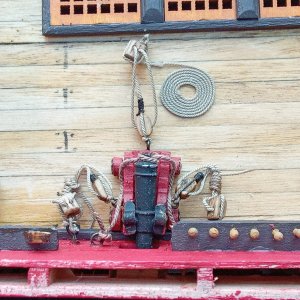
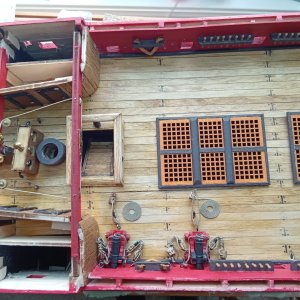
so what I have found out there seems to be a dozen ways to rig it. So I went with something easy and looks good for me. There is a breech line wrapped around the cannon end and fastened with an eyebolt to the bulwark, one inhale line and two outhaul lines also fastened with an eyebolt to the bulwark. I placed the outhaul lines outside of the breech lines. 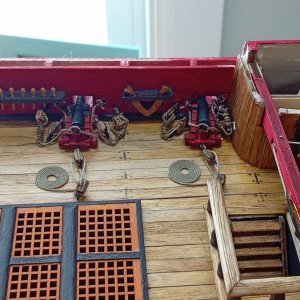
- Joined
- Dec 15, 2023
- Messages
- 68
- Points
- 88
I agree the blocks do look too big for the scale, however, the cost of replacing with smaller blocks was more than I cared to invest in it, also since I am replacing all of their line. Why don't they make kits where you can purchase what you want and not all of the cheap stuff they put in it.

Nice Robert!so what I have found out there seems to be a dozen ways to rig it. So I went with something easy and looks good for me. There is a breech line wrapped around the cannon end and fastened with an eyebolt to the bulwark, one inhale line and two outhaul lines also fastened with an eyebolt to the bulwark. I placed the outhaul lines outside of the breech lines. View attachment 584878View attachment 584879View attachment 584880
Great decision.I'll change the ones provided in the kit with the smaller 2 mm. blocks
British ships used pairs of single blocks, according to The History of British Sea Ordnance by Adrian Caruana, for all cannon smaller than 32 pounders. Do you or does any member know if this was the same for Spanish ships? I cannot find any contemporary models, supply lists, or drawings showing this one way or the other.
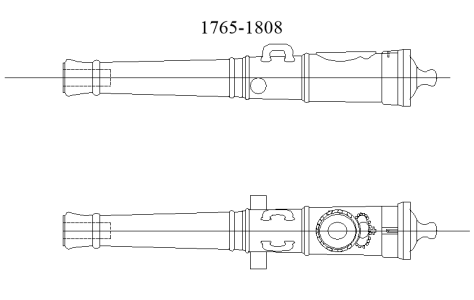
If you or anyone would like 3D drawings of Spanish cannon used at the time of Santisima Trinidad let me know. They can be used to have guns printed in any size in resin. At your scale I have been paying less than US$1 each, including shipping (within the US) I realize many members prefer metal guns, but casting them to show the details can be difficult at best.

Allan
2D drawing
Thank you Allan, but as I decided to spend some money changing the blocks, I think I'll keep the cannons provided by the kitGreat decision.
British ships used pairs of single blocks, according to The History of British Sea Ordnance by Adrian Caruana, for all cannon smaller than 32 pounders. Do you or does any member know if this was the same for Spanish ships? I cannot find any contemporary models, supply lists, or drawings showing this one way or the other.
If you or anyone would like 3D drawings of Spanish cannon used at the time of Santisima Trinidad let me know. They can be used to have guns printed in any size in resin. At your scale I have been paying less than US$1 each, including shipping (within the US) I realize many members prefer metal guns, but casting them to show the details can be difficult at best.
Allan
2D drawing
View attachment 585664
You paid good money for them so totally understand your decision to use them.I think I'll keep the cannons provided by the kit
Allan
I completed the hull openings for the gun ports.
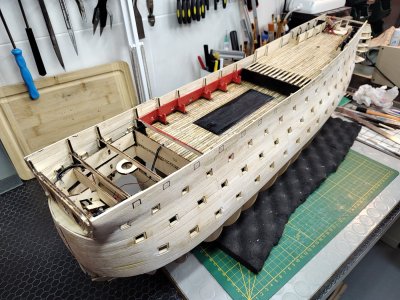
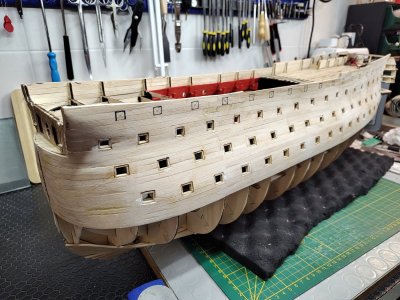
It was quite a complicated operation and actually had to be done before the hull was completely closed, because many of the internal frames fell back during installation and would be irreparable. The result seems acceptable to me, but only because the final filling and sanding, as well as the subsequent painting, still need to be done.
When it came time to continue installing the external planking, I realized that tapering the strips would be greatly aided by a small table saw. So I ordered one and, while waiting for it to arrive, I decided to dedicate myself to building the lifeboats.
It was quite a complicated operation and actually had to be done before the hull was completely closed, because many of the internal frames fell back during installation and would be irreparable. The result seems acceptable to me, but only because the final filling and sanding, as well as the subsequent painting, still need to be done.
When it came time to continue installing the external planking, I realized that tapering the strips would be greatly aided by a small table saw. So I ordered one and, while waiting for it to arrive, I decided to dedicate myself to building the lifeboats.
I think the beauty of this forum is the opportunity to share ideas and tricks that come to you while building models, even at the risk of appearing naive and finding obvious things interesting...
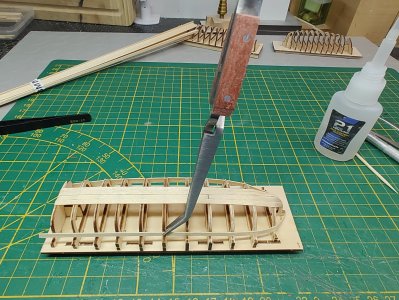
In this spirit, I'd like to point out the use of self-locking tweezers.
When building lifeboats, I found them very handy for holding the strip against the frames just long enough for the glue to set. Given the small size of the parts, the usual clamps are unusable.
In this spirit, I'd like to point out the use of self-locking tweezers.
When building lifeboats, I found them very handy for holding the strip against the frames just long enough for the glue to set. Given the small size of the parts, the usual clamps are unusable.