• SUBSCRIBE TO SHIPS IN SCALE TODAY!

    The beloved Ships in Scale Magazine is back and charting a new course for 2026!
    Discover new skills, new techniques, and new inspirations in every issue.

    NOTE THAT OUR NEXT ISSUE WILL BE MARCH/APRIL 2026
  • Win a Free Custom Engraved Brass Coin!!!
    As a way to introduce our brass coins to the community, we will raffle off a free coin during the month of August. Follow link ABOVE for instructions for entering.

School for Shipmodel Building School for model ship building

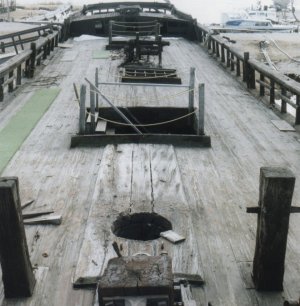
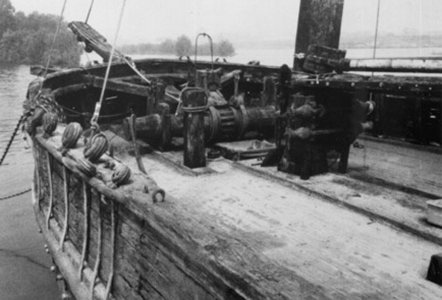
I’m sure that all of these replicas, Niagara included, have electric powered bilge pumps to actually pump the bilges. The one in your photo if it actually works is probably to give passengers a taste of what being a crew member in 1813 was like.

Roger
 
Another factor that may be germane starting about 1815 - small companies utilizing rivers as a power source start manufacturing ship components and furniture as early mass production. The price would probably be below what it cost an individual yard to make their own version. The quality would be known and predictable. My money is on almost every yard - private or Navy jumping on the opportunity to avoid having to self manufacture parts that were a bother and inefficient for them to make themselves. By 1850 there were ads for wooden knees! The iron work stuff is so specialized that any shipyard would probably take every opportunity use an outside source.
I wonder if there are archives of the earliest newspapers with engravings in ads and catalogs of early 19thC. companies that our field has not been explored and reproduced for us.

I would expect that conclusions about the Lake Erie fleet which are based upon on our extrapolations from customary practices at the time would be best tempered by the facts we do know for certain about the pressing circumstances of their construction.

From Wikipedia:

The construction of the fleet was largely supervised by Noah Brown, a shipwright brought in from New York City. The keels of two brigs were each constructed out of a single 14-by-18-inch (360 mm × 460 mm) black oak log. Due to a lack of iron, the timbers that made up the hulls were joined using wooden pins called treenails. In place of the oakum and pitch normally used to caulk ships, lead was used. The timbers used in the brigs were still green, as the builders did not have the luxury of time to allow the wood to dry properly. A total of 65 cannons were shipped to Erie to arm the fleet; Hamilton approved the production of 37 cannons by a foundry in Washington, D.C., and the rest were moved from Sackets Harbor. Tigress and Porcupine were launched in April 1813, Scorpion in May, and the brig Lawrence on 25 June. Niagara was launched on 4 July along with Ariel.

Wikipedia cites Knoll, Denys W (1979). Battle of Lake Erie: Building the Fleet in the Wilderness. Washington, DC: Naval Historical Foundation.

While there may have been some specialized manufacturing concerns making "generic" ships' parts as early as 1815 in active seaports and shipbuilding areas on the Atlantic Coast and certainly we know that the large naval yards had shops turning out an entire range of standardized parts for their ships (and, of course, they had armories making their armament,) the ships built at Erie PA at that time were built "in the field" as it were. Erie, PA was something of an outpost at the time with what they called a "naval station." As they imported a master builder from New York, I don't expect there was a large number of skilled shipwrights available in the local population. From all indications, the ships built at Erie to form the U.S. Lake Erie fleet were "quick and dirty." Notably, they were built of green wood. I have no idea how they managed to caulk a ship with lead. I expect what they did was to sheath the hull with lead plate over something like pitch-soaked felt or something which was an established practice for stopping leaks at that time. Given these facts, I would expect that all of these vessels were equipped with as much pumping capacity as they could be because their builders had to expect they would be heavy "leakers."

Interestingly, the mentioned shortage of Iron is significant. If they didn't have enough for spikes and drifts, to secure the planking, I would expect that while at that time in history, blacksmithing was a very common skilled trade so there was likely little shortage of the skilled labor needed, there would not be enough iron to fabricate any but the most essential items aboard that were at that time customarily made of wrought iron. Perhaps anchors were made of iron, but I would expect that the block strops, eyebolts, goosenecks, and other usually metal items would have been of a much earlier type which did not require iron if at all possible. Those options would be known to any shipwright or rigger back then.
On the other hand, the author of the Wikipedia article may have mistakenly concluded that the use of treenails was due to a shortage of iron. That said, if they were building a ship of green timber, which must be expected to shrink, treenails wouldn't have been my first choice for a fastening! :D
 
There is an old water route between Pittsburgh PA and Erie PA. Up the Allegheny River watershed across a portage and down a small river that could be navigated by bateaux. Pittsburgh is an old settlement dating from the 1750’s and by 1812 was an iron working center. I don’t believe that there was a shortage of iron.

From my Navy Nuclear days, I remember that lead wool was used to caulk joints in lead shielding.

Roger
 
There is an old water route between Pittsburgh PA and Erie PA. Up the Allegheny River watershed across a portage and down a small river that could be navigated by bateaux. Pittsburgh is an old settlement dating from the 1750’s and by 1812 was an iron working center. I don’t believe that there was a shortage of iron.

From my Navy Nuclear days, I remember that lead wool was used to caulk joints in lead shielding.

Roger
Apparently, northwestern Pennsylvania was a lot more developed that I had imagine. Not an area I'm very familiar with, especially during that period.

I learn something new every day! That river route explains how they got all those cannon up there! I had visions of that movie, The Pride and the Passion (1957) which was one of my favorites as a kid.


I've never heard of lead wool before. Makes perfect sense. Odd to think they'd have lead, but not oakum and pitch. Oakum takes some doing to make, though. The Admiralty used to use the POW's to make it from tow from the rope walks. The longer and newer the fibers, the higher quality the oakum. The best oakum was from the tow from the rope walks. Cheap oakum was made from unlaid used cordage which had a lot of broken fibers and was half rotten to begin with. I don't think there was any machinery to make it at that time. It had to be rolled by hand.

It never ceases to amaze me what they could accomplish back then with little more than manpower and ingenuity!
 
Thread drift but I think interesting: Pittsburgh is of course the point where two rivers, the Monongahela from the south and the Allegheny from north join to become the Ohio River. The French had explored and laid claim to the area in the early 1700’s. By 1750 they had defended this claim by building a fort at this point where the three rivers came together.

The British disputed this claim and sent the very young George Washington with some militia members to tell the French to leave. Long story short Washington’s trip was a disaster. Things turned violent, Washington and his band were captured, released, and slunk back to Virginia. The British responded by declaring war. Thus began the Seven Years War or to Americans the French and Indian War. This turned into a true world war the lasted throughout most of the 1750’s.

The British made at least two attempts to capture the fort; the first was the disastrous Braddock Expedition again including George Washington. The second, later in the war caused the French to abandon the fort as the British approached. The British rebuilt the fort named it Fort Pitt and settlers came over the mountains from the east to live nearby.

Thirty or so years later (the end of the American Revolution) Pittsburgh was the point from where settlers into the Ohio Country left, As the Ohio River was the easiest way into this new country, a business developed in Pittsburgh to build the primitive river craft to get them there.

I have also read that guns for Perry’s Lake Erie fleet were cast in Pittsburgh.

Roger

 
thread drift is a good thing it adds depth to the discussion.

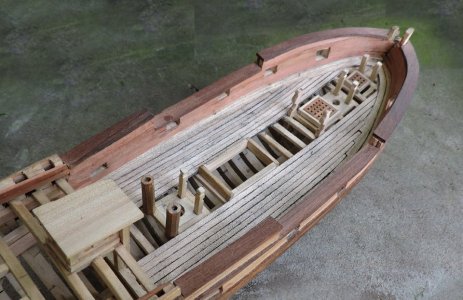
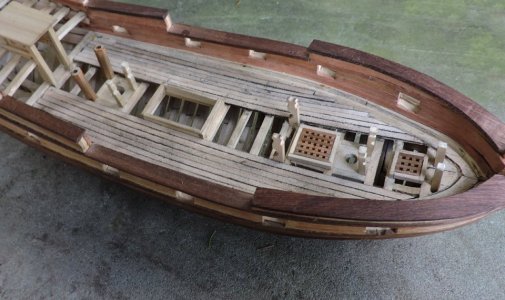
ok back to the deck of the Hawke decking planking reached the center so at this point it is time to add posts, pumps, windlass supports and gratings. None of the posts are glued in they are just a snug fit so i can remove them to finish the deck.


deck planking21.jpgdeck planking22.jpg
 
When you do start this School for Model Shipbuilders, please let me know. I would like to join it. I have nothing against someone new to model ship building start with an easy entry kit to gain knowledge of tools, and basic techniques. That is how I started in the mid to late 1970s. For the last couple of years I have been building the Golden Hind ship from a kit but have been adding extra items that are not in the kit and replacing plastic blocks, dead eyes and anchors with wood pieces. Then doing research on what the captain's cabin looked like aboard several ships. I've even researched the different stoves/ovens and intend on adding some of these on my current build. But I am longing to move from kits to scratch building and would like to get a good set of plans of actual ships. I'm thinking of ordering a set of plans from the Mystic Seaport Museum. Its too bad the industry doesn't shift a small portion of their focus on a transition from kits to scratch builds. I think this is where your school will fit in perfectly.
 
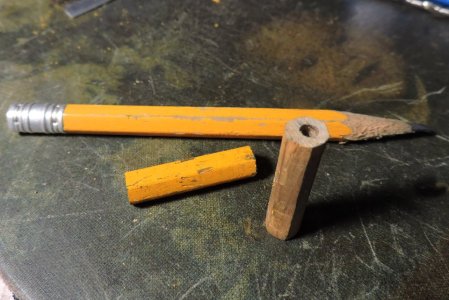
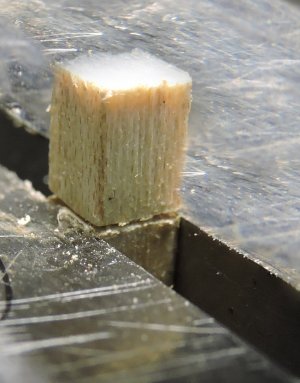
Bitt post take a little more work than just cutting a pencil. start by cutting 4 pieces to length. now some post have angles cut in the top and others do not.

DSCN7042.JPG


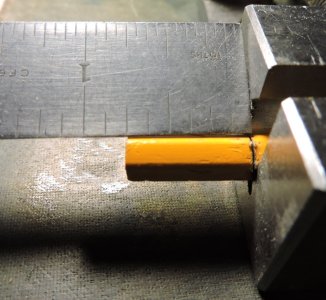
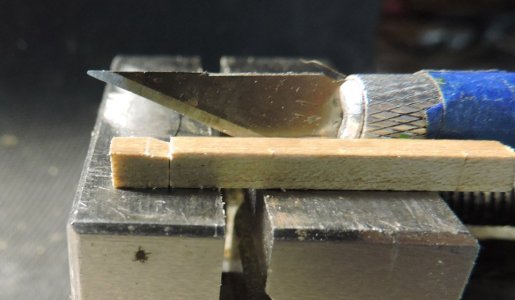
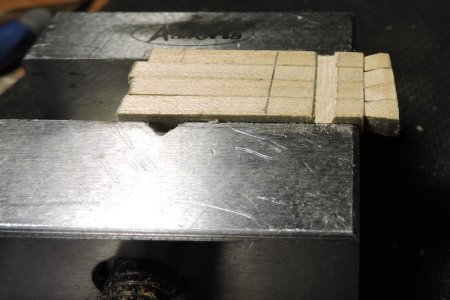
but for the Hawke i am going to cut the tops of the posts. The trick is to make the first cuts on all sides of the posts exactly the same and i do this by clamping the post in a vice.

deck planking25.jpg

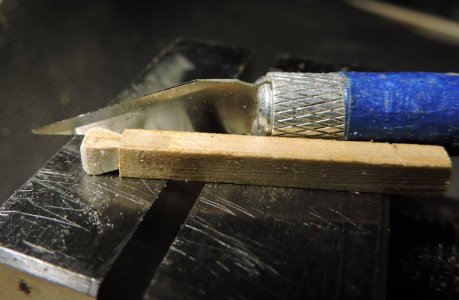
Now for the angle cut on each side, i make this cut lower from the top

deck planking26.jpg

then sand the top down once all the angle cuts are made and give the top edge a slight bevel.

deck planking27.jpg

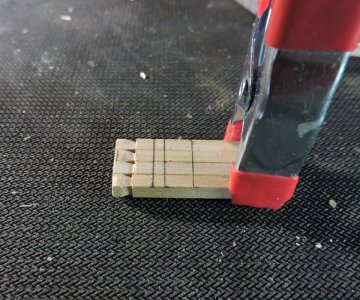
Next i need a slot cut for the rail, it is important you line up the tops of the posts and draw the lines for the slot. The lower line is the deck level.

deck planking28.jpg

Once again i use a vice and place the posts half way in so i can cut all the slots at one to the same depth.

deck planking29.jpg

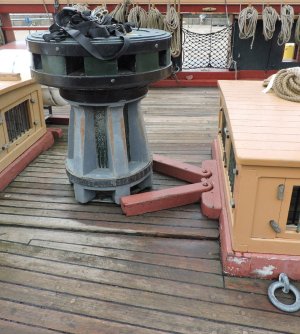
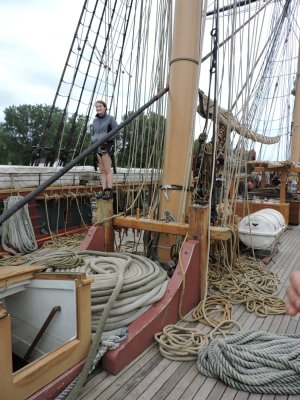
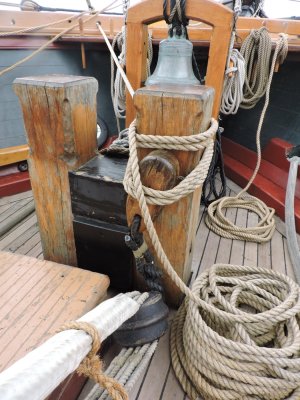
The two posts at the bow are the samson posts where to bow sprit will wedge into so the tops are flat. Here are the samson posts on the Niagara

DSCN6988.JPG
 
When you do start this School for Model Shipbuilders, please let me know. I would like to join it. I have nothing against someone new to model ship building start with an easy entry kit to gain knowledge of tools, and basic techniques. That is how I started in the mid to late 1970s. For the last couple of years I have been building the Golden Hind ship from a kit but have been adding extra items that are not in the kit and replacing plastic blocks, dead eyes and anchors with wood pieces. Then doing research on what the captain's cabin looked like aboard several ships. I've even researched the different stoves/ovens and intend on adding some of these on my current build. But I am longing to move from kits to scratch building and would like to get a good set of plans of actual ships. I'm thinking of ordering a set of plans from the Mystic Seaport Museum. Its too bad the industry doesn't shift a small portion of their focus on a transition from kits to scratch builds. I think this is where your school will fit in perfectly.

This is exactly what the school is all about the school is started and in progress right now i suggest you venture into the other class rooms.

what your doing is what has been described by others by slowly replacing kit parts and making your own fittings and teaching yourself wood working you are developing skills. By repeated tasks you get better and better for example i can cut and shape a bitt post in minutes because of muscle memory having done it over and over. Or knowing how to plank a hull or deck comes second nature as you learn how real ships were built.
Read about Harold Hahn he was not being some elite snob looking down on kit building, what he was trying to say is kit building teaches you how to built kits that's it, expand your knowledge and skills by taking on more challenges.
 
Thread drift but I think interesting: Pittsburgh is of course the point where two rivers, the Monongahela from the south and the Allegheny from north join to become the Ohio River. The French had explored and laid claim to the area in the early 1700’s. By 1750 they had defended this claim by building a fort at this point where the three rivers came together.

The British disputed this claim and sent the very young George Washington with some militia members to tell the French to leave. Long story short Washington’s trip was a disaster. Things turned violent, Washington and his band were captured, released, and slunk back to Virginia. The British responded by declaring war. Thus began the Seven Years War or to Americans the French and Indian War. This turned into a true world war the lasted throughout most of the 1750’s.

The British made at least two attempts to capture the fort; the first was the disastrous Braddock Expedition again including George Washington. The second, later in the war caused the French to abandon the fort as the British approached. The British rebuilt the fort named it Fort Pitt and settlers came over the mountains from the east to live nearby.

Thirty or so years later (the end of the American Revolution) Pittsburgh was the point from where settlers into the Ohio Country left, As the Ohio River was the easiest way into this new country, a business developed in Pittsburgh to build the primitive river craft to get them there.

I have also read that guns for Perry’s Lake Erie fleet were cast in Pittsburgh.

Roger
My great+-grandfather on my father's side served in the Virginia Militia under George Washington in the French and Indian War and in the War for Independence. I wish I had more details, but his name on the official pension records is all there is. That qualifies me to join the Sons of the American Revolution and my sisters to join the DAR, but none of us did.
 
I am longing to move from kits to scratch building and would like to get a good set of plans of actual ships. I'm thinking of ordering a set of plans from the Mystic Seaport Museum. It's too bad the industry doesn't shift a small portion of their focus on a transition from kits to scratch builds. I think this is where your school will fit in perfectly.

Why doesn't the ship model kit industry "shift a small portion of their focus on a transition from kits to scratch builds?"

Well, why doesn't your local crystal meth dealer "shift a small portion of their focus on how to cook the stuff in your own kitchen at home?" Same difference. The last thing the kit manufacturers want any ship modeler to discover is that they can build any model they want from scratch for practically nothing assuming they already have the basic tools required for kit building. Of course, you can spend a lot of money on specialized power tools for modeling, be it scratch or kit, but the knowledge to build from scratch is readily available for nothing more than the time to learn and any a good book or two... or an internet resource like SoS's School for Ship Model Building. Similarly, the materials for scratch building are virtually free if the modeler does his own milling, and, if not, scale modeling wood is readily available from retail suppliers like The Lumberyard, an SoS sponsor, for relatively little cost, considering the small amount required for a model. (And, of course, nobody needs to build a model out of expensive exotic nearly unobtainable wood species to create a "high-quality scale ship model," either.)

What the kit manufacturers want to do, like the meth dealers, is "get you hooked" on ship modeling, but at the same time hoodwink you into believing that you'll never be able to build from scratch and so must buy kit after kit, some costing well over a thousand dollars and nowadays to also sell you aftermarket packages to supplement the kits which they sell knowing full well must be supplemented to produce a satisfactory result. Believe it or not, there was once a time when ship model kits barely existed. The ship modeling business was limited to retailers who sold plans and cast metal scale detail parts like anchors, blocks, belaying pins, winches, ventilators, and bells. Of course, those were the days when the average kid got his first pocketknife at age seven, learned to sharpen it good enough to shave with it by age eight, and, if he was so inclined, by age ten used it to build his first ship model from scratch. Now, there's a con artist ready to sell somebody his father's age a couple of thousand dollars' worth of power tools because they're "essential" to scratch-building a ship model. That's not true, but the con artist gets his mark going and coming. By convincing the potential power tool customer who can't afford the "necessary" tools that he'll never afford to be a scratch-modeler, he's just sold him a lot more of more years, and dollars, worth of kit buying!
(By the way, it was posting truths like these that caused the kit manufacturers who ran MSW to ban me from posting there forever. :D)

Where to find plans for free or little cost? There's an answer for that!

The "mother lode" of historic American ship plans for scratch-builders is the Council of American Maritime Museums' Ship Plans Directory. This online directory lists all the members of the Council, which is most every maritime museum in the country, which have ship plans in their collections, describes the plans they have, and how you can access them. Some are free downloads and others can be ordered at cost.
See: https://councilofamericanmaritimemuseums.org/resources/ship-plans-directory/ Bookmark it!

There are many great sources for scratch-building plans readily available at no cost online. One excellent source is the Historic American Engineering Record aka: HAER. This is primarily a collection of plans of historic American engineering works, some of which are ships. The records are either actual original construction drawings in great detail, or modern survey drawings in great detail made to record the ships where original plans aren't available, usually for the purpose of documenting applications for inclusion in the National Register of Historic Places and engineering works, etc. Most all are available online in both PDR and TIFF formats. Use the TIFF format for copying because it permits enlargement to your desired scale without the drawing lines getting wider as the plan is enlarged. There is one disadvantage with the HAER records and that is that it doesn't have a very good search feature, so you have to dig deep through a lot of entries to find the ships. Once you do, you'll find sometimes as many as twenty 18"x22" plans sheets, all ready for the scratch builder to work from. As these are real scale construction drawings and not the usual crap you get in ship model kits, but you may have to do a bit of lofting on your drawing board to get the shapes you'll need to build your model... just as the original shipwrights did to build the prototype full size.

Another valuable feature of the HAER entries is that there are often many photographs of the vessel, both historical and current where the vessel still exists. There's nothing like photographs to make life easier for a scratch-builder!

Here's a link that will give you a quick overview of how to search the HAER library: https://www.bing.com/search?q=HAER+...efig=69ffdbdd3cbf40b89aeba4f3c20fe0f9&pc=DCTS

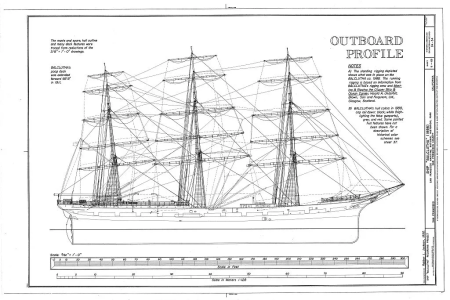
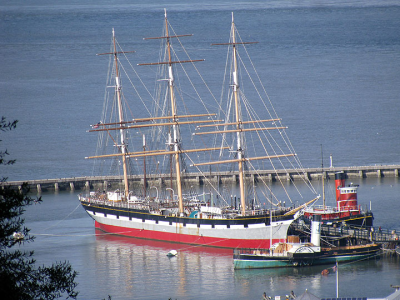
Here's an example of the HAER outboard profile drawing of Balclutha, a Clyde-built sailing cargo ship on display at the National Maritime Historic Park in San Francisco, CA.

1778382534528.png


1778386140120.png
 
Back
Top