• At some point from current UTC of 19:40:30 Thursday up to UTC 19:40:30 Friday, it is possible the forum might be disabled for a short period of time for updates and upgrades. Another notice will be posted for status. Note: Central Standard US time would be 14:40:30 Wednesday up to 14:40:30 Thursday
  • SUBSCRIBE TO SHIPS IN SCALE TODAY!

    The beloved Ships in Scale Magazine is back and charting a new course for 2026!
    Discover new skills, new techniques, and new inspirations in every issue.

    NOTE THAT OUR NEXT ISSUE WILL BE MARCH/APRIL 2026
  • Win a Free Custom Engraved Brass Coin!!!
    As a way to introduce our brass coins to the community, we will raffle off a free coin during the month of August. Follow link ABOVE for instructions for entering.

School for Shipmodel Building School for model ship building

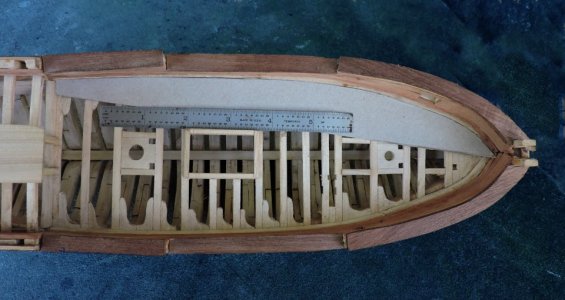
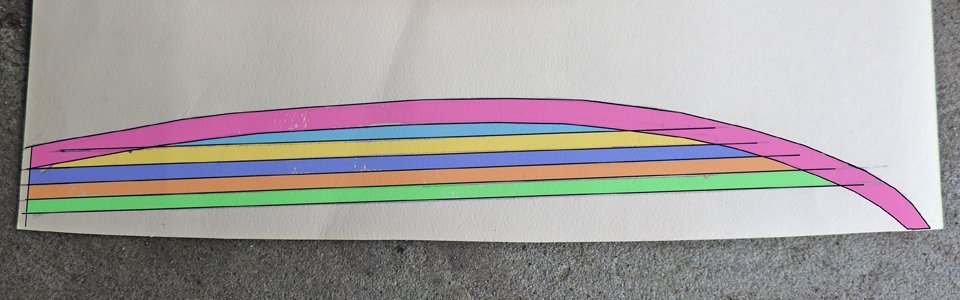
Decking on the Hawke model will be 7 inch wide so to begin the margin plank has to be shaped. Using cardboard the edge is cut and fit to the waterway. I am using a ruler to keep the planking running parallel to the hatch coamings.

deck planking1.jpg
 
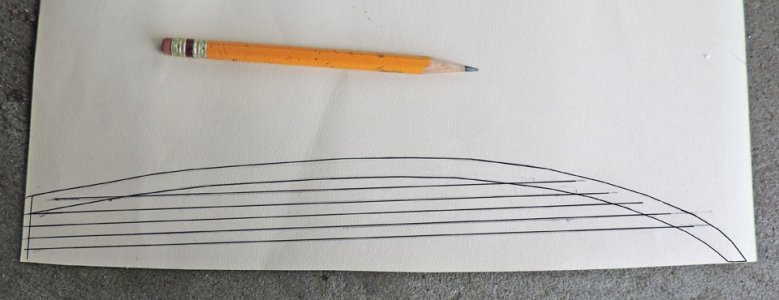
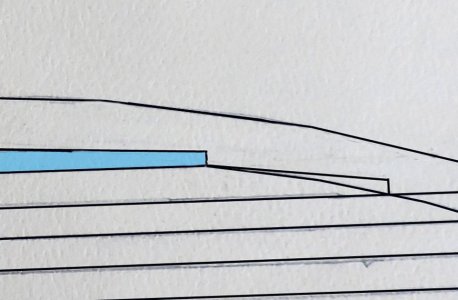
Taking the cardboard pattern i traced in on paper then drew the inside edge and the planking width

deck planking2.jpg

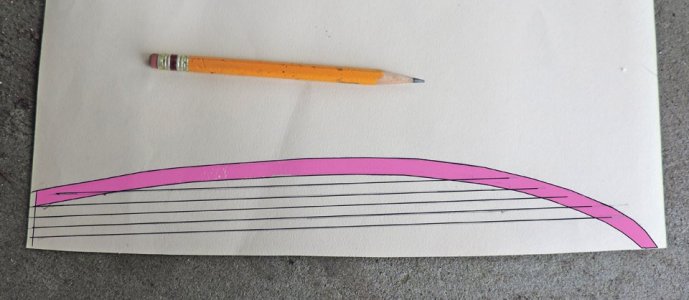
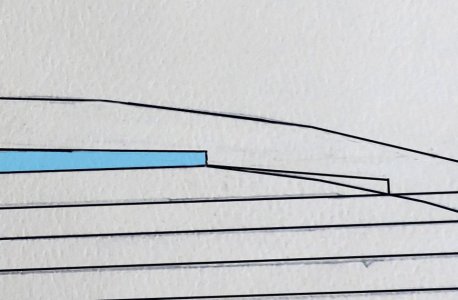
You can see the planking ends in a sharp point so they have to nib into the margin plank

deck planking3.jpg

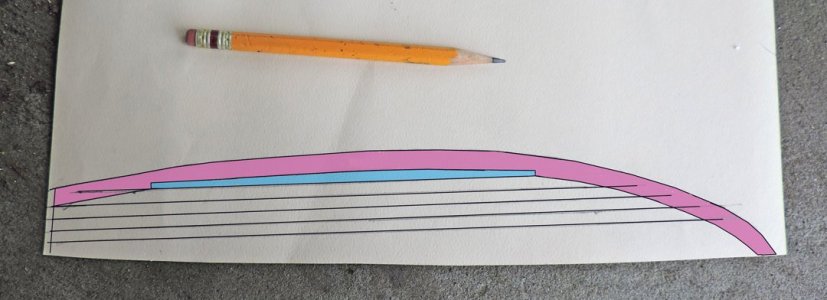
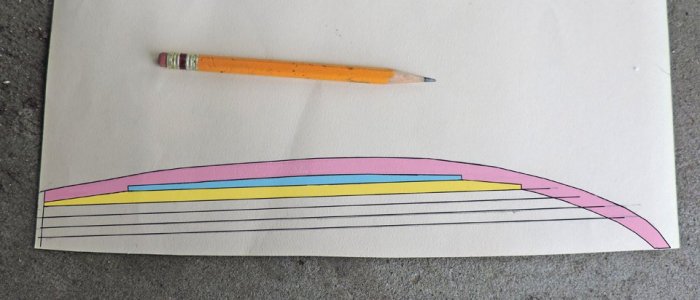
starting with the first plank

deck planking6.jpg

as the planks get closer to the bow the point gets less and less

deck planking4.jpg

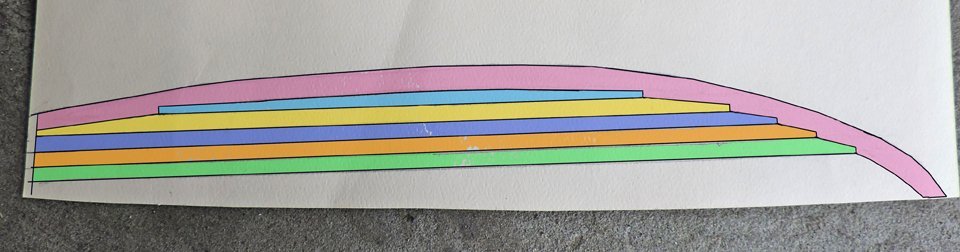
the end of the planks start where they meet the margin plank and go back to point of the last plank

deck planking5.jpgdeck planking7.jpg

deck planking8.jpg
 
Taking the cardboard pattern i traced in on paper then drew the inside edge and the planking width

View attachment 594625

You can see the planking ends in a sharp point so they have to nib into the margin plank

View attachment 594626

starting with the first plank

View attachment 594629

as the planks get closer to the bow the point gets less and less

View attachment 594627

the end of the planks start where they meet the margin plank and go back to point of the last plank

View attachment 594628View attachment 594630

View attachment 594631
Thanks for that, Dave. That makes a lot of sense. One thing, though, how deep is the nip, around one third the width of the plank? Or make it the same nip each time?
 
the number of planks you want to nib into the margin plank is up to you. Historically accurate is only up to a point unless you have actual documentation and archaeological evidence. Here is the Niagara

DSCN6869.JPG

but the nibbing stops as it approaches the center of the bow


DSCN6988.JPGDSCN7005.JPG

So all in all historical accuracy has a point where it goes into a best guess
 
Last edited:
Thanks for that, Dave. That makes a lot of sense. One thing, though, how deep is the nip, around one third the width of the plank? Or make it the same nip each time?

Because of the arc around the bow the nib is getting shorter and shorter until it is not needed. the actual nib depends on the width of the plank. its length is determined at the point where it crosses the margin plank. As far as the width i do not know if there was a standard but it looks like 1/3 the width of the plank. Laying the planking and nibbing it into the margin plank is a cut to fit.

deck planking5.jpg
 
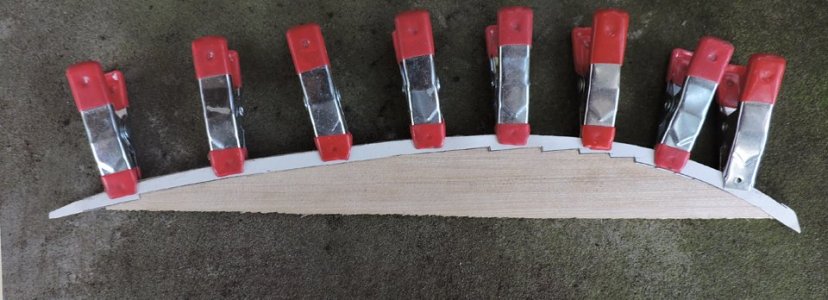
After you lay out the shape of the margin plank and you have a cardboard pattern it is time to cut wood. The cardboard pattern is now clamped to a sheet of wood

deck planking9.jpg

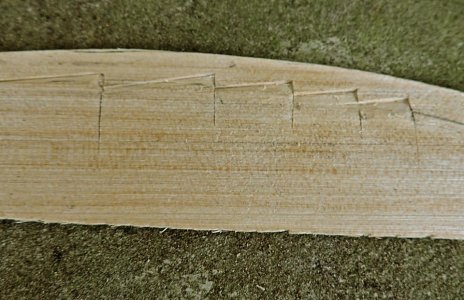
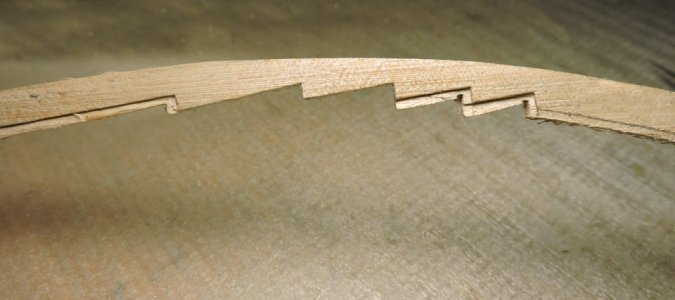
Those nibs have to be accurate and a clean straight cut so what i did was using a new sharp blade i cut along the pattern then made a slice at an angle to the cut. This is giving me that sharp edge. Best to always use a new and sharp blade so it cuts where you want and does not tend to follow the wood grain
.

deck planking10.jpg

Having that edge now i cut away the wood with my scroll saw.

deck planking11.jpg

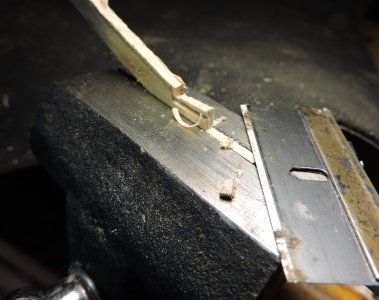
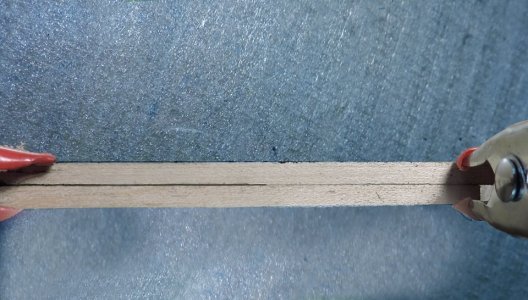
The final finish cut is done by hand in a vice by placing the edge at the top of the vice and slicing it clean to the top of the vice with a razor blade or knife. This ensures the edge is flat.

deck planking13.jpg

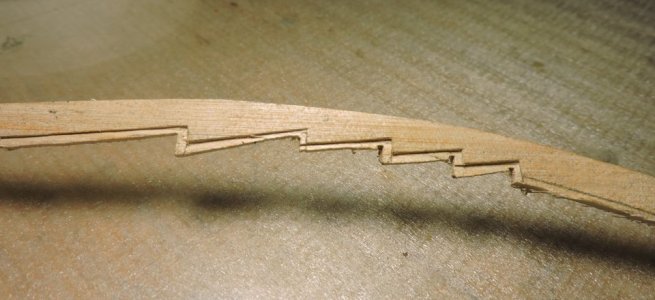
As you can see the final nib is a perfect cut. It is common the edge of a cut is not at a perfect 90 degree to the surface thus the use of a vice to make sure your cut is a perfect 90 degrees and flat. If you cut the nib with a saw you will have saw marks but cutting the final edge it is smooth and clean.

deck planking12.jpg

Installing the margin plank. Now i have to repeat the process for the other side. i would have just made two but both sides may not be a perfect match.

deck planking14.jpgdeck planking15.jpg
 
Before i started the deck i tested different types of caulking and the best results was to use a China Marker

deck planking16.jpg


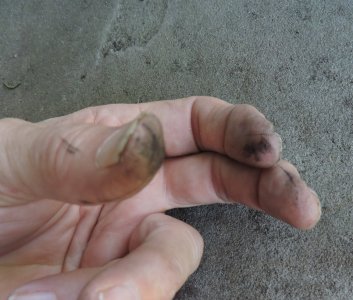
A China marker is a soft waxy marker and when two planks are presses together it fills in nice and even. The drawback is because it is soft it gets on your fingers.

deck planking17.jpg
 
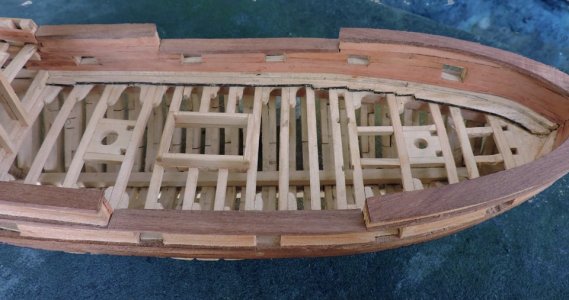
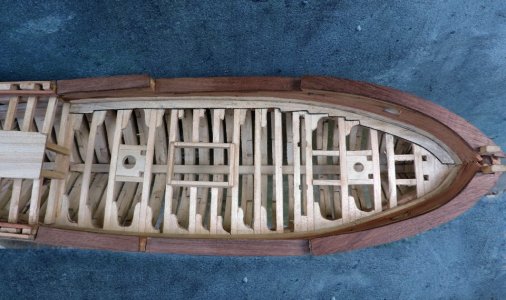
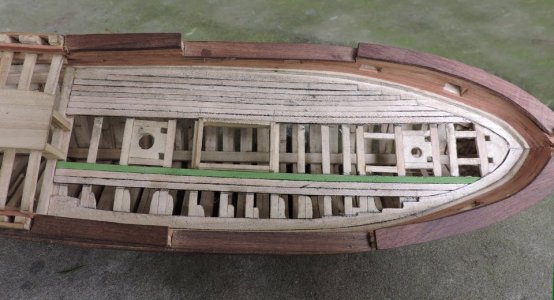
Laying out the decking i started with the plank tinted green. I did this because i wanted to run the plank against the main hatch coaming and straight from the bow to the cabin. You may notice there are no butt joints just one long plank. As was mentioned in an earlier post deck planks can run up to 40 feet long. I did wonder about that but i live in an area there are still massive trees and it is very possible to get a plank as long as 50 feet even today. This deck falls within the 40 foot range so i did not break the decking into smaller lengths.

deck planking18a.jpg
by running the plank straight from the main hatch coaming it falls right on the edge of the notches for the windlass posts.

deck planking20.jpg

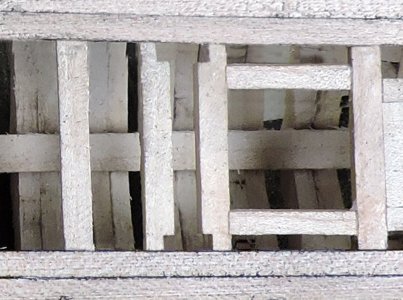
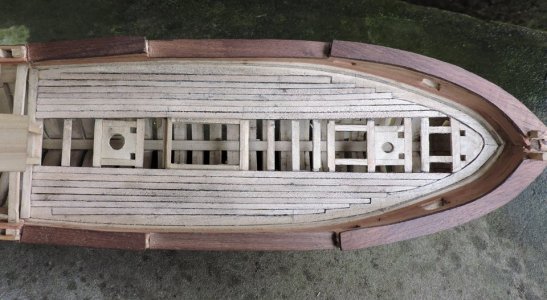
The deck was planked on both sides so now it is time to put in the gratings, windlass braces and posts. Then the center of the deck will be planked. Down the center planking will need to be adjusted around the posts.
At this stage the caulking makes the deck look messy, but when it is finished i will scrape the deck clean and smooth.

Some builders like to keep part of the deck open to show the beams and knees. I planked over all the structural work so you may wonder why bother if it is going to be hidden? Well, it was not hidden you saw the deck being built early on in the build, so you know what is under the planking. Because this is a class on building it was necessary to show how a deck is built and planked. It is not about the finished model.

deck planking19.jpg
 
Last edited:
On some decks the planking it bent to matchup with the shape of the hull. The main deck on the Hawke is short so running the planks straight works out.
I will not pepper the model deck with little treenail dots. Do you see the treenail plugs here? On the model they would be so tiny they would not be visible. To add treenail plugs is a builders choice.

deck10.jpg
 
Last edited:
The wood used for the decking is Red Maple also called Soft Maple which is not really soft it is like the hardness of Cherry. I personally like Red Maple because it has some subtle shaded of color and it will turn a light honey color with a very slight tint of gray. Poplar also makes a nice looking deck.
 
Laying out the decking i started with the plank tinted green. I did this because i wanted to run the plank against the main hatch coaming and straight from the bow to the cabin. You may notice there are no butt joints just one long plank. As was mentioned in an earlier post deck planks can run up to 40 feet long. I did wonder about that but i live in an area there are still massive trees and it is very possible to get a plank as long as 50 feet even today. This deck falls within the 40 foot range so i did not break the decking into smaller lengths.

View attachment 596124
by running the plank straight from the main hatch coaming it falls right on the edge of the notches for the windlass posts.

View attachment 596123

The deck was planked on both sides so now it is time to put in the gratings, windlass braces and posts. Then the center of the deck will be planked. Down the center planking will need to be adjusted around the posts.
At this stage the caulking makes the deck look messy, but when it is finished i will scrape the deck clean and smooth.

Some builders like to keep part of the deck open to show the beams and knees. I planked over all the structural work so you may wonder why bother if it is going to be hidden? Well, it was not hidden you saw the deck being built early on in the build, so you know what is under the planking. Because this is a class on building it was necessary to show how a deck is built and planked. It is not about the finished model.

View attachment 596122

Incredible to think there were Travellers at a wood mill capable of making timber that long in the day. Just imagine tailoring out the 40-foot length of the planks.
 
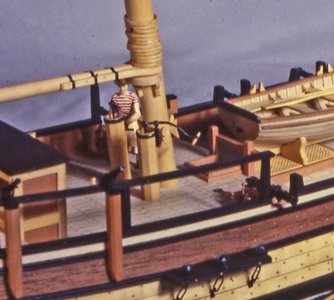
i need a little help with the bilge pumps the Hawke has two i need to make. But what did they look like in colonial America?
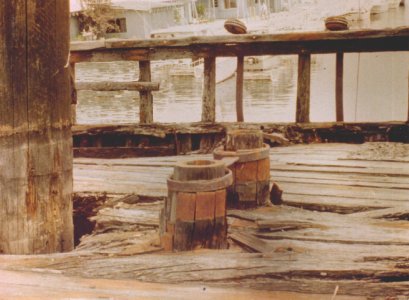
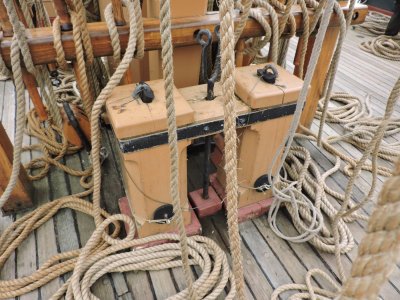
My question is why are they not just a round pipe rather than 6 or 8 sided planks? here is am image od what remained on a Great Lakes schooner of the 1840s

why were they made of wood?
what is the purpose of the wood planks around the pump?
were some just round?

bildge pump.jpg
 
thanks Roger
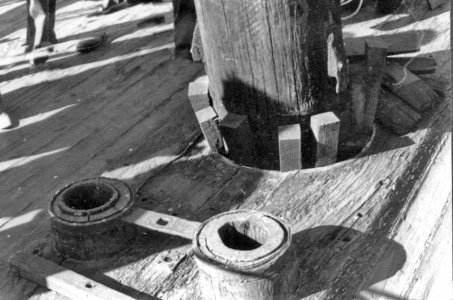
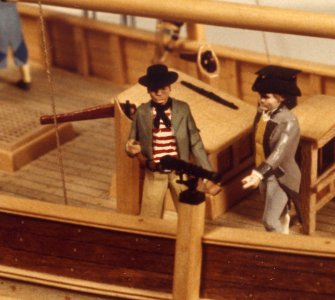
here is another view of the pumps what i see is the pump on the right has a much thicker wall than the one on the left also in the lower left corner it looks like a yoke that must have been attached to a center post. Why bore a wooden log? why not just use a pipe?

Also the pump is quite short 12 to 18 inches off the deck

pic6.jpg

Hahn shows them to be 4 feet or more. Why would you need to pump the water that high?

ahalifax09c.jpg1hannah20c.jpg
 
Dave,

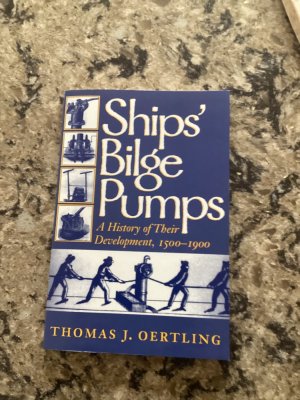
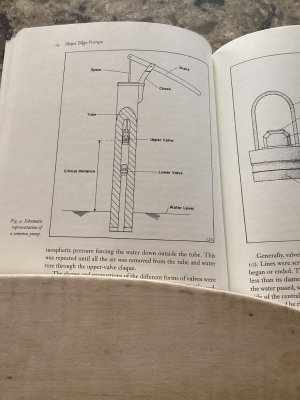
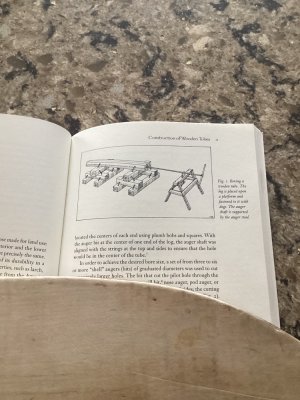
Following from Texas A&M Archeology series book Ships’ Bilge Pumps

1. New England Built Revolutionary War era privateer Defence sunk in Penobscot Bay was fitted with a “common pump.” Second photo.

2. This and many other pumps dating back to ancient times had pump tubes bored from solid logs. Often Elm. Defence’s was pine. Third photo.

3. Metal tubes from the same era have also been found but in vessels built in govt dockyards- French.

IMG_0438.jpegIMG_0442.jpegIMG_0441.jpeg
 
Comment on your two questions:

Use of pipe. Of course lead pipes date back to Roman times and lead was available in the colonies. Casting a hollow tube is an art requiring skilled mold making. Wood was cheap

Height above deck. I believe that It’s ergonomics and economics. The lever needs to be high enough to be easily worked. The pump tube could be cut close to deck level but then a separate frame would be required to elevate the lever. Extending the tube was the simplest solution.

Roger
 
Just possible answers:
Perhaps the person who set the pump level height was taller than average and valued his back.
The bumper layer outside the pump tube barrel - Protection from holystoning, shifting gun trucks, rolling cargo barrels?

Another possibility - are there any lines that are on deck and under tension and moving past the pumps?
 
Last edited:
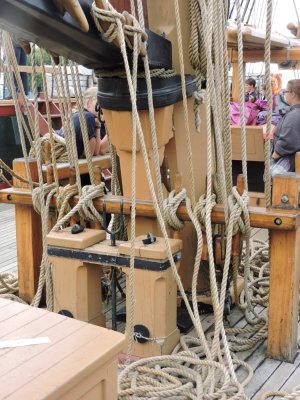
i took a look at the pumps on the Niagara which are totally different, but we have to keep in mind the Niagara may or may not be a true historic reproduction of the actual ship back in 1813.
Ship fittings are a big catagory using bilge pumps as an example you see one style used in a kit and that same style is copied in many kits regardless of time period or where the ship was built.
a young person a little out of frame to the right using to figure the height of the pumps would make the pumps a little above knee level


DSCN7088.JPGDSCN6993.JPG
 
so i can argue anything i use in building the model as long as i find a reference makes it historically, correct? The time period between the building of the Sir Edward Hawke and the building of the Niagara falls within the same generation of ship builders well the Hawke is 1770ish and the Niagara is 1813. The Niagara was built by East coast shipwrights. I would think all the shipyards along the coast would know what each other are doing so would they copy one another or use the same type of fittings?
 
Another factor that may be germane starting about 1815 - small companies utilizing rivers as a power source start manufacturing ship components and furniture as early mass production. The price would probably be below what it cost an individual yard to make their own version. The quality would be known and predictable. My money is on almost every yard - private or Navy jumping on the opportunity to avoid having to self manufacture parts that were a bother and inefficient for them to make themselves. By 1850 there were ads for wooden knees! The iron work stuff is so specialized that any shipyard would probably take every opportunity use an outside source.
I wonder if there are archives of the earliest newspapers with engravings in ads and catalogs of early 19thC. companies that our field has not been explored and reproduced for us.
 
Back
Top