Thx Mike. Not too closely though, eh? (sometimes I cut a corner, or two)Welcome back to the build Tim. I will be watching closely! Magic Mike

-

Win a Free Custom Engraved Brass Coin!!!
As a way to introduce our brass coins to the community, we will raffle off a free coin during the month of August. Follow link ABOVE for instructions for entering. -
SUBSCRIBE TO SHIPS IN SCALE TODAY!
The beloved Ships in Scale Magazine is back and charting a new course for 2026!
Discover new skills, new techniques, and new inspirations in every issue.
NOTE THAT OUR NEXT ISSUE WILL BE MARCH/APRIL 2026
You are using an out of date browser. It may not display this or other websites correctly.
You should upgrade or use an alternative browser.
You should upgrade or use an alternative browser.
How the cannon look today ...
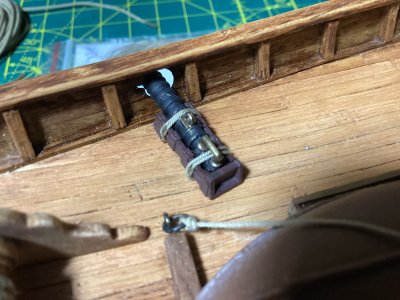
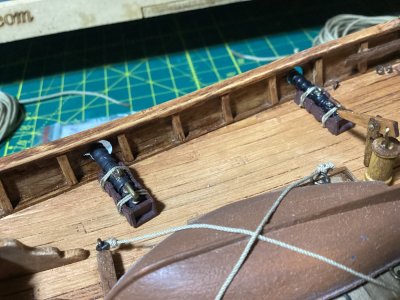
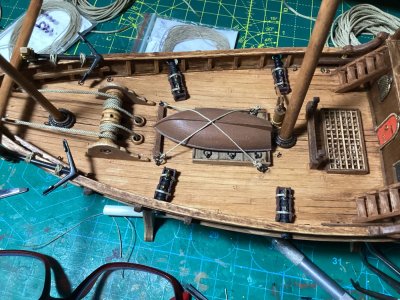
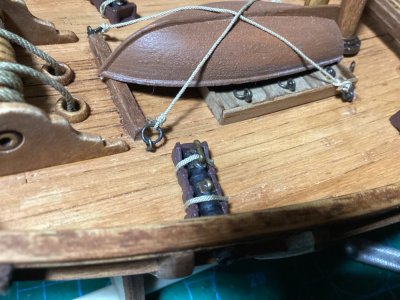
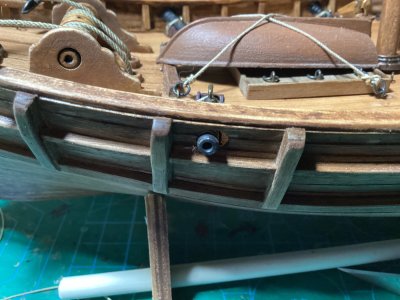
Above, showing one of the bores I drilled out. Was worth the effort.
You can also see the gunwale not centered on the bulwarks ... this was my first hull, done 7 years ago. Blame it on the shipyard.
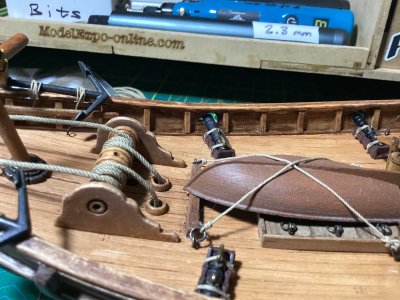
- Used matte black on the barrels.
- Tied em to the carriages with some rope.
- Bored out the barrels.
- Left the lifting/moving HW on top naked brass. (just for fun - IOW historical accuracy was sacrificed for, whatever)
- Carriages painted a flat color called hull red.
Above, showing one of the bores I drilled out. Was worth the effort.
You can also see the gunwale not centered on the bulwarks ... this was my first hull, done 7 years ago. Blame it on the shipyard.
Last edited:
I did some research, and it's unknown if Columbus had cannon on his ships. Some say the Santa Maria (the large ship) had 4 cannon. Some say none. There's no proof, yet, either way. I'm guessing if they did have em - and that they were swivel cannon - large rifles if you will, mounted on the gunwales. Putting holes in the hull for cannon on a mission crossing the ocean into the unknown - I can't imagine they'd' do that.
Into the unknown? Actually, there were rumors sourced from fishermen and whalers, about the new world - rumors because nobody wanted to reveal the locations of their fishing/whaling grounds. And some books say that cod fishermen were working the St. Lawrence area some years before Columbus got to the "new world".
Anyway, I think they woulda used some cannon though, because - cannon existed at that time - they were new tech and difficult to manage - but they did exist - and they served a vital function other than defense - signaling over long distances. Hmmmm.
Into the unknown? Actually, there were rumors sourced from fishermen and whalers, about the new world - rumors because nobody wanted to reveal the locations of their fishing/whaling grounds. And some books say that cod fishermen were working the St. Lawrence area some years before Columbus got to the "new world".
Anyway, I think they woulda used some cannon though, because - cannon existed at that time - they were new tech and difficult to manage - but they did exist - and they served a vital function other than defense - signaling over long distances. Hmmmm.
Last edited:
Main mast supports done, except for the straps ... 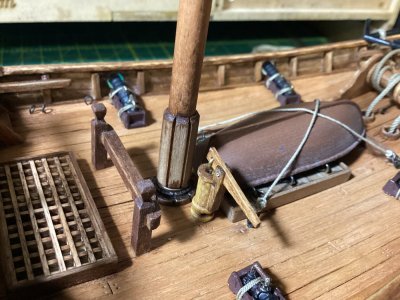
Weather stained at the tops of the mast support boards, where the water running down the mast would be seeping in. And some at the bottom, where the water would collect, and seep upward.
Weather stained at the tops of the mast support boards, where the water running down the mast would be seeping in. And some at the bottom, where the water would collect, and seep upward.
Last edited:
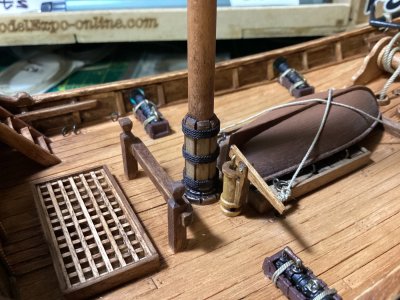
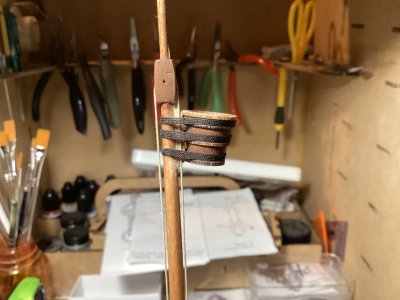
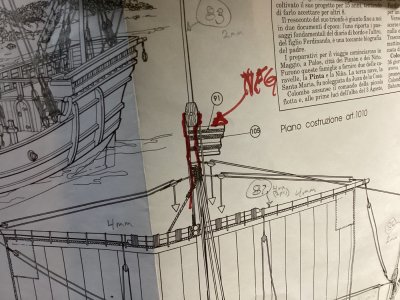
Finished the crows nest. I put a bit of wood between it and the mast, so that the main spar lifting halyard wouldnt bind on the block and the upper lip of the crows nest. As it does when the crows nest is mounted directly to the mast per instructions.
The instructions, showing the crows nest mounted directly to the mast, with the crude red marks showing the true rope run from what the instructions show ...
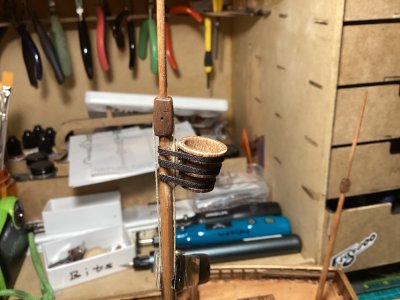
The retired engineer in me, insisted, on a non binding halyard.
The instructions, showing the crows nest mounted directly to the mast, with the crude red marks showing the true rope run from what the instructions show ...
The retired engineer in me, insisted, on a non binding halyard.

- Joined
- May 13, 2019
- Messages
- 75
- Points
- 113

It is not correct that Columbus had no artillery on board during his first voyage. In his ship’s log, lombards are explicitly mentioned repeatedly. For example, Columbus writes on 7 October 1492 that the caravel Niña fired a shot from a lombard to signal that land was approaching. Lombards are also mentioned several times later. On Tuesday, 18 December, the feast day of Santa María de la O (the Annunciation), the Admiral ordered numerous lombard shots to be fired. He further reports that when a cacique departed, lombard salutes were fired in his honor.I did some research, and it's unknown if Columbus had cannon on his ships. Some say the Santa Maria (the large ship) had 4 cannon. Some say none. There's no proof, yet, either way. I'm guessing if they did have em - and that they were swivel cannon - large rifles if you will, mounted on the gunwales. Putting holes in the hull for cannon on a mission crossing the ocean into the unknown - I can't imagine they'd' do that.
Into the unknown? Actually, there were rumors sourced from fishermen and whalers, about the new world - rumors because nobody wanted to reveal the locations of their fishing/whaling grounds. And some books say that cod fishermen were working the St. Lawrence area some years before Columbus got to the "new world".
Anyway, I think they woulda used some cannon though, because - cannon existed at that time - they were new tech and difficult to manage - but they did exist - and they served a vital function other than defense - signaling over long distances. Hmmmm.
Particularly interesting is the entry following the construction of the fort on 2 January: Columbus writes that in the morning he went ashore to take leave of King Guacanagarí. On this occasion, he demonstrated the effect of a lombard. He ordered a gun to be loaded and fired at the side of the stranded Santa María. The king was able to see how far the projectile traveled and how it pierced the ship. A stone projectile is explicitly mentioned, whose flight was visible. The reference to a stone projectile in particular suggests a gun of larger caliber, rather than merely falconets, which normally fired lead-sheathed metal balls or cube-shaped projectiles.
It is not correct that Columbus had no artillery on board during his first voyage. In his ship’s log, lombards are explicitly mentioned repeatedly. For example, Columbus writes on 7 October 1492 that the caravel Niña fired a shot from a lombard to signal that land was approaching. Lombards are also mentioned several times later. On Tuesday, 18 December, the feast day of Santa María de la O (the Annunciation), the Admiral ordered numerous lombard shots to be fired. He further reports that when a cacique departed, lombard salutes were fired in his honor.
Particularly interesting is the entry following the construction of the fort on 2 January: Columbus writes that in the morning he went ashore to take leave of King Guacanagarí. On this occasion, he demonstrated the effect of a lombard. He ordered a gun to be loaded and fired at the side of the stranded Santa María. The king was able to see how far the projectile traveled and how it pierced the ship. A stone projectile is explicitly mentioned, whose flight was visible. The reference to a stone projectile in particular suggests a gun of larger caliber, rather than merely falconets, which normally fired lead-sheathed metal balls or cube-shaped projectiles.
Thx. And yeah, I'd have to agree, as I've read as much myself - OTOH, a quick search for "Columbus and Lombard type guns" provided this ...
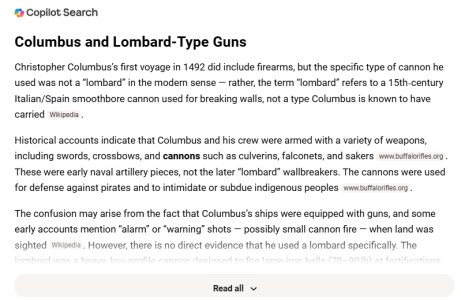
Making it all very interesting. What type of gun(s) he had? I don't have an opinion on that - not enough evidence for me on that.
However, it's common sense that he would have had the latest tech on board - navigation, sails, food storage, medical and military - all the latest gadgets (same as we'd do). And they did have guns at that time - so yeah, Columbus carried something that fired rounds, on his trips. Maybe a lombard.
Have you actually sourced/read the written records you mentioned? If so, I bow to your knowledge on this subject.
Last edited:

Love the crows nest Tim! Magic Mike
Thx Mike. Hey, I see that you have built a lot of models. Wow. No - wait a minute - always finish reading first - and I see that you have about 6 more models waiting on the shelf than I do. (I also have that Model Shipways "Pride of Baltimore" waiting on my shelf). Anyway - cheers.Love the crows nest Tim! Magic Mike
My kit has no rope diameters. So, I searched on "1:65 scale Pinta rope diameters", and came up with the Artesania Latina instructions ... which provided rope diameters for all rigging. And wow, those instructions were just so much better than the crap I got with this Amati kit. OMG what a difference. Wonder if Amati has improved their stuff, as I got this kit about 20 years ago.
I also got this table ...
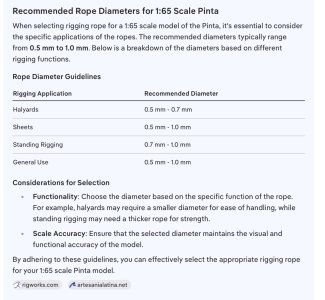
However, the Artesania Latina kit has the anchor line at 1.5mm, the shrouds and stays at 0.5mm, and everything else smaller. A lot of 0.15mm dia roping.
So, I plan to scale to keep sizes relative, while also maximising the view ... so that one thinks they are seeing roping, and not a bunch of very tiny threads.
I also got this table ...
However, the Artesania Latina kit has the anchor line at 1.5mm, the shrouds and stays at 0.5mm, and everything else smaller. A lot of 0.15mm dia roping.
So, I plan to scale to keep sizes relative, while also maximising the view ... so that one thinks they are seeing roping, and not a bunch of very tiny threads.
Last edited:
- Joined
- May 13, 2019
- Messages
- 75
- Points
- 113
Hi Tim,Making it all very interesting. What type of gun(s) he had? I don't have an opinion on that - not enough evidence for me on that.
However, it's common sense that he would have had the latest tech on board - navigation, sails, food storage, medical and military - all the latest gadgets (same as we'd do). And they did have guns at that time - so yeah, Columbus carried something that fired rounds, on his trips. Maybe a lombard.
Have you actually sourced/read the written records you mentioned? If so, I bow to your knowledge on this subject.
The primary source is the Bordbuch des Christoph Kolumbus, which can be found online. If you truly wish to explore this subject in depth, I would recommend consulting the works of Monleón and d’Albertis, as well as Arantegui, who described the evolution of Spanish artillery in considerable detail.
Since Columbus mentions only the term “lombarda,” which can be understood as a rather general designation, unfortunately he does not provide detailed information about the number or composition of the artillery carried aboard his vessels.
I am currently working on a drawing of the Santa María based on Monleón’s sketches, and at the moment I am focusing on the reconstruction of her artillery. In some respects this task is simplified by the fact that it is known that the first reconstruction of 1892 carried two bombards and six falconets aboard the Santa María.
Nevertheless, I am inclined to assume that the original ships of Columbus, for example the Santa María, may have carried either up to four bombardeta, or alternatively two bombards of larger caliber, along with six falconets. On the Pinta and Niña, it is most likely that lighter-caliber weapons were carried — two cerbatanas and two to four falconets each.
Thx for the history with your sources. Fascinating. Gives my reading some focus.Hi Tim,
The primary source is the Bordbuch des Christoph Kolumbus, which can be found online. If you truly wish to explore this subject in depth, I would recommend consulting the works of Monleón and d’Albertis, as well as Arantegui, who described the evolution of Spanish artillery in considerable detail.
Since Columbus mentions only the term “lombarda,” which can be understood as a rather general designation, unfortunately he does not provide detailed information about the number or composition of the artillery carried aboard his vessels.
I am currently working on a drawing of the Santa María based on Monleón’s sketches, and at the moment I am focusing on the reconstruction of her artillery. In some respects this task is simplified by the fact that it is known that the first reconstruction of 1892 carried two bombards and six falconets aboard the Santa María.
Nevertheless, I am inclined to assume that the original ships of Columbus, for example the Santa María, may have carried either up to four bombardeta, or alternatively two bombards of larger caliber, along with six falconets. On the Pinta and Niña, it is most likely that lighter-caliber weapons were carried — two cerbatanas and two to four falconets each.
I do not like working 1:65 scale. Especially the rigging. My first two mainmast shroud blocks, ready to pin to the deck. Took me about an hour to make the 1st - working out how I wanted to do it. About 45m for the 2nd. Geeze!
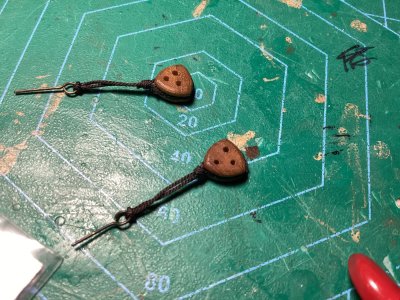
The ropes are spliced (with CA-) on the tops of the blocks. First, I looped some 0.4mm rope through itself around the ring, pulled it taut, and secured it with a tat of CA-. Then I seized it with 0.15 rope, using common whipping, moved the seizing into position, pulled it tight, and secured it with a tat of CA-. Snipped off the two ends. And finally, wrapped the two remaining ends of the 0.4mm rope sticking out past the seizing, around the triangular block - using CA- to splice the rope at the top of the block. For the splice, I laid both ropes into the groove on top of the block, applied CA-, then sliced off the extra with my xacto blade. To make it look like a tightly spliced rope there.
And here's why 1:65 scale is my least favorite to model in ... the sheer impossibility, of these fingers, seizing and tying up these tiny ropes, into something presentable ... and yeah, of course, I've always got two tweezers on hand.
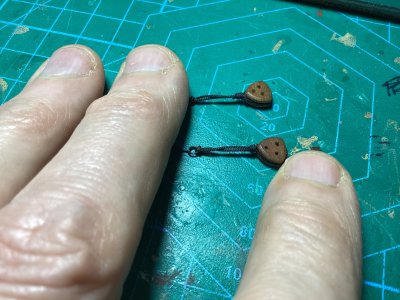
If/when I ever finish this ... and I have dropped the Pinta 2x before ... I will stick to 1:48 or larger scale ... 1:30 and 1:24.
I did order a better helping hand ... this was $26 at Amazon. It should decrease my frustration a bit.
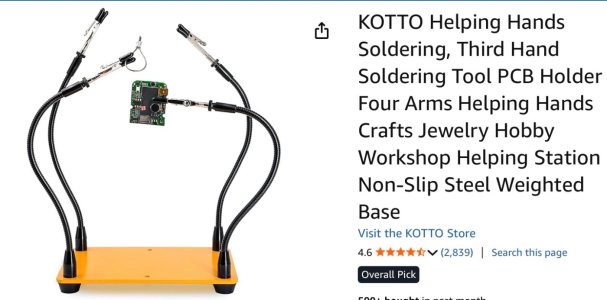
Compared to what I've been using for years now. Nothing stays put.
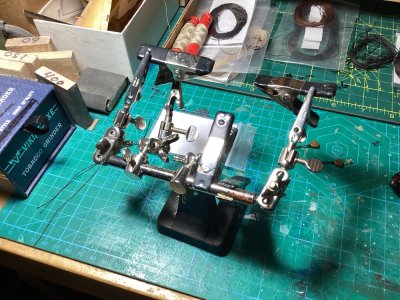
Maybe it will help, a bit.
Cheers.
The ropes are spliced (with CA-) on the tops of the blocks. First, I looped some 0.4mm rope through itself around the ring, pulled it taut, and secured it with a tat of CA-. Then I seized it with 0.15 rope, using common whipping, moved the seizing into position, pulled it tight, and secured it with a tat of CA-. Snipped off the two ends. And finally, wrapped the two remaining ends of the 0.4mm rope sticking out past the seizing, around the triangular block - using CA- to splice the rope at the top of the block. For the splice, I laid both ropes into the groove on top of the block, applied CA-, then sliced off the extra with my xacto blade. To make it look like a tightly spliced rope there.
And here's why 1:65 scale is my least favorite to model in ... the sheer impossibility, of these fingers, seizing and tying up these tiny ropes, into something presentable ... and yeah, of course, I've always got two tweezers on hand.
If/when I ever finish this ... and I have dropped the Pinta 2x before ... I will stick to 1:48 or larger scale ... 1:30 and 1:24.
I did order a better helping hand ... this was $26 at Amazon. It should decrease my frustration a bit.
Compared to what I've been using for years now. Nothing stays put.
Maybe it will help, a bit.
Cheers.
Last edited:

Good morning Tim. I share your pain. Non the less those 2 shroud blocks look awesome . Very cool “helping “ hand you bought.I do not like working 1:65 scale. Especially the rigging. My first two mainmast shroud blocks, ready to pin to the deck. Took me about an hour to make the 1st - working out how I wanted to do it. About 45m for the 2nd. Geeze!
View attachment 594909
The ropes are spliced (with CA-) on the tops of the blocks. First, I looped some 0.4mm rope through itself around the ring, pulled it taut, and secured it with a tat of CA-. Then I seized it with 0.15 rope, using common whipping, moved the seizing into position, pulled it tight, and secured it with a tat of CA-. Snipped off the two ends. And finally, wrapped the two remaining ends of the 0.4mm rope sticking out past the seizing, around the triangular block - using CA- to splice the rope at the top of the block. For the splice, I laid both ropes into the groove on top of the block, applied CA-, then sliced off the extra with my xacto blade. To make it look like a tightly spliced rope there.
And here's why 1:65 scale is my least favorite to model in ... the sheer impossibility, of these fingers, seizing and tying up these tiny ropes, into something presentable ... and yeah, of course, I've always got two tweezers on hand.
View attachment 594908
If/when I ever finish this ... and I have dropped the Pinta 2x before ... I will stick to 1:48 or larger scale ... 1:30 and 1:24.
I did order a better helping hand ... this was $26 at Amazon. It should decrease my frustration a bit.
View attachment 594910
Compared to what I've been using for years now. Nothing stays put.
View attachment 594911
Maybe it will help, a bit.
Cheers.
Cheers Grant
Hey, thanks. The "hand" arrives tomorrow.Good morning Tim. I share your pain. Non the less those 2 shroud blocks look awesome . Very cool “helping “ hand you bought.
Cheers Grant
Well, the standing rigging is finally underway.
A couple pics ...
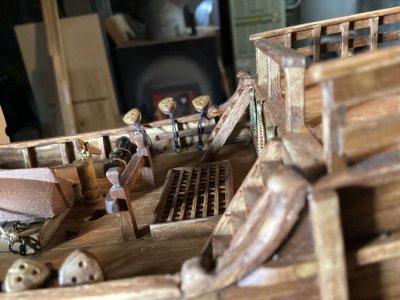
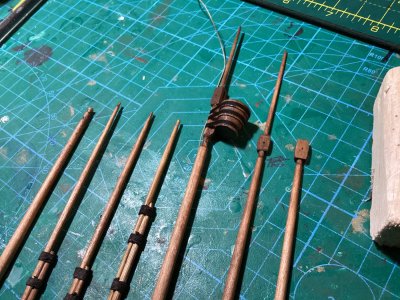
I looked into bowsprit mtg methods (no pic or dwg of that was provided with the kit). And realized that lashing the fat (uncut) rear end of the bowsprit to the base of the formast centers the tip of the bowsprit. Which is perfect alignment for the forstay. The bowsprit will be cocked a bit, IOW.
So, now I wonder how much the mainstay will rub against the formast? Maybe I can tie the mainstay off to one side of the tip of the keel stem, so it hardly rubs the formast. And maybe, it simply doesn't matter.
Cheers.
- The 6 mainmast deckside deadeyes are pinned to the deck.
- And I notched the masts and spars where the ropes hang from them. The bowsprit has 2 notches. The outer one for the mainstay and the inner notch for the 2 sheet blocks.
A couple pics ...
I looked into bowsprit mtg methods (no pic or dwg of that was provided with the kit). And realized that lashing the fat (uncut) rear end of the bowsprit to the base of the formast centers the tip of the bowsprit. Which is perfect alignment for the forstay. The bowsprit will be cocked a bit, IOW.
So, now I wonder how much the mainstay will rub against the formast? Maybe I can tie the mainstay off to one side of the tip of the keel stem, so it hardly rubs the formast. And maybe, it simply doesn't matter.
Cheers.
Last edited:
Tim, you will love the new "hand". You are doing great work! Magic Mike
Glad to hear that. Thx. It's well built, and works like a charm.Tim, you will love the new "hand". You are doing great work! Magic Mike