• Win a Free Custom Engraved Brass Coin!!!
    As a way to introduce our brass coins to the community, we will raffle off a free coin during the month of August. Follow link ABOVE for instructions for entering.
  • PRE-ORDER SHIPS IN SCALE TODAY!

    The beloved Ships in Scale Magazine is back and charting a new course for 2026!
    Discover new skills, new techniques, and new inspirations in every issue.

    NOTE THAT OUR FIRST ISSUE WILL BE JAN/FEB 2026

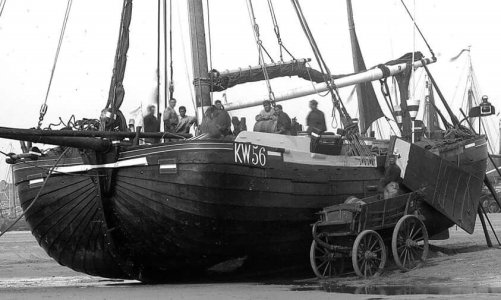
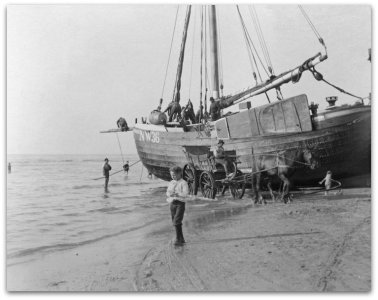
A Katwijk Bomschuit

I recently bought the new book about the Cogs that have been found and excavated in Holland. I haven’t really completely explored it yet, but can’t help wondering if the model that you are building (flat bottom edge to edge, lapstrake topsides) was descended from the Cog?

Roger
 
Roger,
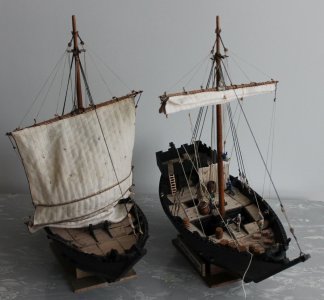
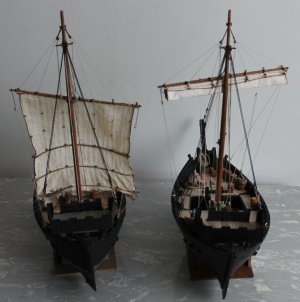
I think the Cog is not an early version of a Bomschuit. It has overlapping planks but there are more differences than simularities. A few year ago I build a Kamper Cog and they are completely different with a Bomschuit.
Compare thes pictures with a Bomschuit.

IMG_9132.JPG

IMG_9133.JPG
 
Update 9
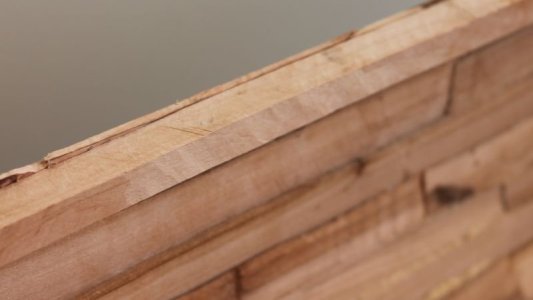
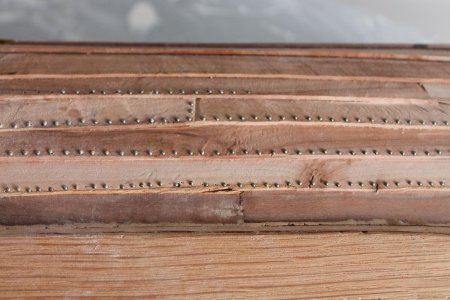
It took a while, but there have been some developments in the construction of the bomschuit. As mentioned in the last update, I removed a few strakes and reattached them, but in such a way that they fit better against the frames by beveling the previous strake.
And then, taking into account the necessary beveling, I applied a few more planks. It makes little sense to show a set of photos of each new strake. That would be very monotonous, so now just the current state of the ship.
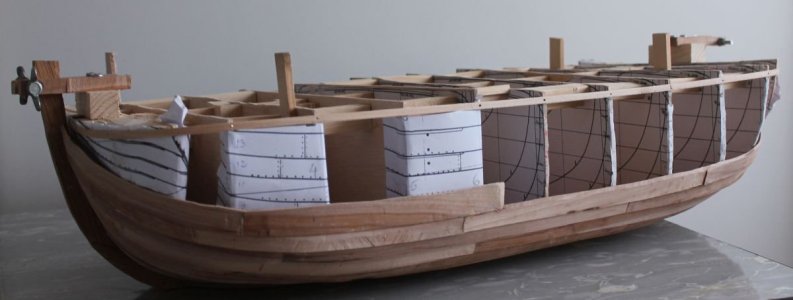
01-zij.jpg
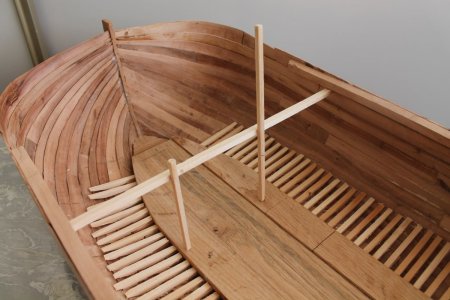
Here, a start has been made on the tenth strake from the bow. I have added some aids to see where I need to end up. At deck level, I have added a strip. The bottom of this is the top of the deck level. I have added pieces of the side drawing to the side to check the sheer.
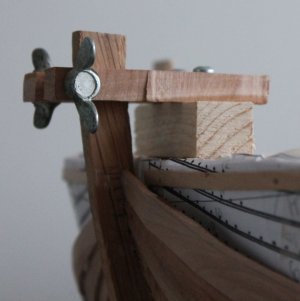
02-BoegOpgehoogd.jpg
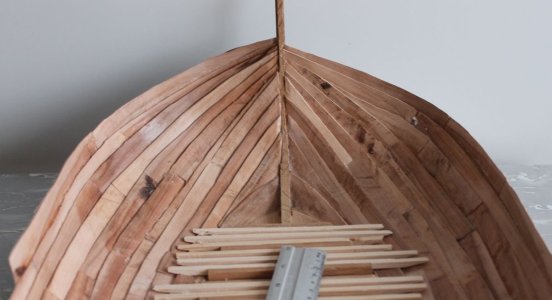
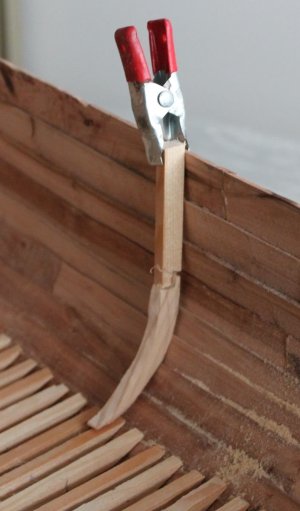
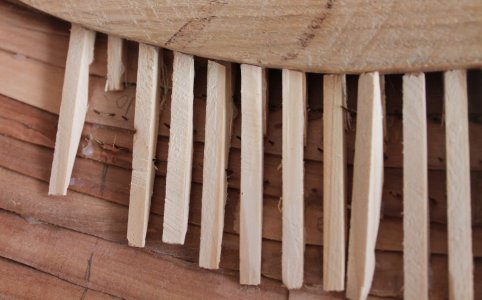
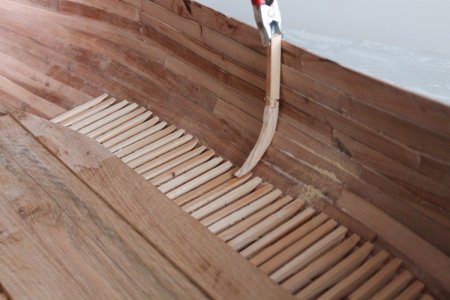
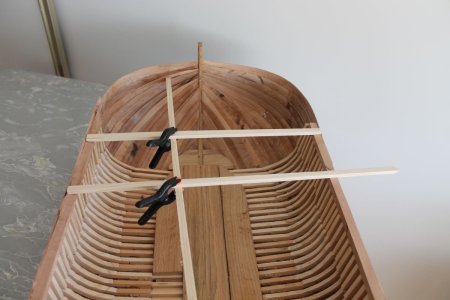
At the bow, and also at the stern, I have clamped the internal frame. Because the strakes here extend above the deck, as can be seen from the centering, I had to raise the clamp a little.
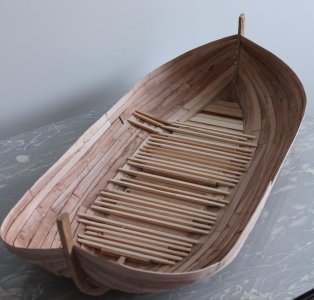

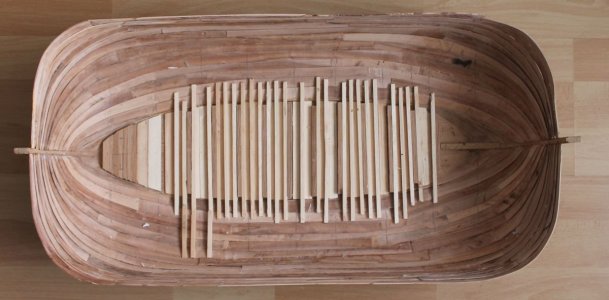
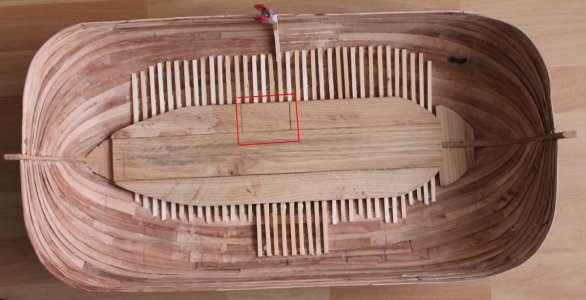
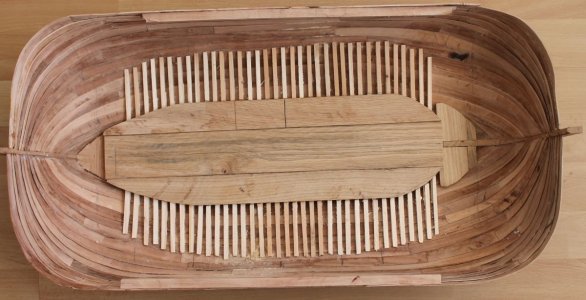
03-Vanbinnen.jpg
This is what it looks like from above.
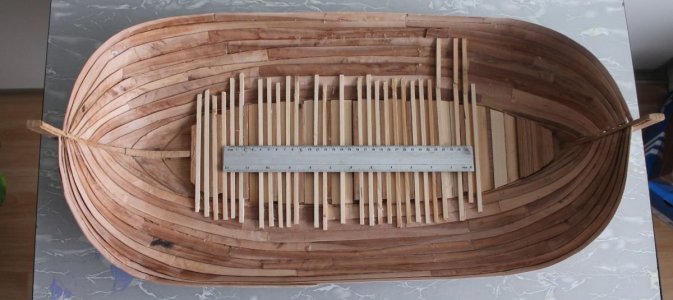
04-lineaal.jpg
To give a better idea of the size, I inserted a 30 cm ruler. My table is almost too small.
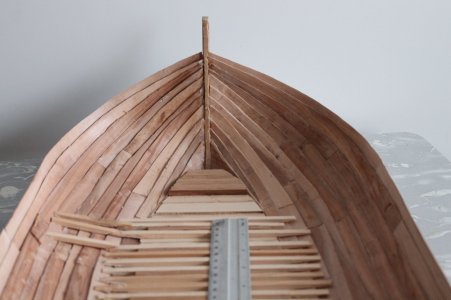
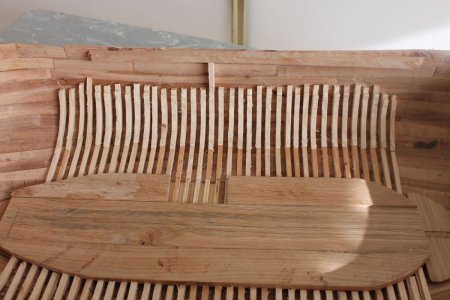
05-AchterstevenBinnen.jpg
This is the stern seen from the inside,
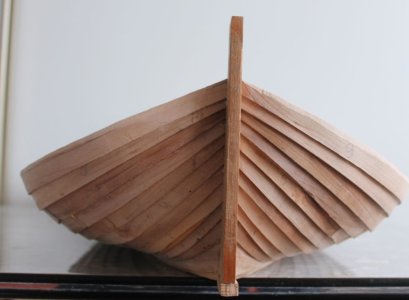
07-AchterBuiten.jpg
and from the outside.

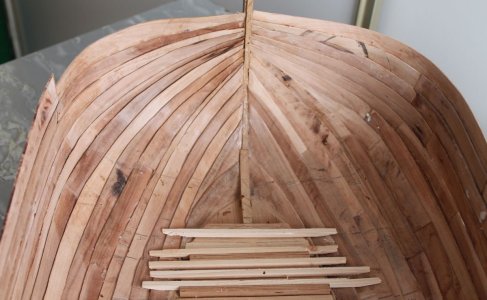
06-VoorBinnen.jpg
And the bow seen from the inside,

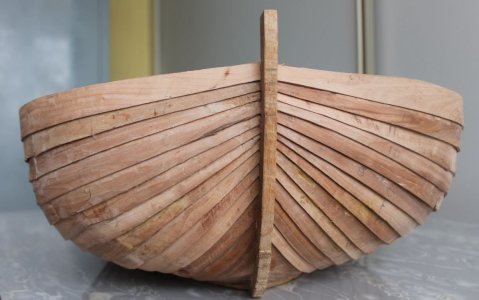
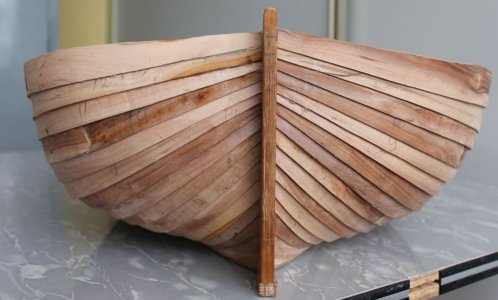
08-VoorBuiten.jpg
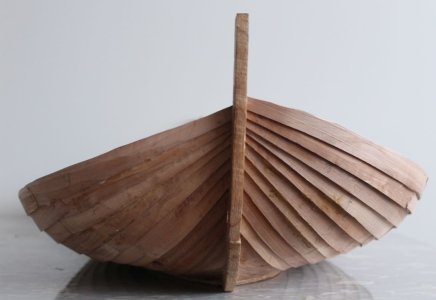
and from the front. Including the beginning of the 10th strake.

I am also busy thinking about how to present this model at the model builders' day in the Maritime Museum.


As you have come to expect from me, there must be action to be seen. That is not so difficult on a fishing vessel, where there is plenty of action.
The problem is that not all the action happens at the same time, or is even possible. How do you deal with that?
I am now thinking of showing the ship in different situations on both sides. For example, on the port side is the ship at sea. Action on the nets, hauling in or setting out. And on the starboard side the ship is on the beach. Then you can show the unloading and action on the nets.
To make all this come alive, I need a lot of props.

First of all, people. I'm going to call in Bert Mogelin for that, that's already been agreed. I've also found a large piece of black tulle that will be perfect for representing the nets. Unfortunately, I can't show it to scale. On a scale of 1:20, a complete kiddle is about one meter high and 70 meters long. I don't have that much space in the shipping museum. So it will probably be 1:50 or so.

A bomschuit also has a few hundred barrels, called “kantjes,” on board. They are filled on the port side and unloaded on the starboard side. So I need barrels. Lots of barrels. A kantje has a capacity of 102 liters, according to Staatsblad 83 of the Netherlands of 1928. In Scotland, it's 118 liters. But I also need baskets.


After being caught, the herrings were placed in a basket and given to the fishmongers, who gutted them and, after salting them in a warbak, stored them in a kantje. After a few days, they had thickened and a barrel was topped up from another barrel. A topped-up barrel was no longer called a kantje but a packed barrel. Five kantjes yielded four packed barrels. Thanks to Peter Voogt, who also described this process in his report.
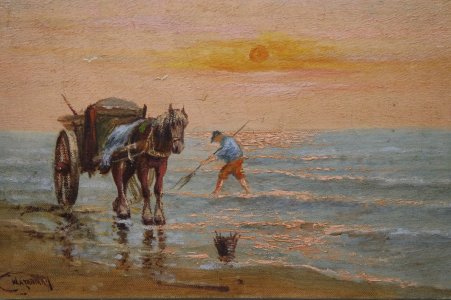
The barrels were unloaded on the beach, hoisted over the embankment onto a horse-drawn cart, and transported further.

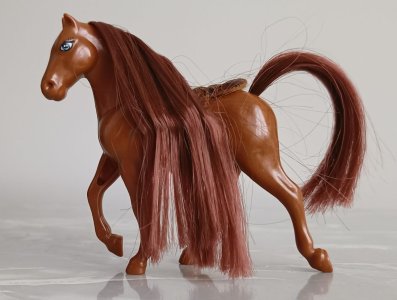
So I need a cart with a horse in front of it. Who has a neat drawing of a horse-drawn cart,
scale 1:20? I already have a horse.
09-paard.jpg

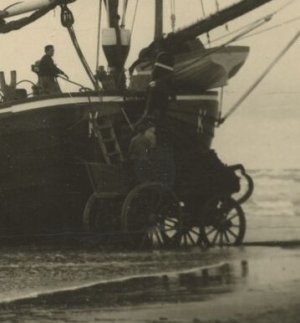
When a bomschuit was on the beach, it was used for all sorts of things. Pulling it further onto the beach, turning it around to sail out again. So pulling and lashing such a boat was a common occurrence, and they had special tools for that.
In short, there is a lot of action possible. I will tell you more about it in later updates.
But first I have to finish it.


To be continued

Translated with DeepL.com (free version)

 
Great update Jan, looks good.

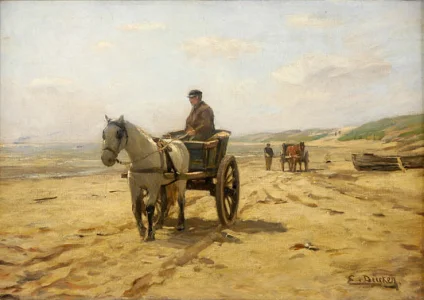
and I just googled a little and I only find 1-axle carts on Dutch beaches.

17de eeuws kustpaard met kar.jpeg
pasted-imageThuMay072020114542GMT0200Midden-Europesezomertijd.webp

I think that is the usual type of cart. Easy to reproduce in scale. But your horse?? ROTF Find another, that one looks like something for the sunday morning church and picnic type and not to pull carts in a muddy enviroment.
 
Update 10
It has been almost two months since the last update. But there is some news to report.
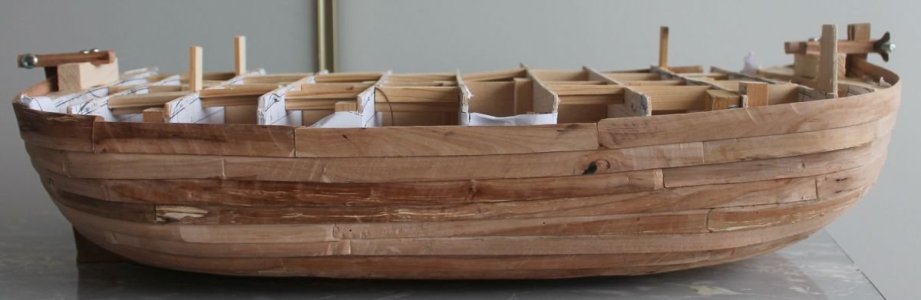
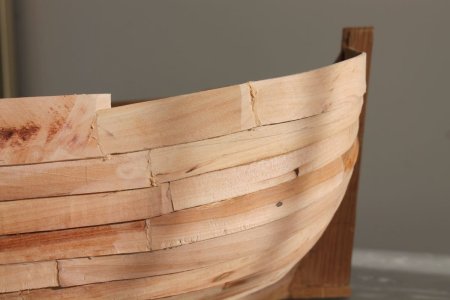
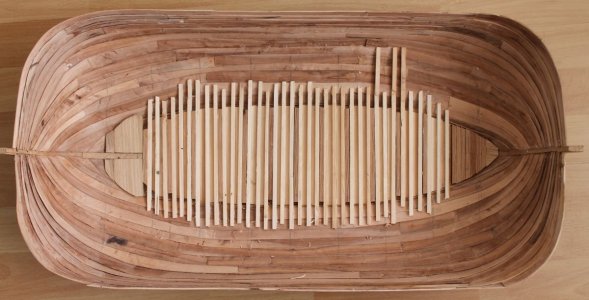
The last strakes have been installed up to the deck line.
10-01-zijkant - kopie.jpg

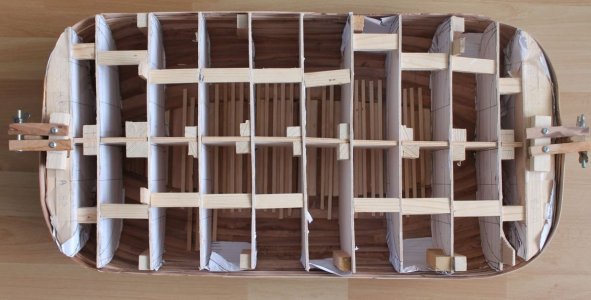
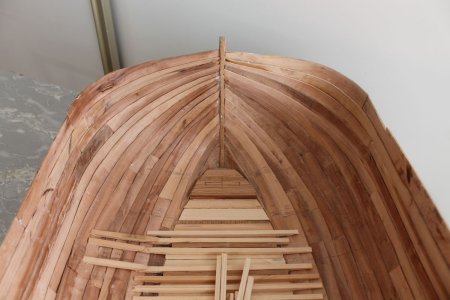
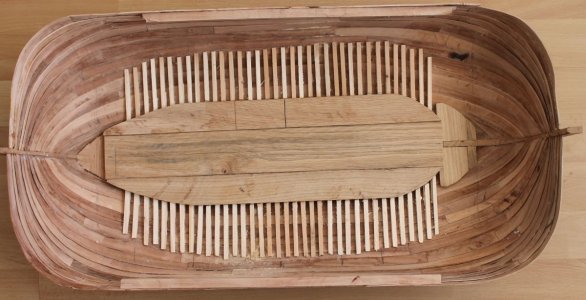
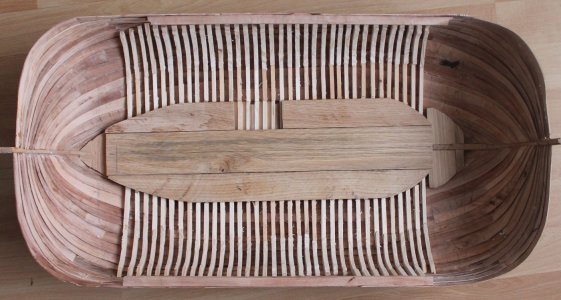
From above:
10-02-boven - kopie.jpg

From the inside:
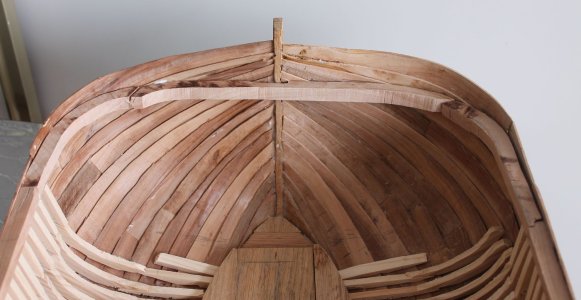
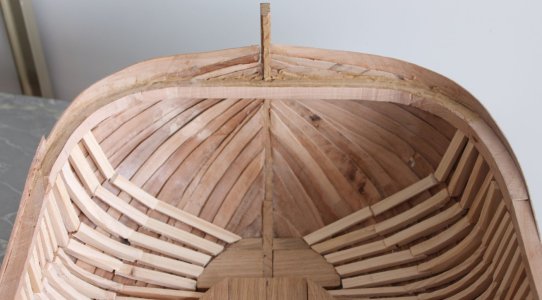
10-03-Binnen - kopie.jpg

The bow:
10-04-Boeg - kopie.jpg

The stern:
10-05-Achtersteven - kopie.jpg

Bow from the inside:
10-06-binnen-voor - kopie.jpg

Stern from the inside:
10-07-Binnen-Achter - kopie.jpg


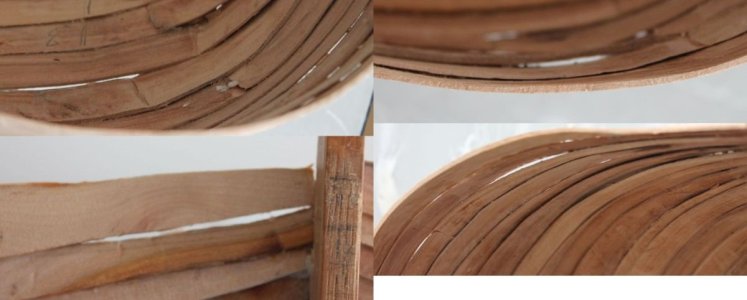
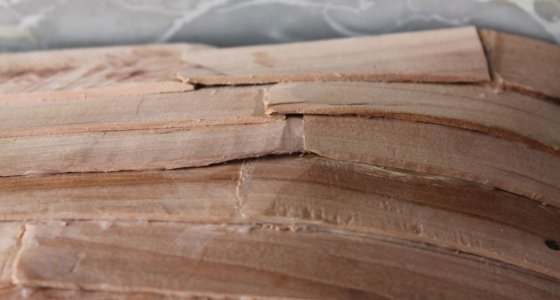
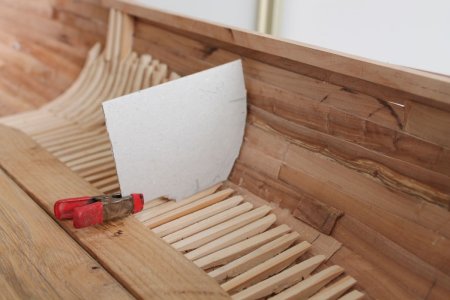
This photo shows that not everything fits perfectly. I don't think a Katwijk sailor would want to go to sea with this, so there is still some repair work to be done. Malleable wood is good for that.
10-08-lek - kopie.jpg


Not everything goes right the first time either. Someone has even been messing around here:
10-09-knutselaar - kopie.jpg


So that was quickly improved:
10-10-Beter - kopie.jpg


I also went through the building instructions with regard to the necessary rope.
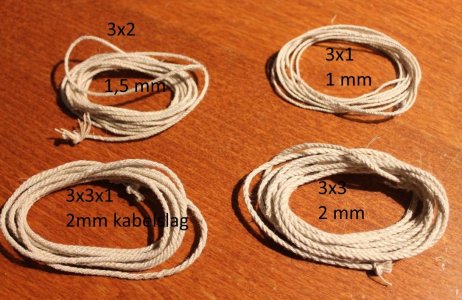
Rope is needed in 0.75, 1.0, 1.5, 2.0, 2.5 cable twist, 2.5, 3.0, 3.0 cable twist, and 5.0 mm cable twist.
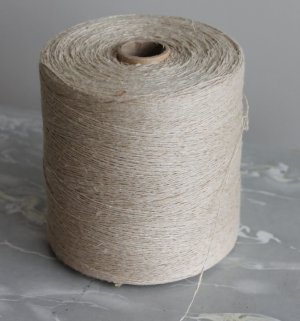
In the past, this was all hemp, so nylon is out of the question. I found a spool of hemp yarn.
10-11-Hennep - kopie.jpg

This spool contains 2 km of yarn. I also made a few test pieces:

10-12-touwen - kopie.jpg

The 5.0 mm cable strand rope is for the "reep". This is the cable to which the nets are tied. A later bomschuit had 30 to 40 nets of 31.5 m on board, so about 1.5 km. On scale, that's 75 m. I'm not going to put 75 m of nets in my model. But I will put in a piece of "reep".
Although...
I did some calculations and 1.5 km of rope can be imagined as a cylinder of that length. A little math means that on scale that is almost 6 liters.
One full hold on my model is about 3 liters. So something is not right here.

So, time to figure it out.

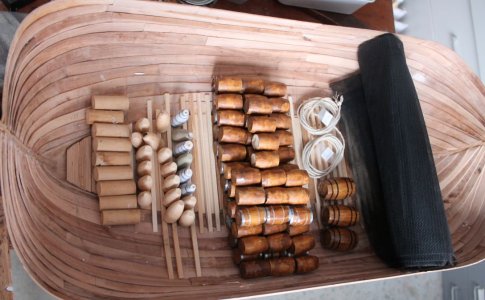
I've also been thinking about what to fill the model with. The deck will be removable, so you'll be able to see the hold. But then there has to be something to see there.
We're not there yet, but I can give you an idea of what it will look like.
10-13-ruim.jpg

Here you can see, from left to right:
- A number of buoys in various stages. A buoy is a kind of float (a watertight barrel) that is attached to the "reep" with a rope every 31.5 m, and to which the nets are attached.
- A number of herring barrels. A Dutch barrel is 102 liters and a Scottish barrel is 118 liters. These are, of course, Dutch barrels. There are 100 of them here, but in reality there are about 400-500.
- Two rolls of sample rope.
- Three larger barrels. There must also be food and drink on board.
- A roll of black tulle to represent a net.

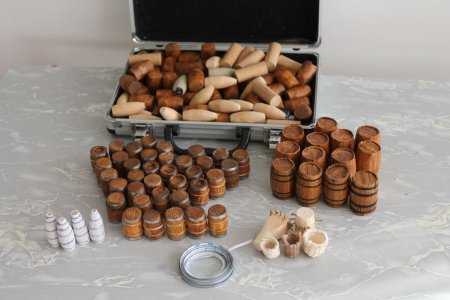
And here you can see my stock of small items in various stages of completion.
10-14-werk.jpg

There is still plenty to do, so to be continued.

Translated with DeepL.com (free version)

 
Back
Top