• SUBSCRIBE TO SHIPS IN SCALE TODAY!

    The beloved Ships in Scale Magazine is back and charting a new course for 2026!
    Discover new skills, new techniques, and new inspirations in every issue.

    NOTE THAT OUR NEXT ISSUE WILL BE MARCH/APRIL 2026
  • Win a Free Custom Engraved Brass Coin!!!
    As a way to introduce our brass coins to the community, we will raffle off a free coin during the month of August. Follow link ABOVE for instructions for entering.

Artesania Latina Anatomy of Lord Nelson’s HMS Victory Trafalgar 1805

Video 19 - (Part 1)
In this video I start to work on the pumps. Not sure what these parts are actually called but they were fun to build.

IMG_6433.JPG

IMG_6434.JPG
You are required to use some brass tubing here.

IMG_6435.JPG

IMG_6436.JPG
The instructions ask you to use the fret the parts came off to align them when gluing, very clever again AL!

IMG_6443.JPG

IMG_6444.JPG

IMG_6468.JPG

IMG_6469.JPG

IMG_6470.JPG

IMG_6471.JPG
Making this round hole into a square one was a bit fiddly. But it did have me singing English singer songwriter Chris Rea's "Square Peg Round Hole". Great song!

IMG_6475.JPG

IMG_6477.JPG
The long tweezer like pump parts required to be wrapped in bands of strip. This is a quick and easy way to cut them.

IMG_6479.JPG

IMG_6480.JPG

IMG_6488.JPG

IMG_6324.jpg
The hand pump part needs to be made hexagonal. This required some simple mathmatics.

Screenshot 2026-05-21 at 7.41.52 am.png

The strip was 4mm square so 4 x 5.77 gives you about 2.3mm. I measured around the strip about 2.3mm and drew some limes to sand too. Worked OK.


IMG_6487.JPG
The metal hand pump is now attached to its hexagonal counterpart.

IMG_6490.JPG

IMG_6492.JPG

Thanks for dropping by.
T

IMG_6462.JPG

IMG_6467.JPG

IMG_6489.JPG
 
Video 19 - (Part 2)
More pump work.

IMG_6462.JPG

IMG_6467.JPG

IMG_6494.JPG

IMG_6496.JPG
I gave the pump handle a little silver dry brush to bring out some detail.

IMG_6462.JPG

IMG_6467.JPG


IMG_6497.JPG
I think these are bilge pumps but please don't hold me to that. Anyway they required some brass parts.

IMG_6498.JPG
A toothpick was the perfect tool to hold the part whilst I cleaned it up.

IMG_6499.JPG

IMG_6539.JPG
Hand pump installed.

IMG_6540.JPG
The long part travels through the base of the hull and is secured there.

IMG_6541.JPG

IMG_6542.JPG

IMG_6543.JPG

IMG_6544.JPG
These parts are glued to what I will call the "Keel"

IMG_6547.jpg

Thanks for dropping by.
T
 
Video 20 - Complete
Capstans.

Lots of parts.

IMG_6289.JPG

IMG_6290.JPG
Another clever piece of engineering is to have the central column slightly offset, this makes it a breeze to align everything.

IMG_6292.JPG

IMG_6293.JPG

IMG_6294.JPG

IMG_6295.JPG

IMG_6296.JPG

IMG_6297.JPG

IMG_6298.JPG

2nd Capstan. Much of the same.

IMG_6463.JPG


IMG_6464.JPG
However I did run into one issue. When I was removing these lower vertical spars from the fret they just fell apart. It looks to me there may have been some with the gluing when the ply was formed. Not a problem I just made some from scratch.

IMG_6465.JPG

IMG_6466.JPG

IMG_6545.JPG

IMG_6546.JPG

Thanks for dropping by.
T

IMG_6547.JPG
 
Video 20 - Complete
Capstans.

Lots of parts.

View attachment 610557

View attachment 610558
Another clever piece of engineering is to have the central column slightly offset, this makes it a breeze to align everything.

View attachment 610559

View attachment 610560

View attachment 610561

View attachment 610562

View attachment 610563

View attachment 610564

View attachment 610565

2nd Capstan. Much of the same.

View attachment 610566


View attachment 610567
However I did run into one issue. When I was removing these lower vertical spars from the fret they just fell apart. It looks to me there may have been some with the gluing when the ply was formed. Not a problem I just made some from scratch.

View attachment 610568

View attachment 610569

View attachment 610570

View attachment 610571

Thanks for dropping by.
T

View attachment 610572
Good morning. Very cool pump details at this scale. I love the hand pumps. Cheers Grant
 
Video 16 - (Part 1)
Time for sanding the hull. I intend to take my time here and get the smoothest convex curve I can to lay the planking onto. This was definitely a job to do sitting outside with a few tunes and a couple of beers.

View attachment 606522
A selection of my sanding tools. In all honesty the vast majority of the hull was sanding using the small yellow hand held sanding block. It has interchangeable sanding pads and fits the hand comfortably.

View attachment 606523
I started with the bow checking the curve regularly with a strip of wood.

View attachment 606524

View attachment 606525
I found the stern to be a little more tricky.

View attachment 606527
I then ran 4 pairs of wires to each deck above, these will be utilised when I come to add the lights to each deck.

View attachment 606528
First row.

View attachment 606529
I wasn't sure if I was going to bend the planks with a bending iron or use the Amati bending pliers you can just see in this picture. In the end I adopted neither of these methods. After soaking the plank in water for about 5 mins I simply shaped the plank between my thumb and forefinger. I was surprised how easily each plank conformed to where I bent it. We will see how this goes with more complex areas of the hull but for now it's a winner for me.

View attachment 606530I regularly fitted the beak to check the plank end point, I wanted it to a snug fit.

View attachment 606531

View attachment 606532

View attachment 606533
Whilst it's easily accessible I removed a large portion of the gun port with a small saw.

View attachment 606534

View attachment 606535
Happy with that!

View attachment 606536
At this point I think I really got the majestic shape of the Victory.

View attachment 606537
The stern was easier to finish. This will be later formed around the rear planking.

View attachment 606538
Repeat on the other side up to the cutout.

View attachment 606539

View attachment 606540

View attachment 606541

View attachment 606542

View attachment 606543

View attachment 606544
There's going to be a few of these gun ports to clear out.

View attachment 606545

Thanks for dropping by
Tony

View attachment 606526
Hi Tony,
Actually, I only just discovered your build log.
I am so impressed by your work! You are on my watch list now.
Cheers, Peter
 
Video 21 - Part 1
Start of the main planking.
Ok lets get the elephant out of the room, this is only my 2nd attempt at planking a wooden ship so this process may hit one or two unforeseen difficulties. I have limited knowledge, experience or the skills needed to complete the process with a fair degree of success. However I have been modelling for close to 50 years so not a complete novice at putting things together.
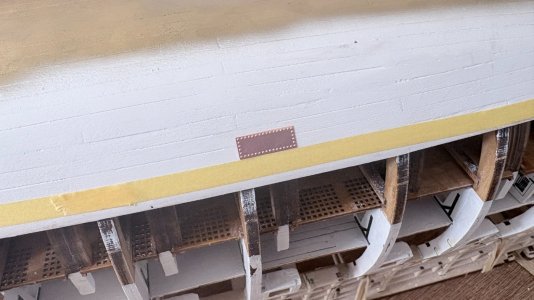
I am aware that there are certain methods experienced ship modellers and indeed shipwrights would apply to correctly plank a wooden ship but because of my mentioned lack of knowledge, experience and skills the best of my ability will have to do.
I had already started the first 4 rows previously but to be honest those planks went down easily without any major manipulation, so far so good!
But now things start to get tricky because soaking, bending, twisting tapering and trimming come into the equation.

THE STERN
Having watched instruction video a number of times I thought I'd tackle this part a little differently to the method shown. It wasn't really clear where the planking actually ended (well to me it didn't).

IMG_6500.JPG
I started off with the first strip going the width of the stern.

IMG_6501.JPG
I then placed the template for the gun ports and rudder hole as a guide.

IMG_6504.JPG
Using one of the metal decoration parts fitted a lot later in the build I could see that the general curve the paper template took did not seem to match what would come later. I had to improvise.

IMG_6503.JPG
This is the curve I needed.

IMG_6505.JPG
I traced the left half of the paper template onto some cardboard and cut it out.

IMG_6506.JPG
After a little trimming I got the shape needed.

IMG_6507.JPG
Since the stern planking would be symmetrical I repeated the process for the right side.

IMG_6508.JPG
I then placed both halves into position and taped them together.

IMG_6509.JPG
I took 6 overlong lengths of strip and using double sided tape attached them together.

IMG_6510.JPG
Then traced the shape onto the strips.

IMG_6511.JPG

IMG_6512.JPG
I left the strips slightly longer to make allowance for the next step.

IMG_6513.JPG
To comply with the curve I put a chamfer on each end.

IMG_6515.JPG
I then drew a centre reference point to make fitting accurate.

IMG_6516.JPG
The strips were then numbered accordingly and the lolly stick removed.

IMG_6517.JPG

IMG_6518.JPG
Strip number one was bent and twisted as necessary.

IMG_6520.JPG

IMG_6521.JPG
I ended up with a true neat edge to glue the side strips too.

IMG_6522.JPG
Happy days. Part to to fllow.
 
Video 21 - Part 2
Here we go then!

THE HULL
I do have a heated bending tool and the Amati bending pliers but I decided to use neither. On testing the Amati bending tool I cut through more planks than I bent. Instead I simply soaked the blanks in water and bent the planks by hand using my thumb and forefingers. On very acute angles I did use round nosed pliers, maybe not the tradition way to bend planks but hey, worked for me.

IMG_6568.JPG
I found I could shape a wet plank fairly easily with these round nosed pliers.

IMG_6569.JPG
I approached shaping and fitting the planks at the stern a little differently. Instead of attaching a plank to the hull and then using a hot iron to shape the plank, I shaped and bent the end of an overlong plank first, attached it to the stern, then cut the plank to length and glued it in place using thick CA glue and accelerator when needed. There was a fair bit of test fitting done here until I was satisfied with the fit.

IMG_6570.JPG

IMG_6573.JPG
Test fitting before bending the plank off model.

IMG_6571.JPG
However at the bow I cut a length of strip about 5mm longer than needed attached it midships and bent it around. This left a gap between the stern strip and the bow strip which is easily cut to length. This way seems a lot more logical than securing a length of strip in the centre then having to get the lengths 100% correct for both ends (especially the stern!)

IMG_6572.JPG
I always test fitted the beak just to make sure my cutting was accurate. The 7th plank here was the first plank where tapering was necessary to get the plank to conform to the shape of the hull. Marked a position where the plank started to turn upward and how much I needed to remove.

IMG_6574.JPG
I trimmed away the wood with a craft knife and sanded away the hump where trimming meets full width plank.

IMG_6575.JPG
As you can see here the amount of tapering needed was dependent on the shape of the hull. I definitely took my time trying to keep the bow curve as smooth as possible.

IMG_6576.JPG
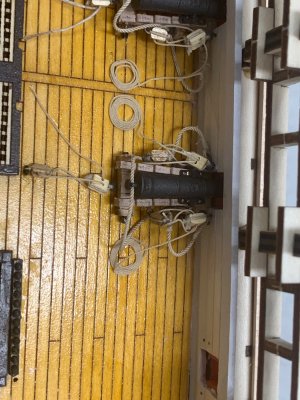
Meanwhile at the other end things were coming along quite nicely.
IMG_6577.JPG


IMG_6579.JPG

IMG_6580.JPG
Happy days!

IMG_6581.JPG

IMG_6582.JPG

IMG_6583.JPG

IMG_6584.JPG

It was at this point whilst I studied the instruction video in the next photo I noticed something a bit strange. If you count the number of planks used to cover the left side of the stern area there is 10. However there are 11 on the right side, strange considering the distance is symetrical.

Screenshot 2026-06-15 at 3.16.48 pm.png
I just found this odd.

IMG_6585.JPG

IMG_6586.JPG

IMG_6587.JPG
Bit of trimming still needed here around the cutout area.

Thanks for looking
T

IMG_6578.JPG
 
Last edited:
Video 21 - Part 3
Continuation of the hull planking.

IMG_6588.JPG
My attention now went to the first row of planking at the keel upwards. The beak had now been glued in place and this curved filler piece attached and shaped to continue the curve of the hull structure.

IMG_6590.JPG
Once again I shaped and test fitted the end before attaching the plank.

IMG_6591.JPG
I followed the instructions here and allowed the natural fall of the plank to determine it's position. I would fill the gap with steelers later.

IMG_6592.JPG
Steeler fitted.

IMG_6593.JPG


IMG_6594.JPG
Ooooooo the gap is getting smaller!

Screenshot 2026-06-15 at 2.25.58 pm.png
OK here I had an issue with the instructions. There is no mention on how to end the planking at the stern post. this photo from the video instructions shows how they did it and to be honest it looks a bit crude and untidy. I really don't want to be doing that amount of filling here.

IMG_6599.JPG
This is how I approached the area. I wanted the sternpost to be free of any planking whatsoever so the copper plating would have a nice smooth transition through to the rudder.

IMG_6596.JPG

IMG_6597.JPG

IMG_6598.JPG

IMG_6600.JPG

IMG_6602.JPG
The full side complete ready for a sanding, a couple of coats of primer and more sanding.

IMG_6603.JPG

IMG_6604.JPG

IMG_6605.JPG
Just for comparison here is my Artesania Latina 'San Fransisco', the only other wooden ship model I have ever built. I never did get to the rigging so that adventure still awaits me. Where does the fun end.

Thanks for looking.
T

Not sure why the site inserted a couple of random images here!!

IMG_6589.JPG

IMG_6595.JPG
 
Last edited:
Video 21 - Part 3 - Complete
Phew! Last of the planking of the hull.
As I now approach Video 22 I have just realised I am ¼ of the way through the instructions. Maybe not ¼ through the build but a landmark it is. I thought I would share my thoughts on the kit and the build so far.
Firstly, I have never built any other wooden kits other than this one and AL's San Francisco so it is impossible for me to compare manufactures so I will keep my thoughts to the HMS Victory.
It is a very complex kit with thousands of parts offering a huge amount of detail. The fact that you need to build and fit out all the decks is a huge challenge. It's fairly obvious from the start that any misalignments or bad fitting will have massive consequences later in the build so the more care and time you take at the beginning, especially fitting out the hold will hold you in good stead.
The quality of the parts (to me) is very good, but I don't have anything else to compare it to.
The instructions come mainly in the form of 87 videos showing a complete step by step approach. I found the instructional videos to be excellent and enjoyed going over each one carefully (many times). Being able to stop rewind and rewatch was helpful. There were one or two mistakes or omissions some of which AL did mention. The others I seemed to nut out as I went along.
AL did have you make jigs for some of the sub-assemblies which I though was great engineering. AL obviously did a lot of thinking when it came to the engineering of the kit.
The fit of everything so far has been great, any issues I have had have been of my own making. The whole soldering process for the lights was at first a nightmare to me. But having said that you don't have to buy the separate lighting kit. I did find the second set of lights on the orlop deck a bit easier.
The build so far for the most has been fun and enjoyable plus I have also learnt a great deal about building ships (models & real).
As for the cons I have come across, there is a couple I would like to mention.
There are a number of processes you will have to complete which are repetitive and tedious, take the guns for example. I am yet to tackle the first set but would imagine making the first few would be OK but the though of 104 may test my patience. Having said that it is what it is, if you want to build the Victory then you are going to build 104 guns.
The are only a couple of gripes I have. Forming a post from scratch was a challenge. Why AL didn't supply ready turned posts was strange to me, after all they do supply ready turned posts with other kits. I think AL dropped the ball here.
I think most modellers have a love hate relationship with PhotoEtch. AL supply a LOT and I mean a lot of PE. Some of it however I would have much rather have had as wooden parts. The wrap around Victory sign at the stern just looks a nightmare to form around the Gallery. The actual sign I will use but the left and right wrap around parts I will ditch in favour of wood. Well that's what I think now, when I get there I may change my mind.
So summing up I think it's a great kit but be prepared to invest a number of years on the project.

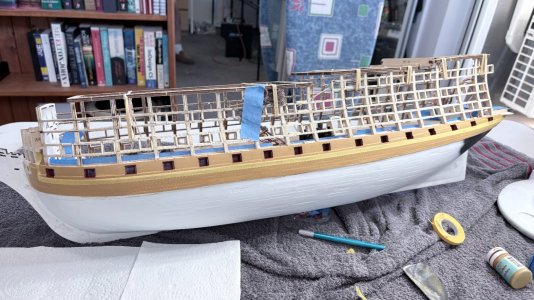
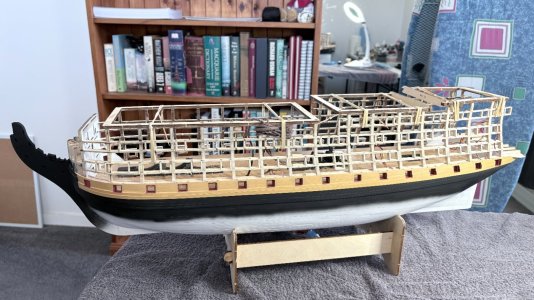
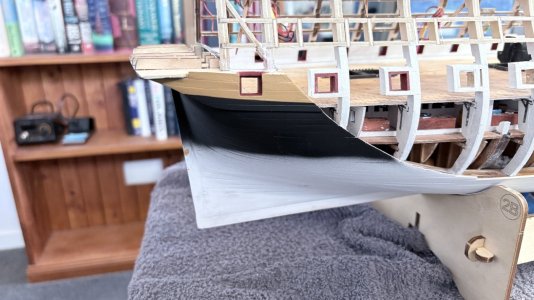
Nearly forgot here are the final pics of the planking. Ummmmmm filling and sanding to follow, deep joy!

IMG_6606.JPG

IMG_6607.JPG

IMG_6608.JPG

IMG_6609.JPG

IMG_6610.JPG

Thanks for looking
T
 
Great work Tony, I had the same thing with the uneven amount of planks, as you say, strange , glad it wasn’t just me :D
 
Back
Top