You are right, Dom. Toys for boys, in all sizes and scales.At least you can use the big-boys tools on the 1:1, I am sure that is much easier than tying ratlines with micro tweezers!
Dom

Regards, Peter

 |
The beloved Ships in Scale Magazine is back and charting a new course for 2026! Discover new skills, new techniques, and new inspirations in every issue. NOTE THAT OUR NEXT ISSUE WILL BE July/August 2026 |
|
 |
As a way to introduce our brass coins to the community, we will raffle off a free coin during the month of August. Follow link ABOVE for instructions for entering. |
|
You are right, Dom. Toys for boys, in all sizes and scales.At least you can use the big-boys tools on the 1:1, I am sure that is much easier than tying ratlines with micro tweezers!
Dom

Just looking at you bent over makes my old back hurt, but I know the end result will be worth it.A lot of work is to be done on this old lady.


 . That is so rare and fabulous Peter. Cheers Grant
Congratulations Peter.Now out for a nice dinner..... tomorrow me and my Admiral have been married for 46 years.
Regards, Peter
Good morning Peter. Congratulations on your 46th anniversary
Thanks, Grant and Herman. Much appreciated!Congratulations Peter.
It's always the new guy who has to crawl around on the deck...
I found it, Paul: me on the millstone.Yes, Paul. But a clever one .. took a blanket out the forecastle to put under my old knees …..
I will look if I can find a pictures of that. Not many has the feeling for that old fashion ‘hammer’ work. It’s called ‘billen’. Yes, like on your back above your legs …….
Regards, Peter
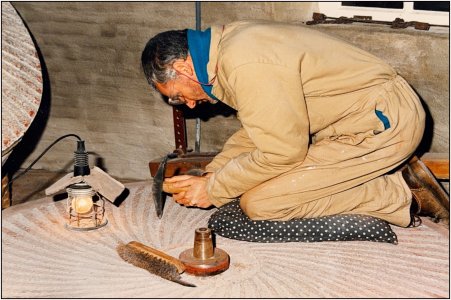
As you can see on the picture of me on the mill stone, you can see that I am resting with my elbows on my upper legs. So, no force on the back. Learned from a old miller and now still in use on the deck of the Balder.Just looking at you bent over makes my old back hurt, but I know the end result will be worth it.

No, millers are still being trained. In the Netherlands, we have the 'Ambachtelijk Korenmolenaars Gilde' / 'Artisanal Grain Millers Guild'. They also provide training, including sharpening millstones. You must be able to do that before you can be a full member of this Guild. I completed that training as well, so I am a qualified and certified miller. But until 2004 I am off the windmills .....How wonderful! And now a lost art?


Nice Photoshop work, Peter.I found it, Paul: me on the millstone.
In the first photo, your hair is grey 


He trimmed the regrowth there...Nice Photoshop work, Peter.

Nice Photoshop work, Peter.
When it grows it became darker and darker ........He trimmed the regrowth there...
But nice gray is not ugly ...... it's sophisticated.
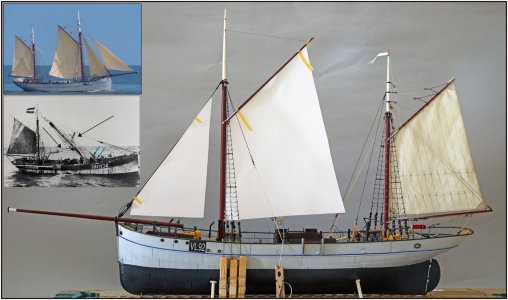


I can only fit one emoji on your post, Christian. But I do love this very nicely compliment!You photoshop skill are unbelievable. It's allows fantastic how you convert fotos of the original ship to pictures of the model.
This is a true story.......You photoshop skill are unbelievable. It's allows fantastic how you convert fotos of the original ship to pictures of the model.


You photoshop skill are unbelievable. It's allows fantastic how you convert fotos of the original ship to pictures of the model.
What can I write without embarrassing Christian and you, Grant ........This is a true story.......
before you know it, this will be taken as truth by someone with an AI search ........
Thanks for this compliment, Johann. The compactness within a limited number of meters, which must be primarily functional, nevertheless makes it complex in a certain way.@Peter Voogt
Hello Peter,
The model is simply beautiful. It doesn't have to be a 120-gun ship—no, these small ships really touch my heart,
especially when they are crafted so masterfully.
Thanks for this post, Brad. I am happy and also (a little) proud that I can keep this old craft alive and pass it on to a new/younger generation.Love the incredible "art" involved in dressing a stone to grind grain into flour!! What a talent, to grind stone into scientific curves and groves with precision and accuracy.
Glad they even figured a way to save your back from the stress of the job!