
-
SUBSCRIBE TO SHIPS IN SCALE TODAY!
The beloved Ships in Scale Magazine is back and charting a new course for 2026!
Discover new skills, new techniques, and new inspirations in every issue.
NOTE THAT OUR NEXT ISSUE WILL BE July/August 2026 -

Win a Free Custom Engraved Brass Coin!!!
As a way to introduce our brass coins to the community, we will raffle off a free coin during the month of August. Follow link ABOVE for instructions for entering.


You are using an out of date browser. It may not display this or other websites correctly.
You should upgrade or use an alternative browser.
You should upgrade or use an alternative browser.
BALDER, Vlaardingen Herring Lugger from 1912, scratch build scale 1:50 Plate-On-Frame
- Thread starter Peter Voogt
- Start date
- Watchers 73



Thanks, Russ. There is always time for a after-party.Happy belated birthday Peter! Three pints for you!
Regards, Peter

Good morning Peter. We don’t begrudge you going on holiday with the Admiral in fact it is obligatory…….however we miss the Balder progress……hurry up nowJust back from (another) holiday, now with my Admiral. Soon a new update from the Balder-Build.
Regards, Peter
 . Cheers Grant
Thanks, Grant. Than I have 4 weeks to show some progress …… Then the BMW is heading Germany for a week-trip.Good morning Peter. We don’t begrudge you going on holiday with the Admiral in fact it is obligatory…….however we miss the Balder progress……hurry up now
It's really hard work with all those holidays in a row .......

Regards, Peter
Not specifically for Grant @GrantTyler , but still....
Work on the Balder resumed.
For the measurements and placement of the chain plates for the mainmast, I also found a drawing in the Amsterdam archive:
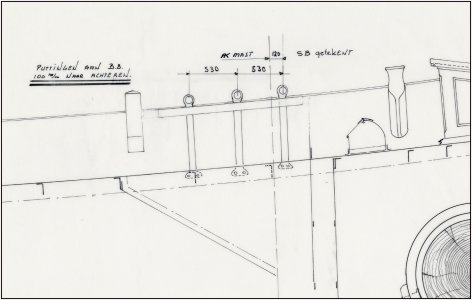
The text is quite unusual, though: "Puttingen aan B.B. 100 m/m naar achteren" / "Chain plates on B.B. 100 mm aft". (Note: B.B. = 'Bakboord' = port)
In my previous post, I had just explained that the chain plates on the starboard side were positioned aft relative to the port side. Because the 'kossing' and the mast has been rotated slightly clockwise, the mast will lie next to the mizzenmast on the port side. Therefore the port puttings go slightly forward and the starboard ones slightly aft. And the front one will be positioned just behind the mast, not behind the rear part of it.
It must be a mistake because it wasn't thought of in the first instance.
This is what they look like on the mainmast:
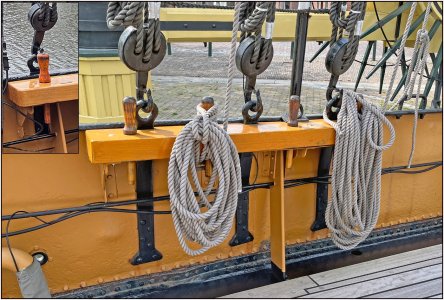
They are longer than those on the mizzenmast and have a wide base. They also do not pass through the bulwark handrail but rest against it on the inside. Above left is an insert of a mizzenmast putting.
Started with the hoops and hooks on the deadeyes. The various stages of making:
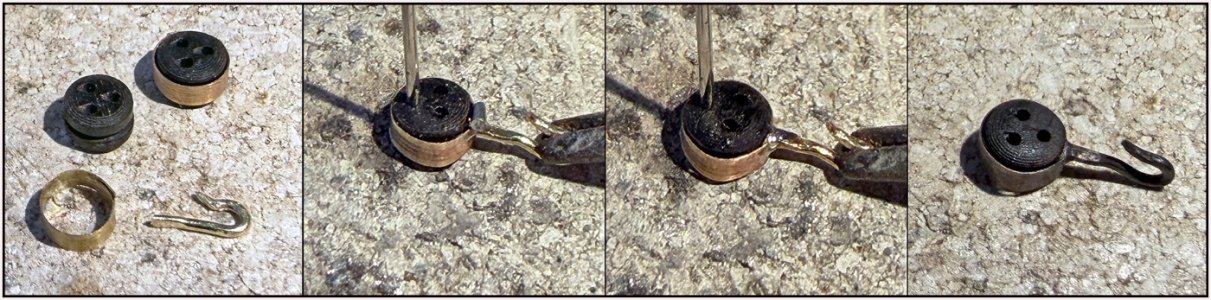
From 'port to starboard':
-bending the hoop and the hook to fit around the 4 mm deadeye. The hoop band is 1,6 mm wide, the hook is from 0,6 wire.
-preparing for soldering: degreasing, flux, and a piece of solder wire.
-after soldering with a small flame.
-cleaned and blackened.
Soldering, cleaning, and blackening can simply be done with the deadeye in place. High-quality blocks from --> DryDock <-- @Dry-Dock Models & Parts.
Regards, Peter
Work on the Balder resumed.
For the measurements and placement of the chain plates for the mainmast, I also found a drawing in the Amsterdam archive:
The text is quite unusual, though: "Puttingen aan B.B. 100 m/m naar achteren" / "Chain plates on B.B. 100 mm aft". (Note: B.B. = 'Bakboord' = port)
In my previous post, I had just explained that the chain plates on the starboard side were positioned aft relative to the port side. Because the 'kossing' and the mast has been rotated slightly clockwise, the mast will lie next to the mizzenmast on the port side. Therefore the port puttings go slightly forward and the starboard ones slightly aft. And the front one will be positioned just behind the mast, not behind the rear part of it.
It must be a mistake because it wasn't thought of in the first instance.
This is what they look like on the mainmast:
They are longer than those on the mizzenmast and have a wide base. They also do not pass through the bulwark handrail but rest against it on the inside. Above left is an insert of a mizzenmast putting.
Started with the hoops and hooks on the deadeyes. The various stages of making:
From 'port to starboard'
:-bending the hoop and the hook to fit around the 4 mm deadeye. The hoop band is 1,6 mm wide, the hook is from 0,6 wire.
-preparing for soldering: degreasing, flux, and a piece of solder wire.
-after soldering with a small flame.
-cleaned and blackened.
Soldering, cleaning, and blackening can simply be done with the deadeye in place. High-quality blocks from --> DryDock <-- @Dry-Dock Models & Parts.
Regards, Peter
Last edited:

- Joined
- Oct 23, 2018
- Messages
- 1,018
- Points
- 443

The next party I missed ...
Gefeliciteerd met je verjaardag, Peter. I hoop dat je een heel fijne dag had.
Gefeliciteerd met je verjaardag, Peter. I hoop dat je een heel fijne dag had.
Thanks, Christian. It was a nice day. And like I wrote in answer to Russ, always on time for a after-party.The next party I missed ...
Gefeliciteerd met je verjaardag, Peter. I hoop dat je een heel fijne dag had.
Regards, Peter
For you a personal reply, Paul: that’s indeed just your feeling. But it has been scientifically proven that those who can celebrate their birthday most often live the longest.It feels like you have them more often than the rest of us!
Do I have the feeling that I wrote that more often ………

Regards, Peter


It can also be they live on a different planet rotating faster around its star.For you a personal reply, Paul: that’s indeed just your feeling. But it has been scientifically proven that those who can celebrate their birthday most often live the longest.
Do I have the feeling that I wrote that more often ………
Regards, Peter


That would actually explain some things about Peter...It can also be they live on a different planet rotating faster around its star.
That would actually explain some things about Peter...
True story guysThat would actually explain some things about Peter...
. He does live on another planet when it comes to model ship building tho. Especially all those minute details.Another one.... you are living the best life Peter....nice. I'm off on my first real off road trip this weekend since my knee replacement. I hope it holds out as we have many 100kms sand riding to do but I guess we will find outThen the BMW is heading Germany for a week-trip.
 . A new trail for me so I'm apprehensively looking forward to it.
Brilliant hoops and hooks. You guys make soldering look so simple however when I try it always ends up "blobby"......still practicing.
Cheers Grant
It can also be they live on a different planet rotating faster around its star.
That would actually explain some things about Peter...
Na mgukjh wrwlehklrj ekl lvcjlas werjsdk sooerjer ........ (That's my other exoplanet language. It means: you don't know what you are talking about .....)True story guys
After 45 years of work, now as a retiree it is time to do nothing but fun things.Another one.... you are living the best life Peter....nice. I'm off on my first real off road trip this weekend since my knee replacement. I hope it holds out as we have many 100kms sand riding to do but I guess we will find out
Brilliant hoops and hooks. You guys make soldering look so simple however when I try it always ends up "blobby"......still practicing.
Cheers Grant
I wish you lots of fun on your upcoming off-road trip, Grant. Challenging to ride a new trail. Exploring new boundaries but stay on this planet.
Regards, Peter
The next step was making the chainplates with eyes:
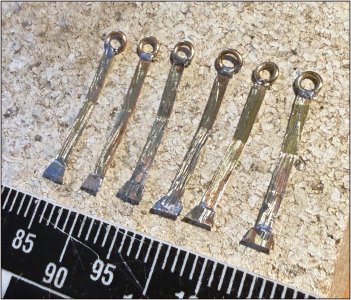
-the originals are 5 mm thick and 8 cm wide = strips of 0.1 x 1.6 mm made, with a length of 17.5 mm.
-a 'trapezoidal' shaped piece soldered to the base.
-the head folded up a fraction to give the eye more bonding surface.
-a slight bend about halfway along.
As flux I use Griffon S-39 liquid. As degreaser 99.9% Isopropanol Alcohol.
Everything degreased again:
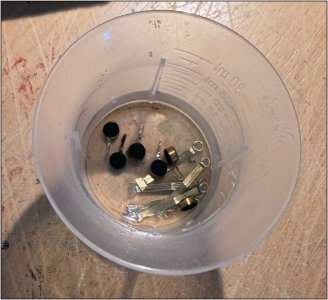
And then in the Ballistol 'browning' bath.
Both parts hooked in the small vise:
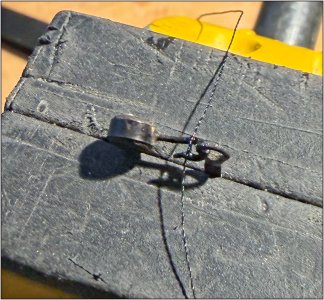
And the hook opening 'afgebindseld' / 'spliced'.
Mounted on the port side:
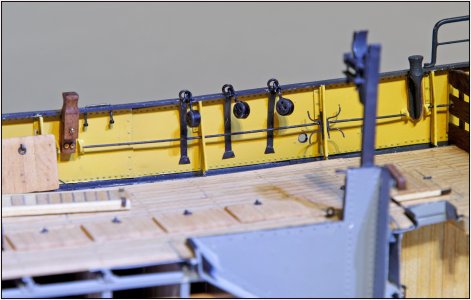
But we are not there yet......... I now first have to make a piece of hull plate for the starboard side. I now know the location where it needs to go and the dimensions.
As can be seen in the previously posted photo with the deadeyes, there is a belaying pin rack on the inside of the bulwark.
This rests on a metal table supported by 4 corner brackets:
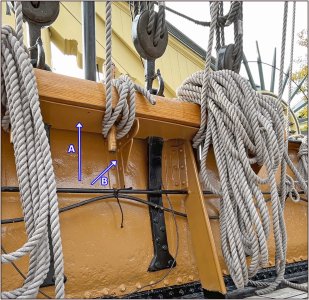
Arrow A: the tabletop, arrow B: 1 of the 4 corner brackets with a small plate.
At the main mast, with 3 recesses for the chain plates.
So, I still need to make 4 of those as well.
In the meantime, I will go look for 9 or 10 mm wooden belaying pins.
Regards, Peter
-the originals are 5 mm thick and 8 cm wide = strips of 0.1 x 1.6 mm made, with a length of 17.5 mm.
-a 'trapezoidal' shaped piece soldered to the base.
-the head folded up a fraction to give the eye more bonding surface.
-a slight bend about halfway along.
As flux I use Griffon S-39 liquid. As degreaser 99.9% Isopropanol Alcohol.
Everything degreased again:
And then in the Ballistol 'browning' bath.
Both parts hooked in the small vise:
And the hook opening 'afgebindseld' / 'spliced'.
Mounted on the port side:
But we are not there yet......... I now first have to make a piece of hull plate for the starboard side. I now know the location where it needs to go and the dimensions.
As can be seen in the previously posted photo with the deadeyes, there is a belaying pin rack on the inside of the bulwark.
This rests on a metal table supported by 4 corner brackets:
Arrow A: the tabletop, arrow B: 1 of the 4 corner brackets with a small plate.
At the main mast, with 3 recesses for the chain plates.
So, I still need to make 4 of those as well.
In the meantime, I will go look for 9 or 10 mm wooden belaying pins.
Regards, Peter
Last edited:
A decision was made regarding the table for the belaying pin rack: brass or just continuing with Evergreen.
Chose the latter because it involves quite a bit of fitting and measuring.
With this final result:
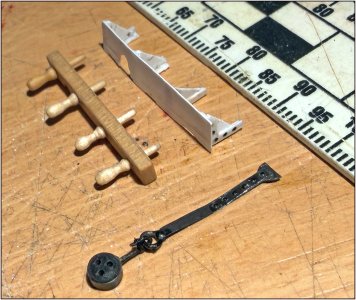
The table is made of 0.25 mm Evergreen with angle profiles of 1.5 x 1.5 mm and small warp plates. The top surface is 29 x 6 mm and fits partly under the handrail of the bulwark. The wooden belaying pin rack is 29 x 3.8 x 2 mm.
PS: I also managed to set the small rivets onto the metal of the chain plates after all. Also on the 3 already installed ones. Boris @Willbor237 has pointed of missing that detail on the Dutch forum.
The Balder has rather robust belaying pins 40 cm long. Went looking for wooden model versions. Couldn't find them quickly.
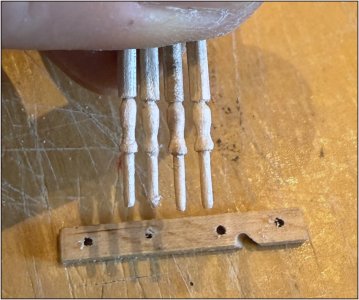
So I just got to work myself with some needle files on the tips of birch cocktail picks. The 1.1 mm pins fit into the 1.2 mm holes of the belaying pin rack. The first photo shows the already better-finished version with 2 coats of linseed oil.
This is how the table should be positioned under the railing:
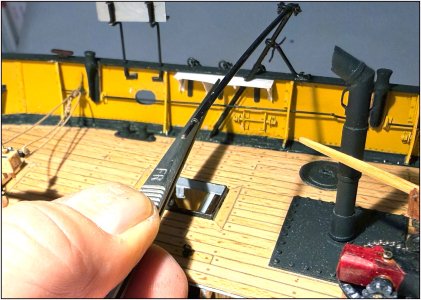
The thin Evergreen is currently still very flexible and difficult to hold in place.
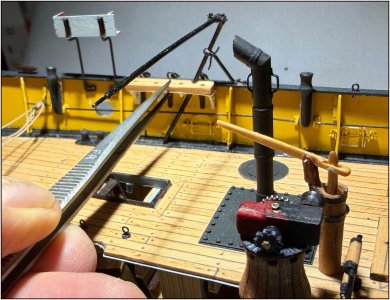
With the belaying pin rack on top.
I can continue with this outcome. 3 more to go. After spray painting, I will glue the wood onto the Evergreen, and then it will suddenly become a sturdy construction. Then I will also drill the 4 holes through the tabletop because it is currently too flexible. After that, I will secure it to the hull plate and handrail with CA gel.
On the original Balder, quite a lot of force is exerted on the table via the rigging. Hence the metal construction with 4 angle brackets. On my model, I have to be careful with the forces. After all, everything is made of Evergreen. But I already have some ideas for that.
Last Thursday, among other things, we repositioned the line for the peak halyard of the gaff of the mainsail. Then 3 men are needed to keep the line under tension while the 4th moves the line to another belaying pin.
And it immediately came up in conversation that, according to the old specifications, that peak halyard was to be secured to that single-sheave bollard. On the Balder, they are sticking to the current situation because the crew is used to it. But who knows.......
Regards, Peter
Chose the latter because it involves quite a bit of fitting and measuring.
With this final result:
The table is made of 0.25 mm Evergreen with angle profiles of 1.5 x 1.5 mm and small warp plates. The top surface is 29 x 6 mm and fits partly under the handrail of the bulwark. The wooden belaying pin rack is 29 x 3.8 x 2 mm.
PS: I also managed to set the small rivets onto the metal of the chain plates after all. Also on the 3 already installed ones. Boris @Willbor237 has pointed of missing that detail on the Dutch forum.
The Balder has rather robust belaying pins 40 cm long. Went looking for wooden model versions. Couldn't find them quickly.
So I just got to work myself with some needle files on the tips of birch cocktail picks. The 1.1 mm pins fit into the 1.2 mm holes of the belaying pin rack. The first photo shows the already better-finished version with 2 coats of linseed oil.
This is how the table should be positioned under the railing:
The thin Evergreen is currently still very flexible and difficult to hold in place.
With the belaying pin rack on top.
I can continue with this outcome. 3 more to go. After spray painting, I will glue the wood onto the Evergreen, and then it will suddenly become a sturdy construction. Then I will also drill the 4 holes through the tabletop because it is currently too flexible. After that, I will secure it to the hull plate and handrail with CA gel.
On the original Balder, quite a lot of force is exerted on the table via the rigging. Hence the metal construction with 4 angle brackets. On my model, I have to be careful with the forces. After all, everything is made of Evergreen. But I already have some ideas for that.
Last Thursday, among other things, we repositioned the line for the peak halyard of the gaff of the mainsail. Then 3 men are needed to keep the line under tension while the 4th moves the line to another belaying pin.
And it immediately came up in conversation that, according to the old specifications, that peak halyard was to be secured to that single-sheave bollard. On the Balder, they are sticking to the current situation because the crew is used to it. But who knows.......
Regards, Peter
Last edited:
The level of authenticity on this ship model is over-the-top, Peter. A special build we get to follow!
Thanks you very much, Paul. I am happy to have you 'on board' as a loyal and (positive) critical follower for so long.The level of authenticity on this ship model is over-the-top, Peter. A special build we get to follow!
Regards, Peter

Although being a member of the Balder crew gives you the chance to see those details up close, it’s a whole different story to actually make them in a small scale. I’m with Paul, there’s great pleasure in watching your Balder grow into a beautiful model.

That's a complex looking gismo sticking through the belay pin rack, the detail is outstanding!
You also thank very much, Jim. By every visit I see new details, and problems …….. how do I gonna make that in 1:50 ……Although being a member of the Balder crew gives you the chance to see those details up close, it’s a whole different story to actually make them in a small scale. I’m with Paul, there’s great pleasure in watching your Balder grow into a beautiful model.
But time is also my friend: It can even be in my head, weighing up all options and possibilities.Regards, Peter
You also thanks very much, Daniel. With a keen eye for that detail. That is the 'traveler' for the mainsail sheet. That is a ‘nuisance’ in several places, but ultimately able to create a nice flow around it.That's a complex looking gismo sticking through the belay pin rack, the detail is outstanding!
Regards, Peter