• SUBSCRIBE TO SHIPS IN SCALE TODAY!

    The beloved Ships in Scale Magazine is back and charting a new course for 2026!
    Discover new skills, new techniques, and new inspirations in every issue.

    NOTE THAT OUR NEXT ISSUE WILL BE MARCH/APRIL 2026
  • Win a Free Custom Engraved Brass Coin!!!
    As a way to introduce our brass coins to the community, we will raffle off a free coin during the month of August. Follow link ABOVE for instructions for entering.

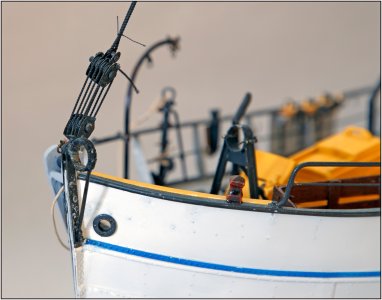
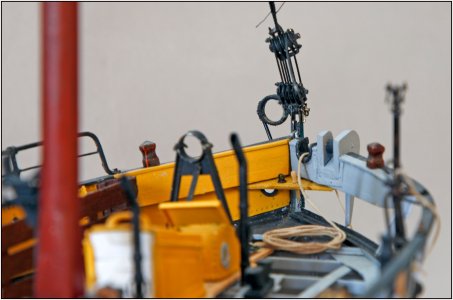
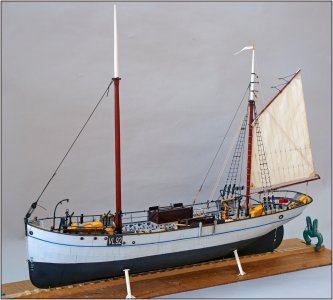
BALDER, Vlaardingen Herring Lugger from 1912, scratch build scale 1:50 Plate-On-Frame

Good morning Peter. Firstly your AL-FI for the outriggers with eyes on them is legendary. I always imagine what you will do to make the rigging work with the split hull and your engineering is superb.

Secondly - what a fabulous tradition. At least this mayor slipped that herring down….. ROTF . Lovely pics. You live in a cool place.

Lastly: I love the detail in your rigging of the Mizzen sail (fabulously made Peter).

Prodigious little Balder being built Peter- shot.
Cheers Grant
Hi Grant. Thanks you very much for this very nice words and compliments!
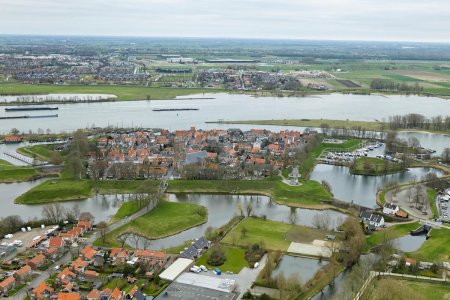
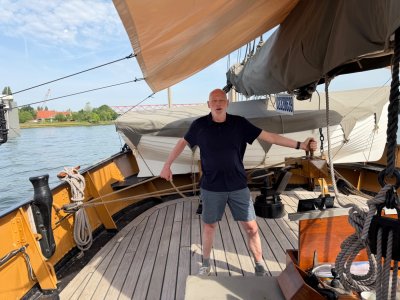
About your ‘2nd-line’: Vlaardingen is the place where I was born and where the Balder is moored. A large part of my family lives there, but I left in 1975. I live in Woudrichem, and that isn't bad either. A beautiful, compact fortified town at the confluence of the Waal and the Maas, which continues as the Merwede.
1781962629777.jpeg
This water also flows partly past Rotterdam and Vlaardingen towards the North Sea. Who knows, maybe I'll manage to moor the Balder in Woudrichem someday. Woudrichem is, after all, also a fishing town, albeit related only to inland salmon fishing. Every two years, they hold 'Fishing Days' there.
Regards, Peter
 
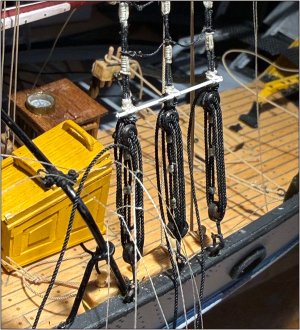
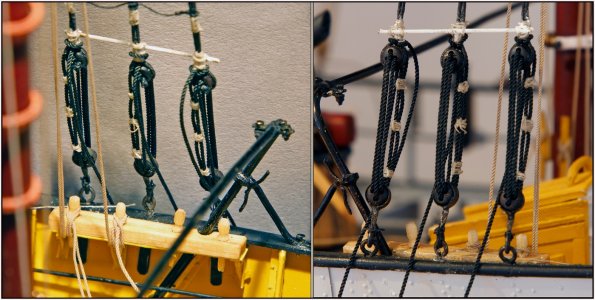
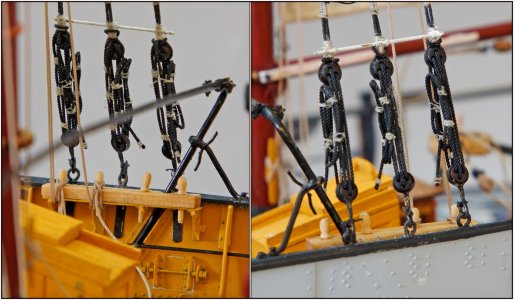
The lacing lines of the shrouds between de deadeyes on the Balder are attached in a way that I have not seen before, in part:
1128 Talies.jpg
The fixed end with the knot is attached to the inside front of the upper deadeye block. After the 3rd pass-through in the lower deadeye block, the working part is first secured with 3 bindings to the adjacent pass-through.
Then it is inserted from the inside out through the opening just above the upper deadeye block between the shrouds. Subsequently, it is laid counter-clockwise behind the shrouds, after which it is threaded back through the front. The remaining end is then secured with 2.5 loops to the front of the lacing strip with 2x2 bindings.

So a challenge to make that in 1:50 as well .....
1129 Talies.jpg
In my report on the Bluenose, I once referred to this binding with various threads - 0.12 mm Serafel - as bobbin lace making.;) Well ...... this is bobbin lace making for advanced students.:rolleyes:

After the stitches, first secured the upward running end with the 3 bindings and made the wrap around the shrouds:
1130 Talies.jpg

Next, secured the 2.5 loop of the running end with the 2x2 bindings:
1131 Talies.jpg

And finally, the 2 ratlines on the outside of the lacing ropes:
1132 Weef.jpg
Unlike all the others, these 2 ratlines were secured not with black bindings, but with the same light-colored bindings.
Thanks to the macros: still a few small loose ends to tie up.
Up to the other side.
Regards, Peter
 
Last edited:
It is great to see the progress of the model and the joy you have building it and sailing the 1:1 version!
Makes me eager to continue my own build. Though I think I can not reach your level Peter.
Thanks for the compliments and nice words, Rob. Have in mind: it's not a competition of making the best model. Every one makes his model on its own level and the fun is: the making of the model! With sharing and showing our progress we can provide each other with ideas.
Regards, Peter
 
Hey Peter,
Had to do some catching up on build logs. She is beautiful!
Thanks for catching you and the compliments, Dean.
Looks like you’re close to being finished?
Only ‘just’ the Main mast and Jib boom with all the stays, lines and furled main sail and jib ………;) Ah, and the lifeboat on the aft deck.
Regards, Peter
 
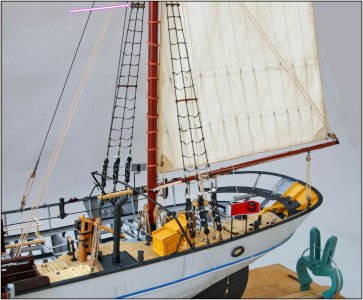
"Mizze-ion Accomplished". The Mizzen mast is completed.
First in detail and then zoomed out.
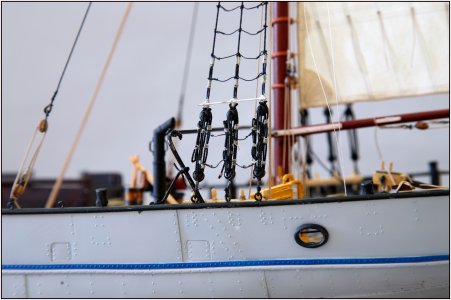
Also managed to tighten the rigging of the shrouds on the starboard side:
1133 Bezaan.jpg
And was able to lay the loops in the running end and secure them.
After that, all lines were tensioned correctly and secured. And fitted with the coiled lines.
1134 Bezaan.jpg
At the 3 cleats at the foot of the mast, it requires a bit more squeezing with lines than on the 1:1. Because I cannot lay lines on the belaying pin rack on the starboard side. Therefore, some lines were combined on some cleats.
At the arrow that made me happy: the planned splitting of the rigging with the small magnets works! The rigging stays taut.

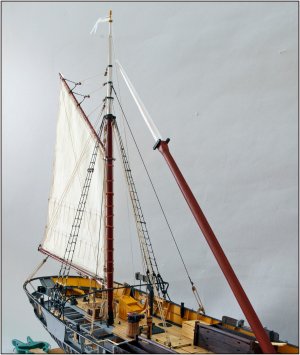
A bit from a front angle:
1135 Bezaan.jpg
The sheet of the mizzen topsail has also been installed. That is a kind of continuous line that runs through 2 blocks on the gaff, with both ends secured at the foot of the mast. I will try to describe setting the mizzen topsail and mast below. Hopefully, I can clarify this next month when we go sailing with the Balder.

According to the old specifications, the topsails are set on the starboard side.
The sail is first secured on deck to the detachable topmast.
-The starboard end of the halyard, which runs over the sheave at the top of the mizzen mast to port, is then secured to the topmast at approximately one-third o the way up.
-The tack is a loose line that is secured to the underside of the topmast.
-As the sheet, the piece of line running diagonally down along the mizzen sail is secured to the clew of the sail.
The topmast with topsail is then hoisted up along the starboard side, past the mizzen sail, gaff, and peak halyard.
Once the topsail is set, the clew comes to rest just above the end of the gaff. Then the clew is tightened with the sheet via the block at the end of the gaff. The sheet runs along the gaff to a block under the gaff's claw and is then secured at the foot of the mast.
If the wind comes from starboard, the topsail presses partly against the peak halyard. If the wind comes from port, the sail becomes loose.
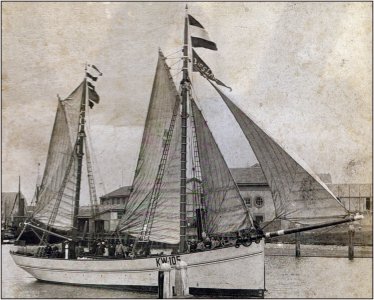
A photo from the book 'Uitgezeild' on page 132 of the Katwijk KW.105:
1136 Bezaan.jpg
The mizzen at approximately the same angle as my photo.

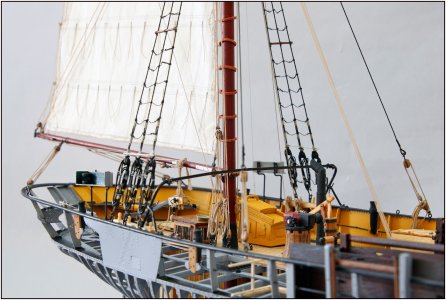
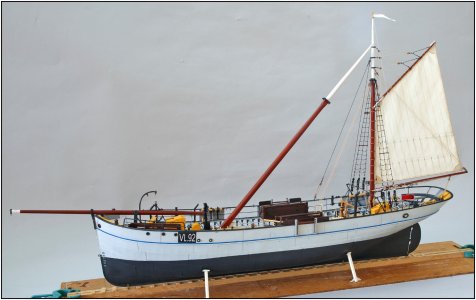
A overall picture:
1137 Bezaan.jpg
The work at the front with the mainmast and jib boom is next.

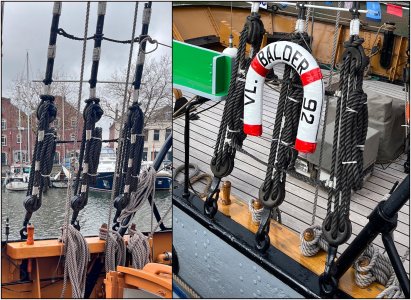
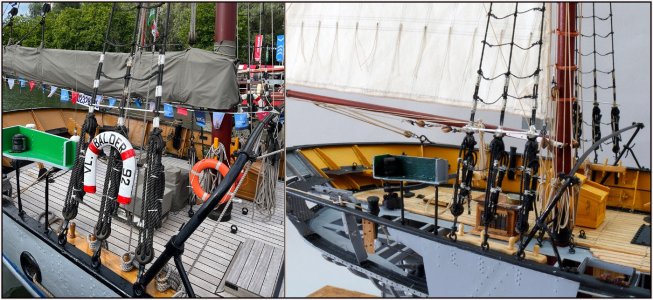
And a comparison picture:
1138 Bezaan.jpg
Even with my 14mm fisheye, it didn't work out well. The problem is that the starting point is the shot on the left, taken with my iPhone. Next time, I should use a photo of my model as a starting point and then try to capture a comparable 1:1 representation.
Regards, Peter

 
Last edited:
Too hot to 'play outside', so staying inside nice with the air conditioning on.
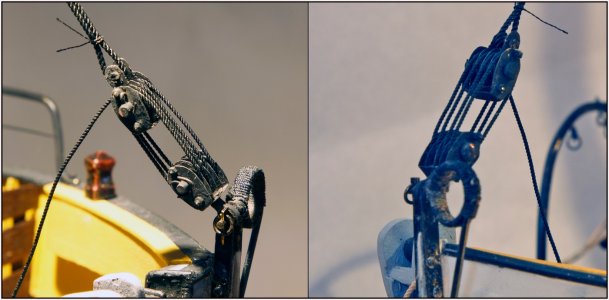
There is a lot to be done on and around the mainmast. To get the feel for the brass back, I first bent over the 2 large metal 4-sheave blocks attached to the forestay:
1139 4-schijfs.jpg
These are used to secure the mainmast but are also used to lower the mast.
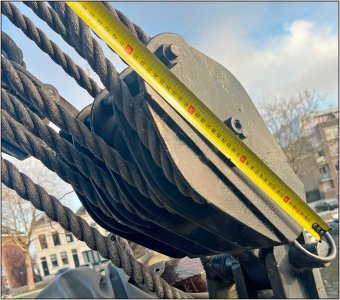
The old specifications state: "The forestay blocks were two four-sheave steel blocks, the upper one with a dog's eye. A chain runner of galvanized short-link 8 mm chain ran over the blocks. The chain of the lowering tackle is long enough that, with the mast standing, it can be secured exactly to a nail in the boom vang. To lower the mast, a (Hercules) rope or a stay cable had to be hoisted onto it. The mast was lowered by wrapping the rope or cable around the capstan and letting it slip."
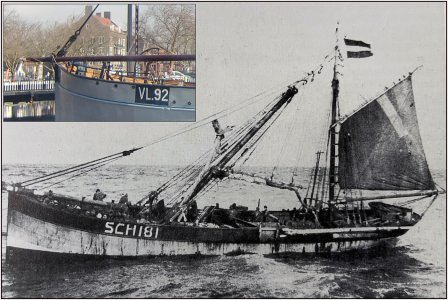
The old photo shows that a chain is indeed used. On the Balder, this has been replaced by a cable.
1140 4-schijfs.jpg
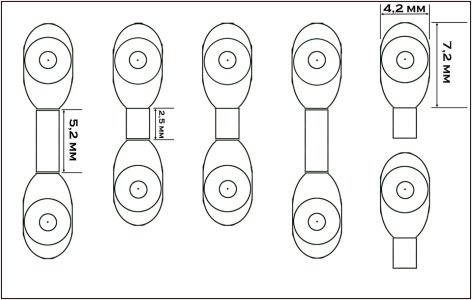
The blocks are 36 cm high and 21 cm wide and thick, and are constructed from 5 cheeks.

Made a scale drawing in Photoshop:
1141 4-schijfs.jpg
My idea is to make a U-shape from the outer 2 cheeks, which I fold around a 5.2 mm bridge. A 2nd U for the 2 cheeks standing inside with a 2.5 mm bridge. In the middle is the 5th cheek with a small 1.2 mm lip on the underside. 4 mm discs will be turned into this.

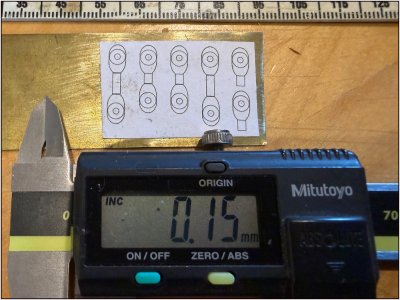
Printed the drawing to the correct dimensions and glued it onto a piece of 0.15 mm thick brass plate:
1142 4-schijfs.jpg
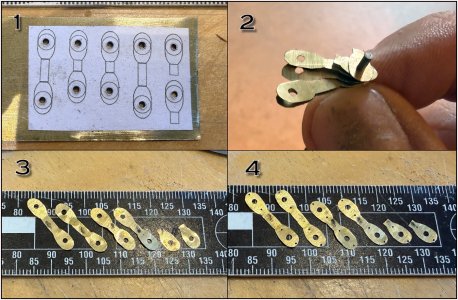
1143 4-schijfs.jpg
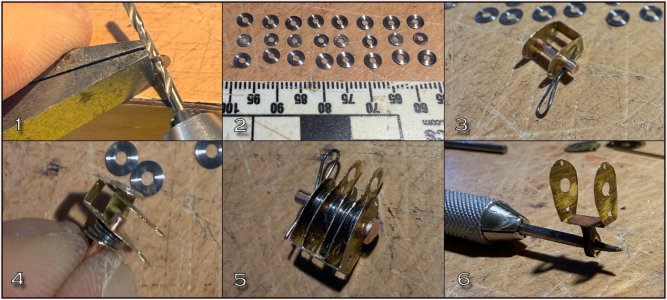
1: first drilled the 1.5 mm holes for the axle in all the cheeks.
2: roughly cut and filed, inserted onto the shaft of the 1.5 mm drill bit, held together, and filed into shape together. Same with the other side.
3: the parts filed into shape.
4: slid back onto the shaft of the 1.5 mm drill bit and provided with the 0.5 mm holes under the drill column for the top bar that holds the plates at the correct distance. The holes on the underside are not present in the original, but I use them to hold all parts in the correct position when all connections are soldered together.

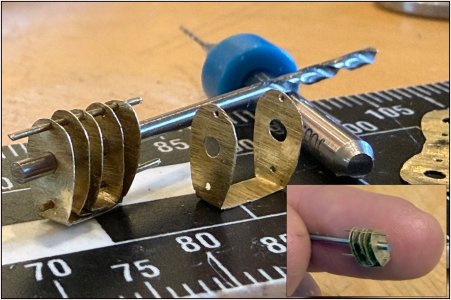
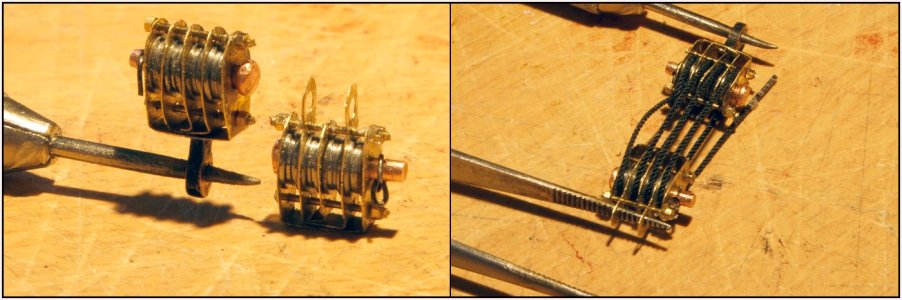
Theory and practice comes together again (for now):
1144 4-schijfs.jpg
Both U-shapes bent, as well as the middle plate with the lip. The whole assembly fixed onto the 1.5 mm drill bit and the 2 0.5 mm wires inserted. On the right the U-shaped cheeks with the 5.2 mm bridge for the other block. It all still needs to be set up a bit better, but I think that can be done tomorrow when I receive the material for making the sheaves.
Regards, Peter
 
Last edited:
"Mizze-ion Accomplished". The Mizzen mast is completed.
First in detail and then zoomed out.
Also managed to tighten the rigging of the shrouds on the starboard side:
View attachment 614490
And was able to lay the loops in the running end and secure them.
After that, all lines were tensioned correctly and secured. And fitted with the coiled lines.
View attachment 614491
At the 3 cleats at the foot of the mast, it requires a bit more squeezing with lines than on the 1:1. Because I cannot lay lines on the belaying pin rack on the starboard side. Therefore, some lines were combined on some cleats.
At the arrow that made me happy: the planned splitting of the rigging with the small magnets works! The rigging stays taut.

A bit from a front angle:
View attachment 614495
The sheet of the mizzen topsail has also been installed. That is a kind of continuous line that runs through 2 blocks on the gaff, with both ends secured at the foot of the mast. I will try to describe setting the mizzen topsail and mast below. Hopefully, I can clarify this next month when we go sailing with the Balder.

According to the old specifications, the topsails are set on the starboard side.
The sail is first secured on deck to the detachable topmast.
-The starboard end of the halyard, which runs over the sheave at the top of the mizzen mast to port, is then secured to the topmast at approximately one-third o the way up.
-The tack is a loose line that is secured to the underside of the topmast.
-As the sheet, the piece of line running diagonally down along the mizzen sail is secured to the clew of the sail.
The topmast with topsail is then hoisted up along the starboard side, past the mizzen sail, gaff, and peak halyard.
Once the topsail is set, the clew comes to rest just above the end of the gaff. Then the clew is tightened with the sheet via the block at the end of the gaff. The sheet runs along the gaff to a block under the gaff's claw and is then secured at the foot of the mast.
If the wind comes from starboard, the topsail presses partly against the peak halyard. If the wind comes from port, the sail becomes loose.
A photo from the book 'Uitgezeild' on page 132 of the Katwijk KW.105:
View attachment 614492
The mizzen at approximately the same angle as my photo.

A overall picture:
View attachment 614493
The work at the front with the mainmast and jib boom is next.

And a comparison picture:
View attachment 614494
Even with my 14mm fisheye, it didn't work out well. The problem is that the starting point is the shot on the left, taken with my iPhone. Next time, I should use a photo of my model as a starting point and then try to capture a comparable 1:1 representation.
Regards, Peter

Beautiful work as ever! I have to do a double check on the images to make sure if I'm looking at the ship or the model!
 
Back
Top