![]() |
The beloved Ships in Scale Magazine is back and charting a new course for 2026! Discover new skills, new techniques, and new inspirations in every issue. NOTE THAT OUR NEXT ISSUE WILL BE July/August 2026 |
![]() |
![]() |
As a way to introduce our brass coins to the community, we will raffle off a free coin during the month of August. Follow link ABOVE for instructions for entering. |
![]() |


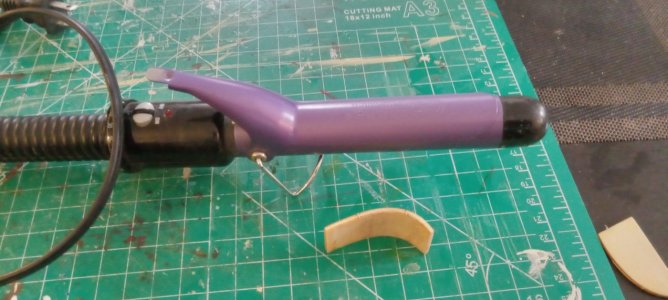
Better to get a "hot enough" devise. Cooking or charring the wood is best avoided.now to just get a hot iron, or somesuch

now to just get a hot iron, or somesuch.

I wrap it in a wet towel/cloth to do this.Try zapping the wooden piece to be bent in your kitchen microwave.

There seem to be many ways to broad bend successfully. I wish someone would invent a practical adjustable tool for edge bending which is as critical and much more difficult to do. Spiling is the best way to go, but most kits only supply straight sticks so it is not so easy to taper in breadth then edge bend so they do not lift.
Allan


he difficulty encountered with edge-bending that you've described is God's way of telling us that he never intended wood to be bent on edge.

You are of course correct, but with the vast majority of planking wood supplied being straight sticks instead of spiled planks something needs to be done. Happily, the method shown in the videos by Chuck Passaro works extremely well to get the proper shape and avoid lifting and gaps.
Allan
Yes, spiling is a great way to go, and some kits provide spiled planks, but most do not, so alternatives are needed. I have only used the Chuck Passaro method with Castello and Swiss pear so cannot speak for the sapeles and other woods we often see. It would be great to see someone use this method and post how it turns out. His method has made it possible to plank a hull realistically with the straight pieces usually provided in kits which I think is terrific.but note that in his demonstration videos he is bending Alaskan Yellow Cedar which is much more amenable to heat-bending than the low-quality "walnut," "mahogany," and other questionably identified exotic species frequently found in kit boxes.

I have only used the Chuck Passaro method with Castello and Swiss pear so cannot speak for the sapeles and other woods we often see.

When I soak a piece of castello planking 0,06" thick and 0,25 inches broad overnight I can edge bend it easily and clamp it down to keep it flat, then dry it over time or with a hot air gun. When I tried to do it dry before trying to heat it, it cracks. I had no clue about the chemistry, but I know what has worked in the past.
Allan
Will be planking the current project in a few weeks so will give it a try. Thanks BobJust for grins, try bending it dry when well heated and see if it still cracks.
"Everything old is new again!"As I was cleaning up my hobby shop in the garage, I found a small metal toolbox that one of my nephews made for me while he lived with me and went to the local high school, those ten or so years ago, AND I FOUND a hot iron to bend planks, I knew I had purchased one back then but had not seen it for more than a decade. There is metal stand to set it in when it is hot, and a template that has curves to use as a guide. I am going to refresh my knowledge of how to use the hot plank bender iron for the next complete hull planking project.
Oh, this box also contained about $100.00 of micro twist drill bits from #60 - #80, plus a metal and plastic mitar board, some micro drillbits for the Dremel plus a dozen or more micor-chucks to hold them. I must have spent a thousand dollars on tools besides all of the expensive kits I bought back then.
Allan, one of our members KeDennis has kindly provided free files of some of the wonderful 3D printed machines he has designed. One of them is a plank bender, which may help with your request. I have not had it built yet but I have built his waterline marker and rope walk. They are wonderful gadgets.There seem to be many ways to broad bend successfully. I wish someone would invent a practical adjustable tool for edge bending which is as critical and much more difficult to do. Spiling is the best way to go, but most kits only supply straight sticks so it is not so easy to taper in breadth then edge bend so they do not lift.
Allan