


• Win a Free Custom Engraved Brass Coin!!!
    As a way to introduce our brass coins to the community, we will raffle off a free coin during the month of August. Follow link ABOVE for instructions for entering.

Bluenose I - YuanQuin 1:72 - Loracs (in progress)

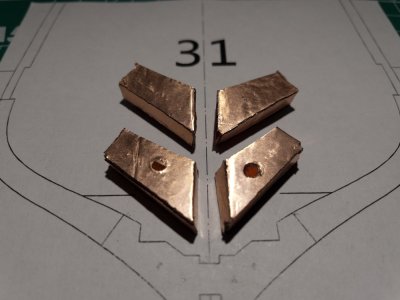
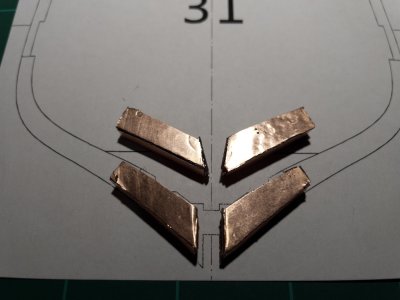
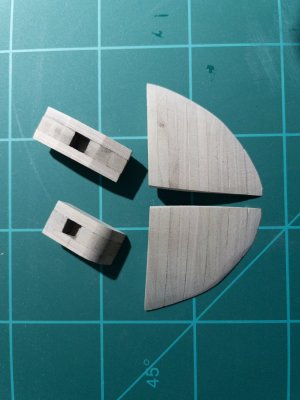
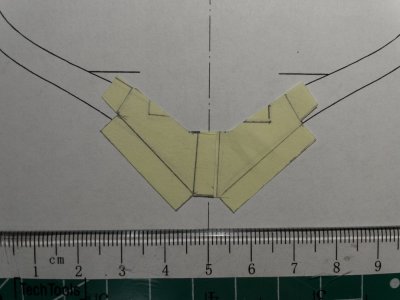
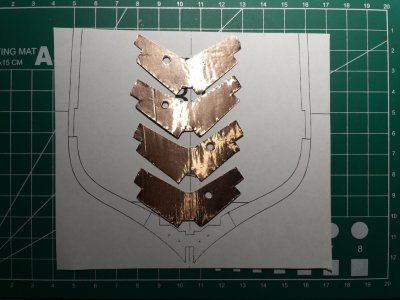
Building Water Wells: One modification that Peter introduced was to build water wells. I'm including the steps I used... but be warned, they are a pain to build... at least for me. In the end I got a set ready for later.

NOTE: I just realized I did not leave enough clearance at the top! Well, I got the idea/practice on how to build them. Will give it another shot. Sometimes, you don't get things quite right the first time. The process will be the same though.
IMG_3633.jpegIMG_3635.jpegIMG_3638.jpeg
 
Last edited:
Shorter version of the water collection wells. A tad long... but hey! There's a lot of water out there.
IMG_3640.jpeg
 
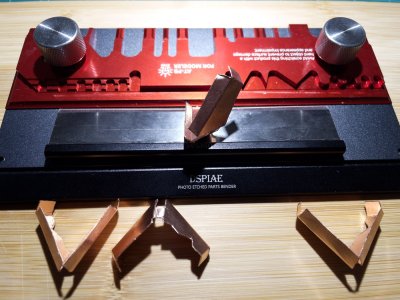
Recommendation for building small copper parts (like above). Copper is nice and malleable but quite fragile to folding. Getting just the right thickness is tricky too. My suggestion for the future. Rather than trying to work with copper only, get some copper fold with adhesive (some are up to 4 inches wide). Then you can "coat" a transparent plastic sheet on both sides, even lay 2-3 layers. You will then have a copper sheet with very sturdy backing. The small piece can be cut easily and even fold back and forth without losing its integrity. I only had 1/4-inch tape on hand, but it tested quite nicely. Food for thoughts: full copper look (even with aging) but with solid backing.
 
It’s nice to see how you build the water wells, Loracs. And indeed there are different options to build them.
And although they will be hard to see, we all know they ate there.
Regards, Peter
 
For me it is indeed all about personal gratification that I craft something to the best possible way. Does not need to be perfect, but that I try my best. Agree, it will barely be seen... but hey! all that water around! Many time I just need the idea and that why BUILD LOGS from all are so precious to modeler. I try my best to have a detailed log. Being the 61th (I think) Bluenose build, there will be some repetition. That's ok thought, small personal touch.
 
Quick update: I reworked the water wells for better fitting. I like them as large as possible (personal preference) but they cannot be an obstruction. Plastic backing is indeed the easiest approach. Here's the third set being folded. This must be the longest thread on water-wells in the history of SOS..... hehe!
IMG_3643.jpeg
 
Last edited:
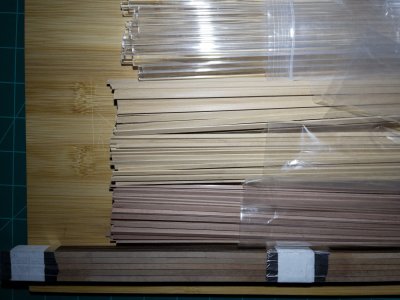
Supplies: Some supplies just came in, boxwood and pearwood strips for working on the interior of the bluenose. The pearwood color is quite different from the kit. Maybe a difference in age and/or specific variety... it may even change with lindseed oil. Will decide later whether to replace or not the supplied strips. The acrylic square rods are to test an idea (more down the road).
IMG_3644.jpeg
 
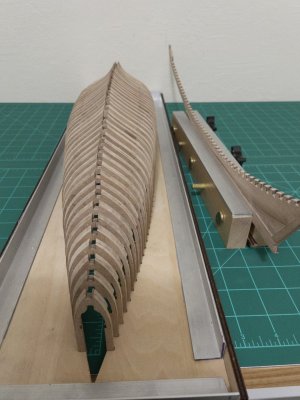
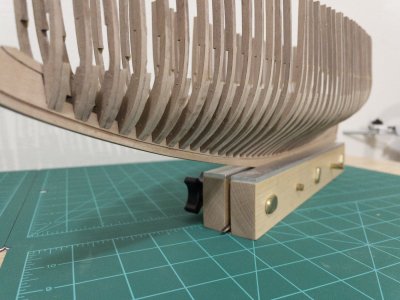
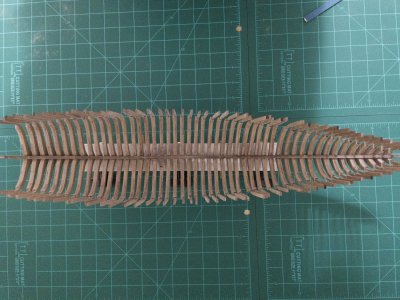
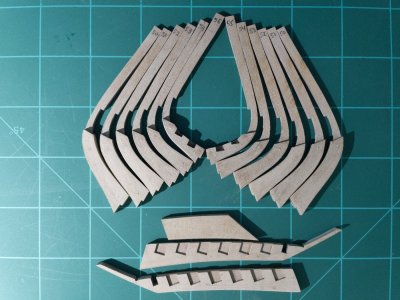
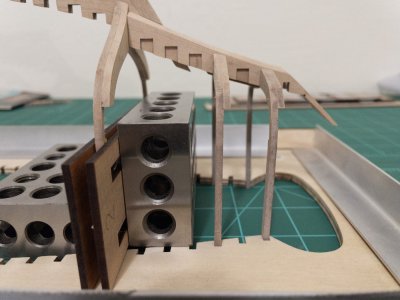
Dry Fitting Frames: Let me focus on what I'm looking for with this initial dry fit.

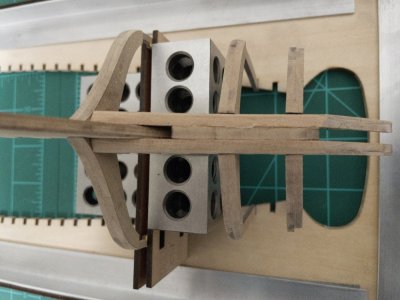
On the stand: That's an easy one. I made sure the frames slide in well and that there are no major mis-alignments.

On the keel: Again, does it slide in without force, position relative to the rabbet on either side, and finally does it sit square (90 degrees) without force on the keel. Both the keel and the frames are made from multiple pieces... so an issue can arise that can be fixed with very light sanding (either or both the keel or the frame). Some frames are a little loose but that is hard to fix and should go away on gluing.

Let me know if I should look at anything else at this point.
IMG_3652.jpegIMG_3653.jpegIMG_3654.jpeg
 
Dry Fitting Frames: Let me focus on what I'm looking for with this initial dry fit.

On the stand: That's an easy one. I made sure the frames slide in well and that there are no major mis-alignments.

On the keel: Again, does it slide in without force, position relative to the rabbet on either side, and finally does it sit square (90 degrees) without force on the keel. Both the keel and the frames are made from multiple pieces... so an issue can arise that can be fixed with very light sanding (either or both the keel or the frame). Some frames are a little loose but that is hard to fix and should go away on gluing.

Let me know if I should look at anything else at this point.
View attachment 562982View attachment 562983View attachment 562985
That’s looking good, Loracs. The fitted nice to the bevel in the keelson. Be assured that the tops of all frames are on line, as fitted full in the jig. Because those aligned tops are the reference for the rest of all the inside beams.
Regards, Peter
 
Last edited:
@Peter Voogt, greeting... a very quick question for you. After planking one side of the Bluenose fully using the Kit strips (50-55 total), is there a comfortable left over? or it is pretty tight in term of number needed. Just trying to plan ahead and see if I could use some for other work.
 
@Peter Voogt, greeting... a very quick question for you. After planking one side of the Bluenose fully using the Kit strips (50-55 total), is there a comfortable left over? or it is pretty tight in term of number needed. Just trying to plan ahead and see if I could use some for other work.
If you plank according to the instructions, you'll have several planks left over. I used some of them for the deck, but I didn't have enough. A few fellow builders donated some leftover planks to me. I'm eternally grateful for that.:)
But how much? For sure do the hull planking before ‘the other work’.;)
Regards, Peter
 
Yes... I learned at the first kit to save even small segment of strips for later use. Often, not much excess. I'm not too surprise. ;-)
 
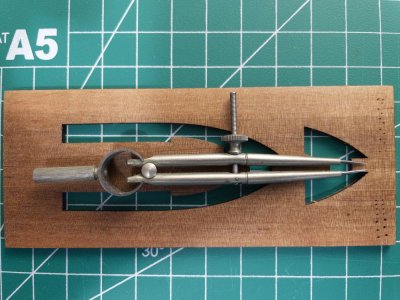
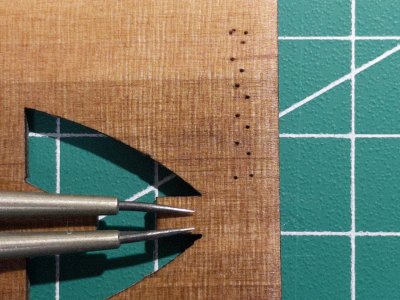
Nails: This build has a lot of firsts for me. Simulating nails is not something I have done before. Nails on 3mm wide planks will be quite tiny, 0.1-0.2mm, not something we can easily do the traditional way (drilling/filling). So, as pointed out before (I think by Peter), why not just some needle holes.

I'm using a quality compass, something I picked up at a flea market, for accurate and reproducible spacing of two needles. Just poke the board and finish with linseed oil/wax. Overall, they are not bad for tiny ones. Large ones will obviously be out of scale and would need filling (not doing those).IMG_3661.jpegIMG_3659.jpeg
 
Back
Top