• Win a Free Custom Engraved Brass Coin!!!
    As a way to introduce our brass coins to the community, we will raffle off a free coin during the month of August. Follow link ABOVE for instructions for entering.
  • SUBSCRIBE TO SHIPS IN SCALE TODAY!

    The beloved Ships in Scale Magazine is back and charting a new course for 2026!
    Discover new skills, new techniques, and new inspirations in every issue.

    NOTE THAT OUR NEXT ISSUE WILL BE MARCH/APRIL 2026

Bluenose I - YuanQuin 1:72 - Loracs (in progress)

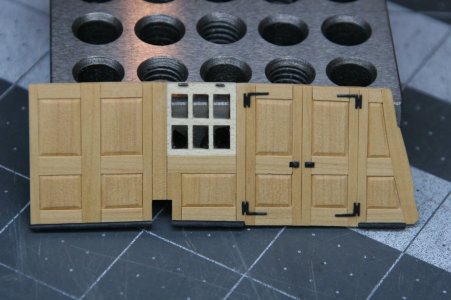
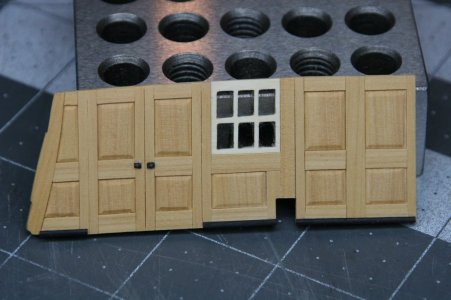
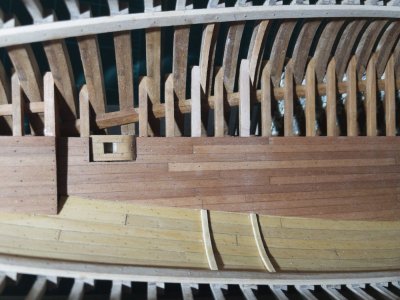
Unusual problem - Walls Warping: I came across an issue that is puzzling me. I can't really find a solution and/or a prevention. Maybe someone here has a tip. The issue is the following:

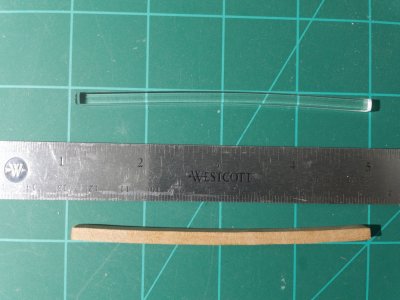
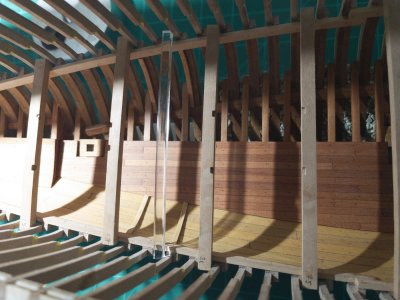
I have been edge-gluing strips to create walls (see above). I then place the wall between two pieces of wood and let it dry either overnight or up to 3 days. When I free the wall, everything is fine for several hours, then I see warping that gets worse with time (see below in picture). Would treating with linseed oil right after the overnight dry help prevent that? Any way other trick? Have any of you ever seen this issue?

I'm guessing that the one solution would be to build the wall frame and glue strips only to the frame - avoiding edge gluing all together.

View attachment 582912
Hi Loracs. At first I haven’t gave you post a ‘like’ ……. ;) ….. because you don't want this to happen. But at the end I did, you showed us one of the pro’s and con’s of scratch building
Hold it in some steam for a while, then hold it against a surface with a slight opposite curve, and let it cool again. You'll have to experiment with the amount of time. It also depends on the glue you used. PVA softens slightly and will regain its bond as it cools.
Regards, Peter
 
You are right though... posting issues encountered can be valuable to other builders. I have no problem with that since, for the most part, I'm still learning. I did try steaming and re-forming.... but after a while it will curve again in a hot day. You can see that I'm dealing with this issue for more than a week, with few experimentations. In addition, this happens reproducibly on all 3 versions.

My assumption is the following: when I edge-glue, there is some glue than spread in the opposite side facing the gluing bench (cover with a plastic sheet). This is un-avoidable. The upper side does not since you tend to see it and wipe right away. Furthermore, it does not spread but just "bead" slightly at the strip's edge. After the glue set, you end up with a side that is permeated with glue and the other side free. Sanding afterward just removes the surface glue but not the permeated portion. Air humidity must then expand wood from the upper side but not has much the lower, creating a gradient that deform the overall structure.
 
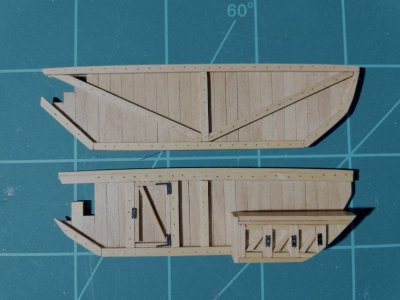
Hello Loracs, I don't know if this will help you...but it appears as if you have added trim details to only one side of the bulkhead. In my experience, when working with thin flat surfaces, whatever you do on one side you must also do on the other side (this applies especially to larger structures - less so with smaller things like shot lockers or wells). This might even mean needing to sand down each respective surface to make the structure thinner to avoid ending up with something too bulky.

IMG_1115.JPG Front

IMG_1117.JPG Back

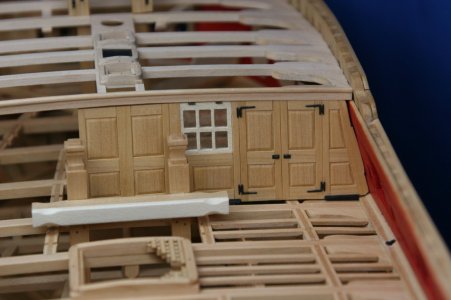
IMG_1118.JPG Front

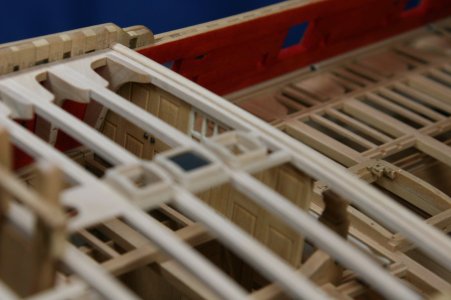
IMG_1121.JPG Back

I hope this helps.
 
Hello Loracs, I don't know if this will help you...but it appears as if you have added trim details to only one side of the bulkhead. In my experience, when working with thin flat surfaces, whatever you do on one side you must also do on the other side (this applies especially to larger structures - less so with smaller things like shot lockers or wells). This might even mean needing to sand down each respective surface to make the structure thinner to avoid ending up with something too bulky.

View attachment 582990 Front

View attachment 582991 Back

View attachment 582992 Front

View attachment 582993 Back

I hope this helps.
That reminds me that I also put the wall covering on both sides of the frame.
 
Back
Top