
• Win a Free Custom Engraved Brass Coin!!!
    As a way to introduce our brass coins to the community, we will raffle off a free coin during the month of August. Follow link ABOVE for instructions for entering.
  • SUBSCRIBE TO SHIPS IN SCALE TODAY!

    The beloved Ships in Scale Magazine is back and charting a new course for 2026!
    Discover new skills, new techniques, and new inspirations in every issue.

    NOTE THAT OUR NEXT ISSUE WILL BE MARCH/APRIL 2026

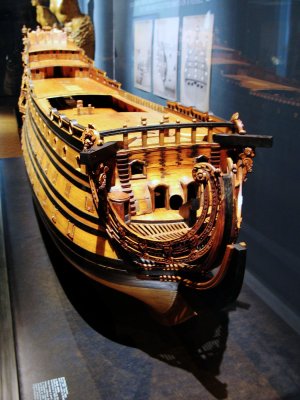
Bowsprit of Soleil Royal

.​


Yet, apparently they care about time and money and that’s their business model, or perhaps they simply enjoy being asked the same thing over and over again. It’s a fairly common trait among many people, and one has to take it into account. I, too, had to remind them a few times to send the missing plate from the album La Marine Française by Morel Fatio, which I had previously bought from Ancre, before they finally sent it after several dozen months of reminders :).


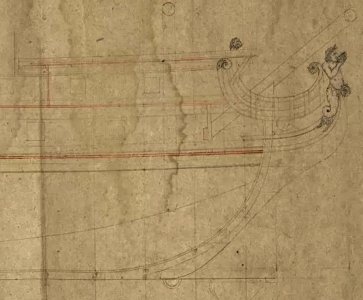
Apart from the plates from Colbert’s album, there are many other period illustrations and plans depicting 17th-century French ships, showing the bowsprit precisely over the stem, rather than off-centre (see sample graphic at the bottom of this post). I do not know why model-makers, instead of consulting the sources, have an unstoppable tendency to copy even the most absurd solutions from one another.


You can find all the information regarding the purchase of the so-called Colbert album on the Ancre website. The quality of the reproductions is excellent, and what’s more, this particular reprint includes commentary, and perhaps most importantly for some, a transcription of the original French text for each plate and its English translation. It weights about 1.33 kg.

If you’re not yet ready to spend money on such trifles as period sources, I can send you the entire set of plates from the Colbert album via PM, which I found online; however, their quality is incomparably worse than the Ancre reprint and they come without any commentary, transcription or translation.


* * *​

Just a very small selection of contemporary graphics displaying French 17-century vessels, both naval and merchant, sporting on-center bowsprits:


.​
Thank you very much, Waldemar!!
Have a nice week-end...
 
.​
Thank you very much, Waldemar!!
Have a nice week-end...
Thank you too, Guillaume. However, perhaps it is still too early to express appreciation, as there may well be a chance that others will also make a valuable contribution and even offer a different solution or perspective on this issue — for example, the individuals or institutions suggested by Allan and Wojtas. I’d be keen to hear what they have to say, should they decide to take the time to share their expertise on this very matter.

.​
 
Thank you very much Allen!!
I spent about 6 hours on internet, wasa museet, Pinterest, model ship world, the finished gallery of models of SOS, and all I can see is centred bowsprit.......
Hi; I have done quite a bit of reshearch on the subject; the reality is there is very little direct information on anything of the 1670 Soleil Royal.
All that I found which potentially relates to the first ship is that since it, and the Royal Duc were from the same master ship builder ( Laurent Hubac), it must be assumed that the Royal Duc was the ''little brother'' of the Soleil Royal of the period, so the best visual reference would be from the couple of drawings Van de Velde made of the Royal Duc, later renamed Reyne in 1671. As for the Tanneron Soleil Royal at the museum, the ship's structure is somewhat of an interpretation, the information of the exact ship being very sparse; I personally don't see any reason for the bow sprit to be offset, except for the construction of the model having been made in 1823, and therefore the wood bowsprit might have bent or offset with time.
If you are very interested on the subject of the Soleil Royal, and you read french, I can send you the document I did with all the information I gathered
 
But I wonder now why everyone says bowsprits in France were deported to the right in the 1700, when I see the drawings of Colbert?
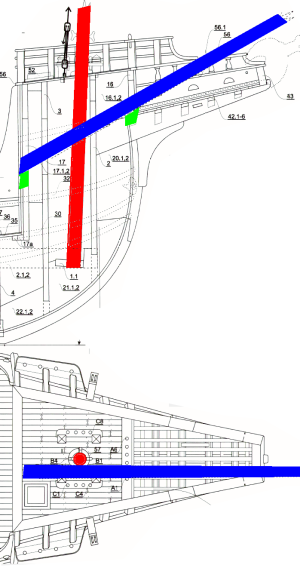
As far as I know, the only ships that had the bowsprit offset to one side are those that have insufficient length between the front support of the bowsprit and the foremast to mount the bowsprit step and give the bowsprit sufficient support. The above drawings clearly show the bowsprit ends just before the foremast, so no offset is necessary. If the bowsprit continued past the foremast, then it would clearly have to be offset. This does not just apply to French ships, but many other nationalities, like my Ragusian Carrack. The plans for the Carrack show the very short distance between the front of the forecastle and the foremast, necessitating running the bowsprit aft alongside the foremast to the rear of the forecastle:
1773500084815.png
Green shows the support for the bowsprit.

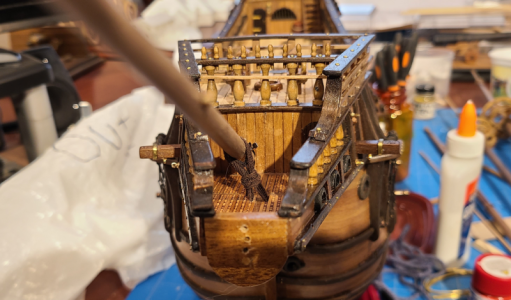
This photo shows the bowsprit entering the forecastle offset from center:
1773500152385.png
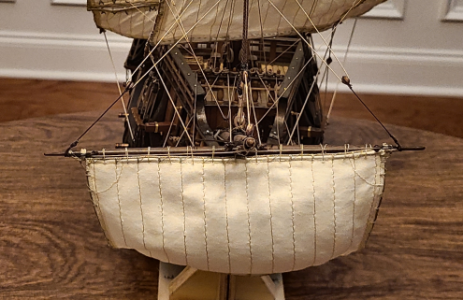
While the Carrack drawings showed the bowsprit parallel with the ship centerline, my research showed they usually were mounted at an angle so that the end of the bowsprit was at or near the ship centerline. You can kind of see that in this photo:
1773500246827.png

Anyhow, it's my opinion that you can pretty much look at the bowsprit, foremast and forecastle and see if an offset bowsprit would have been necessary.
 
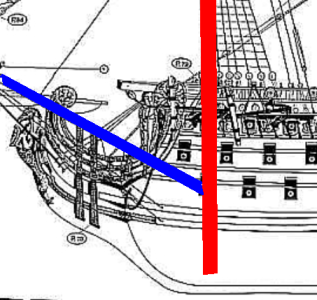
I don't have a good pic of Soleil plans, but the ones I'm seeing show the distance between the front of the forecastle to the foremast fairly close:
1773501040115.png
so IMHO there's a decent chance it should be offset. But I think you could make a case either way, which, I realize, doesn't help you much.

On the other hand, I ran across this drawing of the L'Ambitieux, which clearly indicates the bowsprit step mounted before the foremast, so there would definitely be no reason to mount the bowsprit off of center on this ship:
1773501549387.png
I guess my "rule" is more of a possible suggestion. Well, at least I think I've given a reason for some ships having an offset bowsprit. Hope this helps.
 
I don't have a good pic of Soleil plans, but the ones I'm seeing show the distance between the front of the forecastle to the foremast fairly close:
View attachment 584237
so IMHO there's a decent chance it should be offset. But I think you could make a case either way, which, I realize, doesn't help you much.

On the other hand, I ran across this drawing of the L'Ambitieux, which clearly indicates the bowsprit step mounted before the foremast, so there would definitely be no reason to mount the bowsprit off of center on this ship:
View attachment 584251
I guess my "rule" is more of a possible suggestion. Well, at least I think I've given a reason for some ships having an offset bowsprit. Hope this helps.
This would be a fine diagram for the bowsprit enchor location; from the early 1600's to the beginning of the 1700's, the bowsprit would be enchored along the foremast on the bottom deck; In 1692 when the second Royal Louis was beng designed, it was the first ship to have its bowsprit enchored on the middle deck, changing the angle of it, and from the literature gave a better handling characteristic to the ship; but changing all of the bowsprit from all the ships then would have been too costly, so the modification would ony be adapted on ships during a full reconstruction or new generation. the only three decker constructed in the early1700's was the Foudroyant, therefore it would be the only other ship to actually have that modification up to that point besides the Royal Lous of 1692....As for the other constructions of 1692 and 1693, the designs were too far advanced to have them modified at that point without significant re-designings of the bows
 
Guillaume,
Not much I can add to the knowledgeable comments of others, but here are a few relevant photos of the Tanneron model taken from other posts. There are so many odd unprototypical features and proportions about the Tanneron model that I wouldn't take it too seriously. It's more art than historically accurate. The best researched modern source of information I have is Jean Boudriot's The Three-Decker of the Chevalier De Tourville, which details ships a generation or two younger than the original Soleil Royal (there were, according to how you count rebuilds, three or four), but still has an enormous amount of actionable information. It, by the way, indicates all-centerline bowsprits.  Tanneron_9a.jpg
 
As has been remarked upon, reproductions of these contemporary 17th C. manuscripts, along with modern reconstructions based on these sources, can be quite expensive, but for French subjects, Ancre is Sans Pareil.

The question of the bowsprit, at this point, seems sufficiently answered. I will say, though, that I am not always feeling so flush with cash to buy these sources, but I have made a habit of screen-shotting imagery of interest that Waldemar, Martes and many others post, here, on the forum. Just today, in fact, Waldemar’s posting of Le Trident - a plan I had never seen before - went into my album titled “17th C. French.” Doing this often enough, I begin to get a better sense for which of these resources might best fill-in my knowledge gaps, and therefore, which sources are worth the money.

To repost a couple of Waldemar’s images:

IMG_0090.jpeg
IMG_0091.jpeg

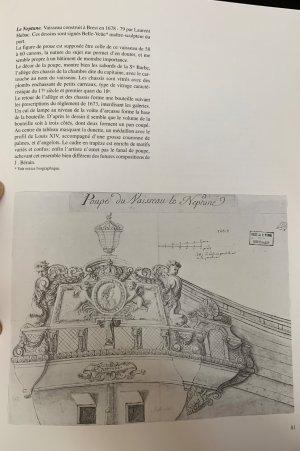
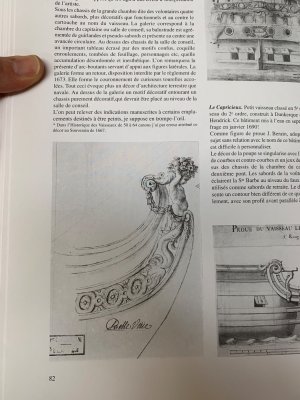
One can better appreciate the higher quality of these reproductions, as compared with thumbnails of the same images, on-line. Obviously, they provide important structural information, and the annotations of the original Album de Colbert explain variances between artistic representation and what is understood about the actual architecture of the time.

As any sort of developed plan set for individual ships of the 1660’s/70’s did not exist, the Album remains a key resource for extrapolating correct detail into subjects previously un-explored. For his part, Waldemar is providing us with the tools to arrive at correct hull geomotry.

These plates, though, are useful for other kinds of information. The ornamental oeuvre of Jean Berain is very well understood, as there are so many preserved examples of full ornamental programs of ships from 1688, onward.

Prior to that time period, though, ornamental resources are less well understood. The things I do presently, definitely fall more firmly in the category of artistic license than technical rigor, as I am always looking to strike a compromise between what is and what should be.

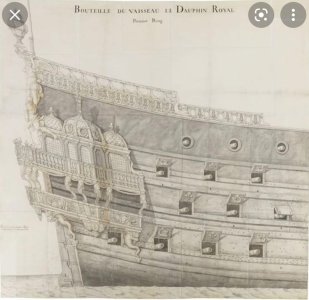
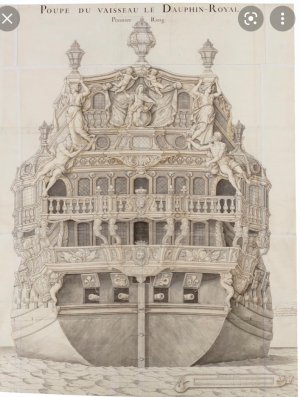
However, the geometric studies Waldemar has done, along with the contemporary resources mentioned and those not mentioned, make it possible to reconstruct a plausible hull form. For example, Tony DeVroude is quite successfully reconstructing the Dauphin Royal of 1668:

IMG_3414.jpeg
IMG_3411.jpeg

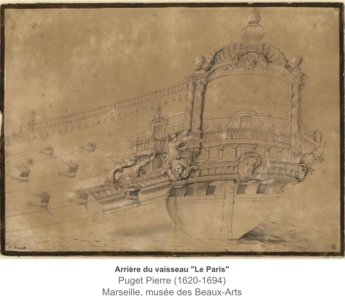
If I can design a plausible hull form, I can use what is known about the early ornamental program of Soleil Royal, and the Royal Louis, along with the drawings of Puget:

IMG_2486.jpeg
IMG_0182.jpeg
IMG_3398.jpeg

LeBrun:

IMG_1549.jpeg
IMG_8775.jpeg
IMG_2477.jpeg
IMG_2552.jpeg
IMG_2553.jpeg

Girardon:

IMG_0874.jpeg
IMG_0873.jpeg

Van Beecq:

IMG_2507.jpeg

Belle Veue:

IMG_2554.jpeg
IMG_3733.jpeg
IMG_3734.jpeg

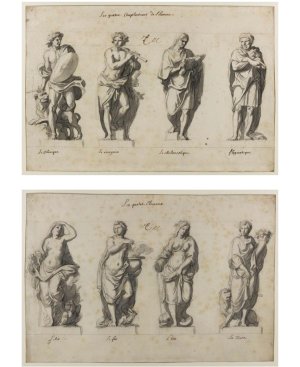
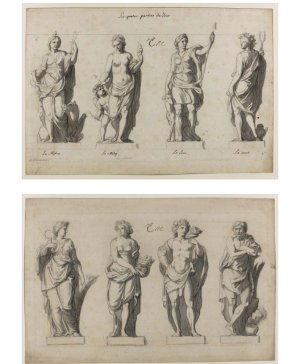
and, the Album to arrive at a fully coherent allegorical program that conveys something of the artistic style of the times. The beautifully drawn figures bracketing the captions on each plate of the Album, for example, corroborate elements of Puget’s Genoese influenced baroque style.

The things I do will always be artistic works of interpretation, but I do think one can arrive at a well-supported educated guess.
 
Last edited:
.​

Hi Marc. Yes, you’ve surprised me (in a good way) with your comment, in which you’ve aptly summed up my general intentions — many thanks :). I think that’s what spurred me on to take a look for any details regarding the mounting of the bowsprit at the available 17th-century French written sources as well.

Indeed, Georges Fournier, in his Hydrographie of 1643, does not have much to say on the subject:

“[…] le mast de beaupré est couché sur l’éperon […]” (i.e. “the bowsprit lies on the beakhead”; which most likely simply refers to the general position of this mast, unless by “beakhead” he meant “l’étrave”, i.e. “stem post”, but that is merely an interpretation).

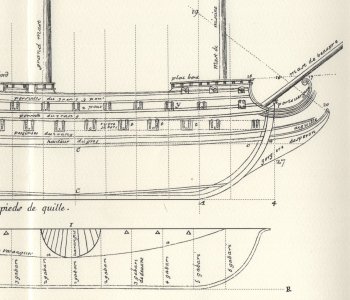
The entire passage concerning the definition of masts in the Fournier's Hydrographie, including the above-quoted fragment on the bowsprit, was copied verbatim by Dassié in Architecture navale of 1677. However, Dassié also includes in his work a schematic diagram displaying not only the bowsprit itself, but also a specific feature, namely the desired distance between the stem post and the bowsprit itself:


Le Navire de 115 pieds de quille par Dassié 1677 - Copy.jpg


In contrast, the description by François Coulomb in his 1683 manuscript is far more comprehensive and informative:

Le Mast de Beaupré sera placé audessus du premier pont. Il sappuye sur le mast davant et est soustenu par une guirlande à fin quil ne porte point sur le bout de l’Estrave […]” (original spelling) — “The Bowsprit will be placed above the first deck. It rests against the foremast and is supported by a breasthook so that it does not bear down on the tip of the stem post”.

By deduction, this must refer to a layout in which the bowsprit is above the stem post, rather than alongside it.

* * *​

Furthermore, in addition to French sources, there are also plans of French ships from this very period drawn up by the British, including the one below, most likely of the Triton from 1697, and pointed out by Martes, which shows yet another method of mounting the bowsprit on large ships:


Арх. 4172 = possibly Triton 1697.jpg


Generally speaking, it can probably be said that both of these somewhat different practices for securing the bowsprit were common to known Dutch practices of that era.


.​
 
Last edited:
That is interesting that the bowsprit was never intended to rest or bear down on the stempost. This had always been my assumption, but it makes sense that the heavily through-bolted breast hook should be the weight bearing structure, and that the fore stays would also help distribute the load.
 
.​

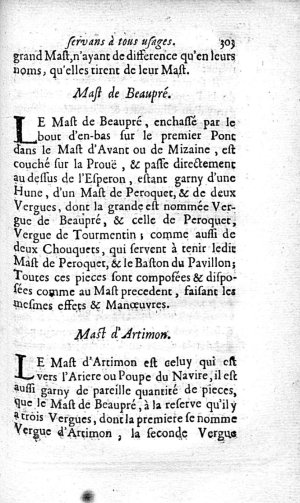
To supplement the above, here is a description of the bowsprit’s arrangement from a 1676 French work by Claude Caron, Traité des bois servans à tous usages, on the harvesting and use of wood. It also includes a fairly extensive chapter on shipbuilding. Admittedly, this particular passage does not add much new, but quoting it does at least no harm, unlike, for example, potentially misleading conclusions drawn solely on the basis of modern reconstructions and today’s model-building experience.

“The bowsprit, with its lower end fitted onto the first deck at the foremast, lies over the bow and runs directly over the beakhead [...]”.


Caron Claude  - Traité des bois servans à tous usages - 1676 - p. 303.jpg
.​
 
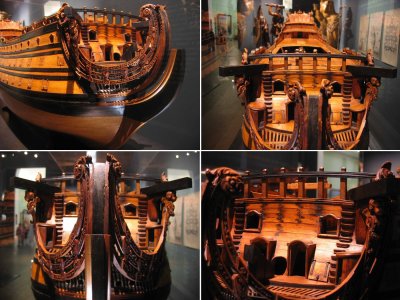
Hallo! I found this photo of the bow of the Soleil Royal on Wikimedia; it seems to me that the bowsprit is centred when you look at its position in relation to the railingsabove it.
However, there is no guarantee that the model is accurate, as it dates from 1839 (170 years after the SR was built)...

Soleil-Royal_img_0279.jpg
 
Hallo! I found this photo of the bow of the Soleil Royal on Wikimedia; it seems to me that the bowsprit is centred when you look at its position in relation to the railingsabove it.

However, there is no guarantee that the model is accurate, as it dates from 1839 (170 years after the SR was built)...

View attachment 584645
Hi; yes; it is the model from Tanneron made in apprx 1832; the bow especially would represent something closer to the 1692 Soleil Royal, having more common features with what was done at that period; it also probably was the closest information which Tanneron had to base his model structure on, the early ship's information has never been found, either because it burned in a huge fire in Brest at around 1675, or simply has never been actually archived, the master shipbuilders of the days not being keen or educated enough to make specific drawings and instead relying on their own experience and transmitting the knowledge to their son(s).....
 
.​


Oh, you must have seen them, since you even left your signature next to them:


One can add other plates from the same album to those as well. The upper one, in particular, nicely illustrates a certain structural feature that was explicitly mentioned in the 1683 Toulon manuscript.


.​
Is that the bow or the stern? I think someone is pulling your leg about the off set bowsprit. I have never see n anything like that.
 
Is that the bow or the stern? I think someone is pulling your leg about the off set bowsprit. I have never see n anything like that.
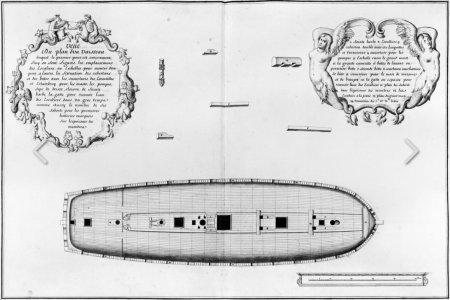
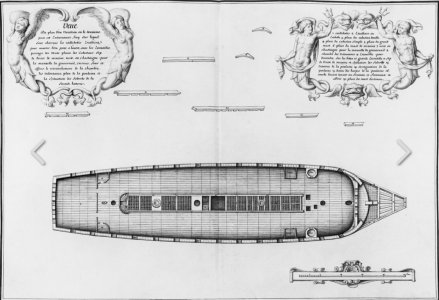
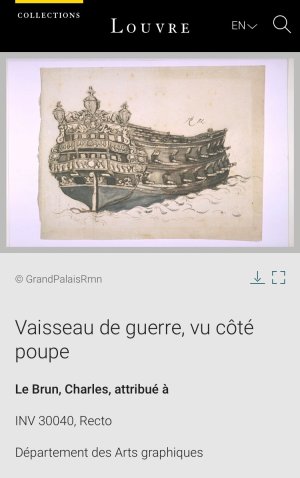
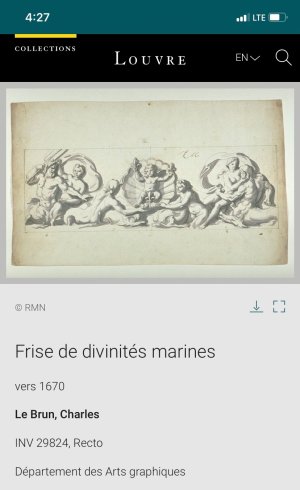
The first pic is a side view from a ship plan in the Admiral de Paris book part 3 if I remember....The second pc is the stern of a ship apparently drwn by Colbert, and found in his monography, a quite old book... As for a bowsprit offset, you have a very good example a little higher in this log showing the bow of a carrack.....
 
Ahhh Ha! I spoke too soon. Honestly I have never even heard of such a thing untill today. I am completely fubblemumblled by what I see here. However they do say that the tip of the bowsprit does come back to the ships centerline at the outboard end. That is odd construction.
 
Just to add to the information here, Google AI gave this information:

Off-center bowsprits were a common feature on16th-century sailing ships, particularly on galleons and large carracks. This design allowed the bowsprit to lie alongside the stempost rather than cutting through it, which simplified construction and permitted the spar to be retractable, a feature often used on smaller vessels.
Ships of ScaleShips of Scale +3
Reasons for Off-Center Bowsprits in the 16th Century
  • Structural Simplification: By placing the bowsprit to one side (usually starboard) of the stem post—the main timber running up the center of the bow—shipbuilders avoided the need to cut a hole through this critical structural piece, strengthening the bow.
  • Retractability: The offset allowed the bowsprit to be slid inboard and stored safely on deck during storms, when in crowded harbors, or when mooring to prevent damage.
  • Balancing the Rig: While the heel of the bowsprit was mounted off-center on the deck/forecastle, the outboard end was often angled slightly toward the center line to maintain a functional center of effort for the rigging, allowing for proper tension on the spritsail.
  • Accommodating the Forecastle: The high, thick forecastles of 16th-century carracks meant the bowsprit was often mounted atop this structure, sometimes requiring it to be offset to fit alongside other deck structures.
    Ships of ScaleShips of Scale +3
Characteristics in the 16th Century
  • Angle of Attack: Early bowsprits had a high angle of "steeve" (upward angle) and were designed largely to secure the forestays of the mainmast, rather than just acting as a platform for jib sails.
  • Spritsail rigging: A square spritsail was commonly flown beneath the bowsprit to assist in maneuvering.
  • Transition to Centerline: As ship design evolved, particularly toward the mid-17th century and beyond, the bowsprit often moved to the centerline as ships became more specialized for speed and maneuvering against the wind.
    Model Ship World +4
While some reproductions or model ships may show the bowsprit directly on the centerline for modern aesthetic reasons, historically accurate 16th-century models and paintings often show a pronounced starboard offset, a design that continued in many types of vessels into the 19th century.
A Golden Hind build here on SoS clearly shows and discusses the offset spritsail, and it's mentioned that it should be angled to the center at the tip.

An excellent video on How a 16th Century Sailing Ship Works clearly shows the offset bowsprit and why it's necessary, but doesn't mention it. The guns look a bit too modern in the video for me, though.

Finally, it should be noted that many modern sailing ships have the bowsprit mounted off-center, for exactly the same reasons as above, as discussed here.

1773710743604.jpeg
 
.​
The first pic is a side view from a ship plan in the Admiral de Paris book part 3 if I remember...

Actually, this isn’t a plate from admiral Pâris’s late 19th-century publication, but one of the plates from the so-called Album de Colbert from the late 17th century. Incidentally, the two-century gap means that any of the admiral’s reconstructions are not even formally suitable as a reliable source.


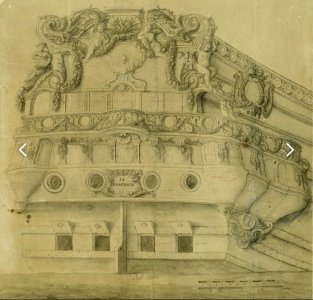
The second pc is the stern of a ship apparently drwn by Colbert, and found in his monography, a quite old book...

The so-called Colbert Album is a collection of illustrations depicting a large warship under construction, none of which were drawn by Colbert, the Minister of the Treasury and Navy, himself. This particular plate depicts a view from the bow rather than the stern, which is, in fact, confirmed by the clearly legible caption on this very plate: “Veue de la Proue d'un Vaisseau a l'ancre [...]” (“View of the Bow of a Ship at anchor [...]”).


As for a bowsprit offset, you have a very good example a little higher in this log showing the bow of a carrack...

Just as with admiral Pâris’s late 19th-century reconstructions, 21st-century reconstructions should certainly not be cited as a source for, say, the medieval and early modern periods, and their accuracy or inaccuracy from a technical standpoint does not alter this scholarly principle.


Just to add to the information here, Google AI gave this information:

Google AI also provided the following information:


The Soleil Royal is neither a 16th-century carrack nor a galleon, but rather a 17th-century French ship of the line. Launched in 1669, she was a 104-gun first-rate flagship of King Louis XIV's navy, built later than the carrack/galleon eras to lead the fleet during the Nine Years' War.
(Facebook +4)
  • Period: She was built between 1668 and 1670 in Brest, France, putting her squarely in the late 17th century, not the 16th century.
  • Type: As a "ship of the line," she represents a more advanced, purpose-built warship design designed for line-of-battle tactics, rather than the heavily-laden carrack or earlier exploratory galleons.
  • Significance: She was known as one of the most powerful and heavily decorated warships of her era, serving as Admiral Tourville's flagship.
    (Facebook +4)

.​
 
I guess I've been sleeping all these years. It says the offset bowsprit was very common in the 16th century but I sure must have forgotten all about this. That was a long time ago,right? I was probably only a bilge rat back then. Actually this is very interesting so bring on the comments.
 
Actually this is very interesting so bring on the comments.

One can be sure that you yourself have something valuable and useful to say on this matter. Perhaps you’ll decide to give it a go, just like others here are trying? Just please remember to provide source evidence.
 
Back
Top