• Win a Free Custom Engraved Brass Coin!!!
    As a way to introduce our brass coins to the community, we will raffle off a free coin during the month of August. Follow link ABOVE for instructions for entering.

Buccaneer 1:100 by Occre - Build log

Great build log. I’m working on the Albatros right now, which is my first ever build. I’m making a lot of mistakes, but learning a lot. The Buccaneer will be my second build. As a matter of fact, I just ordered it today. Your build log should help out a lot when I start. By the way, I grew up in Lakewood and my parents are still there. I’m in Brighton. Well, at least until next June when my wife retires. Then it’s off to Florida.
 
Great build log. I’m working on the Albatros right now, which is my first ever build. I’m making a lot of mistakes, but learning a lot. The Buccaneer will be my second build. As a matter of fact, I just ordered it today. Your build log should help out a lot when I start. By the way, I grew up in Lakewood and my parents are still there. I’m in Brighton. Well, at least until next June when my wife retires. Then it’s off to Florida.
Glad it’s been helpful. There have been a number of mistakes, but I’ve learned a lot along the way.
I know Brighton is a bit away, but there is a club in town… the Rocky Mountain Shipwrights. We meet twice a month. Our workshop is the 1st Saturday of the month at the Arvada Police station and our monthly meeting is the 3rd Saturday of the month at Rockler Woodworking. Check us out at https://rockymountainshipwrights.org/.
 
10/11/25 to 11/10/2025
Greetings from Puerto Vallarta, and welcome back to my Molino build after our five month stay in Colorado (and my Bluenose build).

I’ll be carrying on with my less wordy and condensed build log but will include the full unredacted build log as a pdf for those (hi mom) who want it.

Some of the pictures were right after I completed a step and before the glue had dried, so it is still visible. I’ve found out that if I wait to take pictures of a step until the glue has dried, I tend to forget about taking pictures.

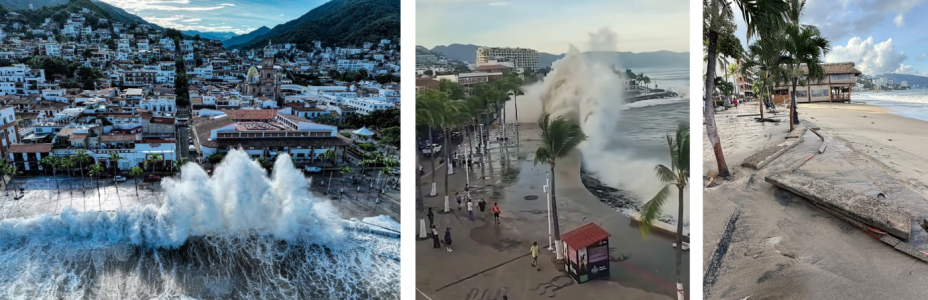
When we got here, Hurricane Pricilla was offshore and heading out to sea when we got here but the waves it caused crazy… beautiful but crazy. Lots of sand, rocks, and water up on the malecón along with some damage to the businesses right along the coast. Do a search for “Hurricane Pricilla in Puerto Vallarta” to get an idea of what it was like. The weather was great, but the waves were bad for a few days.
storm combo1.png
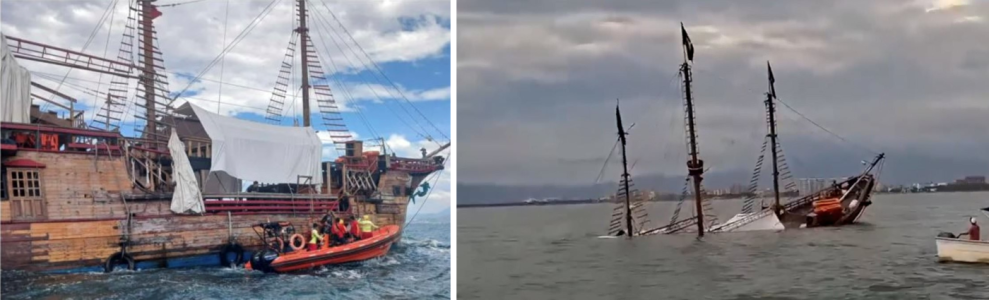
Another casualty (unrelated to the hurricane and waves) was the whimsical pirate ship Marigalante.
Marigalante combo2.png
The Marigalante is the reason why I am building the Molino as I wanted to build something Mexican themed as whatever I chose would become part of the condo’s decorations once it is complete. When I asked my wife what she thought I should build, without missing a beat, she said “a pirate ship.”

Now onto the build…

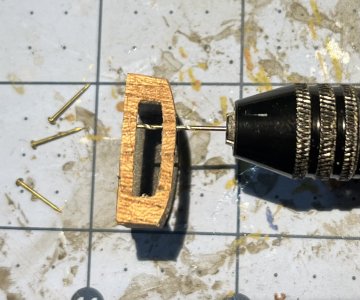
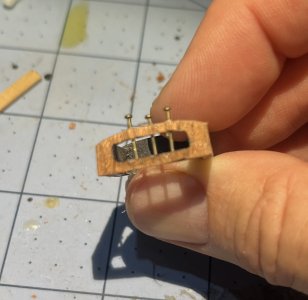
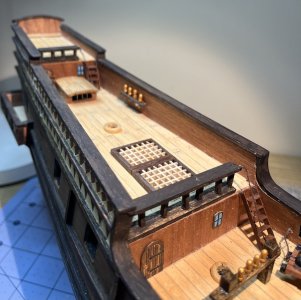
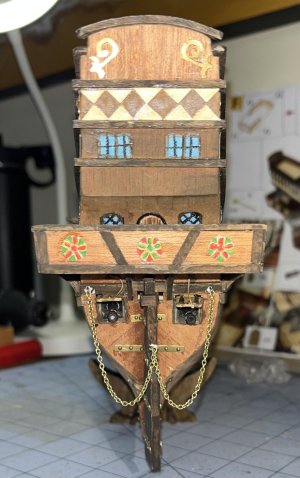
First up is the rudder cockpit.
IMG_4843.jpg

IMG_4848.jpg

IMG_4863.jpg
Time for some introspection… I had made a skylight for my Bluenose that had bars on the openings. And while I was happy with the way it turned out, I will be looking to see how difficult it would be to re-do the skylight using a similar technique as I did with the nails.

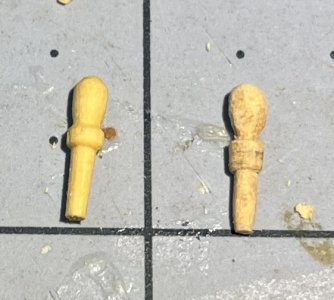
Onto the pin rails of which I was somehow missing one of the eight and had to fashion one out of wood that I have down here.
IMG_4853.jpg

After all is said and done, it is pretty much undetectable (it is the 2nd from the front - I think).
IMG_4862.jpg
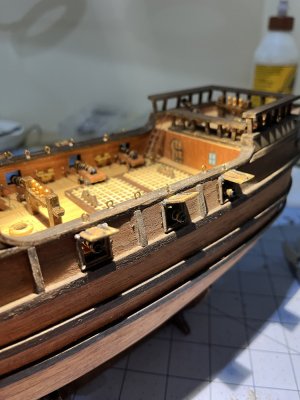
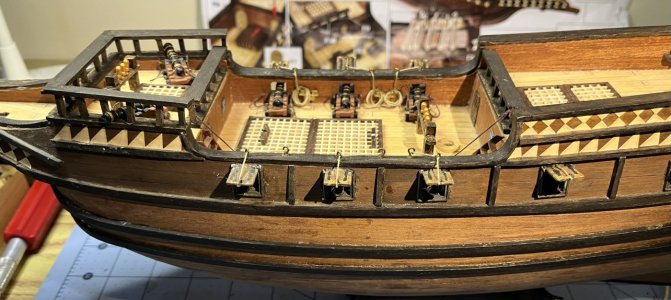
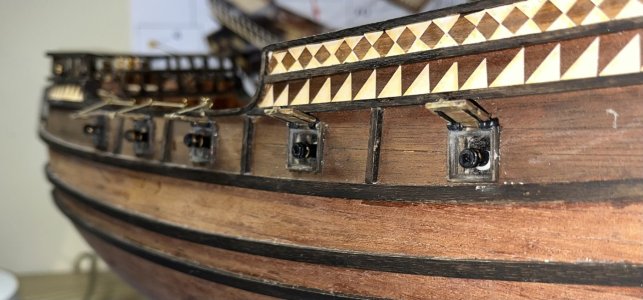
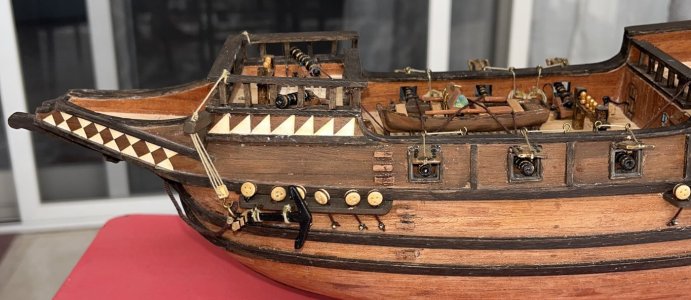
The cannon port frames and lids are up next. My mother-in-law gave me some money as a present with the sole intention of buying something for my ship. Alice passed away last Halloween, but the frames will be going on now. So, a big shout out to her!

I decided to add lanyards to them as well. I know my routing of them up and over the railing would not actually work, but there wasn’t room to drill a hole and just feed it through.
IMG_4935.jpg

lid lanyard combo.png

IMG_5065.jpg

IMG_5087.jpg

IMG_5090.jpg

IMG_5091.jpg
Next up… the deadeye platforms which I believe are called channels. The channel and deadeyes are, at least to me, the start of the overall rigging process.

Time for this portion: 12.5 hours
Total time to date: 216.5 hours
 

Attachments

11/11/25 to 11/23/25
I’ll be carrying on with my less wordy and condensed build log but will include the full unredacted build log as a pdf for those who want it.
Next up are the chainplates and their channels. And that got me thinking about rigging, and more accurately, the fact that I have not yet done any rigging.

But why do chainplates make me think about rigging?

I been told that the rule of thumb in standing rigging is shrouds, then ratlines, and then the stays.

But the shrouds must be connected to the lower deadeyes , so is not the order: chainplates, lower deadeyes, shrouds, ratlines, and finally the stays?
I am following my modified rule of thumb and hence, I will now be starting the rigging of my Molino with the installation of the channels, lower deadeyes, and the chainplates.

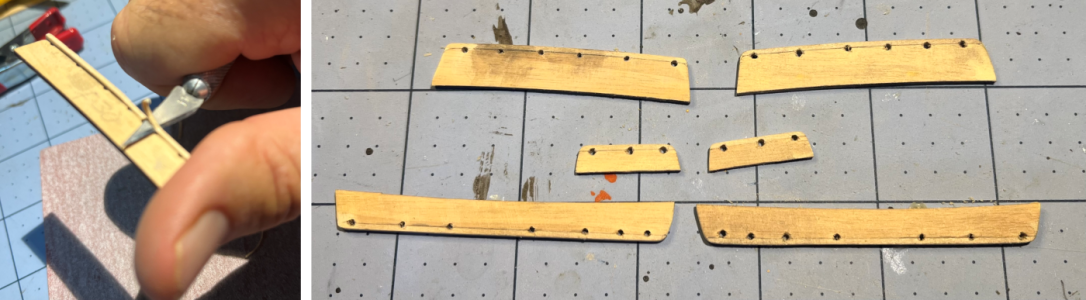
I am going to follow a few other builders and after cutting out and sanding the six channels, I will be adding a thin board to the outside of them to make them look more finished.
channels.png
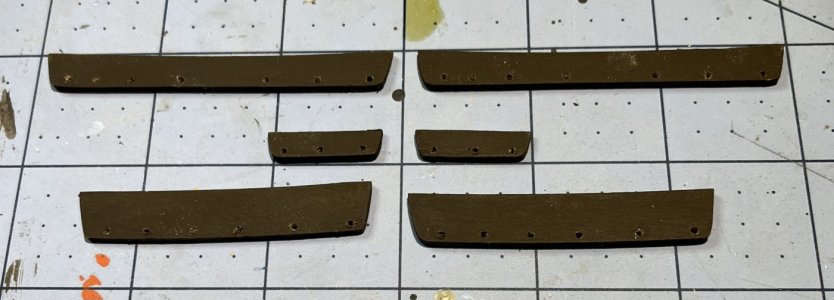
After a light sanding, they get painted with two coats of a homemade Judea Bitumen mix.
IMG_5108.jpg
The channels are then glued to the hull.

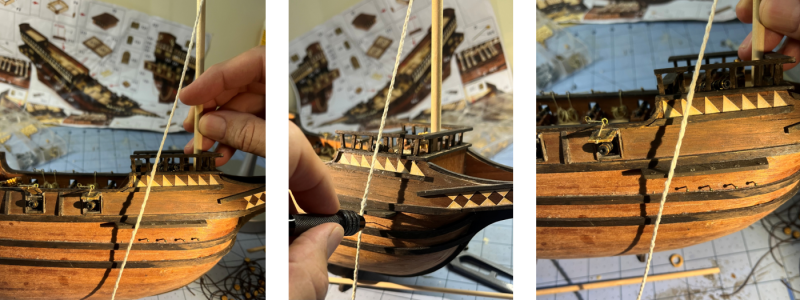
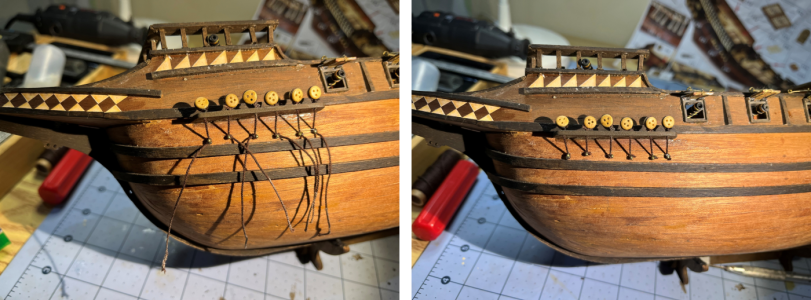
I plan on putting Molino’s rope chainplates at slight angles to give the overall shroud as much strength as possible and to keep the overall shroud as straight as possible from the hound through to the end of the chainplate. One straight line.

Keeping with the straight-line theory, each shroud will get a bit more angled the further away from the mast it is and those closest to the mast will be closest to being 90 degrees. This means the chainplate closest to the mast will be pretty much straight up and down and each one as you move aft becomes a bit more angled.

This is part of why I say the rigging begins with the chainplates and lower deadeyes. The angle of the chainplates on our models is many times a best guest approximation since the masts have not yet been installed.

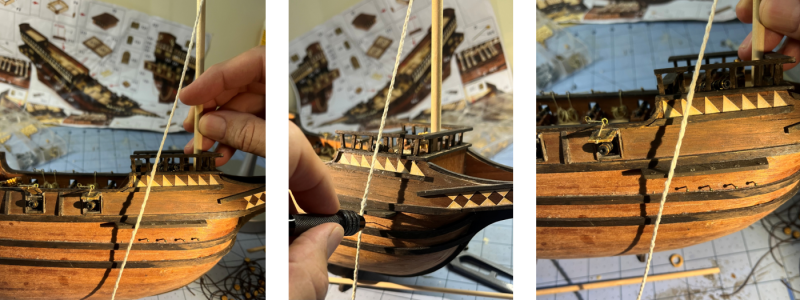
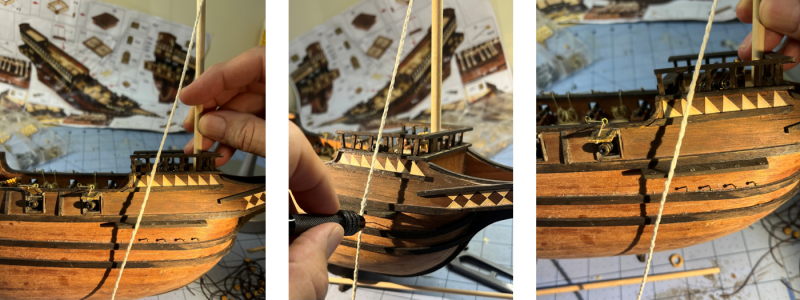
To estimate the height of the hound, I put a small mark on the mast and tape a string where the hound should be. Holding the mast as straight up and down as possible (the Molino’s masts are not raked), I gently pull the string so it lines up with the hole for the chainplate. I put a mark approximately 3/4” below the channel in line with the string. Using a pin vise, I drill a 0.3mm hole at the mark and then insert a small brass nail into it. I tap it in until it is about 1/2 way in and then move onto the next one.
chainplate combo1.png

deadeyes combo.png
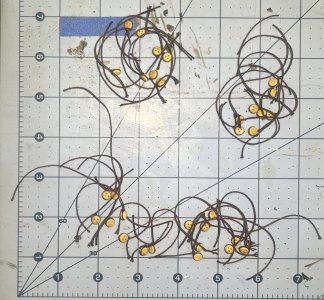
I create 32 chainplate and lower deadeyes.
IMG_5128.jpg
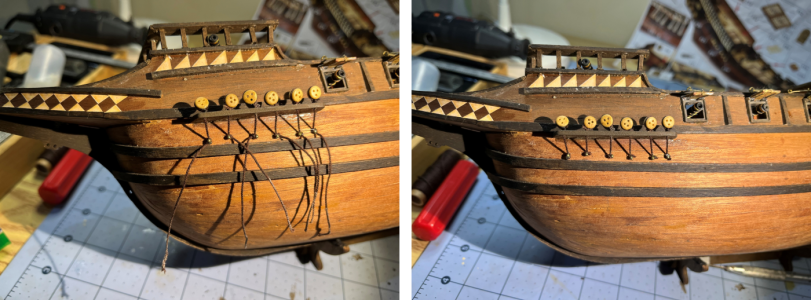
I feed each chainplate through one of the holes on the channels.

Each is tied off using a half hitch around its nail and the line is tightened.

Each knot gets a drop of fabric glue at the knot at the nail.

Once the glue is dry, I push and or tap each nail in until it bottoms out at the hull.
chainplate combo2.png
I cannot wait until I continue with the rigging.

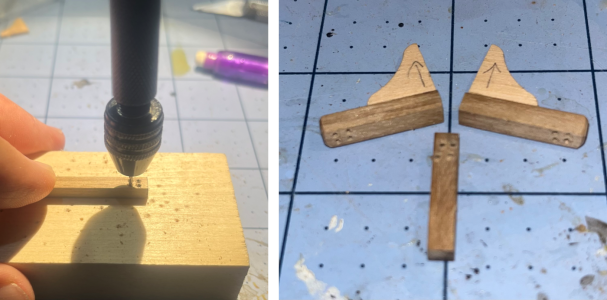
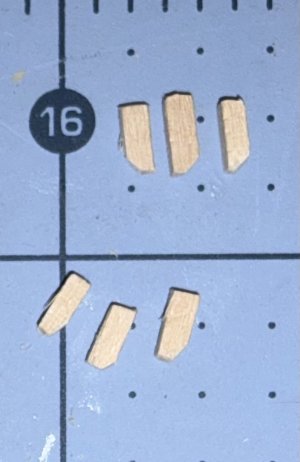
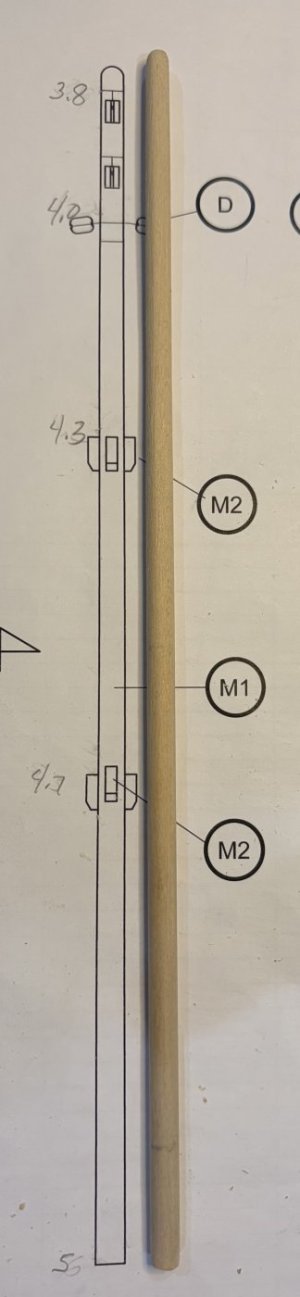
The anchor davits are created using a 4mm x 4mm board that is attached to a piece of laser cut wood. All straightforward except that one tip of the 4 x 4 needs four 1mm holes drilled in them. Doable, but a drill press of some sort would have been helpful (again).

The tips near the holes are sanded at slight angles, and the two pieces are glued together.

One dried and after a light sanding, they get painted with two coats of my homemade Judea Bitumen mix.
davits1.png

davits2.png
Part F of OcCre’s instructions is complete.

Time for this portion: 11 hours
Total time to date: 227.5 hours


chainplate combo1.png

chainplate combo2.png

chainplate combo1.png
 

Attachments

11/23/25 to 12/7/25
I’ll be carrying on with my less wordy and condensed build log but will include the full unredacted build log as a pdf for those who want it.

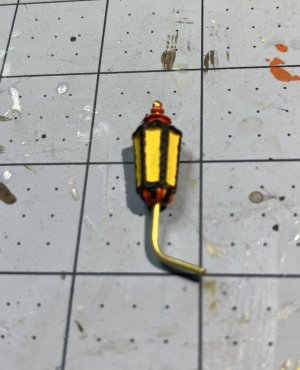
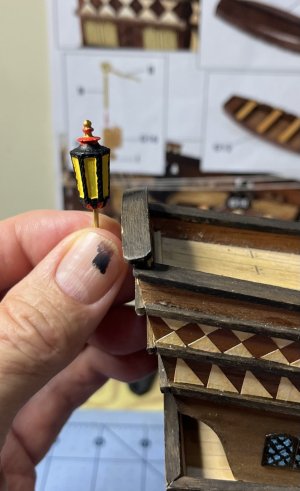
Starting with step G, the first task was the stern lantern.
IMG_5260.jpg

IMG_5259.jpg
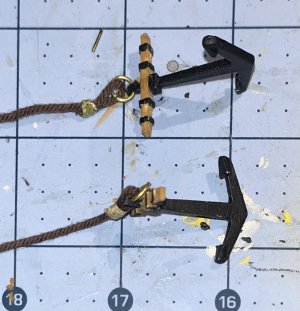
The anchors are next, each made of two pieces of Britannia metal, which required significant sanding. I painted the shanks and associated parts black, while the stocks were painted medium brown with black bands.
IMG_5285.jpg
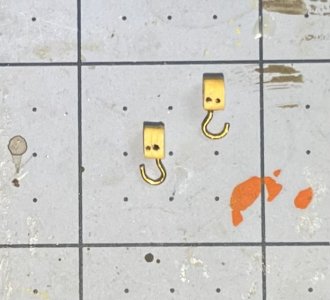
After gluing the anchor together, I opted to make a hook to connect it to a double block, as would be used on a galleon, instead tying it to the anchor as detailed in the instructions.
IMG_5274.jpg
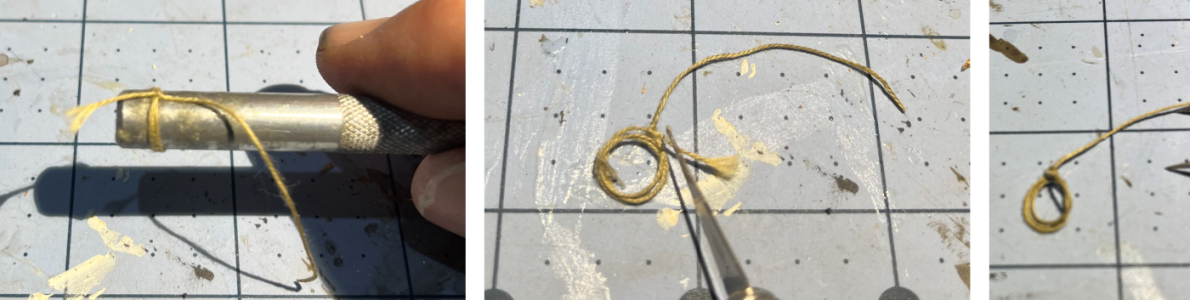
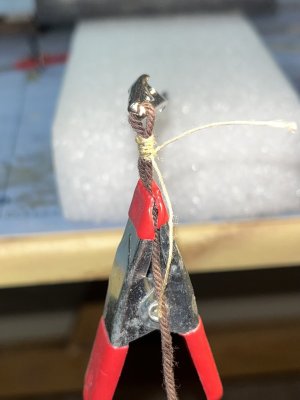
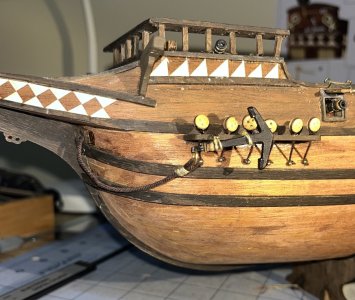
The anchor rope goes through the ring and is seized to itself, marking it as my first attempt at seizing. Instead of tying the anchors to the front channels as instructed, I added two ring bolts to each channel and tied the anchors off to them.
IMG_5275.jpg

IMG_5290.jpg
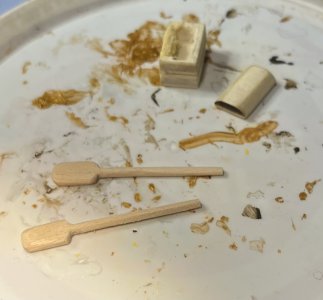
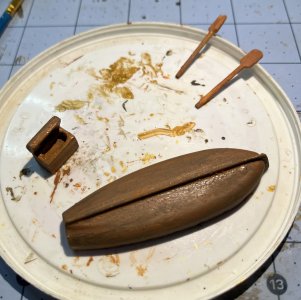
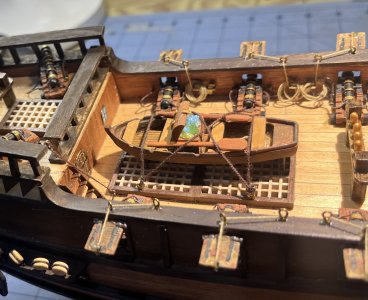
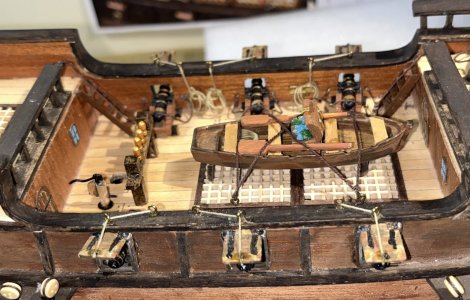
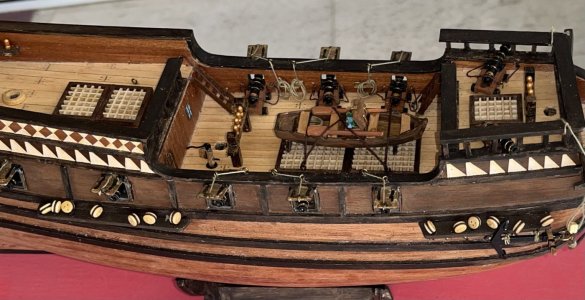
Moving on to the lifeboat, I glued on the four benches, then, I added two oars, a rope coil, and a treasure chest. After all, it is a pirate ship.
IMG_5304.jpg

IMG_5305.jpg
The treasure is tiny bits of sea glass I found on the beach (another hobby of mine).

After arranging and gluing the boat's accessories, I drilled four holes for the eyebolts to tie down the lifeboat. On the third hole, my pin vise broke, so I used a Goxawee (Dremel) for drilling.
IMG_5307.jpg
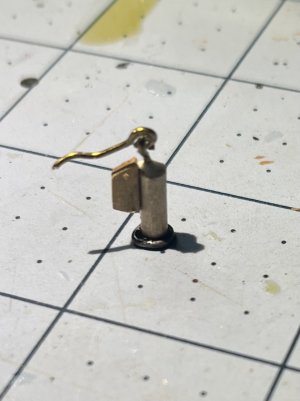
Lastly, I worked on the bilge pump.
IMG_5318.jpg

IMG_5322.jpg
That does it for section G; rigging begins next. Since I only have about a week left in Mexico, I will hold off on starting it. I will look through all my notes to see if there was anything else that I wanted to do that was outside of the instructions.

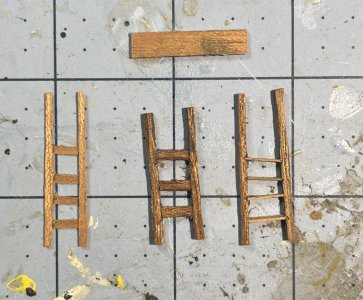
One of the things I have wanted to add for a while is a “plank.” Ok, I know they did not really exist, at least did not exist in mass, but I wanted one. So, after a little research about what they may have looked like, I had to find a place for it. The best place was on the starboard side of the main deck, between the front two cannons. The plank was the easy part, (three pieces of veneer glued together) but I needed a ladder of some sort that the victim would have to climb to get to the plank. I made three different ladders and did not like any of them. So, I am not sure if I will add it or not. Only time will tell.
IMG_5347.jpg
The next thing I wanted to add was a pilot ladder on the hull. I decided on it being placed on the main deck on the port side, right by the stairs to the fo’c’sle or foredeck. So, a person would climb up the “ladder,” then step onto the channel, then climb up and onto the ship. They would then step onto the stairs to get to the deck. I have seen ropes that were either attached or thrown over when people were boarding. I will have to decide if I want them or not.
IMG_5361.jpg
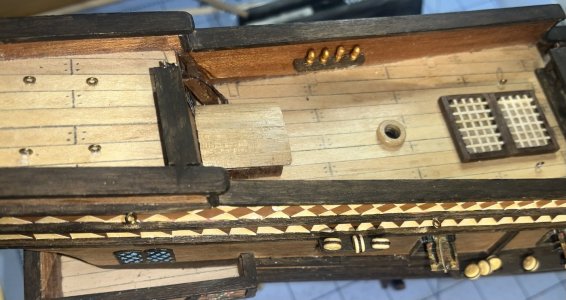
Next up are the eyebolts located at various locations around the ship; 2 on the quarter deck, 4 on the poop deck, and 4 on the bulwarks (2 per side).
IMG_5343.jpg
The biggest challenge with the eyebolts is that my pin vise is under the weather so drilling the 10 holes will take a little bit longer than they should.

The McGuyvered pin vise worked well enough to drill the 10 holes, and then I glued an eyebolt into each one.

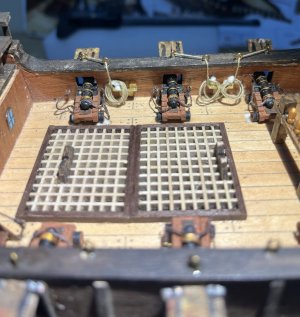
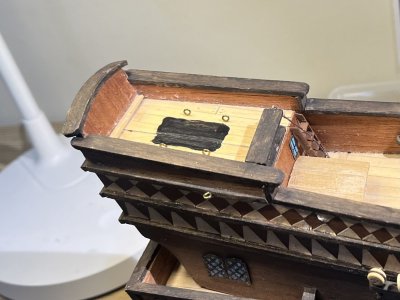
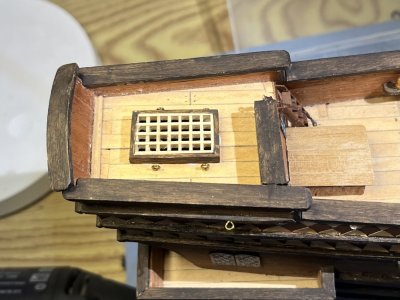
Last up of my list of “extras” is the “extra” grate up on the poop deck between the eyebolts. I saw this on Baltic Submariner’s build log on Model Shop World. I know on a real ship this would not be a suitable location for a hold, but this ship is not real so I can do whatever I feel like. And I like the look of it. Without it, the poop deck would be completely empty space.

I tried several of the leftover pieces of grate and found one that is 15mm x 25mm. I sand the edges and trim them off with some walnut lumber and put a coat of satin varnish on it. Before glueing down the grate, I paint the deck that will be covered by the grate black to give it some depth
IMG_5351.jpg
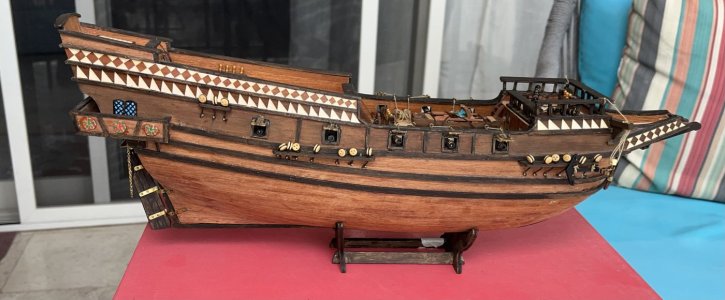
After it is glued in place, my work on the Molino is done for this trip, and she will shortly be put away in the closet.
IMG_5352.jpg

IMG_5356.jpg

IMG_5358.jpg
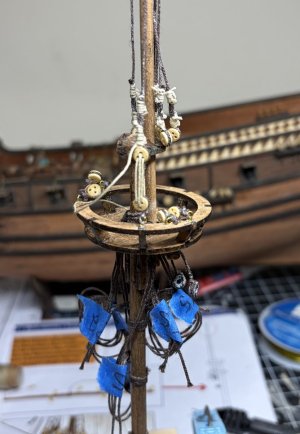
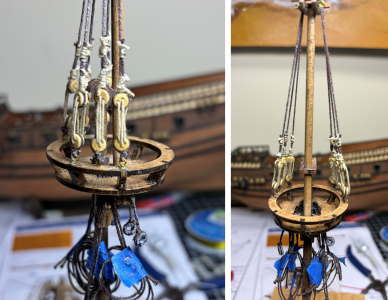
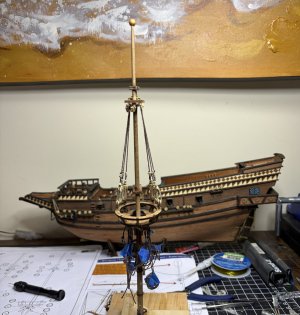
Our next trip is at the end of February, so only about two and a half months, at that point, I will finally get to begin my first work ever on the masts and rigging.

Time for this portion: 15.5 hours
Total time to date: 243.0 hours
 

Attachments

11/23/25 to 12/7/25
I’ll be carrying on with my less wordy and condensed build log but will include the full unredacted build log as a pdf for those who want it.

Starting with step G, the first task was the stern lantern.
View attachment 562670

View attachment 562671
The anchors are next, each made of two pieces of Britannia metal, which required significant sanding. I painted the shanks and associated parts black, while the stocks were painted medium brown with black bands.
View attachment 562672
After gluing the anchor together, I opted to make a hook to connect it to a double block, as would be used on a galleon, instead tying it to the anchor as detailed in the instructions.
View attachment 562673
The anchor rope goes through the ring and is seized to itself, marking it as my first attempt at seizing. Instead of tying the anchors to the front channels as instructed, I added two ring bolts to each channel and tied the anchors off to them.
View attachment 562674

View attachment 562675
Moving on to the lifeboat, I glued on the four benches, then, I added two oars, a rope coil, and a treasure chest. After all, it is a pirate ship.
View attachment 562676

View attachment 562677
The treasure is tiny bits of sea glass I found on the beach (another hobby of mine).

After arranging and gluing the boat's accessories, I drilled four holes for the eyebolts to tie down the lifeboat. On the third hole, my pin vise broke, so I used a Goxawee (Dremel) for drilling.
View attachment 562678
Lastly, I worked on the bilge pump.
View attachment 562679

View attachment 562680
That does it for section G; rigging begins next. Since I only have about a week left in Mexico, I will hold off on starting it. I will look through all my notes to see if there was anything else that I wanted to do that was outside of the instructions.

One of the things I have wanted to add for a while is a “plank.” Ok, I know they did not really exist, at least did not exist in mass, but I wanted one. So, after a little research about what they may have looked like, I had to find a place for it. The best place was on the starboard side of the main deck, between the front two cannons. The plank was the easy part, (three pieces of veneer glued together) but I needed a ladder of some sort that the victim would have to climb to get to the plank. I made three different ladders and did not like any of them. So, I am not sure if I will add it or not. Only time will tell.
View attachment 562681
The next thing I wanted to add was a pilot ladder on the hull. I decided on it being placed on the main deck on the port side, right by the stairs to the fo’c’sle or foredeck. So, a person would climb up the “ladder,” then step onto the channel, then climb up and onto the ship. They would then step onto the stairs to get to the deck. I have seen ropes that were either attached or thrown over when people were boarding. I will have to decide if I want them or not.
View attachment 562682
Next up are the eyebolts located at various locations around the ship; 2 on the quarter deck, 4 on the poop deck, and 4 on the bulwarks (2 per side).
View attachment 562683
The biggest challenge with the eyebolts is that my pin vise is under the weather so drilling the 10 holes will take a little bit longer than they should.

The McGuyvered pin vise worked well enough to drill the 10 holes, and then I glued an eyebolt into each one.

Last up of my list of “extras” is the “extra” grate up on the poop deck between the eyebolts. I saw this on Baltic Submariner’s build log on Model Shop World. I know on a real ship this would not be a suitable location for a hold, but this ship is not real so I can do whatever I feel like. And I like the look of it. Without it, the poop deck would be completely empty space.

I tried several of the leftover pieces of grate and found one that is 15mm x 25mm. I sand the edges and trim them off with some walnut lumber and put a coat of satin varnish on it. Before glueing down the grate, I paint the deck that will be covered by the grate black to give it some depth
View attachment 562684
After it is glued in place, my work on the Molino is done for this trip, and she will shortly be put away in the closet.
View attachment 562685

View attachment 562686

View attachment 562687
Our next trip is at the end of February, so only about two and a half months, at that point, I will finally get to begin my first work ever on the masts and rigging.

Time for this portion: 15.5 hours
Total time to date: 243.0 hours
Have a good vacation Hugh! Magic Mike
 
Back
Top