


• Win a Free Custom Engraved Brass Coin!!!
    As a way to introduce our brass coins to the community, we will raffle off a free coin during the month of August. Follow link ABOVE for instructions for entering.
  • PRE-ORDER SHIPS IN SCALE TODAY!

    The beloved Ships in Scale Magazine is back and charting a new course for 2026!
    Discover new skills, new techniques, and new inspirations in every issue.

    NOTE THAT OUR FIRST ISSUE WILL BE JAN/FEB 2026

Cutty Sark, Vintage Billing Boats BB564, 1:75.

Part 36: The Bumpkins

The masts and yards are a “work-in-progress” mainly because the space I use to do my spray painting is unheated and it’s been too cold to work in there! As soon as it warms up a little bit, I will finish painting and varnishing them and fit the iron works before I post an update.

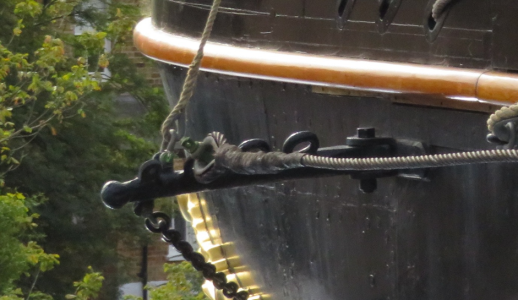
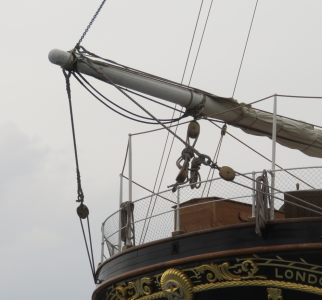
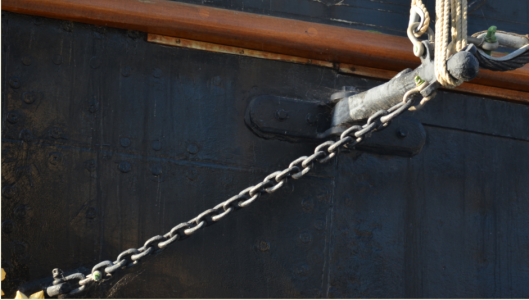
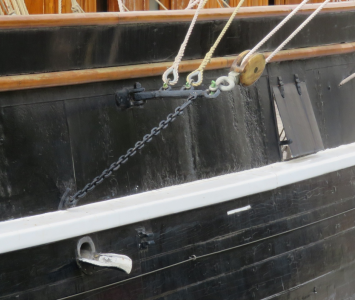
In the mean-time I have been working on some of the detail parts that I need to finish off the hull. One thing I was not decided on were the bumpkins. They are stout hinged rods that are used to secure the lower braces. There are two pairs, one set amid ships and one set on the rear quarter (see images for reference). A short chain guy attached to the hull takes some of the pull of the braces. They are hinged so that they can be folded against the hull when in harbour. The mid and rear bumpkins are not the same (Longridge says they are), the rear set being slightly longer and having more eyes. Kevin at KTL sent me some very nice, printed versions but, I decided that there was a 100% chance of me catching and snapping them or breaking the rings, so I decided to make some from brass using Kevin’s printed versions as a guide.
1769369826990.png
The mid-bumpkin

1769369853492.png
The rear quarter-bumpkin

The rings are roughly angled at 45° to be in line with the braces and guys so they are mirrored pairs port and starboard.

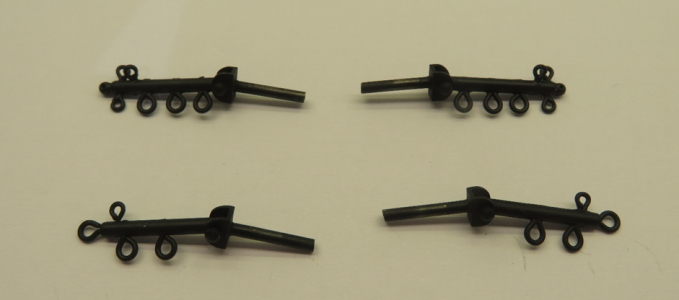
I used some 3mm x 3mm brass C channel for the bracket and 2mm brass rod for the bumpkin rods (the front bumpkin is 15mm long and the rear 16mm). I tried soldering a short rod to the back of the brackets for fixing them into the hull but had some trouble getting a strong enough joint so, I used a micro tap and die to create some threads and screwed the rod into the rear of the bracket, ran a small mill cutter down the channel to take off the protruding end and then locked it with some CA. I drilled out the holes for the hinge pins and eyes in the rod, cleaned and blackened everything up, fitted them together and gave them a coat of black paint. It was rather fiddly work, and several ended up in the bin but they came out OK in the end.
1769369948404.png
The completed bumpkins


Next up:
Finish off the painting and iron work for the masts and yards.


That’s impressive work at that scale. You have me thinking now that maybe I should take a look at putting a brass or CF stiffener in the rod.
Hi Kevin, thanks for the resin prints, they were really useful to use as templates. Longridge does not give the dimensions and the ones in his book are not the same as the ones on the ship now. They came out very nice but it did take me quite a long time to make the set!
 
You're welcome. I largely based mine on my photos, given Campbell just does a rough sketch. I always had it in mind to glue mine on at the last possible moment. The trouble with a plan like that is that there are so many delicate details at these scales that you can get a bit stuck. When I do go back to finish off the model, I'll probably just put bubblewrap or styrofoam around all the vulnerable areas and hope for the best. At least in my case, breakage is just a nuisance as I can usually easily make replacements..
 
Part 37: Progress on the Lower Masts

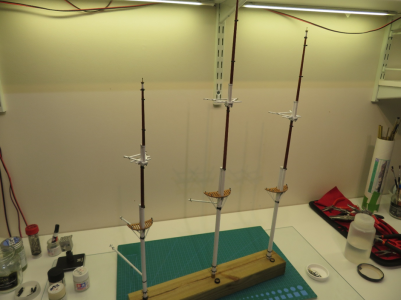
Whilst I am working on the yards, I also needed work out what fittings are needed on each of the masts so that I could position the trusses correctly. To index the masts, I marked a centre line and inserted some 0.5mm brass pegs at the top and bottom to serve as the fore/aft reference orientation. All the lower masts sections are similar as can be seen in the image of the fore mast. Each mast has two eye bolt bands above the foot. The foot is taller on the main and the bands are positioned slightly higher to avoid the bilge pump.

Foremast Lower Mast Bands and Mast Foot (but similar on all masts)

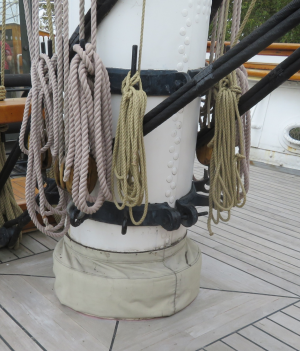
The lower iron band sit just above the mast foot and there is an upper spider band that is used for belaying about 4ft above the deck (17-20mm at scale). I used some 0.3mm thick brass strips 2mm wide and a cut-off brass nail to clamp the band. There are x8 vertical eyes per mast for the lower band (for the purchase blocks) and x8 eye sockets on each of the spider bands for taking belaying pins. The mast foots can be made from some dowel sections slightly larger than the mast diameter which I scaled to 3mm high fore/mizzen and 5mm for the main. The mast foots were normally covered in canvass and tarred to form the seal, so a matt black finish is appropriate.

1769859125849.png

I have already made a few parts for fitting out the masts but I also needed to make the cheeks and the futtock shrouds for the tops. I referred to Longridge’s descriptions because the Billing plans are very basic and do not have this detail. I posted some images of the masts tops in Part 33 that are well worth studying carefully as they contain a wealth of detail. I am not super-detailing the masts but instead I have opted for a “half-way-house” using some of the yard trusses and the goose necks from the kit and making some of the other fittings according to Longridge.

The cheeks: are positioned on the fore-side of the mast (Billing shows them on the sides). Longridge gives the measurements for the length of the cheeks as 6ft fore/main and 5ft for the mizzen (23mm for the fore/main and 20mm for the mizzen at scale size) as measured from the bottom of the tops. They are thin curved plates which are angled at the top corresponding to the mast rake so that when stepped, the tops are level with the keel. I opted to make them from 1.2 mm sapele and I milled some shallow rebates (0.5mm) down the mast using a 1mm mill cutter so that the cheeks fitted neatly to the mast at the correct separation.

Note: the main course yard truss is also the gooseneck for the Spencer Gaff, but I opted to use two trusses, although it would have been easy enough to solder both on to one truss. Similarly, the gooseneck for the spanker boom and cross jack truss are one piece on the ship but I used two.

The futtock shrouds: are steel rods which pass through the main top and are connected to lugs below the lower yard truss. Billing uses thread but I decided to make them from 0.5 mm brass rod to strop the deadeyes in much the same way as for main rails. The easiest way to fix the end at the mast was to drill some holes for the rod.

Chain slings: all the lower yards are supported by chain slings so it was easy to fit an eye on the mast just below the lower top between the cheeks that I can hang the chain from.

I am glad that I took my time setting up the brass mast sockets when I built the hull - a very wise move! Having the sliding brass tubes on the masts made it very easy to work on the masts and then slide them into the hull to check everything lined-up and the tops were at the correct angles.

Painting: According to Longridge and Campbell, the Lower Masts are painted all white. The Top Gallants and Royals are varnished. Fittings on the lower masts may be black or white depending on the period (builders choice, historical pictures show both), all other fittings are black. I opted for all black. The doublings are all painted in white as are the top gallant caps and the trestle trees. The lower tops are wood but the supporting framework is white (but I am not adding the frame). The stunsail booms are varnished except for the ends which extend out beyond the yards which are black. All the yards are black.


1769859270060.png
Lower Mast Sections

Next up:


Finish off painting and varnishing the top masts and yards.

I will also finish adding all the eyes for the rigging blocks as needed and I will do the same for the yards. There is a lot of them, so I will need to study the rigging plans very carefully!
 
Part 38: Working on the “Sticks” and some Fittings

I decided that I needed to work on the upper masts to check that I had not missed anything major before assembling them that would be a pain to fix later! The doublings on the ship should be square in section, but at this scale it is easier to just use round dowel, which is a bit of a compromise, but it saves some work. With using round section it is, however, critical to make sure that the truss positions are properly indexed and that the trestle trees are level with the lower tops - many checks – and still get it wrong!

There is no “definitive” rigging plan for the Cutty Sark, many changes were made during her lifetime, and no records were kept so, it is up to the modeller to decide which way to go. Certainly, at this scale, everything is a bit of a compromise with regards to the accuracy and detail. As far as I am concerned, so long as the rig is a fair representation and is in keeping with the ship, I am OK with that. I will “mostly” be following Campbell’s rigging plans with reference to Longridge and my pictures. Billing’s rigging plans are more basic, miss many runs out and are more “generic” for a full rigged model ship, but they will do the “job”, and being “simplified” is not such a bad thing! I have purchased the full set of rigging blocks (over 750 blocks – groan!) from HiSModel, so that is already way more than is needed if rigging to the Billing plans. The HiSModel rigging set follows Campbell’s plans, so it is necessary to check thoroughly because many more eyelets are needed than are shown in Billing’s plans (or you can just rig the blocks with thread directly to the masts and yards as you go).

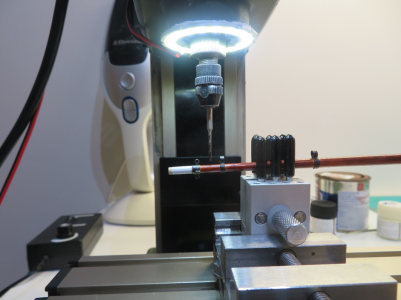
Sheave holes and MF70 upgrade: sheaves through the mast sections are needed for the upper yard halliards but drilling them out takes some care because taking too much material risks weakening the mast sections (which would be a nightmare to repair if they snap!). The halliards for the topsail yards also use chain ties, but the chain in the kit is a bit too large in my opinion, so I purchased some very fine (1mm), high-quality chain which is closer to scale. To make sure I didn’t mess-up drilling the sheaves I used my MF-70 which I have upgraded by adding the X/Y/Z thrust bearings as described by serikoff: MF70 UPGRADE . I also added a light that I bought from AliExpress for £1.60 which works really well (I could not buy the proper Proxxon one in the UK and the cost of getting one shipped from Europe was very expensive). The bearings and light have really improved the useability and if you have this machine, I can really recommend doing the upgrades, the bearings are very cheap to buy and fitting them does not take very long to do (why Proxxon didn’t fit proper bearings in the first place is ?????).

1771259187684.png

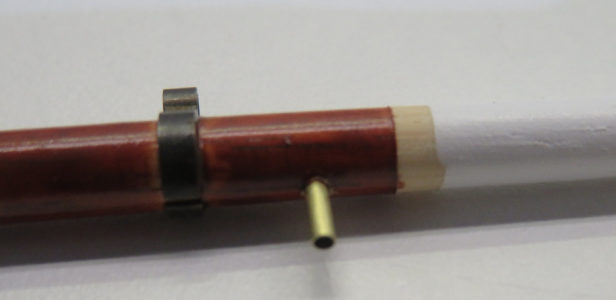
After drilling the sheaves, I decided to reinforce the holes by cutting some 1.25mm OD thin-walled brass tube and gluing that into the hole so that the chain can pass through. It is not necessary for the lower mast sections but the royals are quite “skinny” and you need to take out 30-40% of the diameter, so adding some reinforcement is probably a good thing.

1771259222054.png

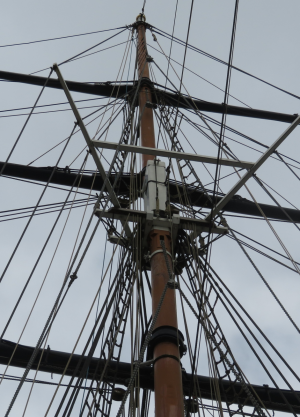
The image below shows some of the detail of the mast sheaves (fore mast), the top mast spider band and the chain ties. You can also see some of the fittings on the crosstree spreaders that are needed. There are some fairlead blocks on the rear of the crosstrees which I tried to make, but by the time I drilled them out there wasn’t enough wood left to hold them together! In the end I decided not to fit them but instead I fitted some brass rod so that the rigging lines would be held in place. The band just below the crosstree is used to secure the upper futtocks but I will use an eye to secure the lower end of the futtock rods to the masts for ease of assembly (and the fact that they will be buried beneath the shrouds and rigging means you will not see them anyway).

1771259260857.png
Foremast topmast and royal

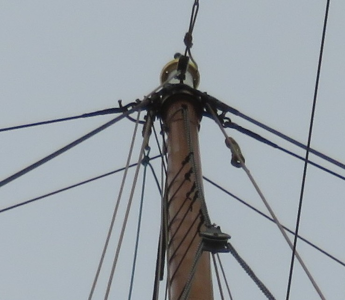
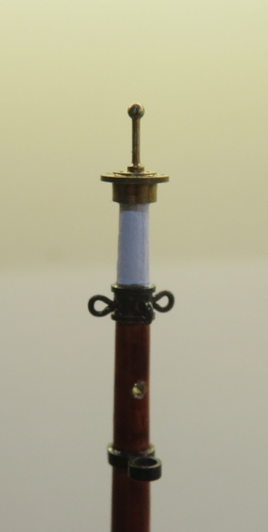
I double checked all the plans and pictures and decided to add a few fittings that were not in the kit but are described either by Campbell, Longridge or are in my pictures. On the mast tops there are spider bands used to secure the top mast stays and the upper back stays. Also, there are the mast caps which have a lightning conductor in the centre. From my pictures it looks like the mast caps are made from brass with a set of holes around the circumference.


1771259314247.png
Mast cap/conductor and Upper Spider-band, Sheave for the Royal Halliard can also be seen.

There are several spider bands and sheaves needed on the Spanker boom and gaff and on the spencer gaff for the pendants and toping lifts. On the spanker boom there is a hoop for the sheer as can be seen in the image and a sheave and cleats for the outhaul.

1771259352166.png
Spanker boom details showing spider band and sheer hoop

After a few trial fits I am almost there, but there are still a few fittings that I will add once the masts are put together properly. When I make the final assembly, I think I will also peg through the tops and mast sections. There are “quite a few” extra eyelets that are needed to be fitted to the masts, mast caps and the tops for the rigging blocks (not to mention all the ones needed for the yards!). I have made a start and have already placed well over 150 but there are plenty more to go!

For the mast caps I decided to repurpose some 5mm portholes which were the perfect size and they even had the holes around the circumference! For the lightning conductors I cut down some rail stanchions and filled the rail hole with some brass wire polished them and gave them a coat of lacquer.


1771259429087.png

Trial assembly:
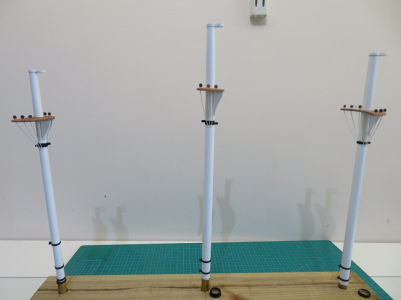
the sections are just loosely fitted. The main mast top is already above my lower shelf, so I am going to have to move the shelf up!

1771259469047.png
The “Sticks!”

Needless to say, the masts are going to be “vertically challenging” when it comes to rigging because even slight differences in tension will pull the tops over and having my plumb-bob is going to be essential later. I am not sure how I will go about rigging the masts but I think the best course of action will be to assemble the lower and upper mast sections first and rig the lower shrouds and stays and then hoist the royals.

Next up:

Back to the yards. I will finish off painting the yards and adding all the eyes for the rigging blocks as needed. There is a lot of them, so I will need to study the rigging plans very carefully!
 
As you say, there are many, many fittings on the masts and yards and you're doing a great job on this. I'll be watching the next bit with great interest. I got to more or less the same point as you are at now, but tied myself in knots trying to come up with a good sequence for progressing the rigging. I think part of the issue for me was that so many parks were so thin, fragile and prone to breakage. Hopefully that extra 25% on yours makes a difference.
 
Part 38: Working on the “Sticks” and some Fittings

I decided that I needed to work on the upper masts to check that I had not missed anything major before assembling them that would be a pain to fix later! The doublings on the ship should be square in section, but at this scale it is easier to just use round dowel, which is a bit of a compromise, but it saves some work. With using round section it is, however, critical to make sure that the truss positions are properly indexed and that the trestle trees are level with the lower tops - many checks – and still get it wrong!

There is no “definitive” rigging plan for the Cutty Sark, many changes were made during her lifetime, and no records were kept so, it is up to the modeller to decide which way to go. Certainly, at this scale, everything is a bit of a compromise with regards to the accuracy and detail. As far as I am concerned, so long as the rig is a fair representation and is in keeping with the ship, I am OK with that. I will “mostly” be following Campbell’s rigging plans with reference to Longridge and my pictures. Billing’s rigging plans are more basic, miss many runs out and are more “generic” for a full rigged model ship, but they will do the “job”, and being “simplified” is not such a bad thing! I have purchased the full set of rigging blocks (over 750 blocks – groan!) from HiSModel, so that is already way more than is needed if rigging to the Billing plans. The HiSModel rigging set follows Campbell’s plans, so it is necessary to check thoroughly because many more eyelets are needed than are shown in Billing’s plans (or you can just rig the blocks with thread directly to the masts and yards as you go).

Sheave holes and MF70 upgrade: sheaves through the mast sections are needed for the upper yard halliards but drilling them out takes some care because taking too much material risks weakening the mast sections (which would be a nightmare to repair if they snap!). The halliards for the topsail yards also use chain ties, but the chain in the kit is a bit too large in my opinion, so I purchased some very fine (1mm), high-quality chain which is closer to scale. To make sure I didn’t mess-up drilling the sheaves I used my MF-70 which I have upgraded by adding the X/Y/Z thrust bearings as described by serikoff: MF70 UPGRADE . I also added a light that I bought from AliExpress for £1.60 which works really well (I could not buy the proper Proxxon one in the UK and the cost of getting one shipped from Europe was very expensive). The bearings and light have really improved the useability and if you have this machine, I can really recommend doing the upgrades, the bearings are very cheap to buy and fitting them does not take very long to do (why Proxxon didn’t fit proper bearings in the first place is ?????).

View attachment 578546

After drilling the sheaves, I decided to reinforce the holes by cutting some 1.25mm OD thin-walled brass tube and gluing that into the hole so that the chain can pass through. It is not necessary for the lower mast sections but the royals are quite “skinny” and you need to take out 30-40% of the diameter, so adding some reinforcement is probably a good thing.

View attachment 578547

The image below shows some of the detail of the mast sheaves (fore mast), the top mast spider band and the chain ties. You can also see some of the fittings on the crosstree spreaders that are needed. There are some fairlead blocks on the rear of the crosstrees which I tried to make, but by the time I drilled them out there wasn’t enough wood left to hold them together! In the end I decided not to fit them but instead I fitted some brass rod so that the rigging lines would be held in place. The band just below the crosstree is used to secure the upper futtocks but I will use an eye to secure the lower end of the futtock rods to the masts for ease of assembly (and the fact that they will be buried beneath the shrouds and rigging means you will not see them anyway).

View attachment 578548
Foremast topmast and royal

I double checked all the plans and pictures and decided to add a few fittings that were not in the kit but are described either by Campbell, Longridge or are in my pictures. On the mast tops there are spider bands used to secure the top mast stays and the upper back stays. Also, there are the mast caps which have a lightning conductor in the centre. From my pictures it looks like the mast caps are made from brass with a set of holes around the circumference.


View attachment 578549
Mast cap/conductor and Upper Spider-band, Sheave for the Royal Halliard can also be seen.

There are several spider bands and sheaves needed on the Spanker boom and gaff and on the spencer gaff for the pendants and toping lifts. On the spanker boom there is a hoop for the sheer as can be seen in the image and a sheave and cleats for the outhaul.

View attachment 578550
Spanker boom details showing spider band and sheer hoop

After a few trial fits I am almost there, but there are still a few fittings that I will add once the masts are put together properly. When I make the final assembly, I think I will also peg through the tops and mast sections. There are “quite a few” extra eyelets that are needed to be fitted to the masts, mast caps and the tops for the rigging blocks (not to mention all the ones needed for the yards!). I have made a start and have already placed well over 150 but there are plenty more to go!

For the mast caps I decided to repurpose some 5mm portholes which were the perfect size and they even had the holes around the circumference! For the lightning conductors I cut down some rail stanchions and filled the rail hole with some brass wire polished them and gave them a coat of lacquer.


View attachment 578551

Trial assembly:
the sections are just loosely fitted. The main mast top is already above my lower shelf, so I am going to have to move the shelf up!

View attachment 578552
The “Sticks!”

Needless to say, the masts are going to be “vertically challenging” when it comes to rigging because even slight differences in tension will pull the tops over and having my plumb-bob is going to be essential later. I am not sure how I will go about rigging the masts but I think the best course of action will be to assemble the lower and upper mast sections first and rig the lower shrouds and stays and then hoist the royals.

Next up:

Back to the yards. I will finish off painting the yards and adding all the eyes for the rigging blocks as needed. There is a lot of them, so I will need to study the rigging plans very carefully!
Nice work on those masts, Dom. My respect!
Regards, Peter
 
As you say, there are many, many fittings on the masts and yards and you're doing a great job on this. I'll be watching the next bit with great interest. I got to more or less the same point as you are at now, but tied myself in knots trying to come up with a good sequence for progressing the rigging. I think part of the issue for me was that so many parks were so thin, fragile and prone to breakage. Hopefully that extra 25% on yours makes a difference.
Hi Keven,

Rigging the shrouds and stays is going to test me for sure! The tallest I've done is the 1/75 Blue Nose and they top out at 50cm above the deck and are two section masts. The Cutty Sark tops out at 60 cm, so I am really only adding the height of the royals and if I get the lower shrouds done properly I should be OK (famous last words!). I think the biggest issue is going to be lacing the lower deadeyes which are a) tiny and b) hard to access being inboard.

Dom
 
Nice work on those masts, Dom. My respect!
Regards, Peter
Thanks Peter,

Seeing your attention to detail is pushing me to go a bit further with my model than I originally intended, so I take some inspiration from your work!

I hope you have enjoyed the Olympics, I have only been to that area for summer hiking, they are really nice mountains to visit.

Dom
 
Seeing your attention to detail is pushing me to go a bit further with my model than I originally intended, so I take some inspiration from your work!
Good morning Dom. This is a true story and I share your inspiration from Peter’s models.

Fabulous work on your Cutty Sark as always and thanks for your descriptive log.
Cheers Grant
 
Hi Keven,

Rigging the shrouds and stays is going to test me for sure! The tallest I've done is the 1/75 Blue Nose and they top out at 50cm above the deck and are two section masts. The Cutty Sark tops out at 60 cm, so I am really only adding the height of the royals and if I get the lower shrouds done properly I should be OK (famous last words!). I think the biggest issue is going to be lacing the lower deadeyes which are a) tiny and b) hard to access being inboard.

Dom
Hi Keven,

I am checking some details on the hull that I need to complete before I start rigging. One thing (amongst many!) I am not sure about that you may know, is how the auxiliary rudder chain is placed. Longridge just says that the chains are attached to the back of the rudder just above the brassing level and are then run along the rubbing strake to the rear quarter bumpkins and that's all the info he gives. Do you know where they are attached to/go on the hull? Thanks if you have anything.

Dom
 
Back
Top