• Win a Free Custom Engraved Brass Coin!!!
    As a way to introduce our brass coins to the community, we will raffle off a free coin during the month of August. Follow link ABOVE for instructions for entering.
  • PRE-ORDER SHIPS IN SCALE TODAY!

    The beloved Ships in Scale Magazine is back and charting a new course for 2026!
    Discover new skills, new techniques, and new inspirations in every issue.

    NOTE THAT OUR FIRST ISSUE WILL BE JAN/FEB 2026

H.M.S. Victory by Caldercraft - Build Log

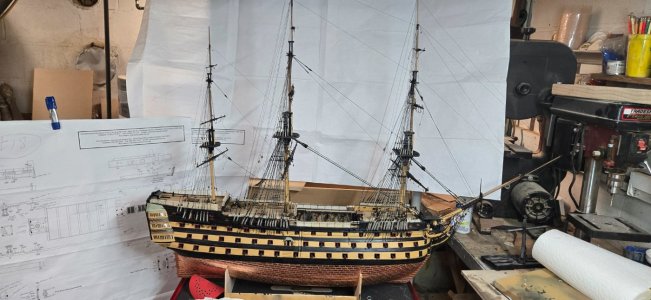
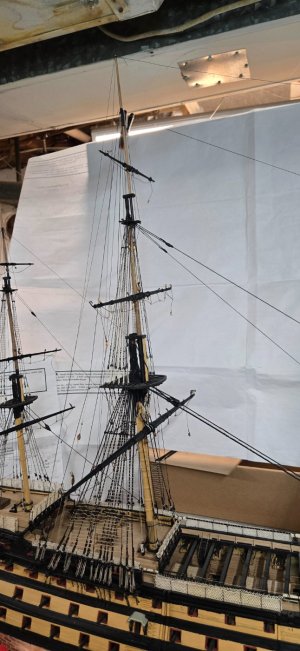
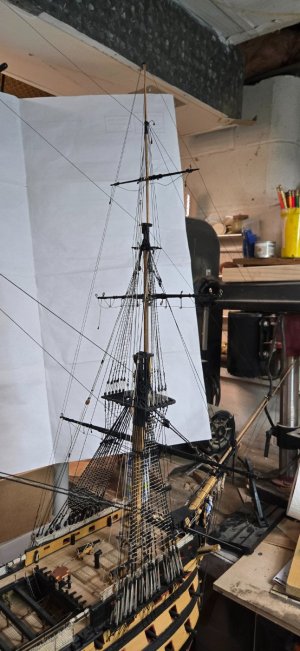
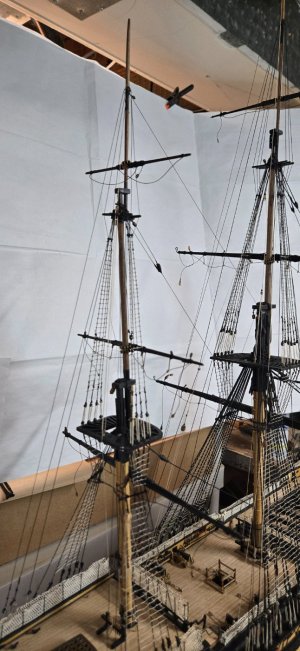
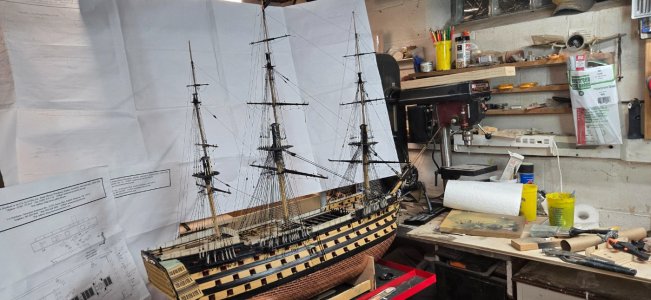
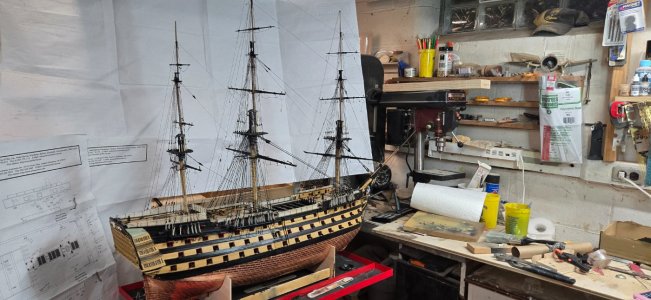
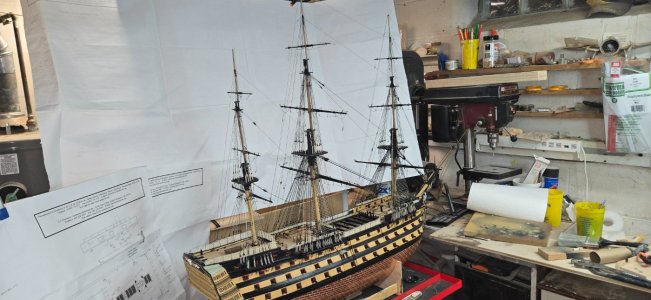
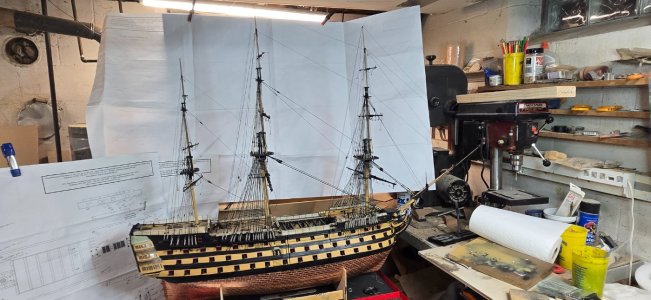
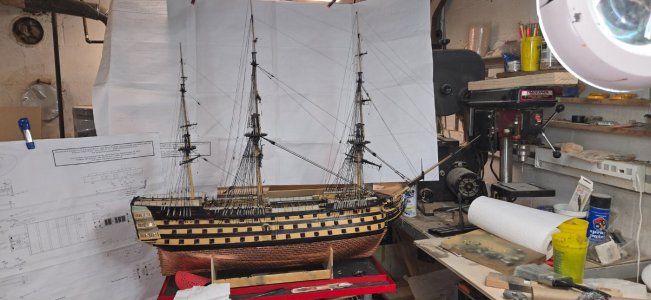
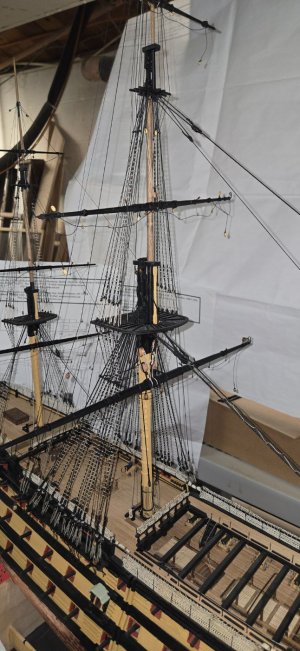
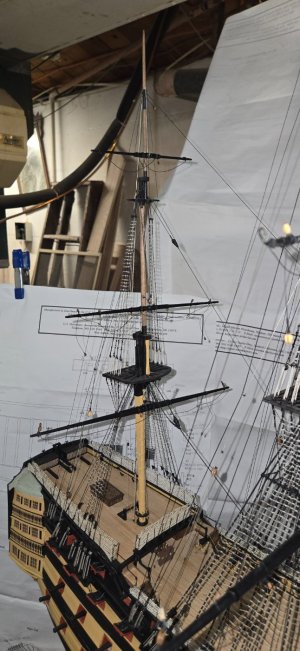
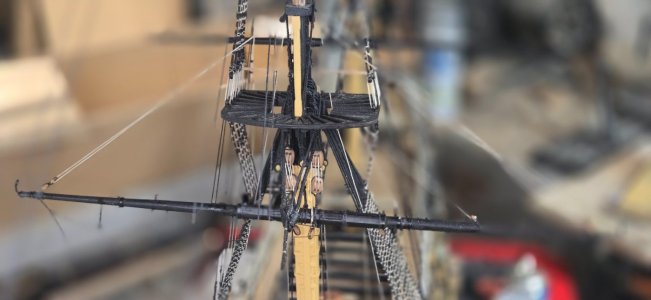
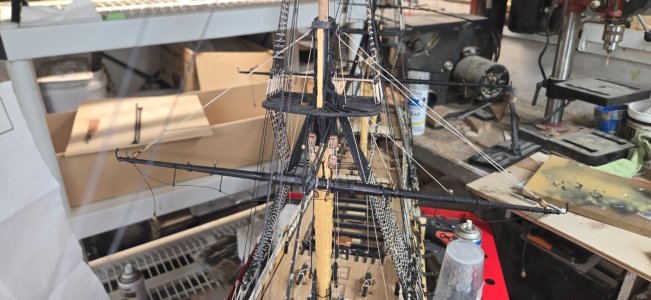
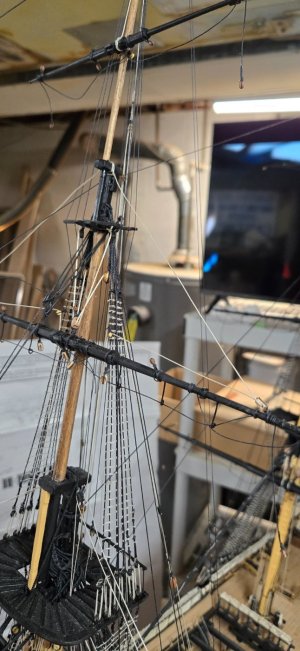
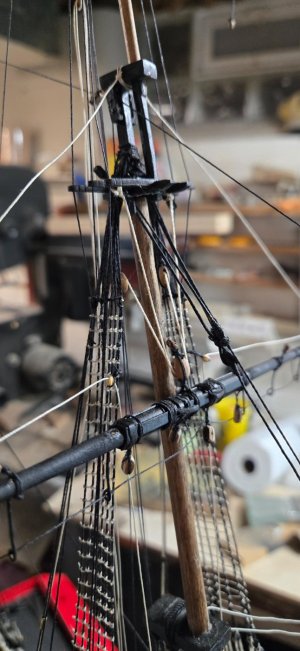
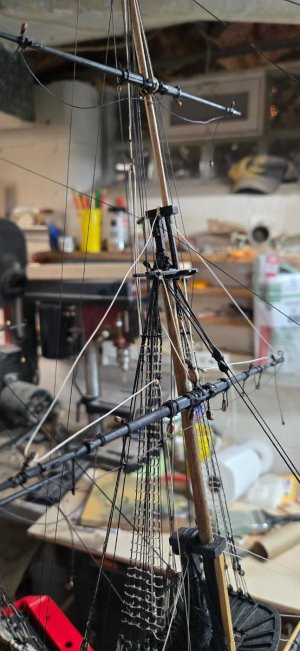
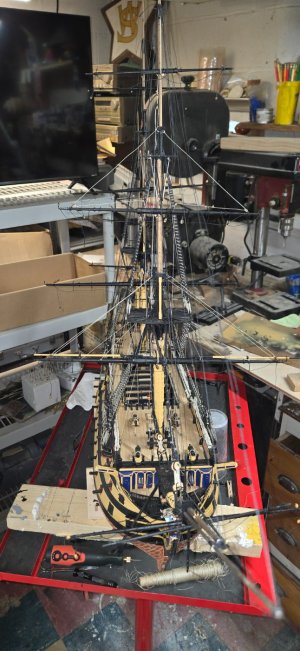
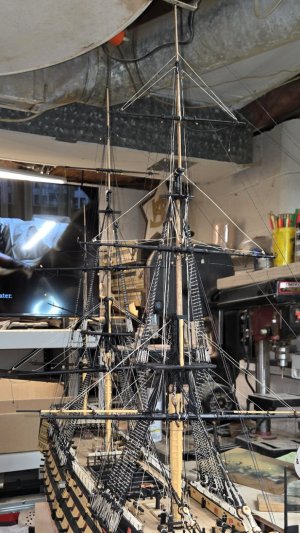
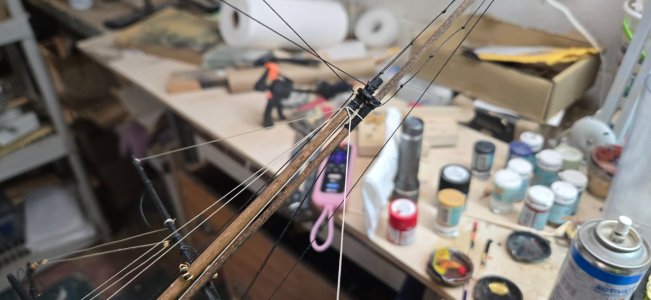
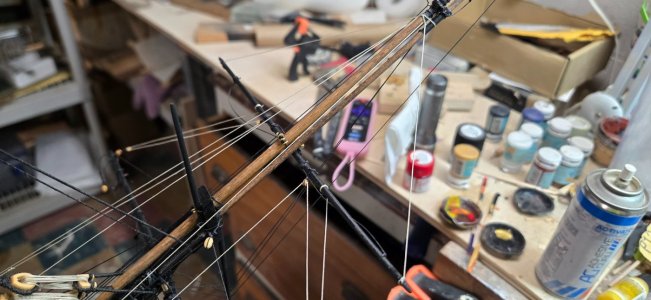
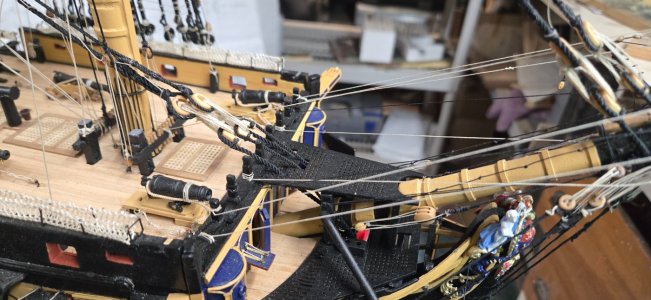
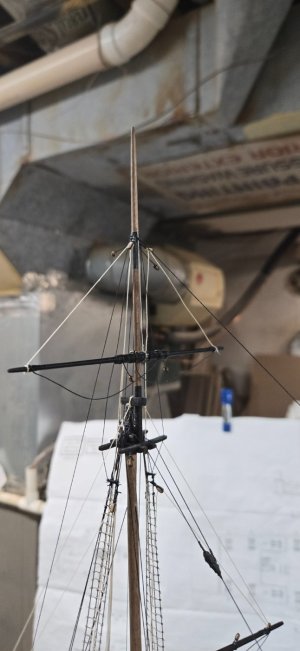
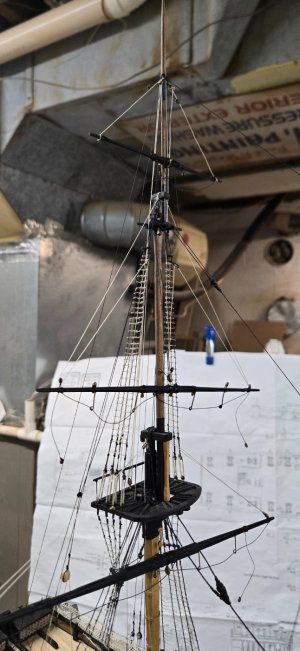
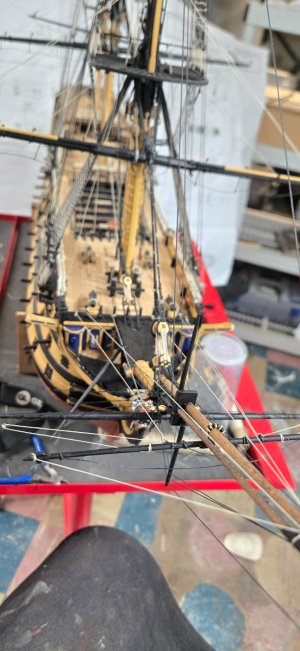
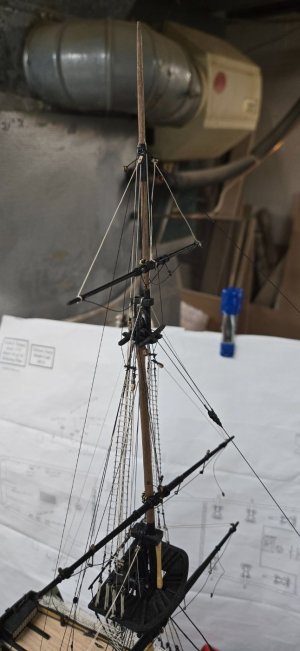
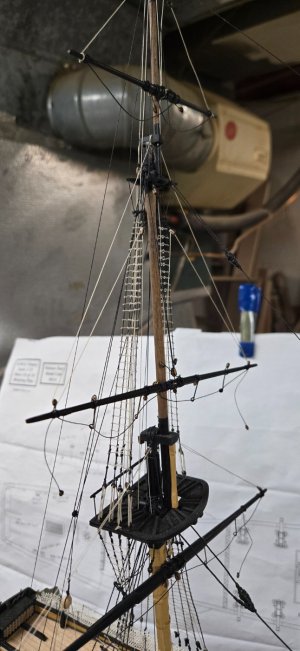
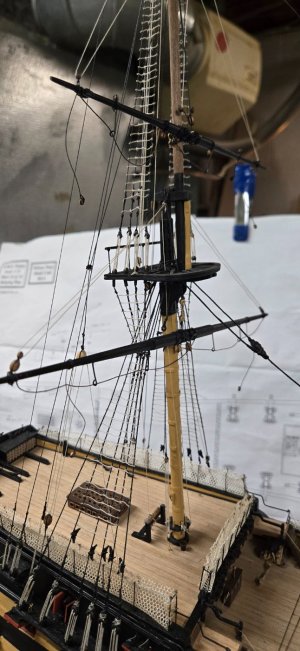
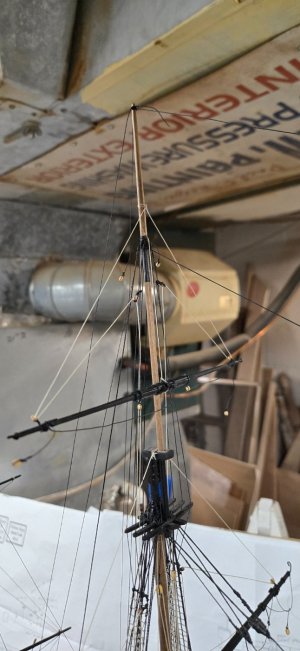
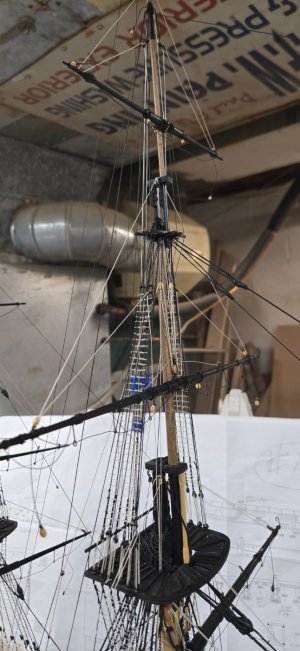
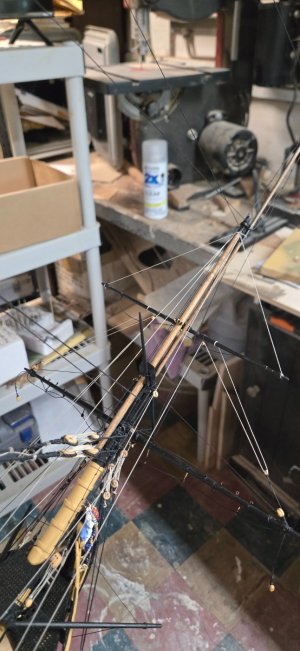
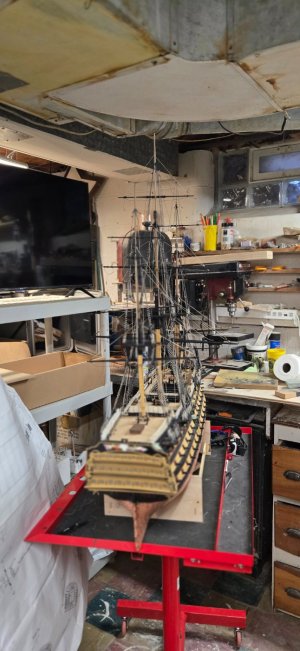
I have finally finished installing all nine yards to the masts. I still have the two yards for the bowsprit and the driver gaff and boom to install....

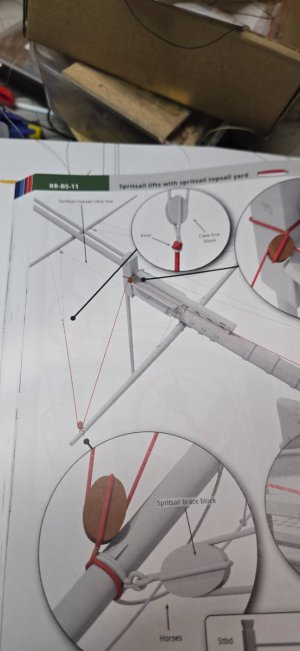
Once again, my new book from Gropp has helped clear the way to making my last few yards much easier to complete.
I still have to paint the horse stirrups and various little touch ups here and there but they will be ready for the next task of running rigging.

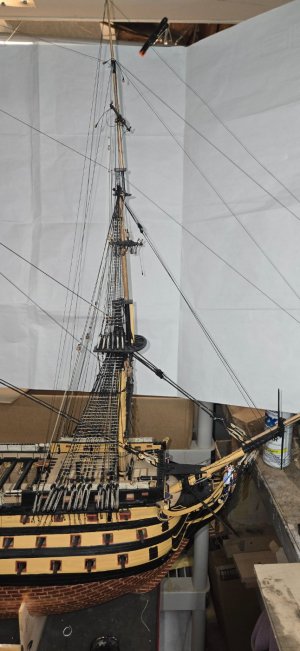
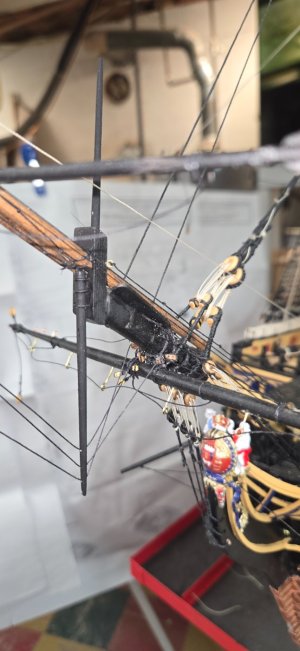
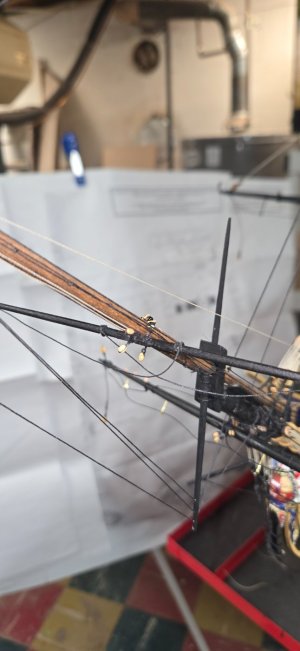
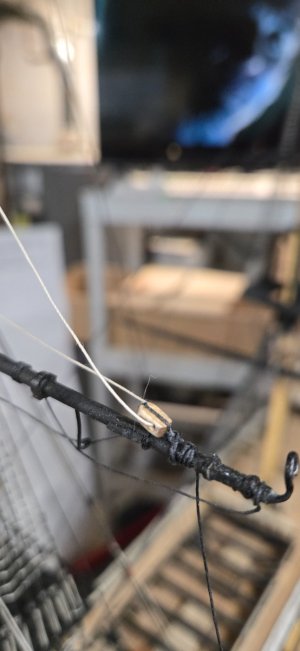
I began adding the final blocks to the boom sprit yards. I hadn't added horses to these two yards but it is clear that they are there. It's funny, I see no reference to them in the instructions, but I will add them.

I wasn't 100% sure just how to rig the two yards but a review of some of my pic saves of other builds has helped. I will attack them over the weekend.

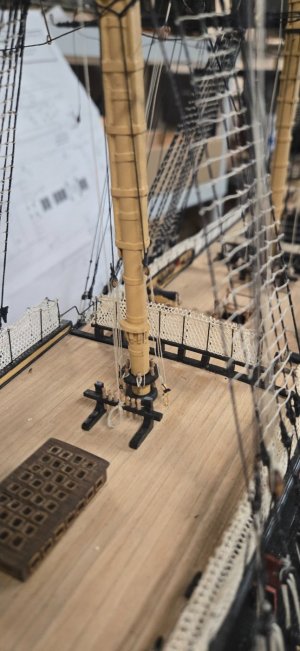
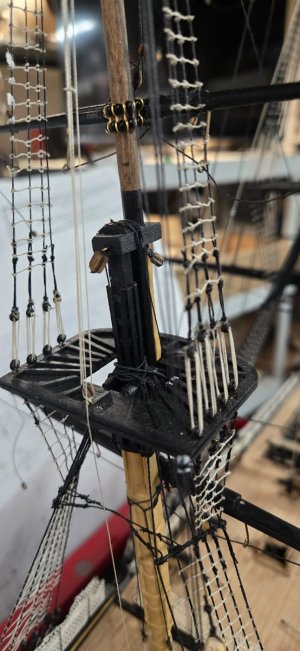
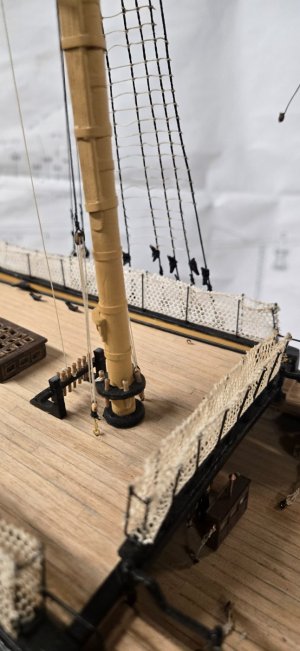
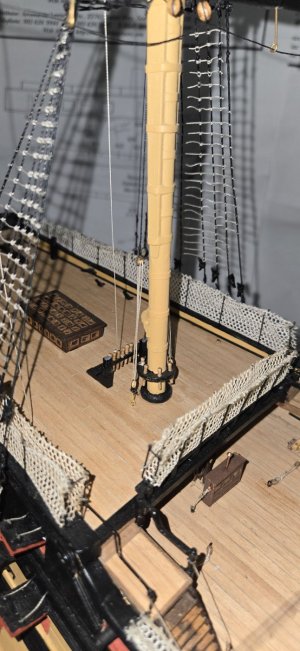
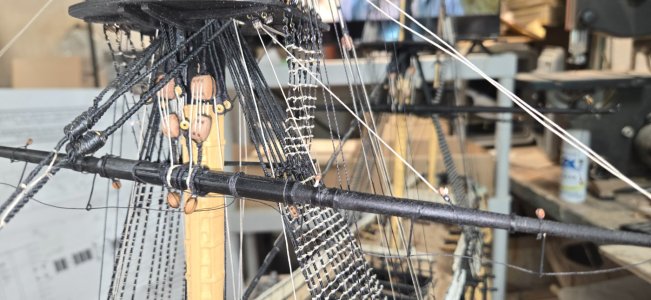
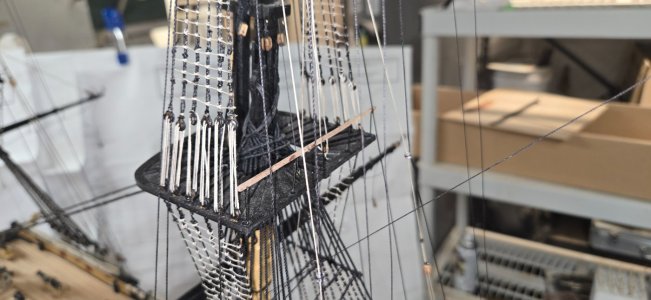
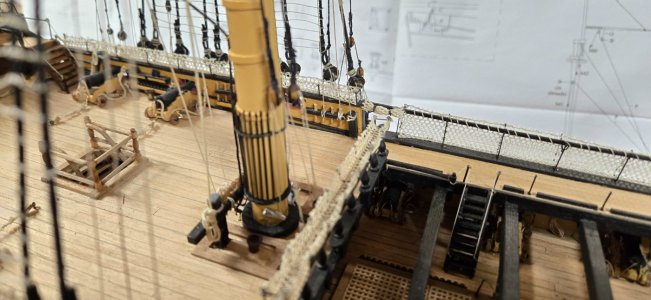
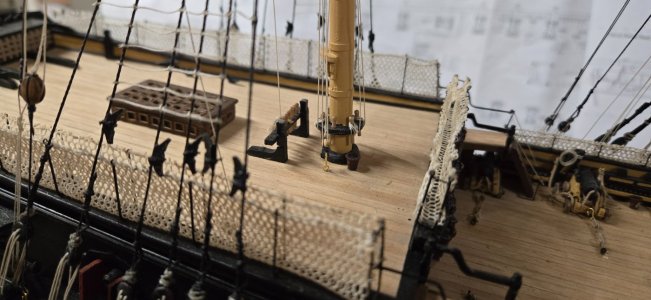
Once done I will add the railings to the upper platforms for the three masts...I didn't do them to keep them out of the way.

After that....I think I will revert back to actual construction and layout all of the cannon lids and also create the stern and mast lights.
Then, the lifeboats, davits, anchor attachments and more.

I would say I am almost done, but I guess I am almost done with getting halfway there!!!!
20260123_171456.jpg

20260123_171502.jpg

20260123_171508.jpg

20260123_171515.jpg

20260123_171520.jpg

20260123_171524.jpg

20260123_171537.jpg

20260123_171543.jpg

20260123_171550.jpg

20260123_171558.jpg

20260123_171749.jpg

20260123_171756.jpg

20260123_171802.jpg

20260123_171806.jpg

20260123_171817.jpg

20260123_171820.jpg

20260123_171834.jpg

20260123_171848.jpg

20260123_171900.jpg

20260123_171908.jpg

20260123_171912.jpg

20260123_171916.jpg

20260123_171922.jpg

20260123_171927.jpg

20260123_171930.jpg
 
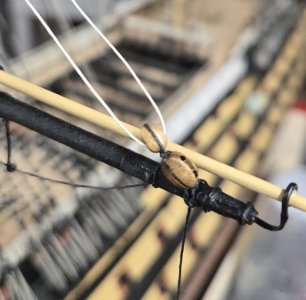
Added the horses to the spritsail and spritsail topsail yards and then installed them on the bowsprit. A lot of finger gymnastics to get them in place.
I also added the spritsail topsail halyard.

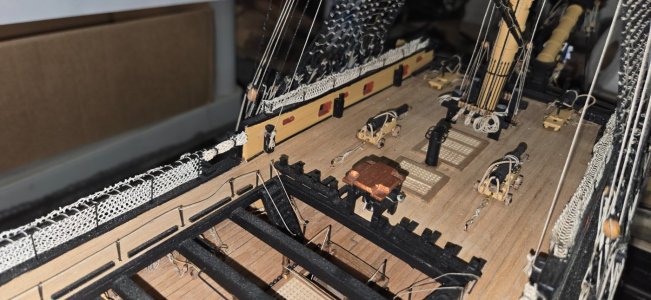
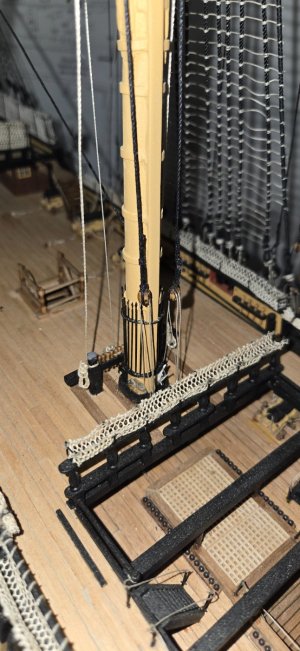
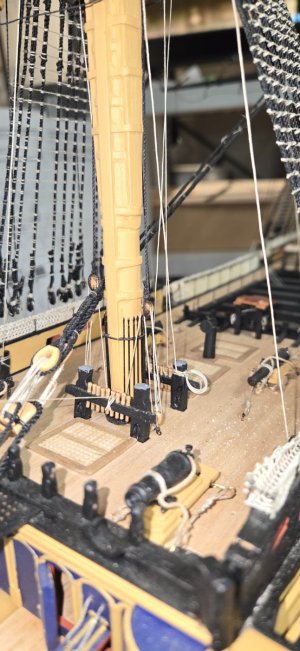
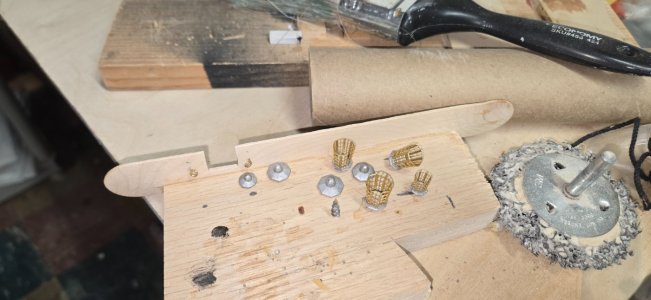
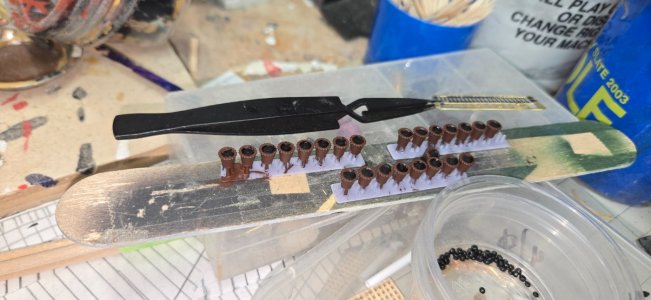
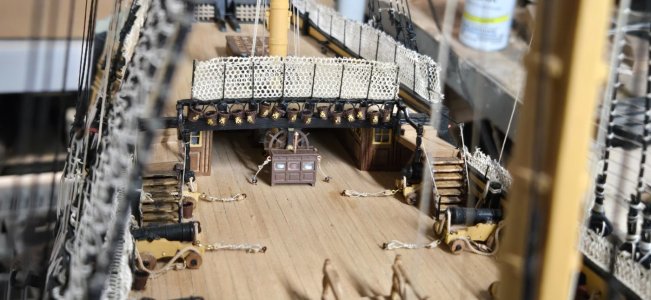
Once done, I went have the 4 lanterns, added the railings to all the platforms and I also started painting the fire buckets. I had bought an after market set for the buckets and they look pretty good. Originally, I was going to drill recessed holes in the tops of the buckets to give them depth, but they are 3D printed items I didn't want to risk them breaking, so I just painted the tops black. The buckets themselves are brown...I was trying to go for a dark leathery color as I think I read that was the material they were made out of it.

There also isn't a lot of detail in making and installing the lanterns, I will go by pictures from other builds and see how I do.

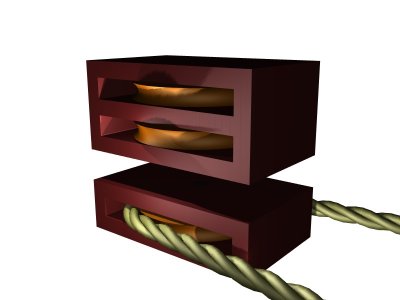
Once I put them out of the way I began working on the running rigging which according to the instructions starts with foreyard lift lines, then the bunt and leech lines. My only issue is that they depend on blocks I installed a year ago when I built the mast platforms. All of these blocks should have lashings attached, since I attached them, I have to essentially tie a lashing to the base of the block. It looks kind of sloppy. In addition, I installed the kit's blocks upside down, oh well!

I was able to add the lift lines for both sides of the fore yard and the first bunt lines on one side. The directions are difficult to understand, but having them side by side with Gropp's book helps. I follow the diagrams in the book and use the directions as a reference and it all makes sense.

I have to paint all the stirrups, railings and a lot of the eyelets tomorrow.

20260124_194235.jpg

20260124_194240.jpg

20260124_194246.jpg

20260124_194257.jpg

20260124_194301.jpg

20260124_194307.jpg

20260124_194318.jpg

20260124_194322.jpg

20260124_194332.jpg

20260124_194336.jpg

20260124_194345.jpg

20260124_194355.jpg

20260124_194428.jpg

20260124_194438.jpg
 
Added the horses to the spritsail and spritsail topsail yards and then installed them on the bowsprit. A lot of finger gymnastics to get them in place.
I also added the spritsail topsail halyard.

Once done, I went have the 4 lanterns, added the railings to all the platforms and I also started painting the fire buckets. I had bought an after market set for the buckets and they look pretty good. Originally, I was going to drill recessed holes in the tops of the buckets to give them depth, but they are 3D printed items I didn't want to risk them breaking, so I just painted the tops black. The buckets themselves are brown...I was trying to go for a dark leathery color as I think I read that was the material they were made out of it.

There also isn't a lot of detail in making and installing the lanterns, I will go by pictures from other builds and see how I do.

Once I put them out of the way I began working on the running rigging which according to the instructions starts with foreyard lift lines, then the bunt and leech lines. My only issue is that they depend on blocks I installed a year ago when I built the mast platforms. All of these blocks should have lashings attached, since I attached them, I have to essentially tie a lashing to the base of the block. It looks kind of sloppy. In addition, I installed the kit's blocks upside down, oh well!

I was able to add the lift lines for both sides of the fore yard and the first bunt lines on one side. The directions are difficult to understand, but having them side by side with Gropp's book helps. I follow the diagrams in the book and use the directions as a reference and it all makes sense.

I have to paint all the stirrups, railings and a lot of the eyelets tomorrow.

View attachment 572746

View attachment 572747

View attachment 572748

View attachment 572749

View attachment 572750

View attachment 572751

View attachment 572752

View attachment 572753

View attachment 572754

View attachment 572755

View attachment 572756

View attachment 572757

View attachment 572758

View attachment 572759
Mighty fine work indeed. This ship is fun to rig especially when there is a gaggle of lines and sheets all over the place. Have fun :D . Cheers Grant
 
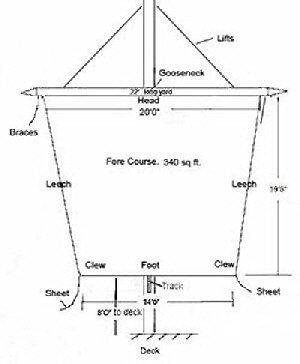
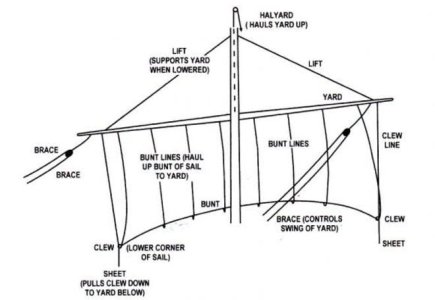
For new builders, perhaps unfamiliar with why there would be so many lines attached to each yard, I thought a quick synopsis of what each of the lines you are going to add actually do.

drawingHR.jpg

For me when sailing, I think of the leeches of a sail where the wind kind of 'leeches' away or spills off the back of the sail. On modern sloops, the wind moves across the sail and actually creates a type of airfoil so that the boat is 'pulled' forward due to the creation of lift. That is what they mean by reaching as the wind is usually just in front or to the side of the boat. From above, the winds are coming into the boat from about 11 o'clock to about 3 o'clock (opposite for the other side). When they say running, the wind is behind you and then you are being pushed forward...no or not much lift.

A square sail is a four-sided rectangular sail hung horizontally from a yard (spar) perpendicular to the mast, characterized by its ability to capture wind directly from behind (running) or from the side (reaching). Key components include the head attached to the yard, the bottom corners known as clews, and control lines called braces, sheets, and halyards, commonly used in traditional sailing rigs.

791884e0-420a-4a7d-acd6-050751d6cd40_660x456.jpg

Key Components of a Square Sail Diagram
Based on traditional rigging:
  • Yard (or Spar): The horizontal beam at the top to which the head of the sail is bent.
  • Head: The top edge of the sail attached to the yard.
  • Leech: The vertical side edges of the sail.
  • Foot: The bottom edge of the sail.
  • Clews: The lower corners of the sail, where sheets (to pull down) and braces (to turn) are attached.
  • Braces: Lines attached to the yardarms to pivot the yard to angle the sail to the wind.
  • Sheets: Lines attached to the clews to pull the bottom corners down and towards the stern or side.
  • Halyard: The tackle used to hoist the yard up the mast.
  • Buntlines: Lines that run up the forward side of the sail to the yard, used to pull the body of the sail up for reefing or furling.
  • Clewlines: Lines used to pull the clews up to the yard when shortening sail.
General Structure
The sail forms a large rectangle, often slightly wider than it is tall, providing maximum surface area to catch the wind. Unlike fore-and-aft sails, square sails are not attached to the mast along their side, but rather hang freely from the yard, allowing them to swing.

Not all of the above lines may be in the instructions, especially since my model doesn't include sails, but can be easily included.
 
Thank you for showing this. :) The first picture of the schooner Britannia forecourse is a good example but do you know if it was rigged the same way as late 17th to early 19th century warships which seem to be one of the main subjects at SoS? It looks very close but may be missing the leech lines which were attached to cringles in the leech then ran up and through blocks on the yard to blocks under the tops then down to the deck. Also, I am pretty sure there were tacks on square sails.
Thanks again for posting this.
Allan
 
Last edited:
Thank you for showing this. :) The first picture of the schooner Britannia forecourse is a good example but do you know if it was rigged the same way as late 17th to early 19th century warships which seem to be one of the main subjects at SoS? It looks very close but may be missing the leech lines which were attached to cringles in the leech then ran up and through blocks on the yard to blocks under the tops then down to the deck. Also, I am pretty sure there were tacks on square sails.
Thanks again for posting this.
Allan
I think the pics are meant to be generic to get a better idea of sail part locations...

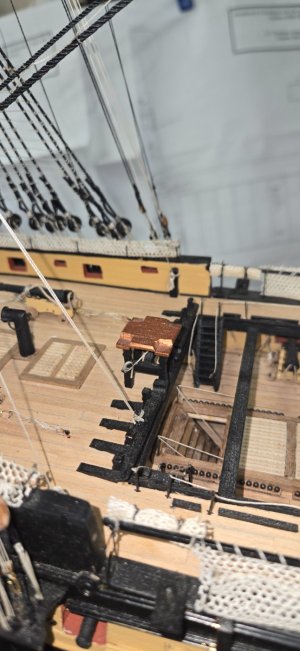
The leech, tack and course lines are missing on the pics. The leech and bunt lines on my model are simply run through blocks with a knot at the end because I don't have sails. They are then run up to the blocks under the foremast platform then back down to the deck to the rail by the belfry.
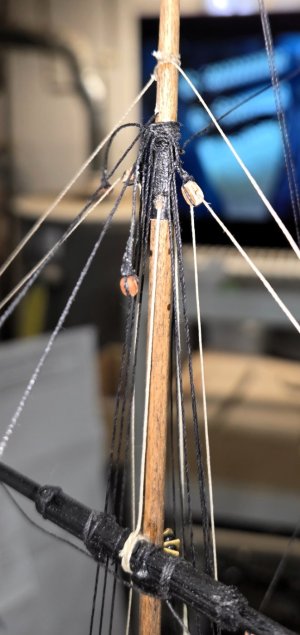
These are the buntlines. I still have to clean them up a bit.
20260124_194257.jpg

The termination of the buntline
20260124_194318.jpg

The tack and course lines are part of that 3-way block system that I haven't gotten to yet. The tack side will go to the bitts and the course side runs to the outside of the hull (to be attached to that cleat on the lower deck that appears to interfere with the cannon...if you remember!)

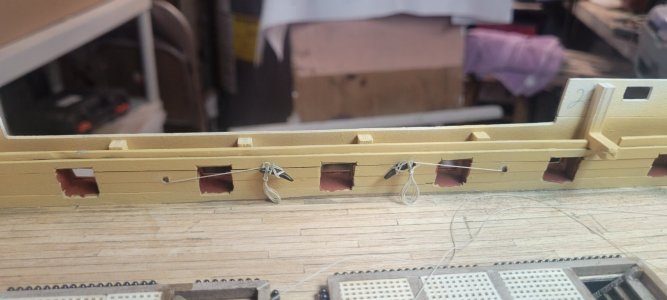
There were the 2 locations of the sheaves I installed on the outer hull and only put a hole on the inner bulwark (instead of a companion sheave)
20240711_140633.jpg20240711_140636.jpg

One of these lines is the sheet for the fore course, the other for the main course tack
20240711_155644.jpg
 
The leech and bunt lines on my model are simply run through blocks with a knot at the end because I don't have sails.
Perfect way to show the lines without sails.:)
Thanks again Chris, I really appreciate your input.

There were the 2 locations of the sheaves I installed on the outer hull and only put a hole on the inner bulwark (instead of a companion sheave)
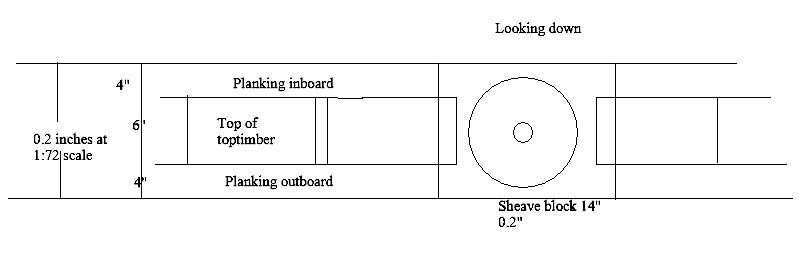
I suspect the moulded dimension of the top of the top timbers in the kit are thicker than was on the ship, so a problem to use a single sheave as was actually done.

Allan
1769362149379.jpeg

Dimensions are for a first rate in Steels The Elements and Practice of Naval Architecture.
1769363051907.jpeg
 
Perfect way to show the lines without sails.:)
Thanks again Chris, I really appreciate your input.


I suspect the moulded dimension of the top of the top timbers in the kit are thicker than was on the ship, so a problem to use a single sheave as was actually done.

Allan


Dimensions are for a first rate in Steels The Elements and Practice of Naval Architecture.
I agree Allan, they would have required HUGE sheaves way out of scale. I figure that since the interior locations on the upper gun deck are now very hidden by the quarterdeck, unless you really get a low angle of sight!

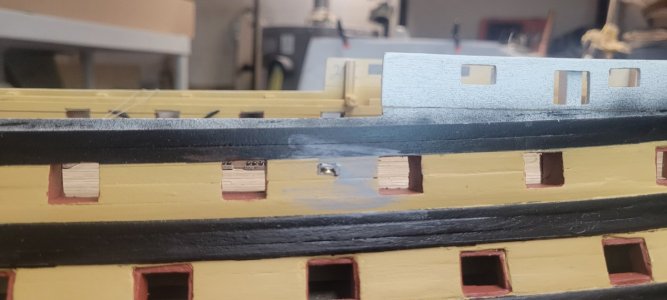
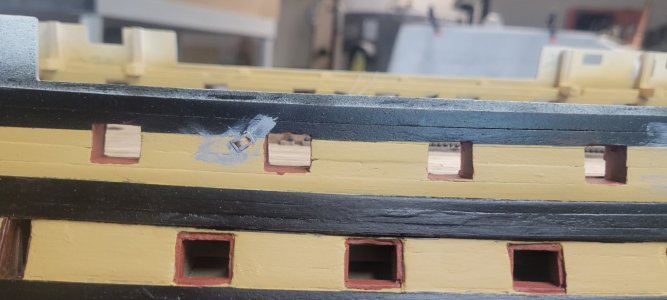
At the time I added the sheaves, I wish I had taken more time to make them clean, right now, they're full of paint and fairly sloppy. But when I was doing all the exterior hull work, I was very frustrated with the 2nd planking, how it looked, how the wales laid down over the hull, how the cannon lining looked, etc.

At some point, I just wanted that done so I could move on..
 
I wanted to complete the fire pails and get closer to done with lanterns before too much rigging was in the way.

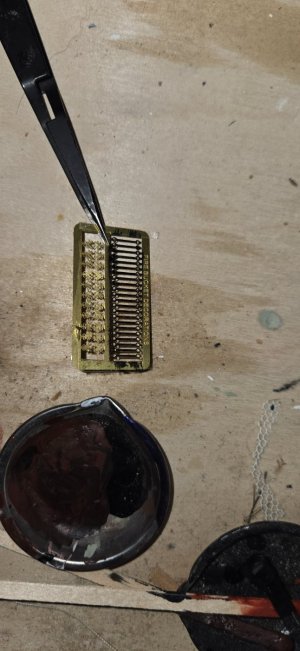
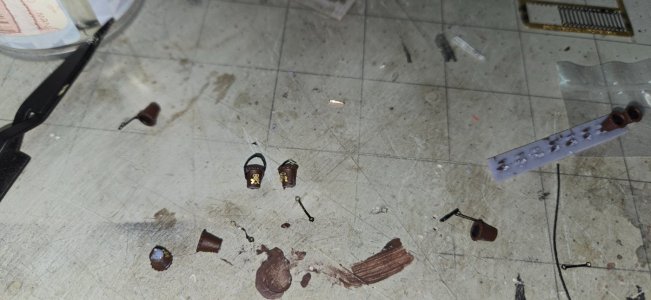
I had bought the aftermarket pails from Woody's a while ago and they really looked good. The photo etch of the logos were very delicate and perfect.
They kit also included PE ropes for the ladders.
I tried to add them and maybe I had them too low on the sides of the pails, but they were going to end up being way too short.
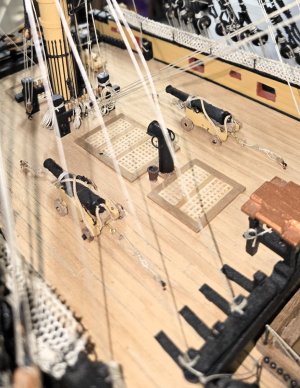
You can see below that the pail on the right is a PE rope and the one on the left is just .25mm black thread. That seemed to work better.

20260125_133708.jpg

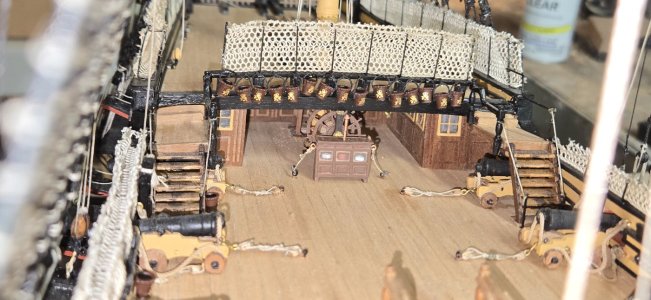
I did find the fire bucket brackets, I had painted them last year and had them in a 'holding bin' I have for parts so they don't get lost.....lol.
It was a mistake to wait so long to do these. They should have been installed before the masts went up, right after I had completed the hammock netting.

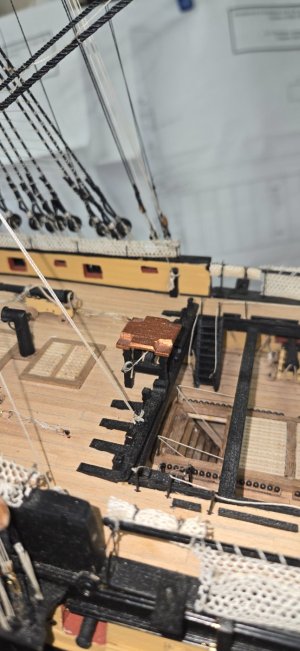
Now I had to twist and turn to try and get the brackets in place around all of the rigging. Even after that, trying to get the finished buckets to hang was terrible Many kept falling onto the deck.

They look more like a string of musical notes than what a ship's captain would tolerate on a ship of war!!!

I am going to say that they are messed up because the ship just got done heeling!
20260125_183955.jpg

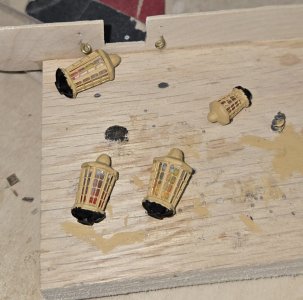
Finally, I worked on getting the lanterns ready. I put metal etch on the PE lantern parts and then carefully bent them using a PE bender I have.

I took some transparency and sanded both sides to create a white opacity to create the glass without actually seeing inside.
I was trying to figure out how I could create the semblance of fire and thought perhaps painting little pieces of cotton with red, yellow and orange might work.

Well, painting cotton just makes it a cotton blob. But it is red! So in it went.

20260125_184028.jpg

I still have to touch up the base with black and then re-add the yellow highlights. Once done, I will create and bend the piping and install them...hoping I don't snag on them!!!!

20260125_183937.jpg
 
Last edited:
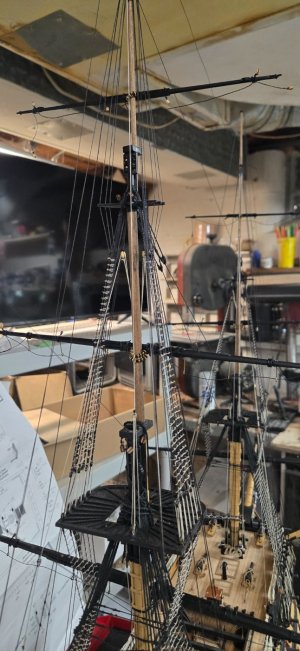
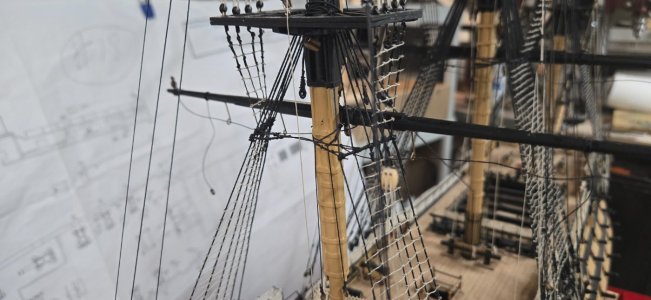
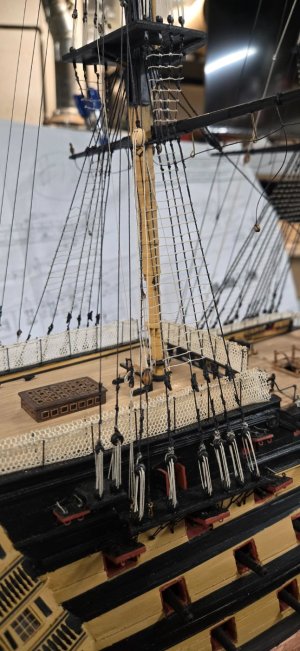
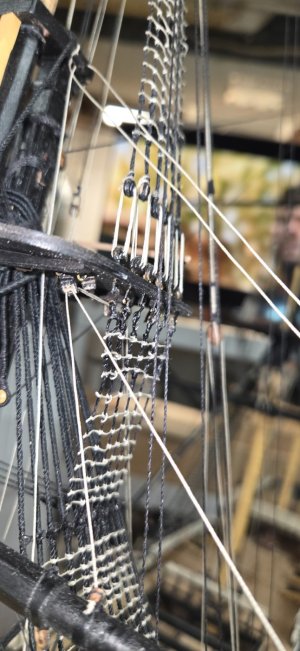
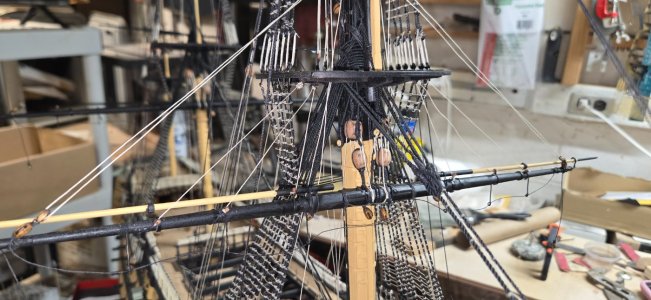
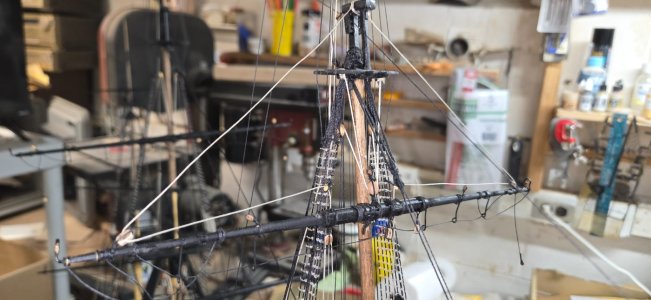
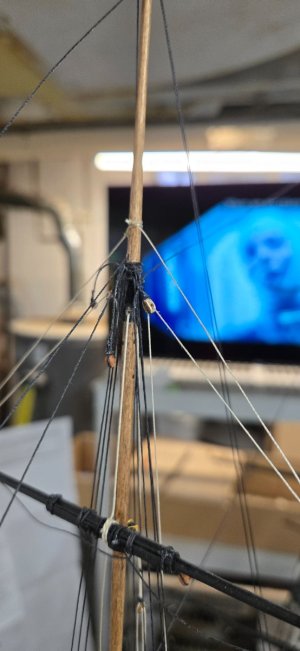
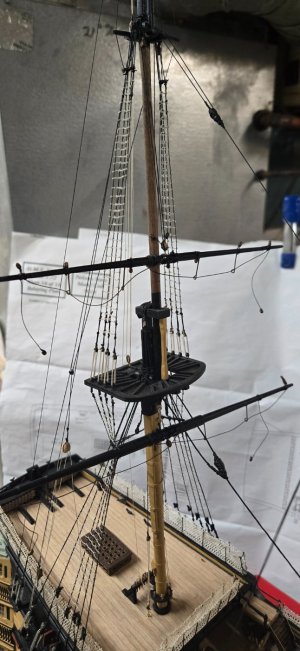
Next I finished the fore yard's lifts, bunt and leech lines for both sides.
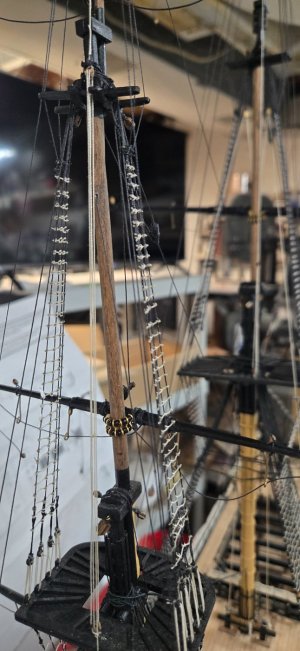
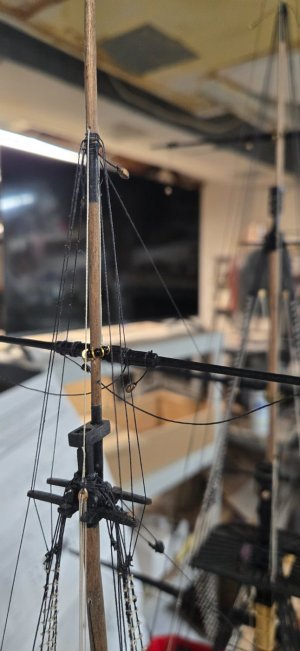
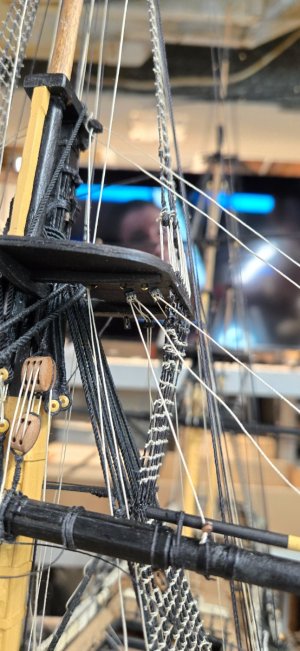
After than I moved to the topmast yard's lifts, this required the addition of 3mm single blocks that have to be tied to the upper shrouds. The ends are secured to cleats on the lower shrouds.

I just try to add a bunch of pics of the work I did today....in no particular order.

Is the foremast course yard showing the completed lift line that goes to the cap with a single/double block system.
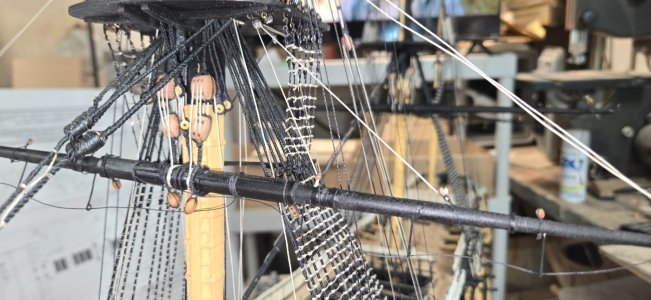
The other natural thread lashings are the buntlines and leech lines that terminate in knots on the blocks on the yards and are then run up under the platform and then back down on deck to the belfry rail.

20260125_183805.jpg

This is the fore topmast yard and the lift lines. They begin as tied off line at the cap, down to the large block on the end of the yard back up to an installed 3mm single block, down to a cleat on the shrouds.
20260125_183812.jpg

A closer pic of the above work.
20260125_183819.jpg
...from the other side
20260125_183905.jpg

Both lift lines in view, the lines are a bit loose as I've haven't tightened them down yet.
20260125_183911.jpg

You can kind of see the ends lashed to the cleat, but they tend to melt in with the ratlines.
20260125_183921.jpg

Some front views of the first two yards I have worked on.
20260125_184110.jpg

20260125_184117.jpg

20260125_184121.jpg
 
Last edited:
I was able to finish the first stage of running rigging on the foremast yards

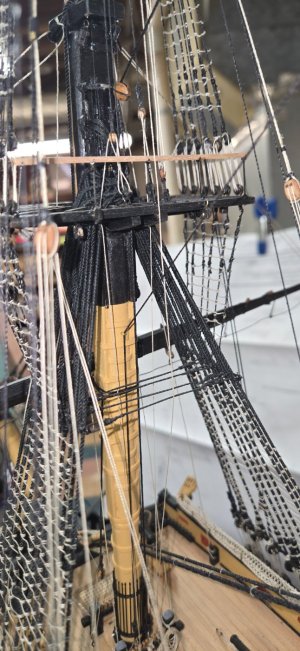
The lift lines begin at blocks tied to the lower cap, topmast cap or masthead (from lowest yard to highest)
The all go to blocks at the ends of the yards, back up and then down to a belay point.
The lower (course) yard has that double block setup and the smaller block on top is an attachment point for its lift lines.
20260126_135931.jpg20260126_135838.jpg20260126_135806.jpg

It is the same setup for the main and mizzen lift lines on their yards.


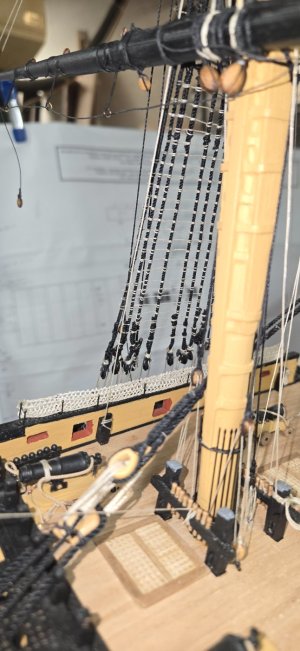
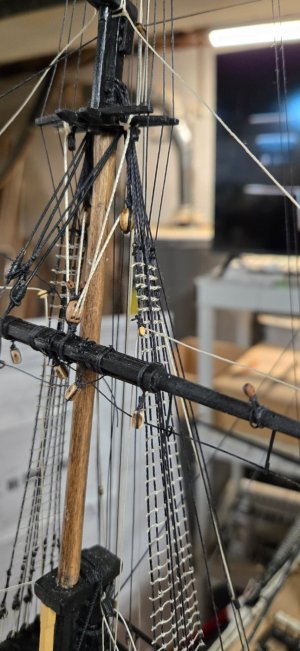
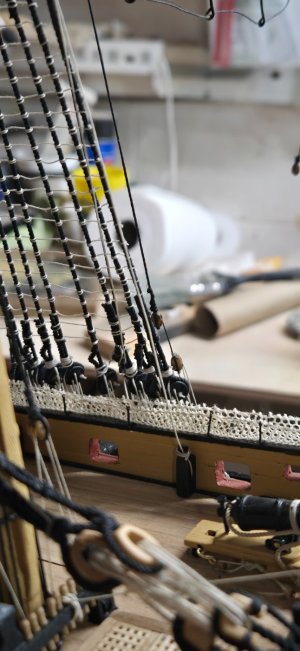
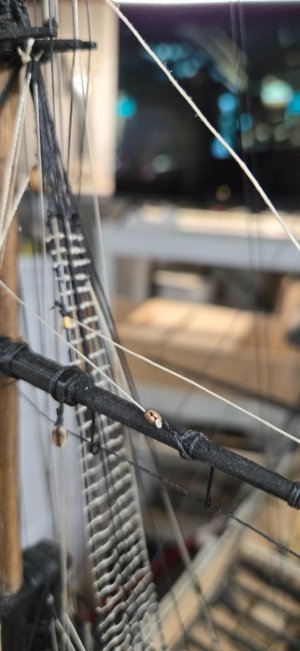
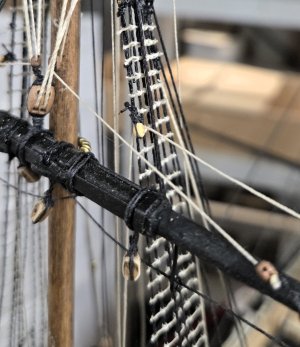
The buntlines are tied to small blocks on the inside of the yard, they run up to blocks previously installed on the underside of the platform and then down to belay points.
There are 2 for the course yard, 1 for the topsail yard whose lines go though the smaller blocks that were tied to the tye/jeer block, the 1 topgallant line goes to a block above the topgallant shrouds. (all of these are for one side....do twice as many all together)

20260126_135941.jpg20260126_135852.jpg

The last set I did were the leech lines.
For the course yard, this is the 3rd outside line that runs up to another set of blocks under the platform and back down to the belfry rail.

20260126_140010.jpg

Depending on the yard, the belay points will vary....

These are for the main mast course leech line.
20260126_162645.jpg

These are belay points for the main mast buntlines
20260126_162626.jpg

This is the belay point for the topgallant buntlines around a topmast shroud.
20260126_135829.jpg

These are belay points for the topsail buntlines
20260126_135920.jpg

All in all:
Six lift lines for the three yards on the foremast, one on each side.
Four buntlines for the course yard, two on each side.
Two buntlines for the topsail yard and topgallant yard, one on each side
Two leech lines for the course yards, one on each side.
20260126_162854.jpg


I have finished the main course yard's lift, bunt and leech lines.....

20260126_135746.jpg

20260126_135813.jpg

20260126_135842.jpg

20260126_135857.jpg

20260126_135935.jpg

20260126_135952.jpg

20260126_162606.jpg

20260126_162620.jpg
 
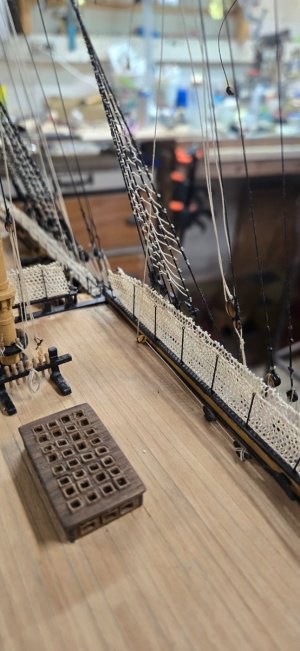
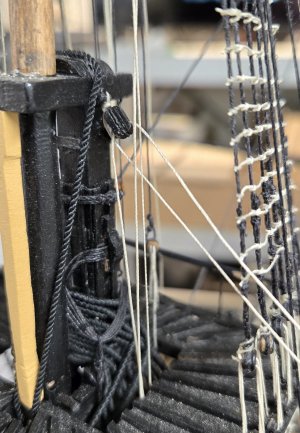
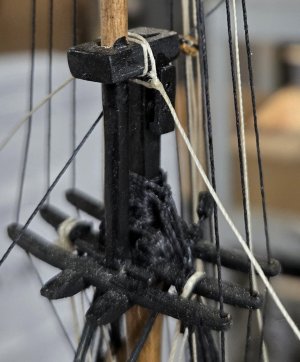
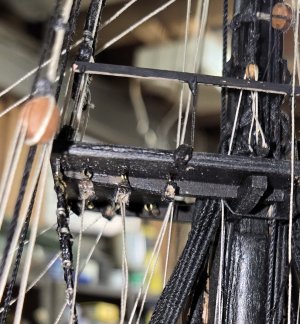
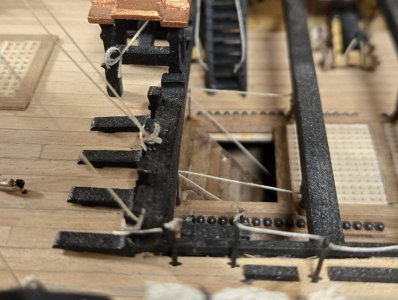
I had issues with the kevels that are attached to the side bulwarks again. They lay flat against the wall and do not allow lashings to attach.
I had to pull the two used for the mainmast yards so that I could sand the tops down more so that I could get lines around them.

I also have a lot of paint touchups to do!

The problem with pictures is they magnify the flaws and reduce the actual beauty of the model when looking at it with just your eyes!
 
For new builders, perhaps unfamiliar with why there would be so many lines attached to each yard, I thought a quick synopsis of what each of the lines you are going to add actually do.

View attachment 572818

For me when sailing, I think of the leeches of a sail where the wind kind of 'leeches' away or spills off the back of the sail. On modern sloops, the wind moves across the sail and actually creates a type of airfoil so that the boat is 'pulled' forward due to the creation of lift. That is what they mean by reaching as the wind is usually just in front or to the side of the boat. From above, the winds are coming into the boat from about 11 o'clock to about 3 o'clock (opposite for the other side). When they say running, the wind is behind you and then you are being pushed forward...no or not much lift.

A square sail is a four-sided rectangular sail hung horizontally from a yard (spar) perpendicular to the mast, characterized by its ability to capture wind directly from behind (running) or from the side (reaching). Key components include the head attached to the yard, the bottom corners known as clews, and control lines called braces, sheets, and halyards, commonly used in traditional sailing rigs.

View attachment 572817

Key Components of a Square Sail Diagram
Based on traditional rigging:
  • Yard (or Spar): The horizontal beam at the top to which the head of the sail is bent.
  • Head: The top edge of the sail attached to the yard.
  • Leech: The vertical side edges of the sail.
  • Foot: The bottom edge of the sail.
  • Clews: The lower corners of the sail, where sheets (to pull down) and braces (to turn) are attached.
  • Braces: Lines attached to the yardarms to pivot the yard to angle the sail to the wind.
  • Sheets: Lines attached to the clews to pull the bottom corners down and towards the stern or side.
  • Halyard: The tackle used to hoist the yard up the mast.
  • Buntlines: Lines that run up the forward side of the sail to the yard, used to pull the body of the sail up for reefing or furling.
  • Clewlines: Lines used to pull the clews up to the yard when shortening sail.
General Structure
The sail forms a large rectangle, often slightly wider than it is tall, providing maximum surface area to catch the wind. Unlike fore-and-aft sails, square sails are not attached to the mast along their side, but rather hang freely from the yard, allowing them to swing.

Not all of the above lines may be in the instructions, especially since my model doesn't include sails, but can be easily included.
Really useful, thanks. I will save this for reference.
 
I was able to finish the first stage of running rigging on the foremast yards

The lift lines begin at blocks tied to the lower cap, topmast cap or masthead (from lowest yard to highest)
The all go to blocks at the ends of the yards, back up and then down to a belay point.
The lower (course) yard has that double block setup and the smaller block on top is an attachment point for its lift lines.
View attachment 573285View attachment 573280View attachment 573277

It is the same setup for the main and mizzen lift lines on their yards.


The buntlines are tied to small blocks on the inside of the yard, they run up to blocks previously installed on the underside of the platform and then down to belay points.
There are 2 for the course yard, 1 for the topsail yard whose lines go though the smaller blocks that were tied to the tye/jeer block, the 1 topgallant line goes to a block above the topgallant shrouds. (all of these are for one side....do twice as many all together)

View attachment 573287View attachment 573282

The last set I did were the leech lines.
For the course yard, this is the 3rd outside line that runs up to another set of blocks under the platform and back down to the belfry rail.

View attachment 573289

Depending on the yard, the belay points will vary....

These are for the main mast course leech line.
View attachment 573294

These are belay points for the main mast buntlines
View attachment 573293

This is the belay point for the topgallant buntlines around a topmast shroud.
View attachment 573279

These are belay points for the topsail buntlines
View attachment 573284

All in all:
Six lift lines for the three yards on the foremast, one on each side.
Four buntlines for the course yard, two on each side.
Two buntlines for the topsail yard and topgallant yard, one on each side
Two leech lines for the course yards, one on each side.
View attachment 573296


I have finished the main course yard's lift, bunt and leech lines.....

View attachment 573276

View attachment 573278

View attachment 573281

View attachment 573283

View attachment 573286

View attachment 573288

View attachment 573290

View attachment 573292
Amazing craftsmanship!
 
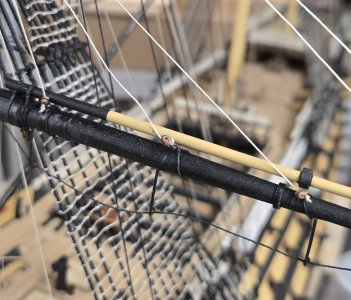
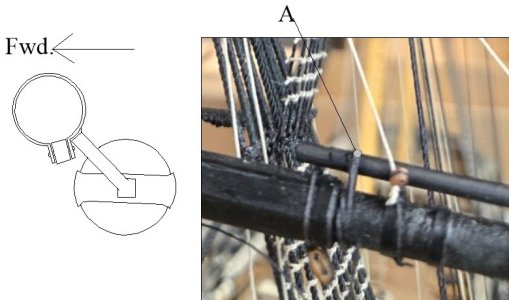
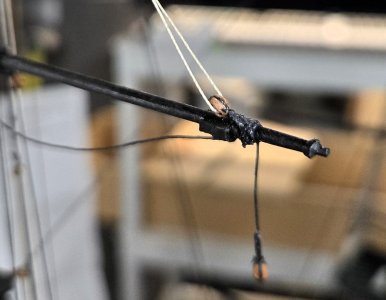
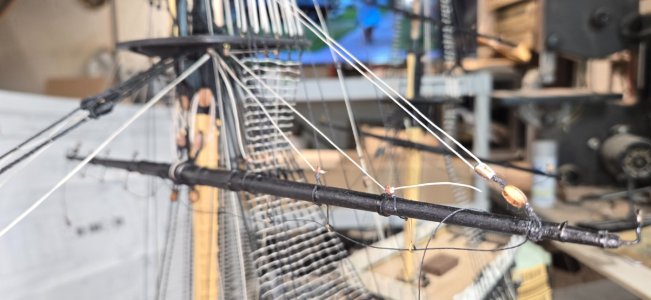
Your great rigging work continues! Seeing the stunsail booms tied inboard is a treat as it is a tiny detail more often than not ignored. (Item A in the photo below.)
Thanks for sharing all the detailed photos!

Allan
1769889794818.jpeg
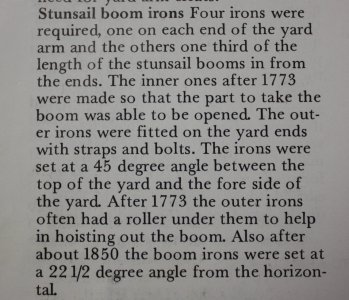
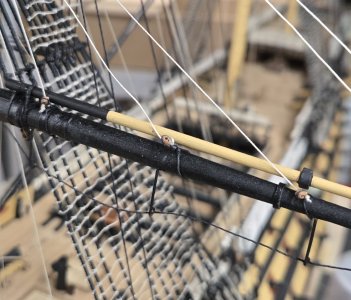
Hard to tell from the photos, but are the stunsail boom irons on top of the yards or are they set at 45 degrees between the top of the yard and the fore side of the yard?
From James Lees' The Masting and Rigging of English Ships of War page 14

1769889641696.jpeg
 
Back
Top