.
It would appear that your personal opinion as stated here would place you outside the great majority of maritime historians and naval architects. They are still using models in towing tanks and wind tunnels as important tools for obtaining hull shapes.
This is, of course, a completely unjustified claim, because my phrase
‘an aid to verify certain features or simply to facilitate certain design processes’ obviously also covers activities such as
‘using models in towing tanks and wind tunnels’ (and possible shape correction based on those tests). It could rather be said that looking at all past centuries solely through the prism of later, 19th-century practices, and even failing to see anything beyond this narrow perspective, places one outside the momentous achievements made previously. In this context, you should also know that the history of towing tank research began much earlier than the 19th century, so there is no reason to worry that I have missed anything significantly important in this regard.
* * *
Would it not appear that this was the loftsman's job to do it at full scale after fairing the lines on the loft floor? One would not seem to get very far analyzing "old forms preserved in graphic form" when those "old forms were never exactly preserved in graphic form at all," such "graphic form" being the loftsman's patterns which were promptly put to better use heating the loft once they'd served their purpose of turning their "graphic form" into an actual piece of the ship.
The point is something else, namely, in short, to find the design intentions, or more precisely, to find the specific methods that the designers of the time employed to realise their intentions (indeed, more or less successfully). From this point of view, the example of carpenters being unable to find timber of the right shape or size during construction is actually a quite separate issue, one of a manufacturing nature, as opposed to strictly design-related.
* * *
Finally, whether in the case of a full-scale ship or a scale model, the fairing of drawn plans is and always will be the builder's, rather than the designer's responsibility and the builder relies in the first instance on the loftsman's skill to create the patterns for the pieces that will be assembled based upon drawn plans which are always subject to being faired in the loft.
Personally, I see this issue differently: if the original design requires fairing by loftsmen (here we need to agree on some reasonable, practically achievable tolerances, in this case, say, one inch more or less for large ships), it simply means that the original design (design intention) was incorrectly executed, and as a result, what the loftsmen must necessarily create in such circumstances is already practically a different, distinct design, incompatible with the original. The more sloppiness in the original design, the more different must be the outcome of such derivative design.
I would rather attribute the actual function of fairing shapes, in a way that seems more consistent with the overall workflow, to dubbing men. Nevertheless, I admit the possibility that we may never reach a common denominator on this issue, as it is more a matter of judgement than fact.
* * *
Might I suggest that CAD perhaps unwittingly enables such mediocrity in the modeling field by making available "pictures" than can be rotated and tipped and viewed from all directions in three dimensions by those with inadequate education and background to truly understand them. I doubt you will find the same level of sloppiness in models built by those who know how to "read" drawn plans in two dimensions and are able to "see" three-dimensional objects when looking at an old-fashioned draftsman's work.
I find it a somewhat surprising comparison. I am not even sure if it is appropriate to compare, for example, a ‘typical’ everyday visitor to a museum, where 3D objects resembling ships are presented in multimedia form, to experienced draughtsmen who adhere to traditional drawing methods. It seems that it would be more reliable to compare individuals (including their abilities and potential) in the same category, for example, draftsmen using older, and already widely regarded as obsolete techniques (we like it or not) to draftsmen using modern methods, which are commonly and inevitably replacing those older ones.
* * *
I know CAD is a very handy, powerful tool, but I'm not surprised by your frustration with manual drafting when "analysing preserved period plans and studying old design methods." It's always been my experience that such primary-source historical research is best done using the language and tools contemporary with that source material's time and place.
My goodness, what will poor researchers of ancient civilisations, and in particular their architectural achievements, do now, deprived of drones, LIDAR technology and, of course, computers with the appropriate software? But joking aside...
No, I am not frustrated at all, if only for the obvious reason that I do not use manual drafting for my analyses, because it would simply be completely ineffective in this particular area. But indeed, one can expect frustration from those who have not yet achieved any real results in this field (despite their best efforts), precisely because of the limitations of manual drafting in such analyses. It could be said that historians, including archaeologists were, in essence, reduced in these circumstances to interpreting textual descriptions almost exclusively, but this only led them astray.
In other words, limiting oneself exclusively to
‘language and tools contemporary with that source material's time and place’ has not only failed to produce real, correct results so far (at least in my area of interest, i.e. ship architecture from the 16th–18th centuries), but has also caused perhaps irreversible damage of catastrophic proportions, as it has generated a largely erroneous and, unfortunately, now widely accepted narrative about the general evolution of ship architecture during this period.
.







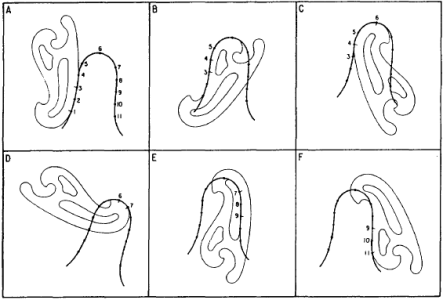


 objects are made as an aid to verify certain features or simply to facilitate certain design processes). Furthermore, I see no reason to view 19th-century American practices as in any way less advanced than those of other centres of this kind, maybe except in the case of semi-professional shipyards and/or less demanding projects, for which it was not worth engaging fully professional, advanced design procedures.
 .
. You're right, they don't lay awake at night worrying about it because they don't even know how wooden vessels were (and still are) built, let alone designed, in real life, in many cases they've never seen a high-quality scale ship model and mistakenly believe that's a picture of one on the cover of the ship model kit box they bought, and the kit manufacturers have created a false impression of "quality" that's got all of them congratulating each other on social media for each other's "awesome" models.