• Win a Free Custom Engraved Brass Coin!!!
    As a way to introduce our brass coins to the community, we will raffle off a free coin during the month of August. Follow link ABOVE for instructions for entering.
  • SUBSCRIBE TO SHIPS IN SCALE TODAY!

    The beloved Ships in Scale Magazine is back and charting a new course for 2026!
    Discover new skills, new techniques, and new inspirations in every issue.

    NOTE THAT OUR NEXT ISSUE WILL BE MARCH/APRIL 2026

Harold Hahn

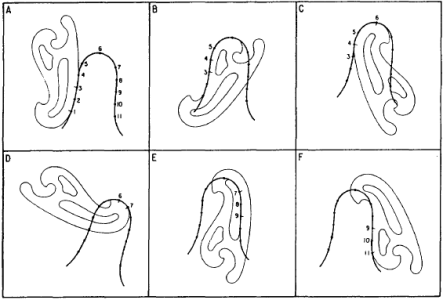
a set of ship curves may be hard to find but if you Google ship curves and you get an image of a set could you use that image and make a setcut out of plastic or wood?
When you are using a computer program to loft and it is the computer version of freehand connect the dots:
and your curves are not constrained by a computer program equation - spline, Boolean(?), that thing with two external control points.
Straight up mouse or pen freehand curve gets sloppy with me. (I use a raster based drawing program, so any curve is a series of facets - which I can live with because a plane. rasp, file, mechanical and then hand sanding, scraper invariably turns it smooth)
Import a photo of each curve into your drawing program.
Use the magic wand to remove the background. Just have the black line of the curve on its layer.
The proper curve to connect the three points - rotate, scale, move the curve layer.
Select the segment of the curve that you want and save to its own layer.
Then merge that layer with the frame layer.
 
This gives you a guide for drawing the frame between the two red frame lines.
The curve between the two guide frames is not an arc. It is a curve that drops off ever more rapidly. But the good part with doing this is that the curve that is drawn is fatter than it would be if it was plotted points. Fatter is good. When the hull is worked into a continuous smooth surface, the extra fat part will go away.
 
Half Models: Half models were the principal and often the only design tool used by many shipbuilders during the Nineteenth century in the USA and in parts of Great Britain. This excludes vessels designed for naval service by government bureaucracies where lines drawings were made. Offsets were measured from the models and sent to the mould loft floor where the design was refined. This practice was still used here on the American Great Lakes into the first quarter of the twentieth century. As Bob mentions Nathaniel Herreshoff refined this process with the invention of a specially designed machine using dial indicators to measure offsets. Many lines drawings available to ship model builders have been drawn from existing half models and sometimes tables of offsets. They (the drawings) were not used to build the ship.

Yes, the middle decades of the 19th century mark a clear separation between two quite different eras with different characteristics and practices, one might say. As a curiosity, I would like to add that in 18th-century France, for example, naval shipyards were also often sent only tables of offsets (based on an officially approved design), with the difference that these tables were based on paper plans, as opposed to measurements of half-models.

.​
 
QUESTION

a set of ship curves may be hard to find but if you Google ship curves and you get an image of a set could you use that image and make a setcut out of plastic or wood?

In theory, yes. In practice, no.

The irregular curve shapes of various types are high tolerance drawing templates. They work in conjunction with one another to produce fair irregular curves.


1772673948357.png

The reduced size drawings of irregular curve sets copied from drafting instrument supply company catalogs are probably not sufficiently accurate to use as patterns if enlarged to full size.

A few years ago, a fellow created a "go fund me" site to produce the full set of ship's curves in acrylic, cutting them out with a laser cutting machine. His project had to be abandoned because he discovered that the cost of laser cutting production was too expensive. Mass production was not sufficient to create economies of scale which would put the project into the black. There wasn't enough of a market for the them anymore.
 
Waldemar, The model that I am currently building is probably an example where the shipyard that built the ship never saw a complete lines drawing.

The Great Lakes Steamship Benjamin Noble was designed by the Cleveland, Ohio design office of the American Shipbuilding Company in 1908. She was built by their Wyandotte, Michigan shipyard located 150 or so miles away. No complete lines drawing is known to exist. Instead there is a table of offsets and a lines drawing of just her fantail stern. To build the model it was necessary for me to make a lines drawing using the table of offsets.

The original lines drawing or half model was probably destroyed by the design office. The drawing package including the table of offsets and fantail stern drawing sent to the shipyard to build the ship was saved and ultimately donated to a museum.

Roger
 
What Harold meant when he said options for introducing detail is his plans are designed so a builder can alter the framing without having to change the framing system or redrawing frames.
I find this extremely interesting!


Non-related to the framing; at some point can you speak to Mr. Hahn's tree nailing principles? I have often wondered why he chose to use the size and number of such. At this point, I am going to guess that it was an artistic choice he made since it is clear that his skills were that he could have reduced the diameter and increased the number. The other competing guess I have made is that the tree nails are as they are for structural reasons.
 
Therefore, personally, generally speaking, I see the use of half-models in the ship design process more as an aid than as the (most important) basis for obtaining hull shapes, at least in the context of fully professional design centres (just as today, 3D models of designed :rolleyes:objects are made as an aid to verify certain features or simply to facilitate certain design processes). Furthermore, I see no reason to view 19th-century American practices as in any way less advanced than those of other centres of this kind, maybe except in the case of semi-professional shipyards and/or less demanding projects, for which it was not worth engaging fully professional, advanced design procedures.

It would appear that your personal opinion as stated here would place you outside the great majority of maritime historians and naval architects. They are still using models in towing tanks and wind tunnels as important tools for obtaining hull shapes.

The analysis of old designs preserved in graphic form actually never involves drawing a single line or, even less so, a larger set of lines that immediately fit together.

Would it not appear that this was the loftsman's job to do it at full scale after fairing the lines on the loft floor? One would not seem to get very far analyzing "old forms preserved in graphic form" when those "old forms were never exactly preserved in graphic form at all," such "graphic form" being the loftsman's patterns which were promptly put to better use heating the loft once they'd served their purpose of turning their "graphic form" into an actual piece of the ship.

Similarly, I am also not sure whether the tempting recipe for ‘quick’ line drawing is always effective in the long run, because in practice it turns out that model makers have notorious problems with sloppy plans, which they quite often complain about, and these are usually the results of manual drafting and in a hurry. As a result, they are faced with a need of correcting these errors in a woodworking way, often quite troublesome and time-consuming, and not always yielding satisfactory outcome, which calls into question the apparent economy applied at the stage of drafting the modelling documentation. They may simply give up on these corrections, but are left with quite noticeable, sloppy shapes of their model hulls, or they correct them at the woodworking stage of model construction, aiming at least to achieve fairness, but such operations are inevitably carried out at the expense of shape consistency, i.e. the final shape of the model hull drifts towards a more or less ‘random’ entity. While indeed this is probably not something that keeps too many hobbyists awake at night, but it is at least worth being aware of such consequences, if it matters to anyone :).

Quite true and shame on them. This "sloppiness" is not only a function of a lack of drafting skill and attention to detail, but also, and perhaps primarily, because of current design practices in the commercial ship model kit industry, including, but not limited to "plank on bulkhead" hull construction. For reasons of crass commercialism, many kit manufacturers actually encourage and support such sloppiness and lack of attention to detail. Finally, whether in the case of a full-scale ship or a scale model, the fairing of drawn plans is and always will be the builder's, rather than the designer's responsibility and the builder relies in the first instance on the loftsman's skill to create the patterns for the pieces that will be assembled based upon drawn plans which are always subject to being faired in the loft. Of course, the vast majority of kit builders who identify as "scale ship modelers" haven't the slightest clue what lofting is, let alone how to do it. If you don't believe that. As one what a diagonal is and what it's used for. ;) You're right, they don't lay awake at night worrying about it because they don't even know how wooden vessels were (and still are) built, let alone designed, in real life, in many cases they've never seen a high-quality scale ship model and mistakenly believe that's a picture of one on the cover of the ship model kit box they bought, and the kit manufacturers have created a false impression of "quality" that's got all of them congratulating each other on social media for each other's "awesome" models.

Might I suggest that CAD perhaps unwittingly enables such mediocrity in the modeling field by making available "pictures" than can be rotated and tipped and viewed from all directions in three dimensions by those with inadequate education and background to truly understand them. I doubt you will find the same level of sloppiness in models built by those who know how to "read" drawn plans in two dimensions and are able to "see" three-dimensional objects when looking at an old-fashioned draftsman's work. I know CAD is a very handy, powerful tool, but I'm not surprised by your frustration with manual drafting when "analysing preserved period plans and studying old design methods." It's always been my experience that such primary-source historical research is best done using the language and tools contemporary with that source material's time and place.
 
Last edited:
.​
It would appear that your personal opinion as stated here would place you outside the great majority of maritime historians and naval architects. They are still using models in towing tanks and wind tunnels as important tools for obtaining hull shapes.

This is, of course, a completely unjustified claim, because my phrase ‘an aid to verify certain features or simply to facilitate certain design processes’ obviously also covers activities such as ‘using models in towing tanks and wind tunnels’ (and possible shape correction based on those tests). It could rather be said that looking at all past centuries solely through the prism of later, 19th-century practices, and even failing to see anything beyond this narrow perspective, places one outside the momentous achievements made previously. In this context, you should also know that the history of towing tank research began much earlier than the 19th century, so there is no reason to worry that I have missed anything significantly important in this regard.

* * *​

Would it not appear that this was the loftsman's job to do it at full scale after fairing the lines on the loft floor? One would not seem to get very far analyzing "old forms preserved in graphic form" when those "old forms were never exactly preserved in graphic form at all," such "graphic form" being the loftsman's patterns which were promptly put to better use heating the loft once they'd served their purpose of turning their "graphic form" into an actual piece of the ship.

The point is something else, namely, in short, to find the design intentions, or more precisely, to find the specific methods that the designers of the time employed to realise their intentions (indeed, more or less successfully). From this point of view, the example of carpenters being unable to find timber of the right shape or size during construction is actually a quite separate issue, one of a manufacturing nature, as opposed to strictly design-related.

* * *​

Finally, whether in the case of a full-scale ship or a scale model, the fairing of drawn plans is and always will be the builder's, rather than the designer's responsibility and the builder relies in the first instance on the loftsman's skill to create the patterns for the pieces that will be assembled based upon drawn plans which are always subject to being faired in the loft.

Personally, I see this issue differently: if the original design requires fairing by loftsmen (here we need to agree on some reasonable, practically achievable tolerances, in this case, say, one inch more or less for large ships), it simply means that the original design (design intention) was incorrectly executed, and as a result, what the loftsmen must necessarily create in such circumstances is already practically a different, distinct design, incompatible with the original. The more sloppiness in the original design, the more different must be the outcome of such derivative design.

I would rather attribute the actual function of fairing shapes, in a way that seems more consistent with the overall workflow, to dubbing men. Nevertheless, I admit the possibility that we may never reach a common denominator on this issue, as it is more a matter of judgement than fact.

* * *​

Might I suggest that CAD perhaps unwittingly enables such mediocrity in the modeling field by making available "pictures" than can be rotated and tipped and viewed from all directions in three dimensions by those with inadequate education and background to truly understand them. I doubt you will find the same level of sloppiness in models built by those who know how to "read" drawn plans in two dimensions and are able to "see" three-dimensional objects when looking at an old-fashioned draftsman's work.

I find it a somewhat surprising comparison. I am not even sure if it is appropriate to compare, for example, a ‘typical’ everyday visitor to a museum, where 3D objects resembling ships are presented in multimedia form, to experienced draughtsmen who adhere to traditional drawing methods. It seems that it would be more reliable to compare individuals (including their abilities and potential) in the same category, for example, draftsmen using older, and already widely regarded as obsolete techniques (we like it or not) to draftsmen using modern methods, which are commonly and inevitably replacing those older ones.

* * *​

I know CAD is a very handy, powerful tool, but I'm not surprised by your frustration with manual drafting when "analysing preserved period plans and studying old design methods." It's always been my experience that such primary-source historical research is best done using the language and tools contemporary with that source material's time and place.

My goodness, what will poor researchers of ancient civilisations, and in particular their architectural achievements, do now, deprived of drones, LIDAR technology and, of course, computers with the appropriate software? But joking aside...

No, I am not frustrated at all, if only for the obvious reason that I do not use manual drafting for my analyses, because it would simply be completely ineffective in this particular area. But indeed, one can expect frustration from those who have not yet achieved any real results in this field (despite their best efforts), precisely because of the limitations of manual drafting in such analyses. It could be said that historians, including archaeologists were, in essence, reduced in these circumstances to interpreting textual descriptions almost exclusively, but this only led them astray.

In other words, limiting oneself exclusively to ‘language and tools contemporary with that source material's time and place’ has not only failed to produce real, correct results so far (at least in my area of interest, i.e. ship architecture from the 16th–18th centuries), but has also caused perhaps irreversible damage of catastrophic proportions, as it has generated a largely erroneous and, unfortunately, now widely accepted narrative about the general evolution of ship architecture during this period.

.​
 
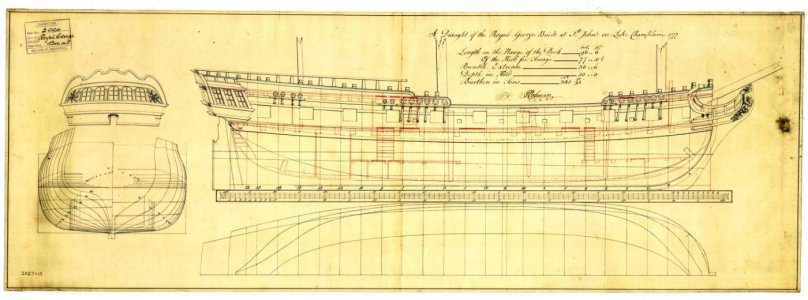
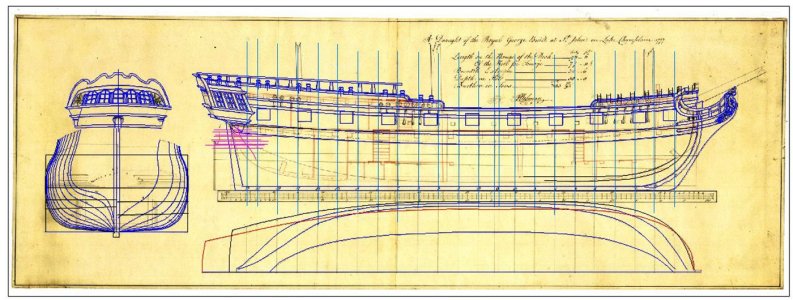
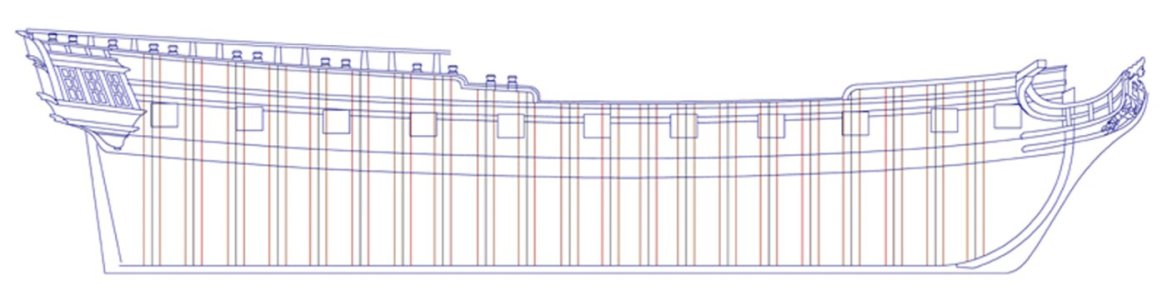
At the peak of Harold Hahn plank on frame modeling plans all the rage was the Admiralty plans and builders wanted to build model from these plans. The most controversial comment from Hahn was those plans were not builders plans they were an artist's conceptual drawing of what the ship would look like. Harold started with the original and traced the drawing which became the master drawing for modeling.

royal george color.jpg
rg plan trace .JPGtracing 1.jpg

Another argument was about station lines and bends were they placed on the location of the bends (frame locations) or was their another reason for their location?

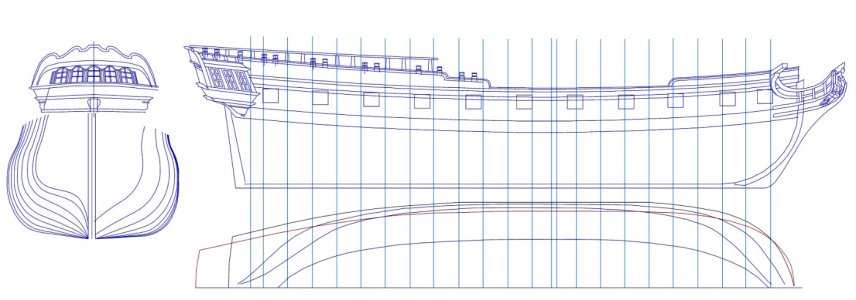
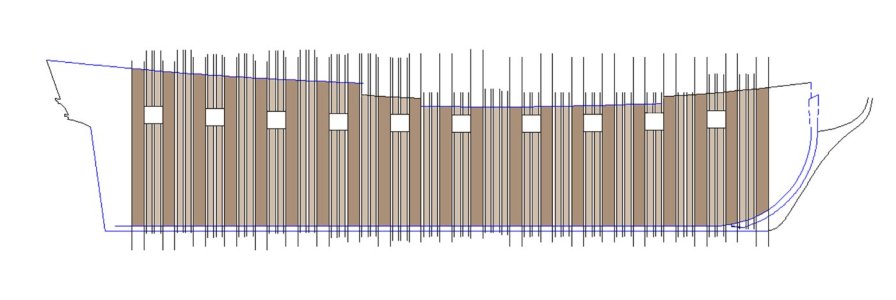
Harold did not use the station lines as a location for framing as an example they did not match up with gun ports


rgf.jpg

for model building framing was set to frame gun ports

s framing.jpg
 
What's the problem with building a model from a copy of the original admiralty drawings?
They were hand drawn and not accurate?
time and reproduction methods distorted the copy?
they were never meant to be used as an accurate source for building the actual ship?

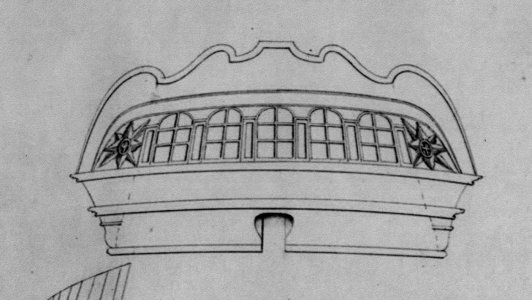
looking at the original stern drawing it look good right?


stern view.jpg

not so fast let's take a critical look

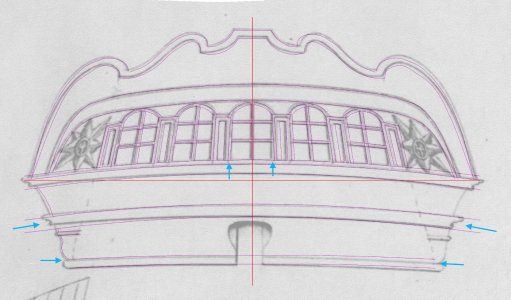
stern overlay2.jpg

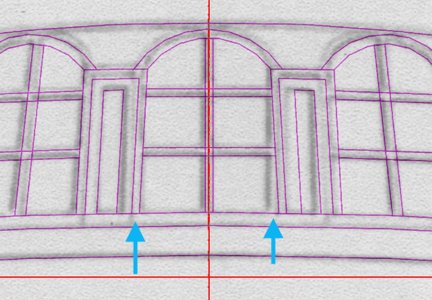
starting with the center window to the left the drawn line is at the edge of the window, now mirror that line. What happened a different angle and not the same distance from center. distortion or drafting error?

stern close1.jpg

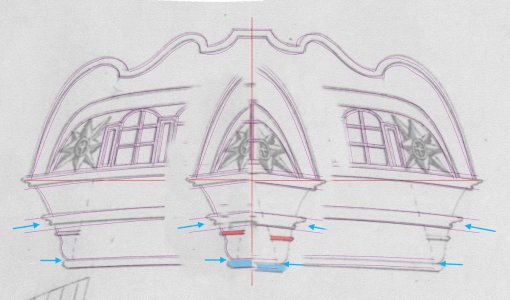
notice in the first image the red cross vertical and horizontal that is the control. Look what happens when the left and right sides are compared. Looking at the red and blue tinted moldings, the right side is lower than the left side. even the top molding is different from side to side.

The question is drafting by hand errors or distortion in reproducing the original drawing. What else about the drawing might be off? Can an accurate model be built from such drawings? Using CAD there is a function called ortho and what it does is mirror exactly at a 90 degree angle up and down and side to side. This function shows the inaccuracy of a hand drawn plan. also CAD has no + or - 1.000 is 1.000


stern overlay distorted.jpg

counter point
i sat with Hahn a draftsman and engineer and Portia Takakjian a model builder and artist. Portia point of view is you do not need accurate plans to build a model all that's needed are over all dimensions and ballpark drawings. The model is shaped and refined during the building process just like real wooden ships were built. This also seems to be the philosophy of kit manufactures we proved the starting point it is you the builder who refines the product into a ship model. However, the kit makers presume you know what you're doing to make those refinements.
 
Last edited:
The original drawings are on organic material that reacts - micro and macro.
A lot are torn and Scotch tape "fixed" . If there were multiple sisters the plan is worn.
The worst that I have seen is Leda. Outside my era but back then I wanted Shannon to go with Chesapeake.
It served for a switch from flat to elliptical stern and open to closed forecastle/bow. Same plan for the RN's most replicated frigate - two of which are still here.

I have lofted over 80 sets of timber patterns for my particular building method.
All of the vessels are from the 1719 to 1776 time period.
For not one of them has the 0 frame which is duplicated P&S on the Body plan been identical.
Most are not even close to being identical.
I just pick one - usually Fore, because I work fore first.
Almost never is the shape of the next station aft outside the fore 0. On the rare plan where (1) or 3 is outside, I just substitute the 0 section there.

Hell, I have lofted about as many of HIC's plans and none of his have identical 0 frames P&S.
We just cannot afford to be anal about this. The originals were about work. They did what was required to get the job done. Their country or a lot of money was at stake. Esoteric indulgence: no way!


For the aft disposition shown above - which it is to be extremely fortunate to have anything as detailed - about half have nothing at all - pick a side and mirror it.
The mold loft guys would have done that and they did not have a key function for "flip horizontal". They could just flip the physical timber pattern - or rather the senior shipwright in the yard would.
The display of the complete stern above was probably not about the mold loft at all. It was the draftsman/designer showing off to his peers and bosses.
 
i sat with Hahn a draftsman and engineer and Portia Takakjian a model builder and artist. Portia point of view is you do not need accurate plans to build a model all that's needed are over all dimensions and ballpark drawings. The model is shaped and refined during the building process just like real wooden ships were built. This also seems to be the philosophy of kit manufactures we proved the starting point it is you the builder who refines the product into a ship model. However, the kit makers presume you know what you're doing to make those refinements.

Takakjian is absolutely correct for the reasons stated. For the same reasons, a ship or boat builder is also an artist and "does not need accurate plans to build a boat or ship, all that's needed are over all dimensions and ballpark drawings." Both models and ships are "shaped and refined during the building process." Thus, it always was and always will be. When it comes to plans, "accuracy" is a relative term. At the end of the day, it's always the craftsmanship that determines if the parts fit well enough. There used to be a saying: "A good framing carpenter works to the nearest eighth of an inch and a good finish carpenter works to the closest sixteenth of an inch, but a good a shipwright works to the closest ship."

Any professional craftsman who uses drawn plans for any purpose lives by the universal rule that "Measurements are never taken from the drawing, but rather always from the notations." In fact, many draftsmen printed a standard caveat on all their drawings saying just that. This is a rule that is widely ignored by modelers who commonly do the exact opposite, and in many instances by kit manufacturers as well. :rolleyes: If modelers followed it, all of this dithering about the accuracy of model plans would be moot. What keeps a wooden boat from leaking is not the accuracy of the drawn plans, but rather the craftsmanship of the framers, plankers, and caulkers that spans the distance between the inherent inaccuracies of the plans taken as a given at the outset and the reality of a tight hull.

Of course, there's no question that CAD drafting is far better in many respects than manual drafting, certainly in the professional production environment, but let's not forget that we sent men to the moon with tee squares and slide rules. :D
 
Last edited:
I propose the following evaluation based what is presented On Forum:
For the translation of original ship design and as built plans into parts that can be used for scratch POF:
Any use of CAD beyond basic drafting is a textbook example of False Precision.
 
Non-related to the framing; at some point can you speak to Mr. Hahn's tree nailing principles? I have often wondered why he chose to use the size and number of such. At this point, I am going to guess that it was an artistic choice he made since it is clear that his skills were that he could have reduced the diameter and increased the number. The other competing guess I have made is that the tree nails are as they are for structural reasons.

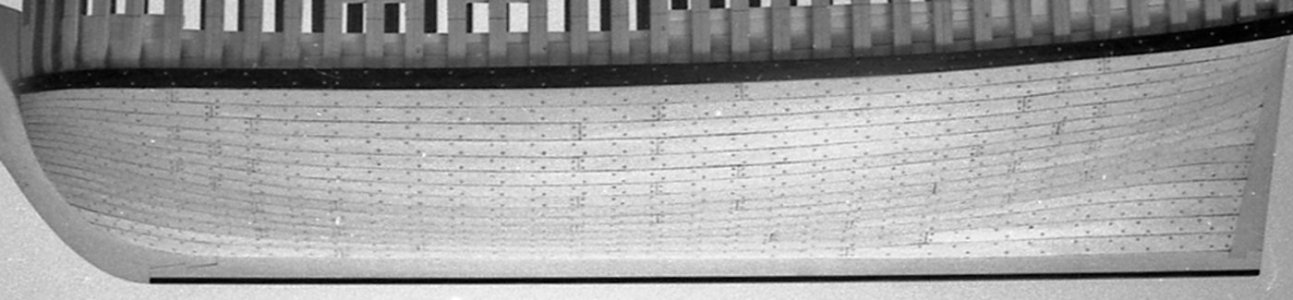
personally, i find Hahns use of treenails a bit districting


hahn t4.jpghahn t3.jpghahn t2.jpghahn t1.jpg

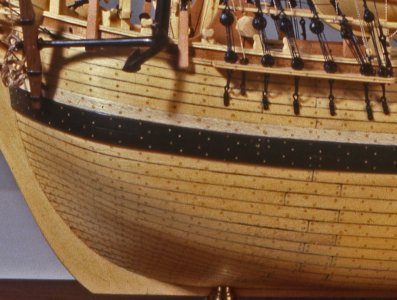
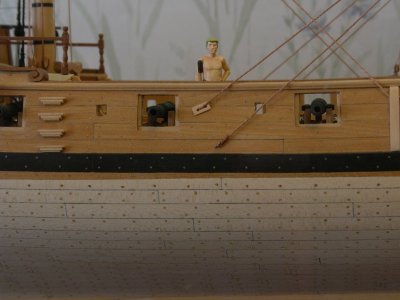
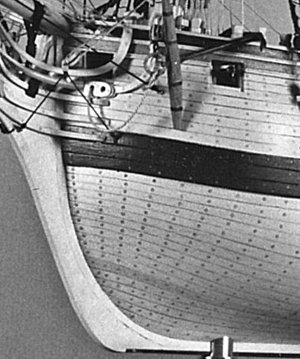
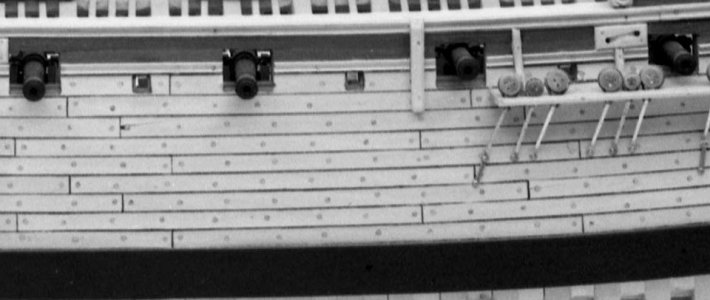
Lets follow the trail and it leads to Bob Bruckshaw here is a closeup of Bob model Harold copied Bob

bob treenails.jpg

Bob copied the Admiralty models here is a closeup of an admiralty hull.

admiralty treenails.jpg

It could be a case of monkey see monkey do or it could be an artistic style of model building handed down from generation to generation.
I think it is an artistic choice. Both Bob and Harold were building hulls in the traditional admiralty style. Well Bob was building hull admiralty style Harold was building so they looked like admiralty style.
Then more model builders began following the trend until realism clashed with artistic style and oversize "treenailing" became unpopular.
As they say in fashion and art one day you're a trend setter and the next day you're out.
If you're going for realism then treenails are too small to even be seen in a scale model. If you're following artistic style that is a different approach to the build. Harold followed to artistic road and not the historical realism of ship building
.
 
I propose the following evaluation based what is presented On Forum:
For the translation of original ship design and as built plans into parts that can be used for scratch POF:
Any use of CAD beyond basic drafting is a textbook example of False Precision.


would you expand on you comment

over the years i heard and still hear how instructions and poor plans prevent builders from building a good model. Sure, blame it on the plans. Did you know during the war of 1812 around the great lake master builders like William Bell, Henry Eckford and the Brown brothers went out and built fleets of war ships without the use of plans. Kind of tells you it is not the plans it is the skills of the builder. I believe you can build a first-class fine art model ship from crappy plans or from no plans and just a list of numbers.
 
As a different explanation for the original 17thC. use of trunnels:

They are an effective way to secure the planking to the frames.
On a hull built at a time soon after Hahn introduced his method, I used trunnels.
I used brass pins and had a piece of scrap wood between the plank and the head of the pin.
This hitch chock is an excellent clamp to hold down the plank until the PVA sets.
To use the pinhead requires that the frame be thru drilled. Inside = ugly.
With a more shallow hole = the pin is bent on the chock. When everything as set, the pin is pulled, the hole broached with a drill that allows a push fit for a Bamboo trunnel. For the pin that will not let go, it is nipped and filed flush.

I miss not using this excellent clamping method. I build 1:60. A #70 Bamboo dowel is proper scale for a trunnel. It is beyond tedious and low yield to pull enough #70 Bamboo. I even have #70 brass and #70 copper wire. I have pictures from AAMM monographs showing heavy brass trunnel use in French museum models.
The negatives
It is busy looking.
The rules for the proper placement - staggered - X inches in scale from the edge requires an attention to detail and a lot of extra time.
The negatives outweigh the positive of easy and strong clamping.
 
Last edited:
would you expand on you comment
It is more at MSW than here, but most CAD displays there involve assembling the entire hull in 3D. Then "correcting" for plans aberrations in CAD. Maybe it is me not having the patience to follow the thread to completion but most seem to get abandoned before it can yield any product. I am not sure what is done to then produce frame patterns if the process is completed. It just seems to take an inordinate length of time better spent working actual wood.

By "false precision" I mean that CAD is capable of many decimal points of precision. The original plans are not even close to being considered precise. To me, it appears that there was a heck of a lot of Kentucky windage involved. How accurate and how internally precise were the rulers way back then? Were the rulers in the drafting room identical to those in the mold loft? If the original had significant slop what is the point of going to a precision that was not realistic when the original designs were created?

Do not misunderstand, I am not addressing or criticizing those who do a complete 3D model that is electrons and always will be. To me that is its own disciple. Impressive work is done there.

If the points for a frame are taken directly from the profile plan - it is a vertical line. There is not much aberration in this small slice. Certainly not enough to warrant redrawing the whole plan. Station intervals can be and a few often are off their theoretical location. I do my assembly based on what it is theoretically supposed to be for frame width. I just ignore any stretching or squishing caused by time and wear or by a Parkinson's twitch in the original draftsman. I bet the farm that the loftsmen did the same. I will not bother to try to untie the knot. I just wack it with a sword. or another to use another cliche: Cut to the chase.

I am not going to miss this opportunity to ask a question that has been nagging me:


I have conceptual questions about the use of 3DCAD for lofting for POF.
After the lines have been imported, and the skeleton has been traced.
A plane transecting an XY frame location will show no shape because there is nothing there?
Skinning the skeleton using a vertex modeler and applying a black texture will show a shape - but it will be heavily faceted?
Skinning the skeleton using a NURBS modeler and applying a black texture will show a curved shape that is a usable frame shape?
When I asked AI what skinning was called in NURBS, it brought up CAGD. This sounds like a quick and dirty way to extract every frame shape without having to plot each curve individually. I am betting that it is not quick. I am betting that a program with this capability would be really expensive.
Is this what is done?
Is it fiscally practical?
 
Last edited:
.​
over the years i heard and still hear how instructions and poor plans prevent builders from building a good model. Sure, blame it on the plans. Did you know during the war of 1812 around the great lake master builders like William Bell, Henry Eckford and the Brown brothers went out and built fleets of war ships without the use of plans. Kind of tells you it is not the plans it is the skills of the builder. I believe you can build a first-class fine art model ship from crappy plans or from no plans and just a list of numbers.

Indeed, plans do not necessarily have to be in physical form, and a project can be expressed in numbers rather than graphically, optionally supported by an auxiliary, sloppy sketch. A very good example of this approach are the ‘age-old’ methods used in the Mediterranean and described in many works from the late Middle Ages and early modern period, referred to by the English as ‘whole-moulding’ and explained by them in works on naval architecture as late as the end of the 18th century. In fact, they are still used today by traditional boat builders in small or undemanding projects.

It can be said that the use of these non-graphic or semi-graphic methods (as they are called by scholars) involves the application of strictly defined procedures, which could be carried out precisely or imprecisely, depending on the skills of the carpenter. If the carpentry result of a given construction could indeed be "anything", then these very procedures, which formed the basis of the construction (intangible plans), were in themselves characterised by virtually infinite precision.

For some, the most important thing is the carpentry skills and their result, while for others it is the concept the carpenters tried to follow, with varying degrees of success in practice. Personally, I see no reason to oppose one to the other, because there is no conflict or contradiction here.

I believe that there is no such thing as true precision or false precision :). Rather, precision either exists or it does not, and to a varying degree.

.​
 
Would you like me to try to address your questions, or would you prefer someone else?
Please. Go ahead.

re: the way you ask that, I have a very different concept of what was the historical shipyard practice from yours it seems. I do not mean anything personal. Either an idea is true or it is not. How I feel about it matters not. I was not aiming at you, just seeking a debate. I enjoy licking around ideas. (That idiom may not translate?) Also, part of the way that I play this game is to try to emulate what the old guys did in the ship yard. I think that the way that I fabricate my hulls is very similar to getting the final shape by battens and an adz. It is just that my wood is 60 times smaller and I can use paper patterns and a drum sander and it is all done on a bulk station to station thick section of frames. It works so easily for me that it seems logical that the mold loft did something similar.

I started out by plotting both faces of every frame. That takes forever. After a long evolution of development, I just trace the station shapes from the body plan, set the moulded dimension, determine the butt lines for the timbers and isolate the individual timber patterns. I can loft a first rate in about 10-14 days. I am just wondering if 3DCAD can match that - once the lines from the plan is entered as program lines.
 
Back
Top