• Ships of Scale has incorportated an extra level of security when you log In. Please follow on-screen prompts to acknowledge that you are not a robot via a "Check Box" or a "Pictorial Check Box Puzzle". This is needed due to higher level of AI Activity Security.
  • SUBSCRIBE TO SHIPS IN SCALE TODAY!

    The beloved Ships in Scale Magazine is back and charting a new course for 2026!
    Discover new skills, new techniques, and new inspirations in every issue.

    NOTE THAT OUR NEXT ISSUE WILL BE July/August 2026
  • Win a Free Custom Engraved Brass Coin!!!
    As a way to introduce our brass coins to the community, we will raffle off a free coin during the month of August. Follow link ABOVE for instructions for entering.

HMS AGAMEMNON 1781 from scratch - scale 1/75

In all cases, yes. The point is that hammocks laid in nets were intended to protect against enemy fire. The hammocks provided excellent protection from rifle and pistol bullets, and also prevented the enemy from aiming. Hammock nets were always installed on the forecastle and quarterdeck to protect the gun crews. Nets were also installed on the poop-deck to protect officers. In addition, nets were always placed on the waist to protect people moving along the bridges.
In old paintings, you can always tell a merchant ship from a warship. The warship has hammock nets.

What was the advantage of hammock nets? They allowed for a lower bulwark, thereby reducing parasitic windage. The parasitic windage of high bulwarks impaired the seaworthiness of ships. In fact, hammock nets filled with hammocks were only most effective during combat. In normal times, the hammocks were removed from the nets, and the ship's bulwarks seemed to decrease in height, making the ship more resistant to the wind.
That's why nets were nets—to let the wind pass through them. Until the mid-18th century, painted cloth (usually red with a white stripe) was used instead of nets. The cloth was removed when a crosswind struck. But then they started to put up nets because it was easier and there was no need to constantly remove the fabric.

View attachment 591419

I'm by no means an expert on this, but the hammock cranes on the quarterdeck in the first image don't seem to make any sense (despite it being an otherwise beautiful model). How would they fit any hammocks in there with the railing in the middle of it?
 
Dear friend! The fact is that mattresses did not necessarily have to be rolled up. In tight spots, such as the quarterdeck railing, mattresses were not rolled but were simply stowed in the available recesses however they fit best.
 
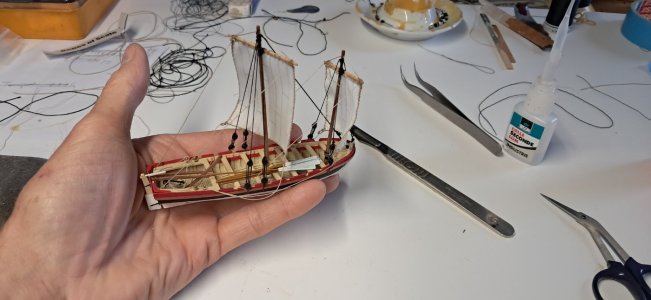
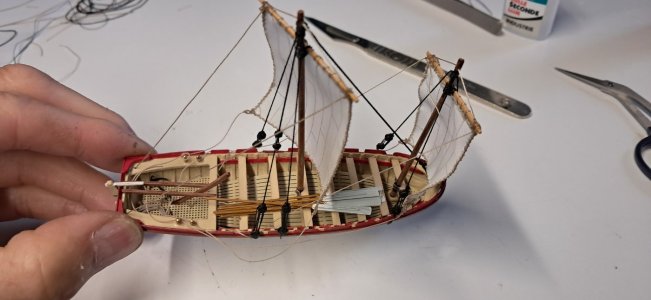
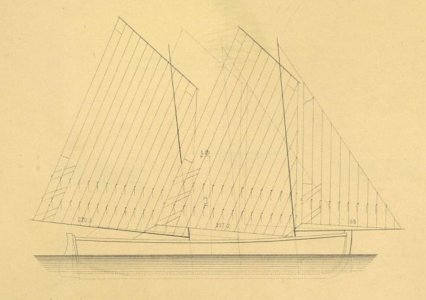
Dear William! The longboat is very good. But a small mistake occurred. Two-masted boats never carried square sails. The square sails would have overlapped each other. Only lateen sails—that is, slanted sails—were rigged. A boom was used, while a sliding yard took the place of a gaff. A boom was fitted only on the mainmast, while a bowsprit was installed forward of the foremast.
According to the complement, you are supposed to have a 30-foot longboat. This drawing shows the standard sail plan of a 30-foot longboat. Use this drawing; knowing the boat's length along the keel, you can easily draw the masts and sails.
баркас 30 ф.jpg
 
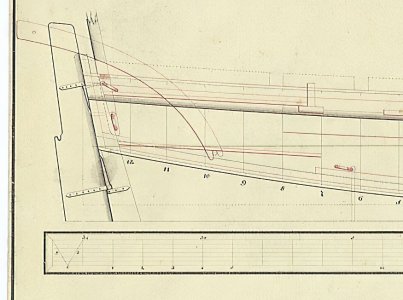
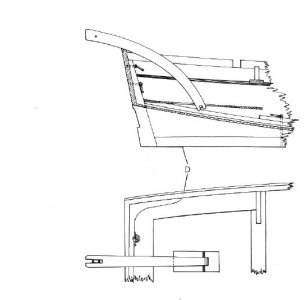
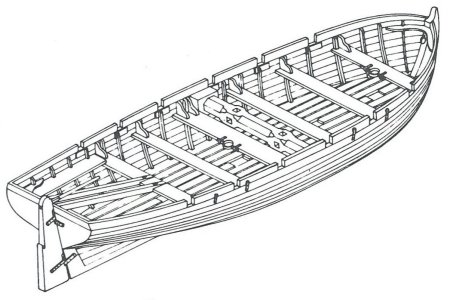
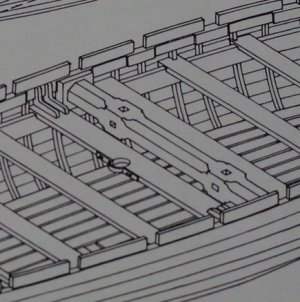
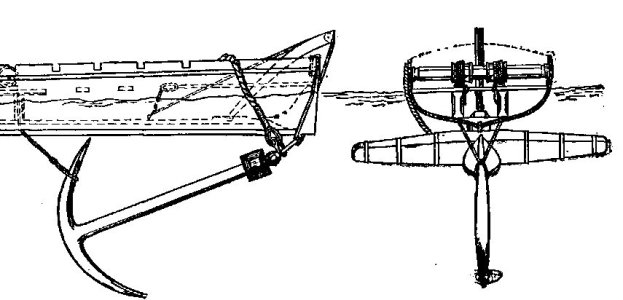
The fish davit was detachable. It rested against a special metal pivot and could be easily removed. At its top, the fish davit featured a sheave for the buoy rope. The fish davit was removed while the boat was underway because it interfered with steering. As the longboat approached the anchor's position, the rudder was removed from the stern and the fish davit was installed. The buoy rope was wound around the windlass, thereby hauling the ship's anchor—by its fluke—out of the seabed mud. For some reason, you have omitted the windlass on the longboat and haven't even shown its mounting points. If the longboat was used for purposes other than weighing the ship's anchor, the fish davit was left on board the ship because it was too bulky and got in the way. The windlass, however, was usually left in place. If, on the other hand, the longboat was needed to transport barrels, both the windlass and the rowers' benches were removed. Furthermore, the windlass and fish davit made it possible not only to pull the ship's anchor out of the seabed silt but also to transport the anchor underwater in shallow waters where the ship could not anchor on its own (last image).


Davit.jpg балка.jpg
брашпиль.jpg

34ф барказ — копия (3).jpg
1487339614179533491.jpg
 
Dear Igor,
Thank you for this feed back.
Very interesting, the plans and explanations about the sails and the process for raising up the anchors. It's not an insurmountable job to replace my sails and adjust the spars. I will correct it Thumbsup
 
Back
Top