• Win a Free Custom Engraved Brass Coin!!!
    As a way to introduce our brass coins to the community, we will raffle off a free coin during the month of August. Follow link ABOVE for instructions for entering.
  • SUBSCRIBE TO SHIPS IN SCALE TODAY!

    The beloved Ships in Scale Magazine is back and charting a new course for 2026!
    Discover new skills, new techniques, and new inspirations in every issue.

    NOTE THAT OUR NEXT ISSUE WILL BE MARCH/APRIL 2026

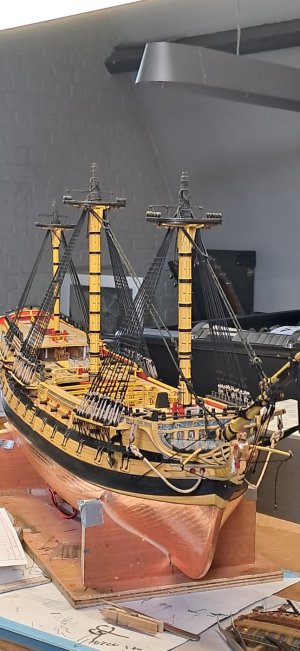
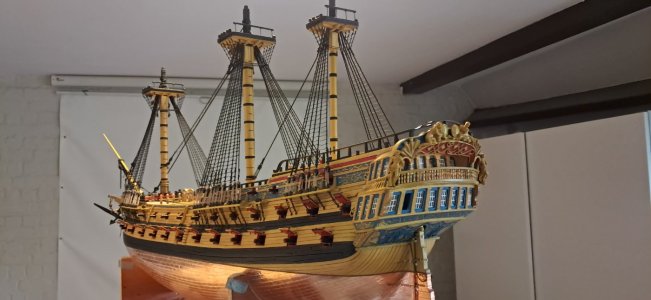
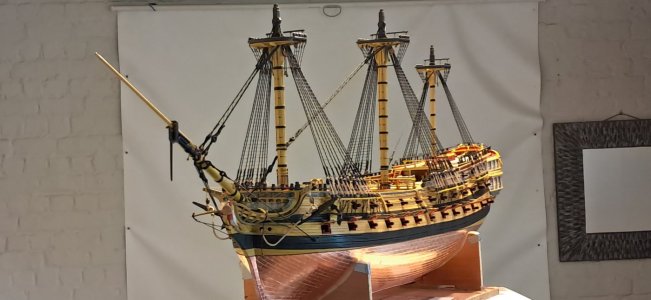
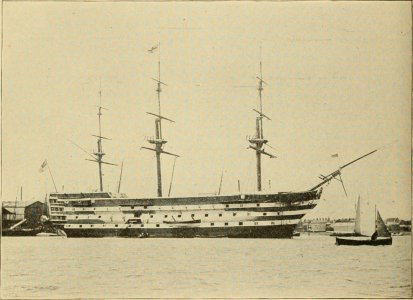
HMS AGAMEMNON 1781 from scratch - scale 1/75

James Lee is not helpfull for construction details.
Hi William,
Not sure what you are referring to, the masts, the tops, something else. The information from David Steel is probably the most worthwhile unless there are drawings for Agamemnon specifically.

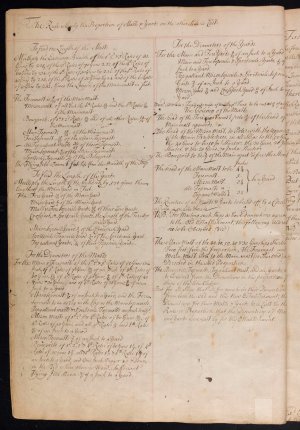
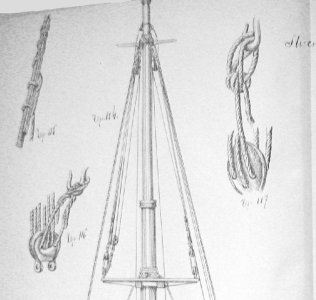
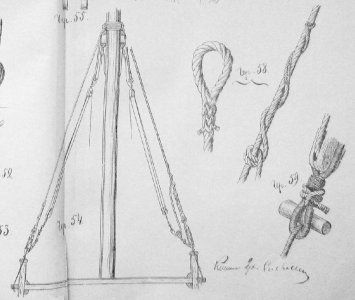
While not appropriate for Agamemnon necessarily the 1719 Establishment pages at RMG give a lot of details that may be helpful for anyone interested for earlier vessels. It has informaation on the tops, trestle trees, masts, etc.

Couple pages as an example follows.
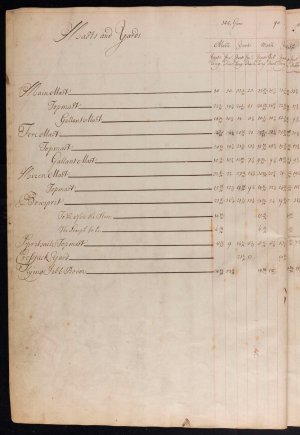
1719 Establishment hand written copy sample 1.jpg

1719 Establishment hand written copy sample 2.jpg

There are a number of high resolution drawings of masts and yards on the Wiki Commons site and hundreds in low resolution on the RMG Collections site.
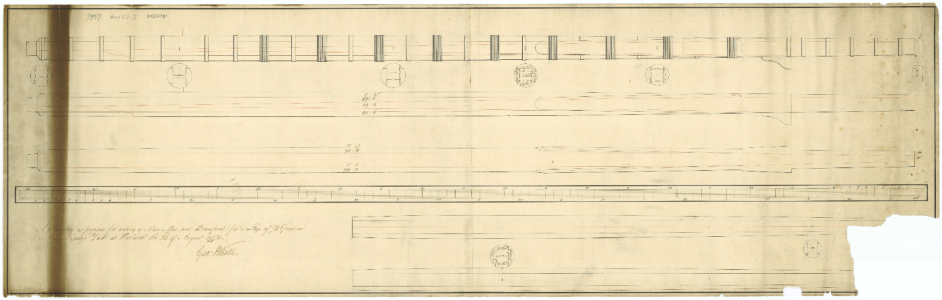
74_GUN_SHIP_1778 MAIN MAST RMG_J7795.png
 
Last edited:
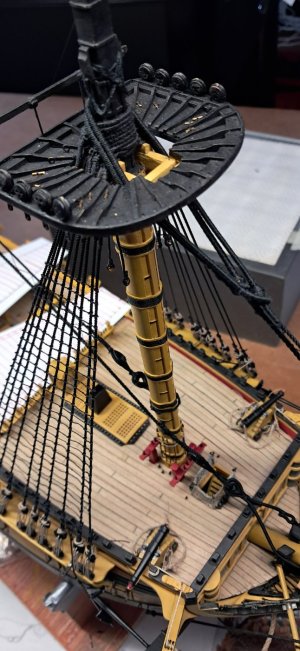
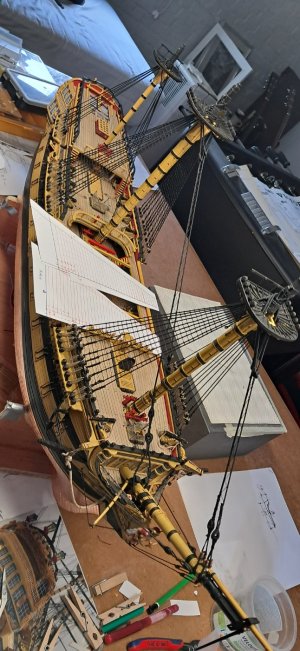
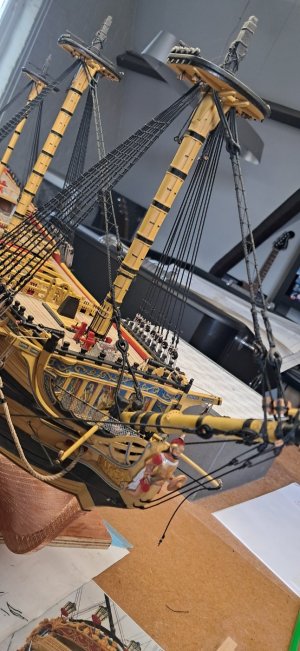
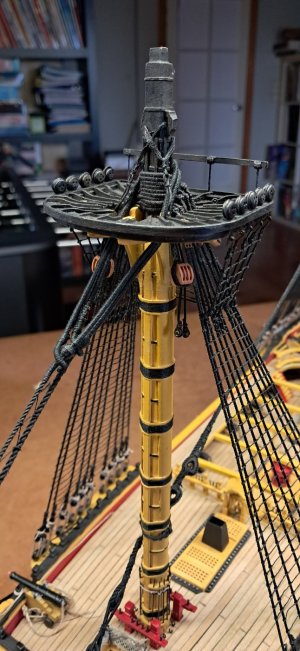
The construction of the lower masts is fantastic!

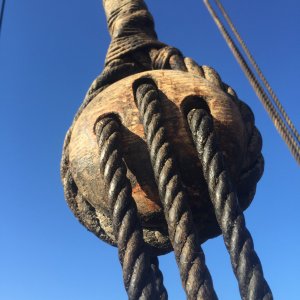
This came up on another Agamemnon build earlier. According to James Lees in The Masting and Rigging of English Ships of War, after about 1775 if there was a swifter like on the Agamemnon main mast only every sixth ratline extended to the swifter. It is great to see you started the lower six rows of ratlines starting on the second shroud for the first six rows as was done on the actual ships at that time. Nicely done. :) I have no idea why they did this and would love to find an answer. I thought it might have to do with the forward most shroud being served the entire length, but then there would be none tied to it, so I am at a loss on this. Beautiful model William!

Allan
 
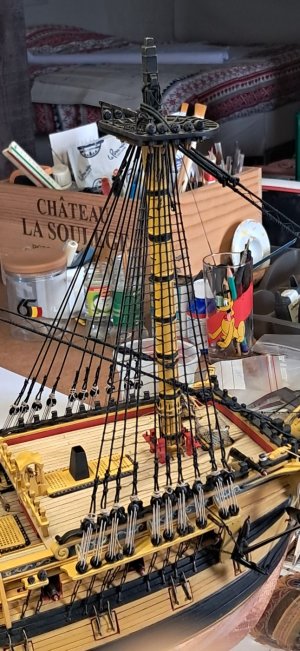
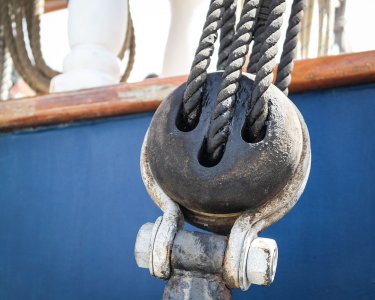
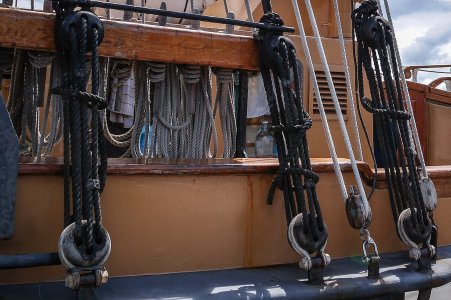
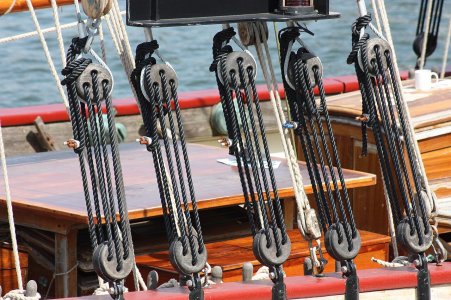
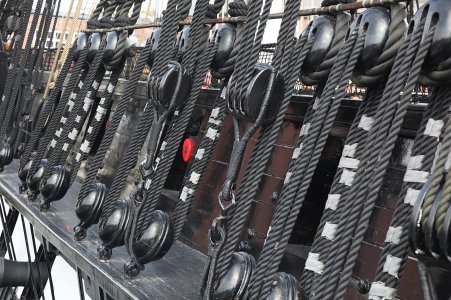
Dear William! Do you know how to dye thread? If so, paint the rigging lanyards black.
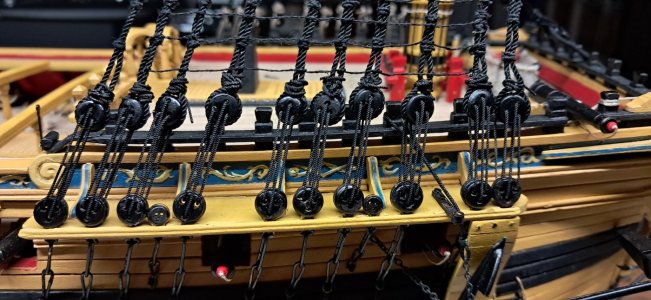
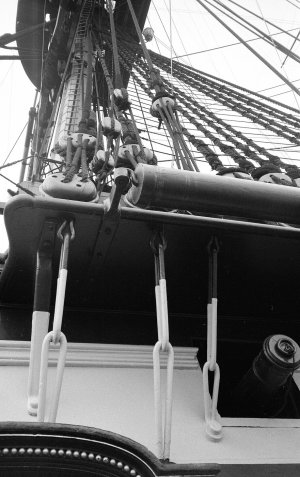
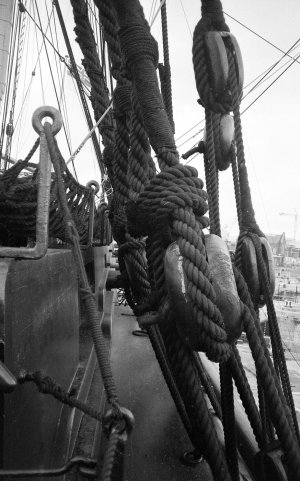
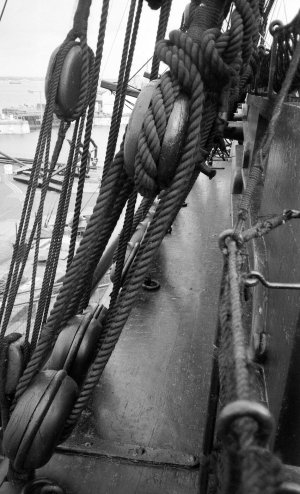
Your stays are done correctly: the lanyards are black. But the lanyards on your shrouds are white, which is a mistake.
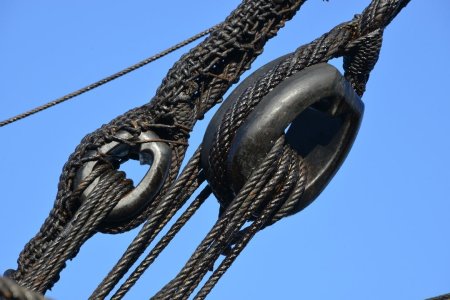
The fact is that on ships, after the standing rigging was finally tensioned, it was completely coated with tar. If these rigging elements weren't tarred, they would rot.
That's why the lanyards were always the same color as the shrouds and stays. Yours should be black.

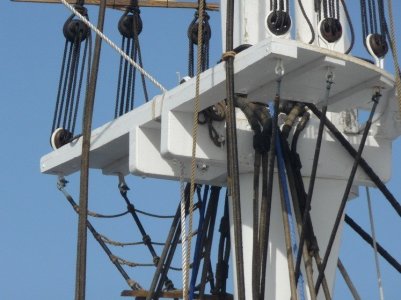
5XImJm6i2ak.jpg 1420784217_futtockshrouds.jpg.37f04a99d0c42938fb1968cd48fcace5.jpg Hawaiian_Chieftain_(Coos_Bay,_Oregon)-5.jpg Hawaiian_Chieftain_(Coos_Bay,_Oregon)-7.jpg Johanna_Lucretia,_Belfast,_June_2010_(05).JPG USS_Constitution-IMG_5307.jpg Victory204 Modified JPG — копия.jpg

0HJJwThigtSzgQswDAx6UsVJkIp8eITom_SdaL971DiBSP67b9nGT5a13req2b3m5sK0UeuLz4zoNEChujdkMuwf.jpg

1-2 (2).jpg
 
Dear William! Do you know how to dye thread? If so, paint the rigging lanyards black.
Your stays are done correctly: the lanyards are black. But the lanyards on your shrouds are white, which is a mistake.
The fact is that on ships, after the standing rigging was finally tensioned, it was completely coated with tar. If these rigging elements weren't tarred, they would rot.
That's why the lanyards were always the same color as the shrouds and stays. Yours should be black.

View attachment 589322 View attachment 589323 View attachment 589326 View attachment 589327 View attachment 589328 View attachment 589329 View attachment 589330

View attachment 589320

View attachment 589321
Thank Iutar, for the information and pictures.
I know about risk of rot but did they never retight the schrouds during ship lifetime ? I gess yes. When lanyards are coated, this will be not possible..
Anyway I will think about how to dye the thread and make some tests. I do not want to take any risk of damaging the aesthetics.
1775246947856.png
 
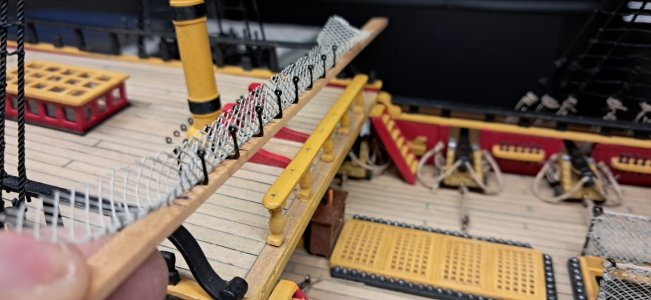
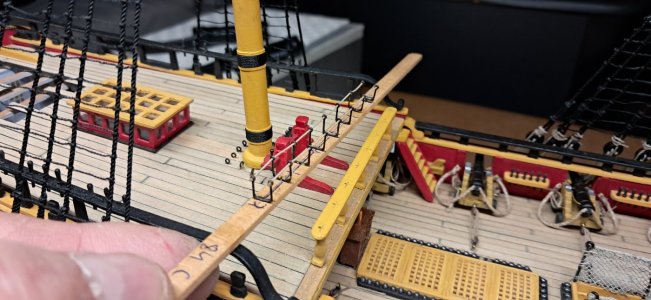
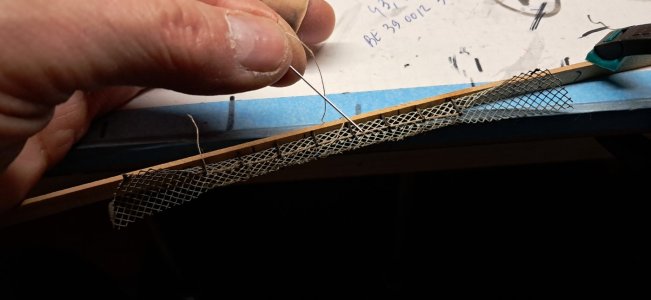
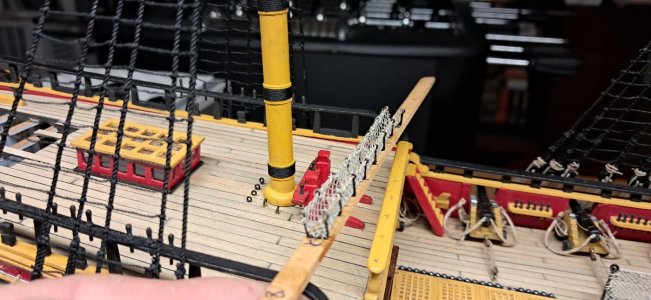
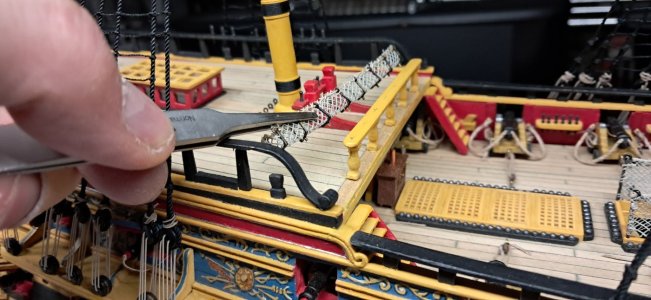
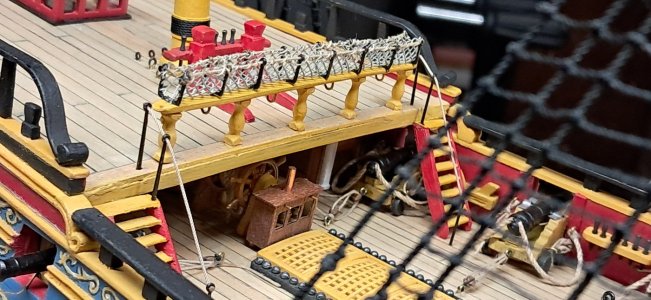
Hammock netting on poop deck
My method :
1) attach the hammock cranes on a separate plank,
2) attach the 2 ropes (0,5 mm)
3) attach the net with thread and needle,
4) placement on the balustrade secured by small drop of glue.
In this case the net is a plastic mosquito net 1,5 x 1,5 mm mesh and painted.

20260403_201210.jpg

20260403_202709.jpg

20260403_204714.jpg

20260403_205617.jpg

20260403_205902.jpg

20260403_231612.jpg
 
Last edited:
I know about risk of rot but did they never retight the schrouds during ship lifetime ? I gess yes. When lanyards are coated, this will be not possible.
What does "entire service life" have to do with this? According to English regulations, all rigging was thoroughly overhauled once a year. In most cases, worn-out rigging was dismantled for scrap. If standing rigging needed tightening, lard and heavy-duty tackles were used. If the deadeye lanyards became worn, it was replaced with a new one. This was easy and simple, and presented no difficulties. Lanyards were replaced using mast hoists.

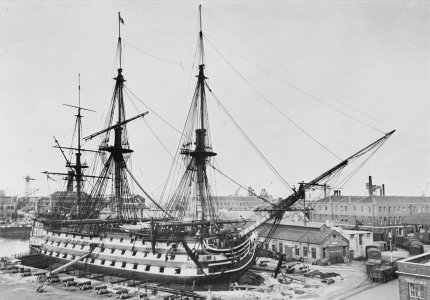
In the photo. The shrouds were tensioned using mast and topmast hoists. They were so powerful that even lard wasn't required!

nfkhtgs 1.jpg nfkhtgs.jpg
 
Anyway I will think about how to dye the thread and make some tests. I do not want to take any risk of damaging the aesthetics.
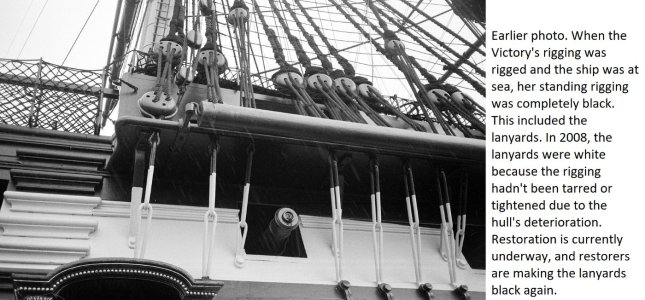
I just said that you can't use photos of the 2008 Victory as a basis for arguments, and now you're showing exactly that!

:(

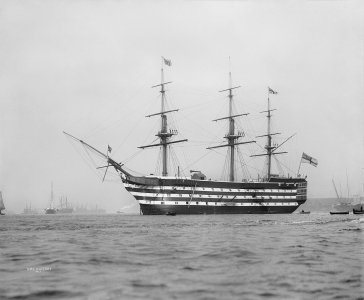
William, look for photos of the Victory at sea. All the rigging there is tarred without fail. It's not even up for debate, it's the law!

Between 2000 and 2008, museum engineers deliberately loosened all the rigging because the ship was in catastrophic disrepair. These photographs (2000-2008) are not evidence!

TxrQMO9kXx_besALQooAM3yJdQyJfM7VUxEol1PUD3B17QJdpNCFGXQ6KTecGRWkRCRjhglo-xsn1SEInrRTCY1W.jpg
URACjkeFR-YdhhpZm5PqtNcSwsE1k5ouHXAhqJPjqEdNaiG9PiBHHiMCLDOKlfjxagokrJR8ceXt_ElARG4Vlc--.jpg
Victory196 Modified JPG.jpg
Victory271 Modified JPG.jpg
Victory291 Modified JPG.jpg
Triumphs_and_wonders_of_the_19th_century,_the_true_mirror_of_a_phenomenal_era,_a_volume_of_ori...jpg
OvSa_GChuE0wXIyEkDbgI5YXtxzKZl4qFJpE4OGThKQqdTiViejMkpKbaHRlFIZgCuP8r7d6b5gLlsx7LkJK0WIU.jpg
il_fullxfull.3045530382_abcx-1579575463.jpg


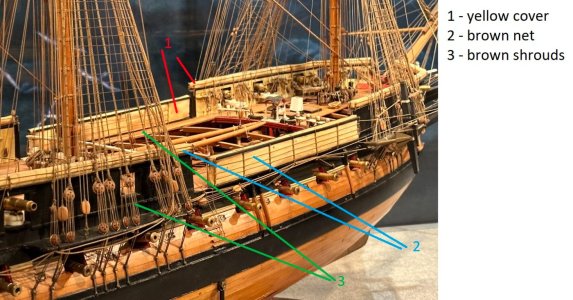
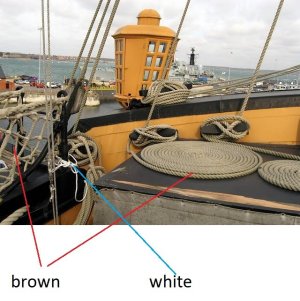
Dear William! Until the second half of the 19th century, cotton and cotton-blend threads were not used in the English navy. All rigging was made of hemp. Hemp was brown and greenish-brown in color. Hemp bleached with bleach was dark gray. Therefore, bed nets ("Hammock netting") could not be white.
Victory145 Modified JPG.jpg Victory259 Modified JPG.jpg Victory284 Modified JPG.jpg
 
Last edited:
I just said that you can't use photos of the 2008 Victory as a basis for arguments, and now you're showing exactly that!
Hi Iutar
As you will not give others permission to use modern photos as a basis for arguments, why do you post them? Just curious :)
Allan
 
When I show modern photos of Victory, I always explain what exactly, what specific detail, you need to look at. There are so many authentic details on Victory. Even the white lanyards. They're white because the rigging shown is not taut. This is appropriate for a ship on the slipway, but is absolutely inapplicable to a ship at sea. The esteemed William's model shows the ship at sea. It is already equipped and armed. Photos of the Victory's rigging on the slipway are not suitable for William's model.
 
It's not even up for debate, it's the law!
It is great to know there were laws on rigging, that was new for me. Thus far, I cannot find any books or information on written UK laws on rigging. Common practice information is widely available, but I cannot find the written law you mention. Can you please tell us specifically where you found this piece of legal information? I hope there are additional laws in your source on rigging that will be helpful in future builds for us. I am aware of the 2023 contract tender sent out to bidders that gives specifications for re-rigging Victory, but it is a contract based on standard practice, not a pre-existing law on rigging.
Many thanks.
Allan
 
Last edited:
Dear Allan! The process of coating rigging with resin to protect it from rot is described in every seafaring manual I've come across. It details where, how, when, and under what circumstances to apply the first, second, and third tensions to the shrouds, and how to apply the resin. There is even a description of the requirements for sawdust that should be sprinkled on the deck to prevent it from becoming contaminated with resin.
Everything's been written, everything's been said. I don't know why you still haven't read such fundamental books. And as for the contracts, they tell you precisely zero about seamanship. You can find the number of deadeyes in them, but there won't be a word about why there should be fewer shrouds, or why the forward steps weren't tied down...
Sincerely, Igor.
 
Everything's been written, everything's been said. I don't know why you still haven't read such fundamental books.
Please do not presume what I or others have read. You said it is the law, so I asked if you could please give the names of these law books. My books are from Lees, Steel, and others, but they are not law books, but rather common practice. I do not know everything about rigging but I continue to learn and do not appreciate your demeaning comments.
Allan
 
Last edited:
Perhaps this was "lost in translation." I didn't mean to humiliate or offend anyone. To avoid such unpleasant situations in the future, Allan, please write to me in Russian. Russian, like English, is also a language of international communication. It has every right to be used on this forum. Perhaps then you'll understand how difficult it is to convey contextual information so that the other person understands you correctly.
Your use of the term "law" is a case in point.
A: Force equals mass multiplied by acceleration. That's a law!
B: I've combed through all the Congressional papers for three hundred years, and there's no such law there.
A: You're looking in the wrong place; you need to read a physics textbook.
B: You're insulting and humiliating me!
I hope this awkward misunderstanding between us will end here, and you won’t be offended at me.
 
Dear gentlemen,
I finaly decided to paint the schrouds lanyards in black as recommended. (thank for your comments).
Concerning the color of netting, I wrote this in Peter Goodwin's book (the construction and fitting of the Sailing Man of War..): ...."during hot weather the tar stained the hammocks . This was eliminated by a Navy Board order of 1780 that the covering cloths were painted either white or yellow".... I leave the netting in white color.
gr
William

20260406_225508.jpg
 
Dear William! Peter Goodwin wrote about covers. But you showed hammock nets. They're different items. White and yellow covers were used to protect only from drops of light tar.
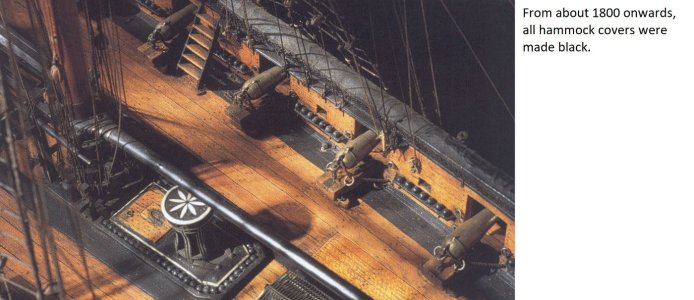
I'll also add to Goodwin's point: due to the abundance of coal soot in the tar, which dripped down from the rigging, covers were subsequently painted only black. The hammock net, however, remained hemp-colored. Soon the net was removed and wooden boxes, which bore the old name "hammock net", were installed in its place.

55A01FB2-220E-4D91-8AC8-CC412EEAC21D.jpeg
0713427.jpg
0AGsDsTAobo.jpg
 
Back
Top