• Win a Free Custom Engraved Brass Coin!!!
    As a way to introduce our brass coins to the community, we will raffle off a free coin during the month of August. Follow link ABOVE for instructions for entering.
  • PRE-ORDER SHIPS IN SCALE TODAY!

    The beloved Ships in Scale Magazine is back and charting a new course for 2026!
    Discover new skills, new techniques, and new inspirations in every issue.

    NOTE THAT OUR FIRST ISSUE WILL BE JAN/FEB 2026

HMS Alert [1777] 1:48 POF by serikoff. (Two hulls: skeleton and fully rigged)

2. Trials and Experiments.

And again, this is my least favorite part of the build, but I've never given it up.

Making samples and experimenting with them seems like an interesting activity, but it often takes a lot of time, and sometimes it takes weeks or even months to see the results... for example, after applying oil and waiting before applying bitumen, or other moments of waiting for the results.

So, I've already shown that I created two large samples of the board and deck.

Alert 1927.jpg

1. Before gluing, while preparing the material (the planks for the sheathing), I coated the boards with a thin layer of tung oil diluted 2:1 with thinner for oil-based paints. After selecting the right planks, I glued them in the correct order and position... and

2. ... after gluing the planks, I sanded the surface with 320-grit sandpaper.

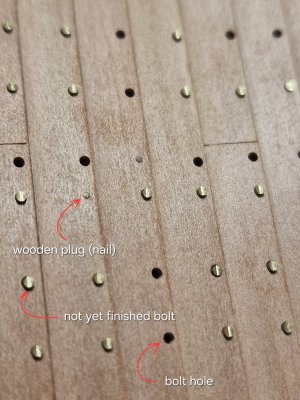
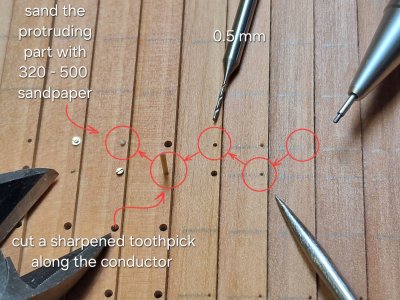
As I already showed, I secured and finished the dowels like this:
Alert 1927a.jpg

And I'll make the bolts like this:

Alert 1927b.jpg

And I had a dilemma... I will do the bolts before applying oil and bitumen, and I will blacken them after... And I had a question, how will the blackening agent work after oil and bitumen... and here is the answer:

Alert 1927c.jpg

... simple! The blackening agent worked perfectly with the oil (Danish). But there's a point to consider!!! (By the way, I applied it with a special brush used in dentistry for applying bonding agents and adhesives).

The bolt at the bottom center had a long exposure time, and during that time, not only did it darken significantly (losing its features, turning into a solid blob), but the wood also became slightly pigmented, which is unacceptable.

But! If you apply the blackening agent for 2-4 seconds and immediately blot it with a napkin, not only will the wood be undamaged, but the metal will also be partially blackened, and the bolt's features will still be legible. (You'll need to experiment with the timing to achieve the perfect color. I'll show all this in more detail later.)


And the deck isn't difficult either:

Alert 1928.jpg

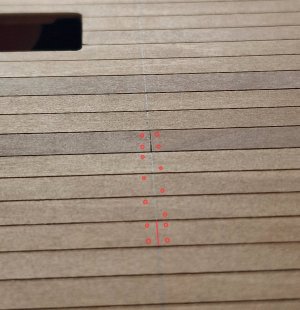
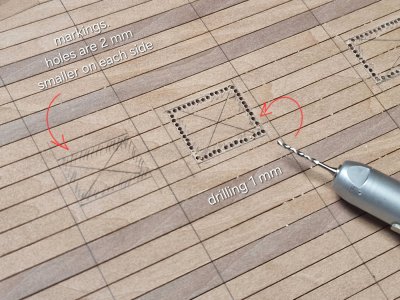
To make precise markings without using a pencil (which can leave streaks), you can cut 2mm-wide strips of masking tape (in my case) and place drilling holes on both sides. The key is to center the strip along the joints of the boards so the nails are equally spaced on both sides.

Then comes the drilling, the toothpicks, and the sanding. And finally, the result after oiling – the top two boards. I'm more than satisfied with the result. This sample will be coated with Danish oil (one and two coats for comparison), and next month it will be coated with bitumen... and I'm already looking forward to it...

UPD: I think I'll give up on Danish oil. Its advantage is that it dries quickly and has a pleasant scent, but unfortunately, it doesn't provide the same color change as Tung oil. I previously used Belinka but ordered Rustins Tung oil. So, I'll experiment for now.

With the side panel sample, after installing the bolts and applying the oil, I'll also be trying different concentrations of bitumen and blackening the bolts in a month... ah... it's so exciting, but it's better to test everything on samples a hundred times before doing everything on the model, you know...
 
Last edited:
Really interesting to follow. Your build log will help me a lot and safe me a lot of time, if I will find time in the future to continue my own build.
 
Good morning Sergey. Your work is exceptional. Thank you for the guide on how to make stunning treenails and bolts.

I just set my goals low so I am always elated with the outcome ROTF ROTF

Cheers Grant
Thanks for the feedback. And regarding goals... well, first of all, you have excellent results... and I like to talk about something else: I set huge goals for myself because they're easier to hit and harder to miss. ROTF ROTF

Really interesting to follow. Your build log will help me a lot and safe me a lot of time, if I will find time in the future to continue my own build.
Thank you, that's what it all started for (detailed overview). I'm already looking forward to your build; it's off to a promising start.
 
3. Bolting.

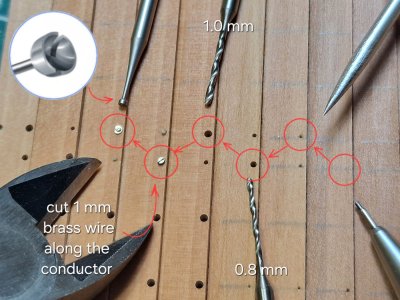
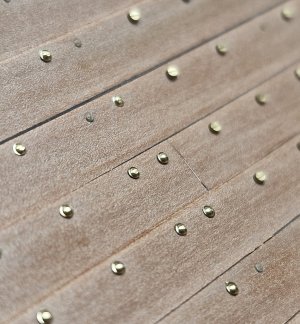
I make the bolts from 1 mm brass wire.

And as I already mentioned, due to a mistake in the plank joints, I had to slightly shift the bolt alignment on several frames. This won't be noticeable (unless you have access to the interior), but it would be noticeable if the bolts weren't positioned correctly relative to the plank joints.

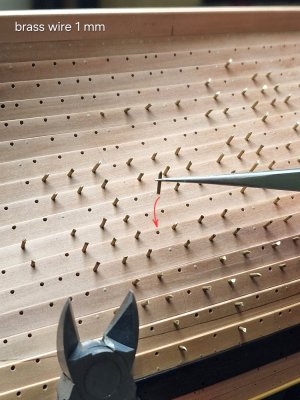
That's why some of the bolts protrude completely from the inside. So, I first cut the wire into small pieces and inserted them into the through holes...

Alert 1929.jpg

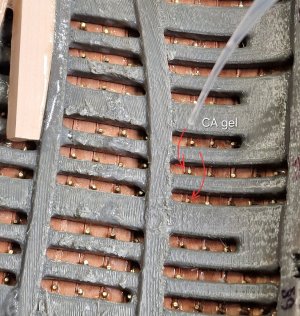
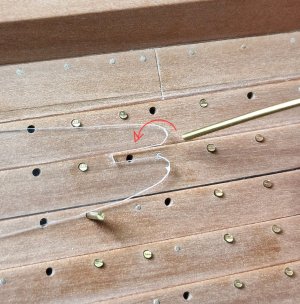
... then from the inside I filled these ends of the СA gel with activator.

Alert 1930.jpg

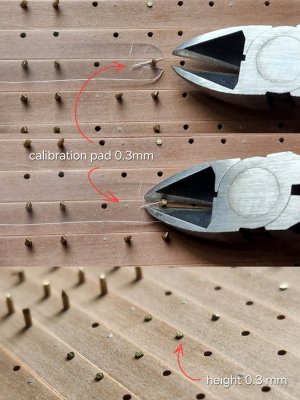
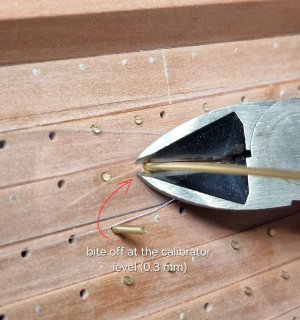
And then, using a calibration gasket, I bit off the excess so that 0.3 mm remained.

Alert 1931.jpg

And thus all the through holes were filled.

Alert 1932.jpg

Alert 1933.jpg

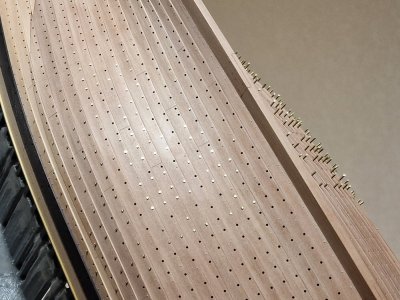
But there were some that weren't through... that's the majority... I filled them out like this:

Alert 1934.jpg

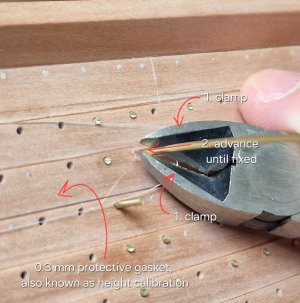
I insert the wire into the hole...

Then I clamp it with wire cutters and push it until it locks in place. I cover the wood with a protective plastic sizing pad.

Alert 1935.jpg

Then I press the nippers against the calibration gasket and cut off the excess so that 0.3 mm remains.

Alert 1936.jpg

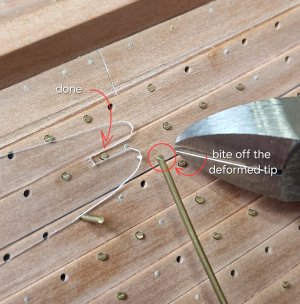
Then you have to bite off the deformed edge so that the new fragment is cylindrical and passes freely through the hole.

Alert 1937.jpg

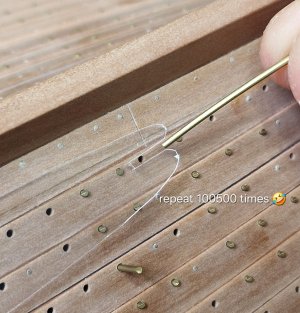
Then this process is repeated many, many times...

Alert 1938.jpg

I only got a third of it done, but decided to take a break from the monotony and make some bolt heads.

Alert 1939.jpg

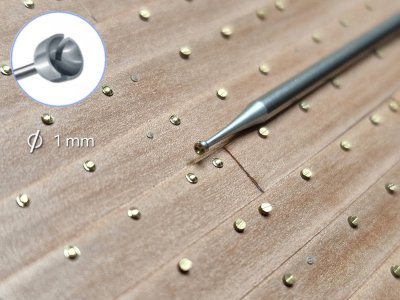
As I already mentioned, I make the caps with a special 1mm diameter burr.

And... how can I say... the result, unfortunately, isn't the same as the samples...

Alert 1940.jpg

The repeatability is decent, but not as good as when everything is convenient and on a flat surface. The housing is more complicated, so some bolts had to be removed and redone. Naturally, the glued-in ones couldn't be removed, but there were fewer of them, and fortunately, they were more or less OK. The advantage of the simply inserted ones is that they can be removed and redone.

But I think that after the bitumen and blackening, all the bolts will look fine even in macro photography, not to mention that it's difficult to spot anything with the naked eye. So my perfectionism is calming down a bit... :rolleyes:
 
For me, the outcome of the bolts is looking very nice, Sergey.
But I think that after the bitumen and blackening, all the bolts will look fine even in macro photography, not to mention that it's difficult to spot anything with the naked eye. So my perfectionism is calming down a bit...
With macro-photography you will ALWAYS see imperfections. Be a little kind and forgiving to yourself.:)
I also learned my lessons……. ;)
Regards, Peter
 
The macros show pure perfection and have in mind if every bolt would be perfect it could look to perfect and so with no "atmosphere", like dead. That is btw the reason I sometimes like the wood pigmentation when I have to blackend directly on the wood. And I guess it would look even great maybe together with the bitumen, which I can't wait to see how you do it as I might try it too then
:)
 
Please say it isn't so! Your attention to detail is a positive trait, do not lose it.
Allan
No, no, I'm not going to lose her. There's a good saying: "Excellent" is the worst enemy of "good." Because often, striving to bring something to perfection can only ruin it. So sometimes you have to know your limits.


For me, the outcome of the bolts is looking very nice, Sergey.

With macro-photography you will ALWAYS see imperfections. Be a little kind and forgiving to yourself.:)
I also learned my lessons……. ;)
Regards, Peter
That's what I'm saying, that sometimes it's irrational to try to get everything perfect, especially since my idol doesn't bother at all, but at the same time he has amazing work.

The macros show pure perfection and have in mind if every bolt would be perfect it could look to perfect and so with no "atmosphere", like dead. That is btw the reason I sometimes like the wood pigmentation when I have to blackend directly on the wood. And I guess it would look even great maybe together with the bitumen, which I can't wait to see how you do it as I might try it too then
:)
I completely agree. Yes, I can't wait to see the expected results, even on samples. I'm already hearing about how much I'm looking forward to working with bitumen on the bodywork. It's both terrifying and very motivating.
 
4. Lower deck.

1/2


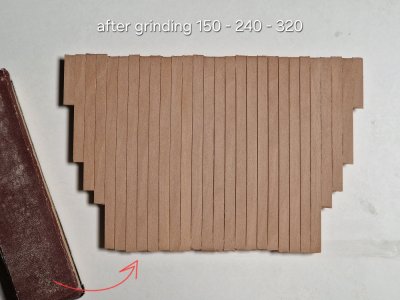
I'm getting a bit tired of bolts, so I decided to switch to the lower deck.

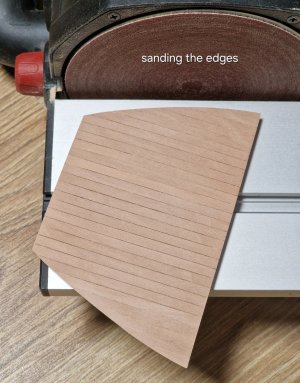
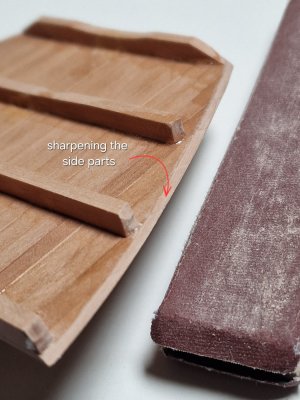
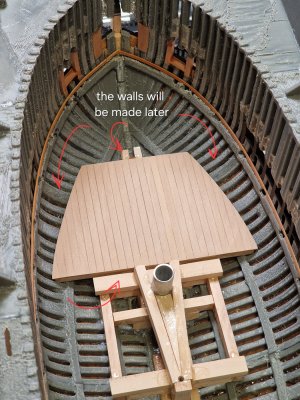
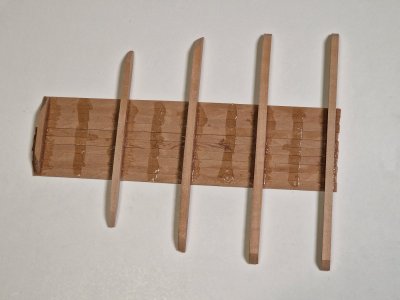
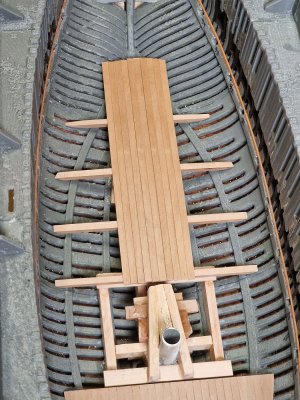
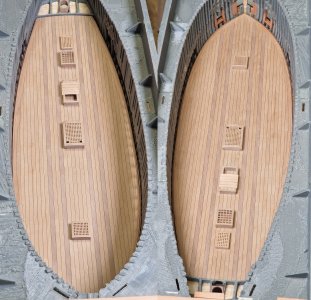
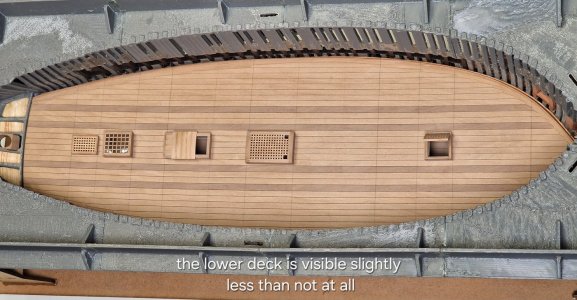
When I started the second hull, I wasn't planning on doing a lower deck, but I changed my mind. So I left the forward grate open, the central companionway is also open, and the skylight will also allow me to see everything below. The two remaining grating will be practically invisible, but I'll be making the lower deck a little larger for another reason. I want to practice with bitumen coating; there's plenty of material, and the deck is very quick to build, so here's the first part.

Alert 1941.jpg

Alert 1942.jpg

Alert 1943.jpg

Alert 1944.jpg

Alert 1945.jpg

Alert 1946.jpg

Alert 1947.jpg

Alert 1948.jpg

Alert 1949.jpg

Alert 1950.jpg

Alert 1951.jpg

Alert 1952.jpg

Alert 1953.jpg

Alert 1954.jpg

Alert 1955.jpg

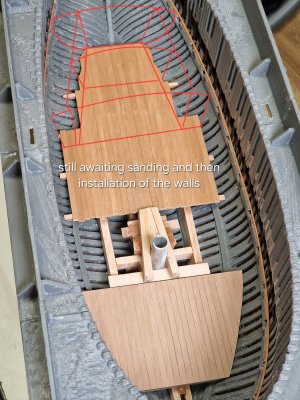
The second deck section is almost complete; it just needs sanding.

The second part involves building the walls.

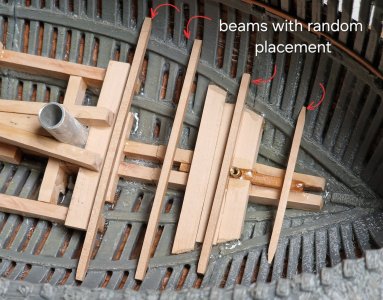
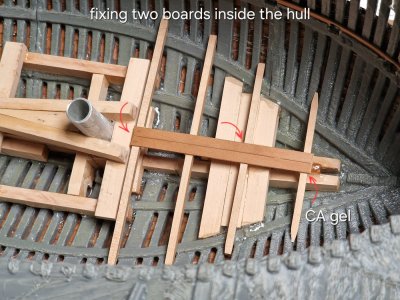
* Let me reiterate, the lower deck will be virtually invisible and is being constructed primarily for practice with a bitumen coating. Therefore, all the walls and beam positions are approximate; only small fragments of the planks will be visible.
 
Last edited:
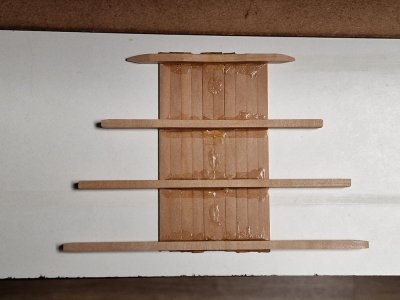
Sergey, can you show how you sharpern the toothpicks?
It's not a quick method, but I can get a lot done this way in a short time if I get the hang of it.
The repeatability is pretty good, but the key is not to make the shape too conical, so the toothpick doesn't widen the hole when inserted.
But if you do it like in the photo, when you cut it, you can see that all the ends are the same diameter, and if you pull it out, you can see that the toothpick shrinks to the diameter of the hole as it moves. Maybe I'm just being elementary, but I wanted to clarify just in case.


Alert 1904.jpg
 
Oookk, so it's a rotary grinder on the left... didn't get it right away. And you manually rotate the toothpick
I need about 20-25k toothpicks each used twice, that's 40-50k tips that have to be sharpened. Even if it's 5sec per tip, that's 55-70 hours. Or, if 1h per day, 55-70 days... How many seconds do you spend per tip? :)
 
Oookk, so it's a rotary grinder on the left... didn't get it right away. And you manually rotate the toothpick
I need about 20-25k toothpicks each used twice, that's 40-50k tips that have to be sharpened. Even if it's 5sec per tip, that's 55-70 hours. Or, if 1h per day, 55-70 days... How many seconds do you spend per tip? :)
Well, yeah... I only have 2500 holes, and 3/4 of them are bolts... One sharpening takes 1-2 seconds. Then you'd be better off with another method:

20161104_171733_HDR.jpg

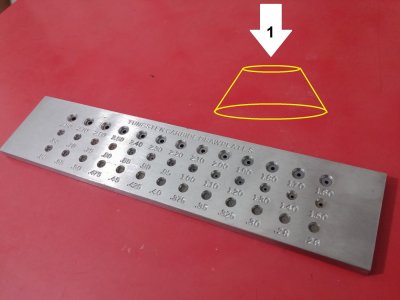
You need to cut a lot of 1x1 mm strips (this is the hardest part). Then you need a board like this with holes. It's used to reduce the wire diameter, but if you turn it over with the sharp edges, you can insert this strip (after sharpening it a bit first) and pull it through several diameters one by one until you reach the desired diameter.

20161104_185243_HDR.jpg

Kudin even painted the outside with black paint to imitate the resin around the nail.

20161104_212005_HDR.jpg

This way you can quickly make 100,500 pieces. Good luck.

P.S. I don't recommend cutting veneer - it's very fragile. You need to cut the most even wood into strips.

20180103_211335.jpg
 
Last edited:
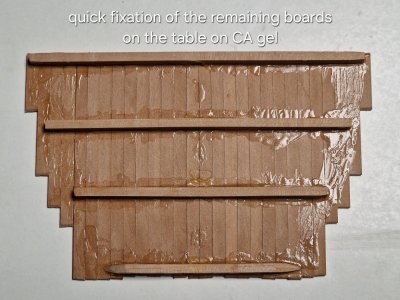
I'm putting off working with the bolts in every possible way... Continuing with the lower deck.

Alert 1956.jpg

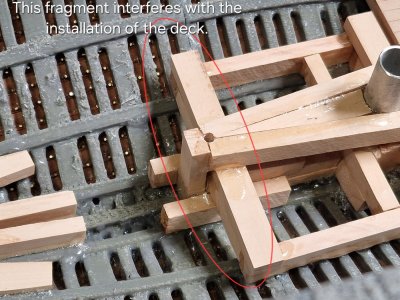
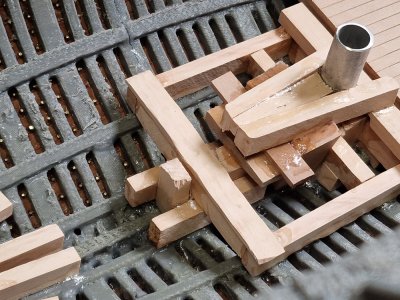
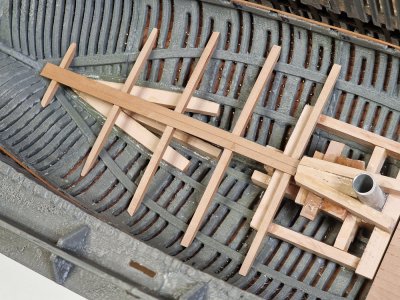
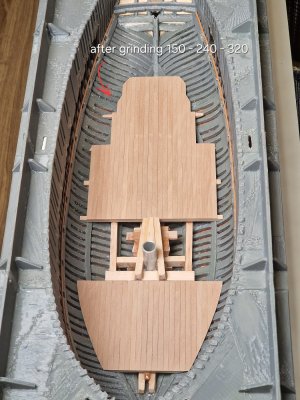
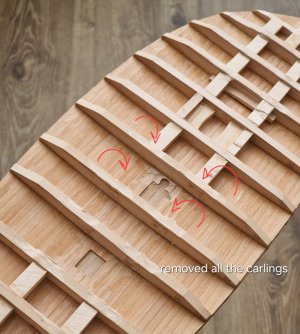
And when I turned the upper deck over I remembered that I had not planned to make a lower deck and the beams on the upper one are very thick... and I had to remove the carlings first...

Alert 1957.jpg

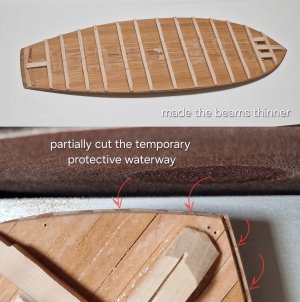
... and then use a plane to cut off the thickness so that the beams become the required size.

Alert 1958.jpg

I also partially cut away the temporary waterway (but didn't remove it) to allow the deck to fit.

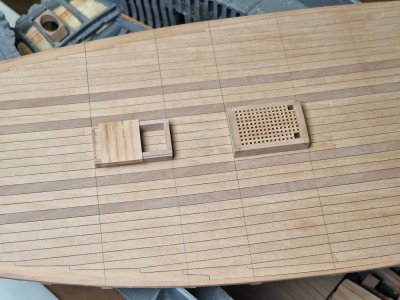
After installation, I tried on the previously made gratings and ladders.

Alert 1959.jpg


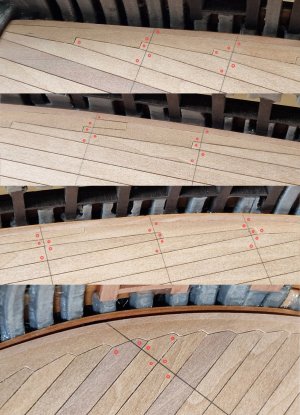
Marking the beams.


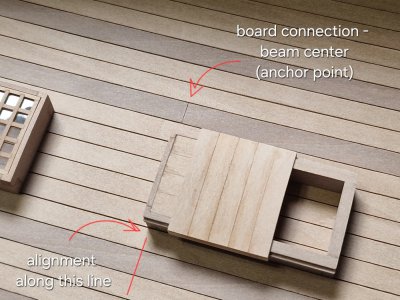
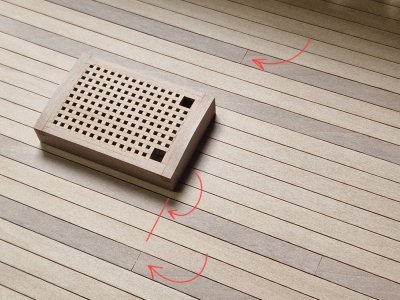
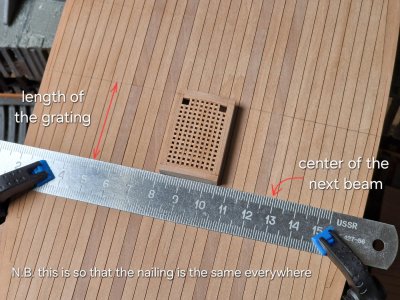
Since the four load-bearing boards (the ones in a different color) have joints (there was a material shortage), all the seams (the beam center) and the gratings frames had to be precisely aligned to this line.

The logic is that no one will notice from above if a beam is off by 1 mm, but if the nailing line is uneven or offset (if the grating protrudes or doesn't reach the line), it will be noticeable. Therefore, it's better to adjust the beam center line to the dimensions of the grating frames and then plan for even nailing.

Alert 1960.jpg

Alert 1961.jpg

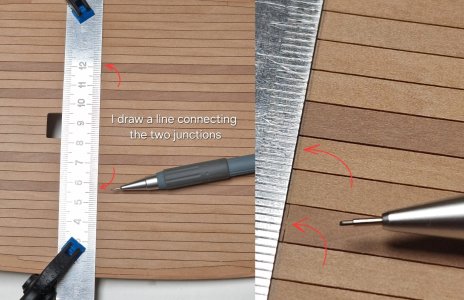
So I drew starting lines where the boards would join...

Alert 1962.jpg

Alert 1963.jpg

...then he placed the edge of the grating against the first line and drew a second line on the other side.

Alert 1964.jpg

This way I marked the beam centers everywhere...

Alert 1965.jpg

...except for two places where there will be pins, but I will do that when I make them.

Alert 1966.jpg

I'd like to clarify once again: the beam lines aren't placed randomly, but rather slightly shifted if necessary to achieve the correct nail spacing (usually no more than 1 mm). This allowed me to position them so that all the nails wouldn't hit the joints and looked appropriate.
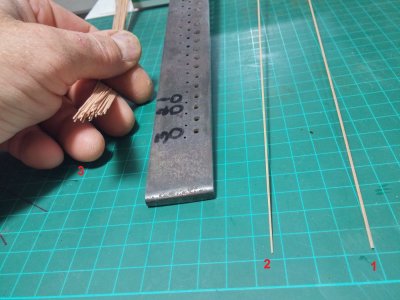
Alert 1967.jpg

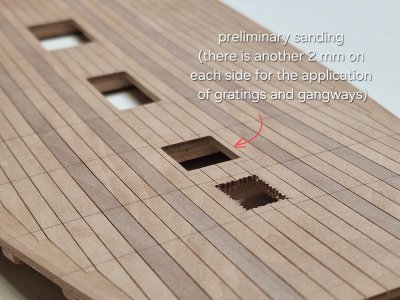
When everything was ready, I cut the holes for the gratings. But this isn't the final result. The holes are 2 mm smaller on each side (so the frames fit onto the deck itself).

Alert 1968.jpg

Alert 1969.jpg

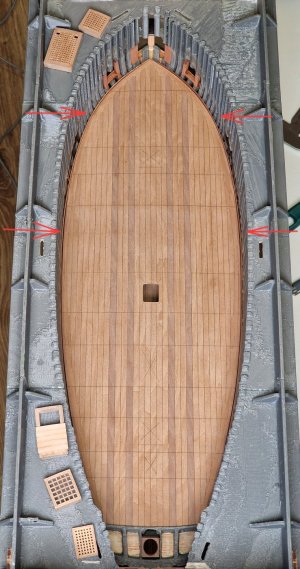
In the end...

Alert 1970.jpg

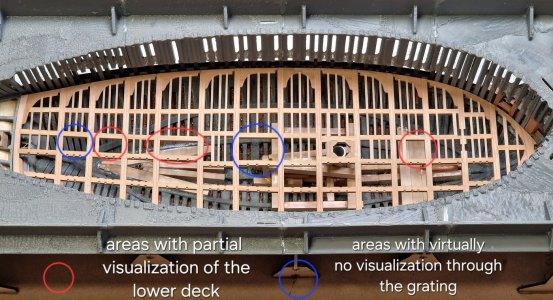
...through the openings (not even considering the stairs that would further obscure the view) it's practically impossible to see anything. BUT...

My wife suggested a brilliant idea...

...what if we installed lighting inside. Specifically, in the captain's cabin and the officers' quarters? I'm thinking of mounting two dim yellow LEDs on the ceiling above the lower deck, and running wires through the metal pins of the stand and connecting a Type-C connector. In short, this needs some more thought, but it's a good idea...soon I'll try to visualize the approximate result and then decide whether to implement it. ;)
 
I'm putting off working with the bolts in every possible way... Continuing with the lower deck.

View attachment 574299

And when I turned the upper deck over I remembered that I had not planned to make a lower deck and the beams on the upper one are very thick... and I had to remove the carlings first...

View attachment 574300

... and then use a plane to cut off the thickness so that the beams become the required size.

View attachment 574301

I also partially cut away the temporary waterway (but didn't remove it) to allow the deck to fit.

After installation, I tried on the previously made gratings and ladders.

View attachment 574302


Marking the beams.

Since the four load-bearing boards (the ones in a different color) have joints (there was a material shortage), all the seams (the beam center) and the gratings frames had to be precisely aligned to this line.

The logic is that no one will notice from above if a beam is off by 1 mm, but if the nailing line is uneven or offset (if the grating protrudes or doesn't reach the line), it will be noticeable. Therefore, it's better to adjust the beam center line to the dimensions of the grating frames and then plan for even nailing.

View attachment 574303

View attachment 574304

So I drew starting lines where the boards would join...

View attachment 574305

View attachment 574306

...then he placed the edge of the grating against the first line and drew a second line on the other side.

View attachment 574307

This way I marked the beam centers everywhere...

View attachment 574308

...except for two places where there will be pins, but I will do that when I make them.

View attachment 574309

I'd like to clarify once again: the beam lines aren't placed randomly, but rather slightly shifted if necessary to achieve the correct nail spacing (usually no more than 1 mm). This allowed me to position them so that all the nails wouldn't hit the joints and looked appropriate.

View attachment 574310

When everything was ready, I cut the holes for the gratings. But this isn't the final result. The holes are 2 mm smaller on each side (so the frames fit onto the deck itself).

View attachment 574311

View attachment 574312

In the end...

View attachment 574313

...through the openings (not even considering the stairs that would further obscure the view) it's practically impossible to see anything. BUT...

My wife suggested a brilliant idea...

...what if we installed lighting inside. Specifically, in the captain's cabin and the officers' quarters? I'm thinking of mounting two dim yellow LEDs on the ceiling above the lower deck, and running wires through the metal pins of the stand and connecting a Type-C connector. In short, this needs some more thought, but it's a good idea...soon I'll try to visualize the approximate result and then decide whether to implement it. ;)
Man your work is brilliant Sergey. I also love this log I’m learning loads. Cheers Grant
 
Man your work is brilliant Sergey. I also love this log I’m learning loads. Cheers Grant
Thanks for your feedback, friend. ;)

1-2 seconds? really? I need to try
Okay, maybe I exaggerated the 1 second, but it can definitely be done in 2-3. But I still recommend the second option more.

Just remember, this is Sergey we're talking about. Your mileage may vary! ROTF
Hahaha, very flattered ROTF ROTF ROTF
 
Back
Top