

• Win a Free Custom Engraved Brass Coin!!!
    As a way to introduce our brass coins to the community, we will raffle off a free coin during the month of August. Follow link ABOVE for instructions for entering.
  • PRE-ORDER SHIPS IN SCALE TODAY!

    The beloved Ships in Scale Magazine is back and charting a new course for 2026!
    Discover new skills, new techniques, and new inspirations in every issue.

    NOTE THAT OUR FIRST ISSUE WILL BE JAN/FEB 2026

HMS Beagle 1/60

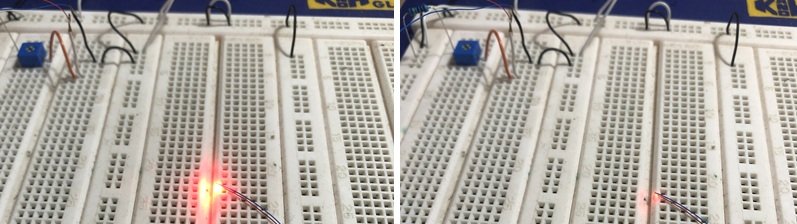
To light my model, I decided to use LEDs and a common DC voltage source (5Volts) from a USB charging socket. I stripped a USB cable to find and check which coloured wire carried the 5V. It's the red wire.
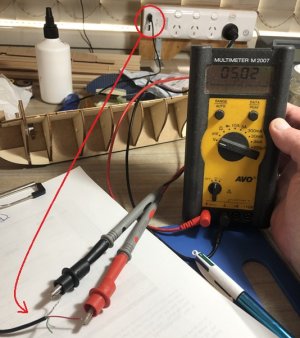
HMS-Beagle Build 27a.jpg

The LEDs I am using have a 3V drop and use 20 milliamps (mA). The following formula calculates the load resistor value to use to drop the 5v to the required 3V at 20mA. It turns out to be 100 ohms. To dim the LED I decided to use a variable resistor up to 10x the load resistor (i.e., 1k ohms), which worked well in my past 'aged' projects.
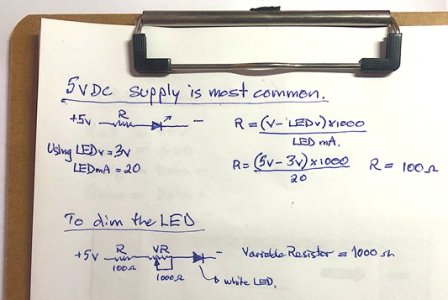
HMS-Beagle Build 27.jpg

To my surprise, I discovered that LEDs are much brighter these days! I needed to increase the resistor values by 10 times to get a reasonable dimming effect.
Now the R=1k ohms and VR=10k ohms.
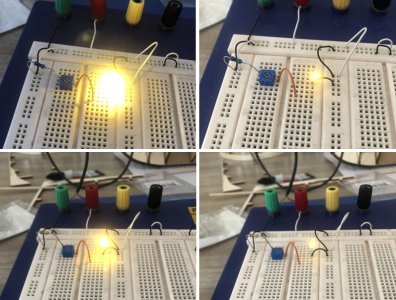
HMS-Beagle Build 27b.jpg
 
Throughout the festive season, I fell (caught two bouts of cold in the middle of summer!). Being 70+ y.o. is vastly different from being 60+.
Anyway, I did get to do a bit here and there towards the build.

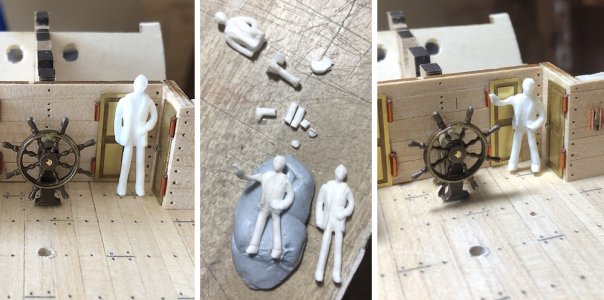
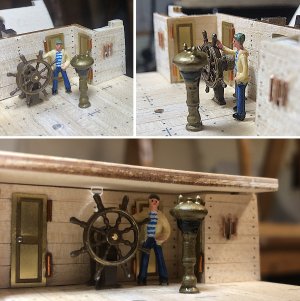
I hesitated attaching the upper aft deck due to needing to put the helm section underneath it, as well as a night (red) light. I decided it was best to put those bits in first.

Since the sailors of the period were short in stature, even 1:72 scale figures were too tall for a 1:60 scale ship. I had to cut the poor helmsman down to size. I also amputated his arm to relocate it to handle the helm's wheel. I think the helsman will look better after I paint him.

HMS-Beagle Build 31a.jpg

HMS-Beagle Build 31b.jpg

At first, I really botched up both the Marine and Binnacle compasses. They are bloody small! And my peepers are not exactly on the ball.
I tried to drill out the Binnacle compass window, but that did not work out too well. However, to some degree, I was able to recess the red micro LED into it. My goal is to have some sort of light reflection onto the helmsman. Something like in the following image...


gettyimages-1162919252-612x612.jpg
 
The helm's wheel was attached to the deck. The steering rope was fed through the deck and glued to the framework to show tension in the rope.

HMS-Beagle Build 32a.jpg

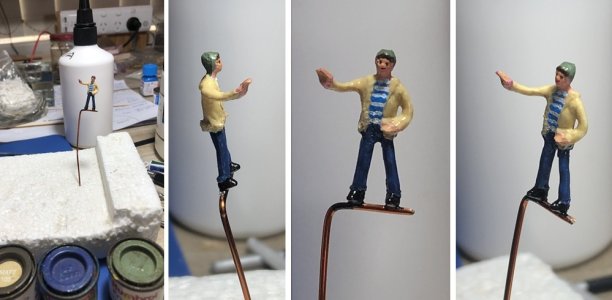
I was not too happy about the cutdown version of the helmsman, so I operated on him again. This time, instead of just cutting his legs, I cut a piece out of his midsection and some of his lower legs. This made him more proportional in appearance. I found that Blu Tack works well to keep loose parts in place while gluing with Supa glue.

HMS-Beagle Build 32b.jpg

Then I stuck the figure on some copper wire, as a stand, to paint it.

HMS-Beagle Build 32c.jpg
 
When will I start planking the boat?

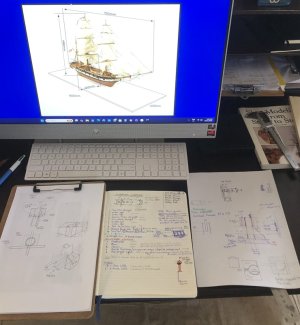
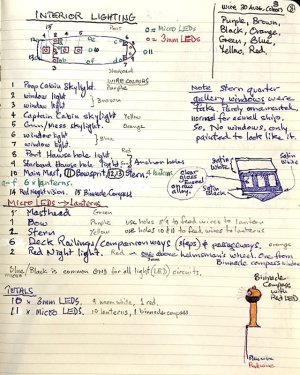
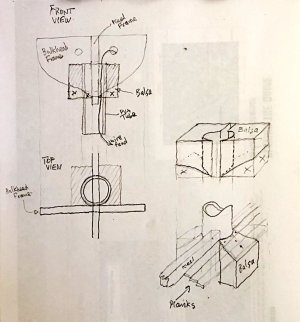
A few weeks ago, I had an idea of including lights in the model. This idea has turned into a multi-layer problem due to 'wiring'. Because there are more than two wires (+volts and ground), a simple socket attached to the hull won't work. Two wires are the simple solution where all LED lights are set to one prearranged degree of brightness. However, I want to be able to adjust the brightness of the different LEDs to suit the ship in its completed state. In other words, there will be a need to harness many wires exiting the boat through its two display standposts. These wires will be connected to a control panel that allows me to select lights and vary their brightness levels.

I cannot start planking the hull until I sort out the wiring. There will be about twenty-one LEDs. Eleven of them will be in lanterns.
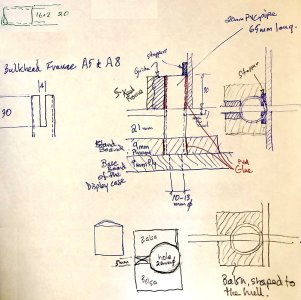
Also, need to sort out how to attach the two hollow standposts to both the hull and the stand.
I think I am very close to sorting all these things out.
 
Thank you for the encouraging response. It helps me to keep at it.
You can put the lantern used at night on one circuit, and the cabin lights on another
circuit.
You have heard of KISS...keep it simple, stupid.
What is the size of your hull?
I tried to light my card stock HMS Alert, and made the base thicker as a place for my switches and batteries. The switches were push button. The batteries were thin round watch batteries. Just remember to "turn off those darn lights!
It was great until the cat got into it and wiped it out.
 
You can put the lantern used at night on one circuit, and the cabin lights on another
circuit. Each circuit through one of the posts.
You have heard of KISS...keep it simple, stupid.
What is the size of your hull?
I tried to light my card stock HMS Alert, and made the base thicker as a place for my switches and batteries. The switches were push button. The batteries were thin round watch batteries. Just remember to "turn off those darn lights! I added a Ship Yard dock to help hide things.

It was great until the cat got into it and wiped it out.
 
You can put the lantern used at night on one circuit, and the cabin lights on another
circuit.
You have heard of KISS...keep it simple, stupid.
What is the size of your hull?
I tried to light my card stock HMS Alert, and made the base thicker as a place for my switches and batteries. The switches were push button. The batteries were thin round watch batteries. Just remember to "turn off those darn lights!
It was great until the cat got into it and wiped it out.
Thank you for pointing out a few things for me to remember.
My current plan is...

1. I will be having a few circuits, namely cabin lights, deck and companionway lights, navigation lights, and helmsman night vision lights. The wiring will be fed through the hollow display standposts (no wiring to be seen).
2. I use KIS. I always leave out the last S.
3. I am using a USB 5v supply, which everybody has access to.
4. The switches and potentiometers will be on a control panel outside the display case.
5. I have no pets, nor pests situation (except myself) :D.
 
Thank you for pointing out a few things for me to remember.
My current plan is...

1. I will be having a few circuits, namely cabin lights, deck and companionway lights, navigation lights, and helmsman night vision lights. The wiring will be fed through the hollow display standposts (no wiring to be seen).
2. I use KIS. I always leave out the last S.
3. I am using a USB 5v supply, which everybody has access to.
4. The switches and potentiometers will be on a control panel outside the display case.
5. I have no pets, nor pests situation (except myself) :D.
For added realism, you may want to consider yellow flickering lights to better simulate candles or lanterns.


Rob
 
For added realism, you may want to consider yellow flickering lights to better simulate candles or lanterns.


Rob
Thanks, Rob.
It is an attractive idea, but I have a little problem with that; they are a bit expensive. Twenty LEDS at US$3.85 each = AU$115.

Besides, that would make a lot more sense if the lights were candles in a breeze, but in sealed oil lanterns, they hardly flicker at all. I cannot imagine a sailor climbing the main mast to relight a lantern because it overflickered itself, yet again. Just joking ;).
Anyway, if I do wish to add a flicker circuit, I can make my own and add it to the console wiring.

There is another way to make the lights more interesting. The cabin lights do not necessarily stay on all night long. They can, over time, turn off and on.
I once made a small model house in a diorama that had a LED in each room. A circuit would operate one LED at a time. You can easily imagine a person going from one room to another and stopping at the front enclosed verandah, where a person stands looking out the window for several minutes. Later, you see a light trail back to the start, and all lights are off for several minutes.

https://shipsofscale.com/sosforums/threads/bridge-and-boat-diorama.1706/post-28462
 
Thanks, Rob.
It is an attractive idea, but I have a little problem with that; they are a bit expensive. Twenty LEDS at US$3.85 each = AU$115.

Besides, that would make a lot more sense if the lights were candles in a breeze, but in sealed oil lanterns, they hardly flicker at all. I cannot imagine a sailor climbing the main mast to relight a lantern because it overflickered itself, yet again. Just joking ;).
Anyway, if I do wish to add a flicker circuit, I can make my own and add it to the console wiring.

There is another way to make the lights more interesting. The cabin lights do not necessarily stay on all night long. They can, over time, turn off and on.
I once made a small model house in a diorama that had a LED in each room. A circuit would operate one LED at a time. You can easily imagine a person going from one room to another and stopping at the front enclosed verandah, where a person stands looking out the window for several minutes. Later, you see a light trail back to the start, and all lights are off for several minutes.

https://shipsofscale.com/sosforums/threads/bridge-and-boat-diorama.1706/post-28462
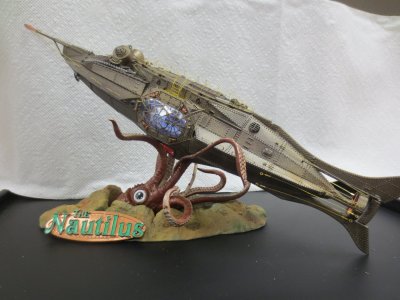
Your electrical abilities are far beyond mine! The only ship I tried to light was a model of Jules Verne's Nautilus which came out OK. After that I have not bothered. Perhaps if I had your knowledge I would try more!

IMG_1027.JPG
 
Back
Top