
• Win a Free Custom Engraved Brass Coin!!!
    As a way to introduce our brass coins to the community, we will raffle off a free coin during the month of August. Follow link ABOVE for instructions for entering.
  • SUBSCRIBE TO SHIPS IN SCALE TODAY!

    The beloved Ships in Scale Magazine is back and charting a new course for 2026!
    Discover new skills, new techniques, and new inspirations in every issue.

    NOTE THAT OUR NEXT ISSUE WILL BE MARCH/APRIL 2026

HMS ONTARIO - A MARISSTELLA WOODEN SHIP KIT

Hello!
I hope all of you had a great Christmas Season.

My Ontario build is slowly progressing.

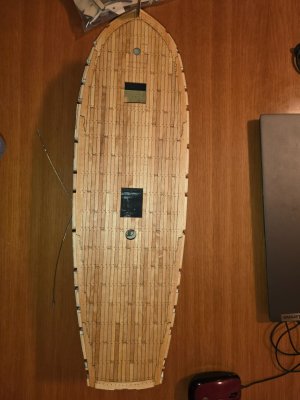
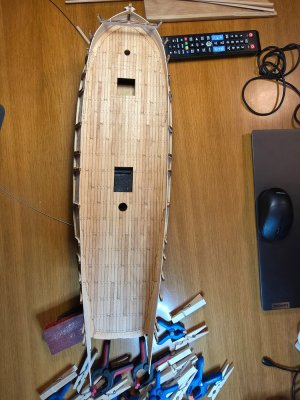
The first phase of the gun deck planking is complete. All the planks were glued to the veneer.
It will now have to be sanded, the spaces between planks filled with dark wood filler paste to simulate the caulking, sanded again and finally drilled for the treenails construction with toothpicks. Last of all I will apply linseed oil. It will also have to be prepared to receive all the metal rings and nails securing the cannons to the deck.
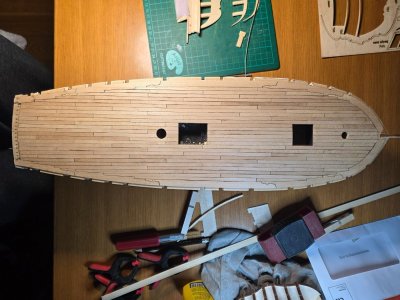
20251221_231641.jpg

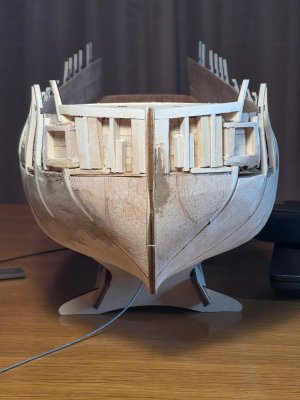
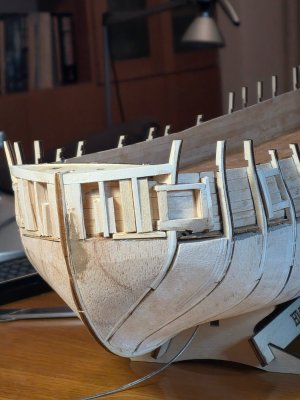
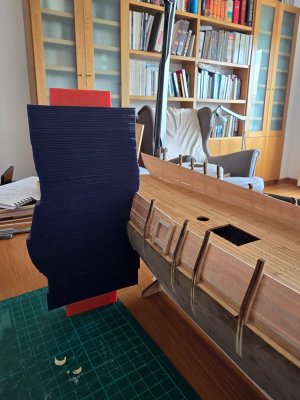
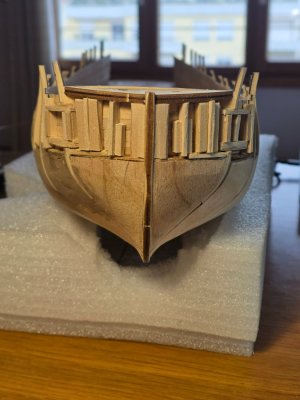
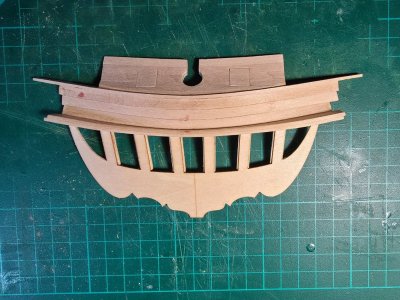
I also proceeded with the transom. It is not yet completely trimmed - I have to dry fit the planks of the hull before trimming it; can't be too careful to avoid making a mistake and having to re-do the whole part....

I found the construction quite difficult to my skills, but the result, so far, is not that bad.
20251221_230210.jpg20251224_164420.jpg

It also seems to fit the model quite well.

20251224_170609.jpg20251224_170624.jpg

Not very beautiful seen from the inside, but it will not be visible when the build is complete, so no issues.

I am considering the possibility of planking the upper part of the transom on the inside, above the upper deck. Instructions are not completely clear about this.

I also had to remove the two vertical wood parts that go between the outer and inner hull planks and allow to secure the complete transom in place. They will have to be reinstalled.


I whish you a great 2026!

Best regards

Catela
 
Hello!
I hope all of you had a great Christmas Season.

My Ontario build is slowly progressing.

The first phase of the gun deck planking is complete. All the planks were glued to the veneer.
It will now have to be sanded, the spaces between planks filled with dark wood filler paste to simulate the caulking, sanded again and finally drilled for the treenails construction with toothpicks. Last of all I will apply linseed oil. It will also have to be prepared to receive all the metal rings and nails securing the cannons to the deck.

View attachment 566396

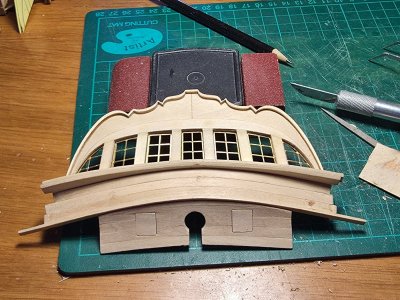
I also proceeded with the transom. It is not yet completely trimmed - I have to dry fit the planks of the hull before trimming it; can't be too careful to avoid making a mistake and having to re-do the whole part....

I found the construction quite difficult to my skills, but the result, so far, is not that bad.
View attachment 566404View attachment 566398

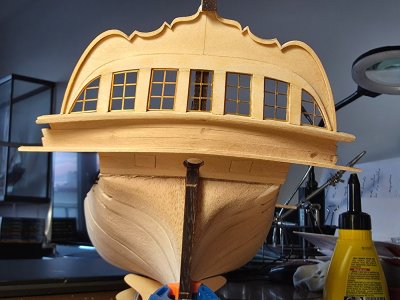
It also seems to fit the model quite well.
View attachment 566399View attachment 566400

Not very beautiful seen from the inside, but it will not be visible when the build is complete, so no issues.

I am considering the possibility of planking the upper part of the transom on the inside, above the upper deck. Instructions are not completely clear about this.

I also had to remove the two vertical wood parts that go between the outer and inner hull planks and allow to secure the complete transom in place. They will have to be reinstalled.


I whish you a great 2026!

Best regards

Catela
Good morning Jose. I hope you had a great Christmas. Nice deck planking, the pattern is real good. I model like you do. If it’s going to be covered up there is no need for it to be neat and tidy- just right ROTF. The rear of the transom is looking mighty fine. Cheers Grant
 
Hi,
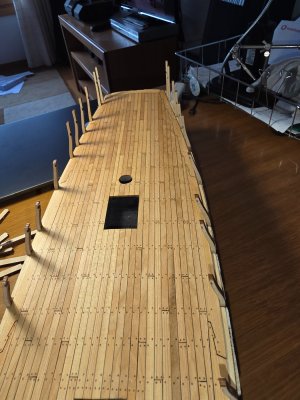
I finished the treenails on the gun deck.
It served mainly as practice, since, for the most part, it will covered by the upper deck and will not be visible .
I was planning to apply dark wood filler between the deck planks to simulate caulking, but decided not to. The planks are too close too one another for that, with a few exceptions due to uneven installation.
To avoid this in the upper deck, I'll probably built it before installing it to the model. I believe it will be easier to guarantee the right clearance between planks and correct alignment of the treenails.
A photo of the deck after sanding and application linseed oil.
20260121_203531.jpg

It can be seen that the wood supplied for the planking varies significantly. Largest and most consistent differences may be observed between the simple wood strips and the side laser cut boards the finished the lateral of the deck under the wall boards.
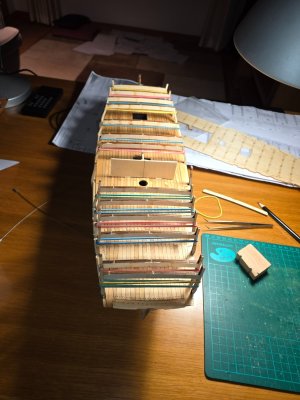
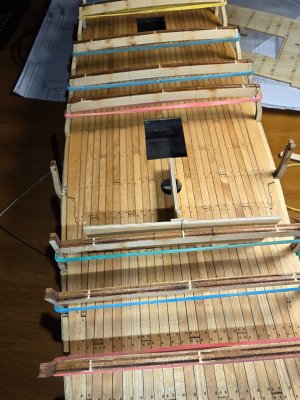
I also installed the side parts of the bulkheads. These have to be carefully installed, to prevent misalignment of the beams that support the upper deck and, consequently, misalignment of the two decks.
Built a small wooden tool to verify that the transverse beams are well centered and will guarantee the alignment between the two decks, while gluing the bulkhead sides.
20260123_211858.jpg20260123_211922.jpg
The deck and bulkhead sides glued in place, with the beams removed again.
20260125_164855.jpg

The next step will be to trim the lateral surfaces of the hull. I verified that the adjustment of the side pieces of the bulkheads to the transverse beams resulted in some slight misalignment with the hull. Probably something was not as properly aligned as it should be during construction, because the kit laser cut parts seam to be very accurate.
Best regards,
Catela

20260125_164734.jpg
 
Hi,
I finished the treenails on the gun deck.
It served mainly as practice, since, for the most part, it will covered by the upper deck and will not be visible .
I was planning to apply dark wood filler between the deck planks to simulate caulking, but decided not to. The planks are too close too one another for that, with a few exceptions due to uneven installation.
To avoid this in the upper deck, I'll probably built it before installing it to the model. I believe it will be easier to guarantee the right clearance between planks and correct alignment of the treenails.
A photo of the deck after sanding and application linseed oil.
View attachment 573051

It can be seen that the wood supplied for the planking varies significantly. Largest and most consistent differences may be observed between the simple wood strips and the side laser cut boards the finished the lateral of the deck under the wall boards.
I also installed the side parts of the bulkheads. These have to be carefully installed, to prevent misalignment of the beams that support the upper deck and, consequently, misalignment of the two decks.
Built a small wooden tool to verify that the transverse beams are well centered and will guarantee the alignment between the two decks, while gluing the bulkhead sides.
View attachment 573053View attachment 573054
The deck and bulkhead sides glued in place, with the beams removed again.
View attachment 573057

The next step will be to trim the lateral surfaces of the hull. I verified that the adjustment of the side pieces of the bulkheads to the transverse beams resulted in some slight misalignment with the hull. Probably something was not as properly aligned as it should be during construction, because the kit laser cut parts seam to be very accurate.
Best regards,
Catela

View attachment 573056
Good morning Jose. Those treenails look pretty good to me. I’m having a similar problem with my planks and it does get frustrating sometimes. Lovely work. Cheers Grant
 
Hello!
I hope all of you had a great Christmas Season.

My Ontario build is slowly progressing.

The first phase of the gun deck planking is complete. All the planks were glued to the veneer.
It will now have to be sanded, the spaces between planks filled with dark wood filler paste to simulate the caulking, sanded again and finally drilled for the treenails construction with toothpicks. Last of all I will apply linseed oil. It will also have to be prepared to receive all the metal rings and nails securing the cannons to the deck.

View attachment 566396

I also proceeded with the transom. It is not yet completely trimmed - I have to dry fit the planks of the hull before trimming it; can't be too careful to avoid making a mistake and having to re-do the whole part....

I found the construction quite difficult to my skills, but the result, so far, is not that bad.

View attachment 566404View attachment 566398

It also seems to fit the model quite well.
View attachment 566399View attachment 566400

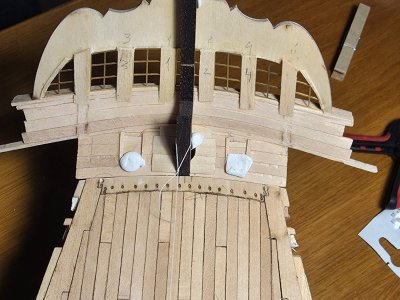
Not very beautiful seen from the inside, but it will not be visible when the build is complete, so no issues.

I am considering the possibility of planking the upper part of the transom on the inside, above the upper deck. Instructions are not completely clear about this.

I also had to remove the two vertical wood parts that go between the outer and inner hull planks and allow to secure the complete transom in place. They will have to be reinstalled.


I whish you a great 2026!

Best regards

Catela
Very nicely done Jose'. I am working on the earlier version of this ship. The Updates I notice are good changes . This Transom area for my skills I am fineing most difficult, but I am hanging in ,having pulled it apart once to fit properly with the upper deck and windows. Still on it but getting through it. I appreciate your build and photos. Can't wait to see how you approach the lifeboat..... anyway many thanks.....I will be with you on this build..........
 
Hi Gedailey,

Thanks for your comments.

Maristella classifies this model as an "intermediate" kit... I wonder how difficult the "advanced" models will be...
I should not complain though, for I was looking for a more difficult kit after my first one. Well, I surely found one!
Plus, this is a hobby for me and has be to challenging, otherwise it will get boring.;)

The transom is quite an headache.
Mine seems to fit well on the model, but is by no means perfect (photos hide a lot of defects and mistakes...) and there is still a lot do do before being completely sure.
I cannot imagine the difficulty it was to build it without the jig they supply with these later kits.
Have you tried to ask Maristella to provide you with the jig and last version of the laser cut parts for the transom. I used them as they came with the kit and, even so, I found it difficult to build. Actually it is not finished yet: I am postponing the day I'll have to cut/trim the plank sides...An error and it will have to be built again...

The dingy will probably be another headache: how to prevent the planks from being glued to the boat construction jig?... I'll find out when I get there! Perhaps covering the jig with food/kitchen wrap film may be a solution. It will have to be investigated with some tentative solutions.

From my short experience it pays to invest time investigating how to do some operations, before getting to the definitive thing and spend the precious parts supplied with the model: lots of dry fitting...

For the time being I am focused on starting the inner planking. The hull is ready to receive the outside planking and the two decks do align quite well.
I already started to think about how to cut the cannon ports, sweep ports and hull sheave holes, properly aligned, which seems to me to be the major difficulty.

Best regards
Catela
 
Hi Gedailey,

Thanks for your comments.

Maristella classifies this model as an "intermediate" kit... I wonder how difficult the "advanced" models will be...
I should not complain though, for I was looking for a more difficult kit after my first one. Well, I surely found one!
Plus, this is a hobby for me and has be to challenging, otherwise it will get boring.;)

The transom is quite an headache.
Mine seems to fit well on the model, but is by no means perfect (photos hide a lot of defects and mistakes...) and there is still a lot do do before being completely sure.
I cannot imagine the difficulty it was to build it without the jig they supply with these later kits.
Have you tried to ask Maristella to provide you with the jig and last version of the laser cut parts for the transom. I used them as they came with the kit and, even so, I found it difficult to build. Actually it is not finished yet: I am postponing the day I'll have to cut/trim the plank sides...An error and it will have to be built again...

The dingy will probably be another headache: how to prevent the planks from being glued to the boat construction jig?... I'll find out when I get there! Perhaps covering the jig with food/kitchen wrap film may be a solution. It will have to be investigated with some tentative solutions.

From my short experience it pays to invest time investigating how to do some operations, before getting to the definitive thing and spend the precious parts supplied with the model: lots of dry fitting...

For the time being I am focused on starting the inner planking. The hull is ready to receive the outside planking and the two decks do align quite well.
I already started to think about how to cut the cannon ports, sweep ports and hull sheave holes, properly aligned, which seems to me to be the major difficulty.

Best regards
Catela
Hi Gedailey,

Thanks for your comments.

Maristella classifies this model as an "intermediate" kit... I wonder how difficult the "advanced" models will be...
I should not complain though, for I was looking for a more difficult kit after my first one. Well, I surely found one!
Plus, this is a hobby for me and has be to challenging, otherwise it will get boring.;)

The transom is quite an headache.
Mine seems to fit well on the model, but is by no means perfect (photos hide a lot of defects and mistakes...) and there is still a lot do do before being completely sure.
I cannot imagine the difficulty it was to build it without the jig they supply with these later kits.
Have you tried to ask Maristella to provide you with the jig and last version of the laser cut parts for the transom. I used them as they came with the kit and, even so, I found it difficult to build. Actually it is not finished yet: I am postponing the day I'll have to cut/trim the plank sides...An error and it will have to be built again...

The dingy will probably be another headache: how to prevent the planks from being glued to the boat construction jig?... I'll find out when I get there! Perhaps covering the jig with food/kitchen wrap film may be a solution. It will have to be investigated with some tentative solutions.

From my short experience it pays to invest time investigating how to do some operations, before getting to the definitive thing and spend the precious parts supplied with the model: lots of dry fitting...

For the time being I am focused on starting the inner planking. The hull is ready to receive the outside planking and the two decks do align quite well.
I already started to think about how to cut the cannon ports, sweep ports and hull sheave holes, properly aligned, which seems to me to be the major difficulty.

Best regards
Catela
Yes I am with you on being challenge and I am stubborn so I know I will get there. This is my second ship . I learned on the first ship that instructions are not always dead on. but the craft is rewarding. On my transom the bottom half is in and the window second just needs a little lift to be above the upper deck.problem solved ,I hope.........On the dingy I have double plank it and ground out the inside. Came out good, but now directions say grab your scrapes and make the inner frame , so while I figure that out ,on to the canons . So yes, a great challenging kit indeed. Great chatting with you , loving what you have done so far........Thank You......George
 
Hello!
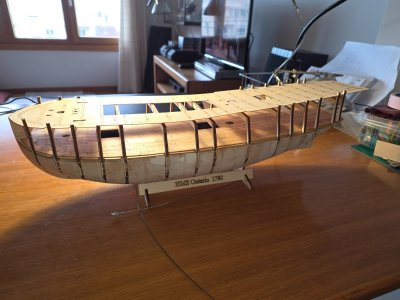
Since my previous post, I've partly built the hull inner planking.
Internal planking cannot be completed all the way up, because it would make it impossible to install the beams that hold the upper deck.
The two first planks - the spirketing - are 1.5 mm thick; the others 1mm, as written in the instructions.
I gave up scarfing the 2 first planks. After all they will be covered by the upper deck. But I made a few attempts to do it, and expect to use it in the upper deck spirketing planks, if the instructions point so.
Planking is not as perfect as I would like it to be, but after some woof filling and painted, I believe they will not be that bad.
With the planks glued in place the transom can be fitted in place. It seems to fit quite well, respecting the space available between the first and second windows on each side.
20260210_190507.jpg
I've installed some interior structure which I expect will make easier to plank the upper part of the bow.
20260219_064043 - Copy.jpg20260219_064050.jpg
I've also built the frames for the gun ports and sweep ports.
The hull is not straight. It has a curve. So I used a device to take the form of the hull and make it simpler to adjust the frames
20260214_124727.jpg

From the instructions, some of the bulkheads would have to be cut, to give place to the ports.
In fact the first bulkhead from the bow lies right in the middle of the first gun port but all the others do not interfere with the bulkheads.
As for the sweep ports I decided to shift one or two, by on or two millimeters, to avoid cutting the bulkheads.
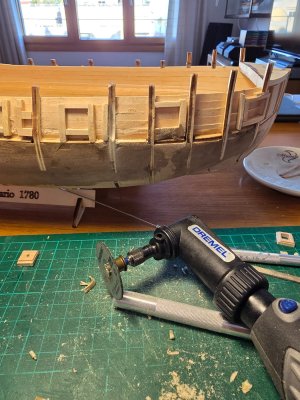
The first sweep port, however, lies right in the middle of the bulkhead. I carefully cut it with a Dremel. I then reinforce everything internally with some pieces of wood, before sanding everything to fit flush to the hull line.

20260222_165903.jpg


It looks a little ruff, but what's important is the inner side of the frames.
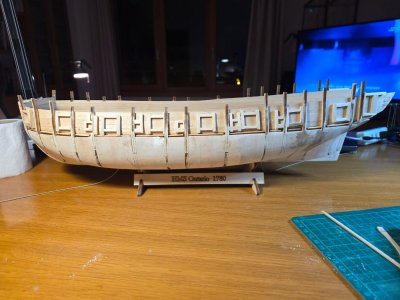
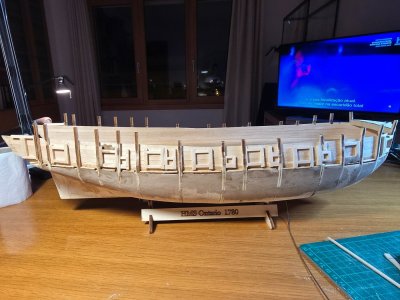
All frames are already sanded, so that they respect the line of the exterior planking to be installed.
20260222_203648.jpg20260222_203705 - Copy.jpg
Next step is to install the frames for the four sheave blocks.
Those seam to be more difficult. Not only they're angled, they also require cutting of the bulkheads.

After that it will be the time to cut the inner planks flush to the frames.

Best regards,

Catela

20260217_164458.jpg
 
Why didn't you fill the upper part of bulkhead frames with balsa as well?
Hi Kuba,
Sorry, but could not understand your question.
Above the gun deck (already installed) there will be cannons, stairs and other "furniture" to install.
It cannot be filled with balsa.
In my previous ship, the hull was hard to build. It was a double planking model, so, the first layer could be less well built. it was more "structural".
In this ship there is one only plank layer. So it will have to be "presentable".
That's why I decided to fill all the spaces below the gun deck and reinforce the walls above it, so that the planks have something to guide them and be glued to, respecting the ship's curves.
I hope this allows for the hull to be simpler to build and result in a better looking model, in despite of my limited skills.
Best regards
Catela
 
That's exactly what I was asking. Why did you only reinforce gunport structure, only holes, and not completely fill them with balsa?
That would have created a solid structure oversides to create gunports.
 
That's exactly what I was asking. Why did you only reinforce gunport structure, only holes, and not completely fill them with balsa?
That would have created a solid structure oversides to create gunports.
Because that would be much more difficult to do and because the number of contact points between the exterior planks and the structure inside the hull walls (bulkheads, port frames and other wood pieces) seamed to be sufficient.
The ports structure had to be properly measured (on the interior) so that it follows the ship's plan.
Now the interior planks will have to be cut flush to the ports. Later the external planks will be cut the same way.
The ports must be built with "solid wood", not balsa, which is too soft and would have been much more difficult to cut with precision.
 
Because that would be much more difficult to do and because the number of contact points between the exterior planks and the structure inside the hull walls (bulkheads, port frames and other wood pieces) seamed to be sufficient.
The ports structure had to be properly measured (on the interior) so that it follows the ship's plan.
Now the interior planks will have to be cut flush to the ports. Later the external planks will be cut the same way.
The ports must be built with "solid wood", not balsa, which is too soft and would have been much more difficult to cut with precision.
Your approach is interesting, Jose.
In Eastern Europe, modelers use hull filler as a form of "fin" that can be left inside ship or removed after planking is completed.
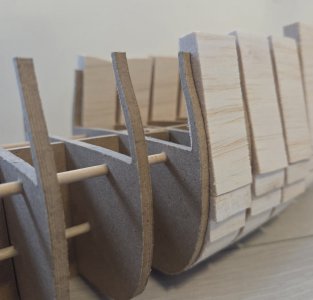
I'm currently in the process of applying balsa filler, and leaving it inside model. Side wall is only 2mm wide. Trick is to simply apply a very thick layer of PVA glue to balsa before applying next layer of correct planking. You can use several thin layers of wood, or a single wooden strip. Balsa shaped to desired hull shape and coated with PVA glue doesn't warp and creates a very hard structure. This can also be applied to woods like birch, alder, or pine.
However, you have to be careful because you can ruin the entire structure of the ship if the wood absorbs too much glue.
20260223_160802.jpg
 
Your approach is interesting, Jose.
In Eastern Europe, modelers use hull filler as a form of "fin" that can be left inside ship or removed after planking is completed.
I'm currently in the process of applying balsa filler, and leaving it inside model. Side wall is only 2mm wide. Trick is to simply apply a very thick layer of PVA glue to balsa before applying next layer of correct planking. You can use several thin layers of wood, or a single wooden strip. Balsa shaped to desired hull shape and coated with PVA glue doesn't warp and creates a very hard structure. This can also be applied to woods like birch, alder, or pine.
However, you have to be careful because you can ruin the entire structure of the ship if the wood absorbs too much glue.
View attachment 580355
I understand now what you were writing.
Well, I think I am in a different league...
I don't think I would be able to build the structure in the photo from scratch. I also do not have access to a cnc where to cut it.
Too complicated for me.
I purchase the kit and try to follow the instructions from the manufacturer as close as possible, with one or two modifications inspired in tutorials and logs from other builders.
I'll be happy if I get to finish the model this way.
Best regards
Catela
 
I understand now what you were writing.
Well, I think I am in a different league...
I don't think I would be able to build the structure in the photo from scratch. I also do not have access to a cnc where to cut it.
Too complicated for me.
I purchase the kit and try to follow the instructions from the manufacturer as close as possible, with one or two modifications inspired in tutorials and logs from other builders.
I'll be happy if I get to finish the model this way.
Best regards
Catela

You're doing a fantastic job, here is no league. I'm surprised you're using balsa filler for frames, because nobody usually does it that way.

You can learn anything, don't necessarily need to be an advanced modeler, only thing that counts is the willingness and time.

Good luck with your build, i'd love to see it on sails. It looks interesting.
Regards.

 
The frames are not balsa. Too soft.
Balsa was used in the lower part of the hull.
The frames were made from limewood (I think it is limewood...) strips, with 3 mm, sanded and shaped to the hull shape.
This is the type of construction foreseen in instructions and that you may find, for instance, in Olha Batchvarov tutorials.
Catela
 
Back
Top