• "Thank you for your Donations and Support"
    As we close this Annual Donations Drive, we want to thank you all for your Generosity in Donating to Ships of Scale. It is Greatly Apreciated !!!
    Ships of Scale continues to explore exciting things to offer to the Ship Building Community.
  • SUBSCRIBE TO SHIPS IN SCALE TODAY!

    The beloved Ships in Scale Magazine is back and charting a new course for 2026!
    Discover new skills, new techniques, and new inspirations in every issue.

    NOTE THAT OUR NEXT ISSUE WILL BE MARCH/APRIL 2026
  • Win a Free Custom Engraved Brass Coin!!!
    As a way to introduce our brass coins to the community, we will raffle off a free coin during the month of August. Follow link ABOVE for instructions for entering.

HMS Victory - Caldercraft 1/72 build log by Andi

Joined
Nov 18, 2025
Messages
23
Points
58

Altered the build room a bit as had limited space when I built the Endeavour
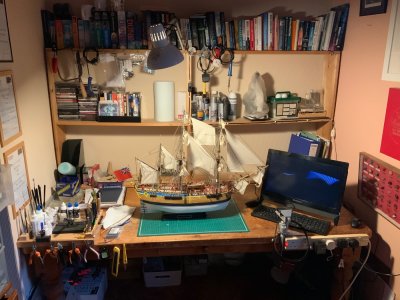
IMG_0374.jpeg

Bought a reasonable priced computer table and put it at 90 degrees to my original work bench
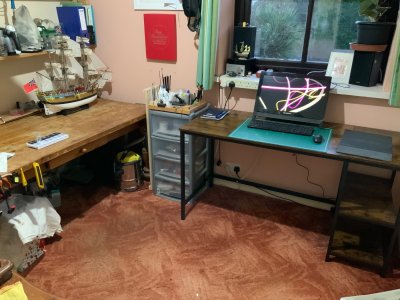
IMG_0376.jpeg

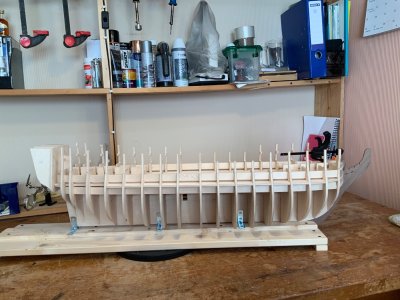
I then bought a cheap turntable from amazon and made up a support base for the keel (as many others of you have done). As you can see from the photo I have added a spacer at each end of the board to stop it tipping left or right when being worked on
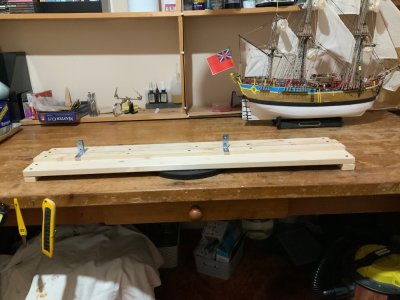
IMG_0377.jpeg

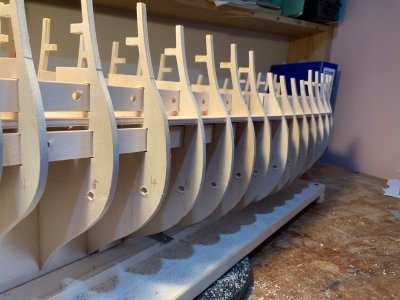
Have sanded down the beard line as instructed and as every one will agree the bulkheads are an extremely tight fit on the keel. Every one of the bulkheads (apart from 9 for some reason) has 3 slightly raised areas about 1cm long on either side of the slot (the slots in the keel also have the same raised areas). On the bulkheads only, I carefully sanded the raised areas and this then gave a perfect tight push fit to seat the bulkheads fully. Below is a picture of a bulkhead with the raised areas and also a picture of bulkhead 9 slot which was perfectly flat on both sides.
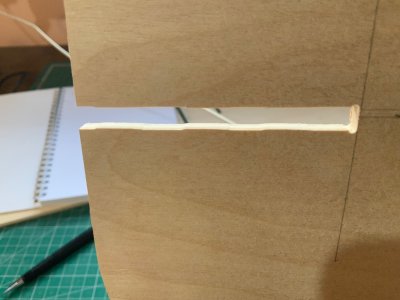
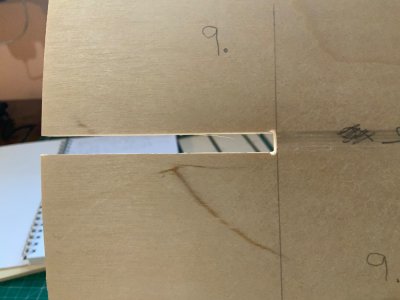
IMG_0412.jpegIMG_0407.jpeg

My wife bought me this for Christmas

IMG_0414.jpeg

But also told me I can’t drink it until I have finished the ship!!! I am sure it will be a really good vintage by then.

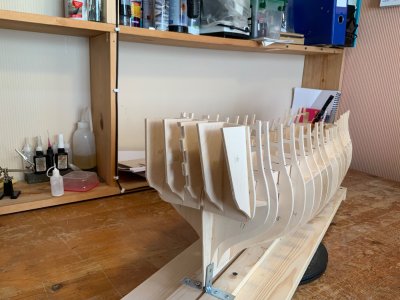
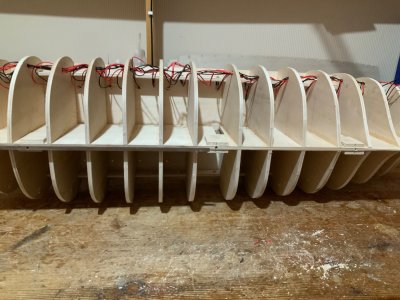
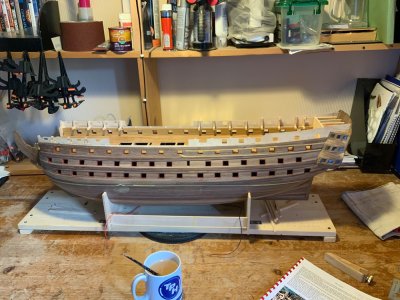
Have now dry fitted the bulkheads to the keel and also dry fitted the middle gun deck - it looks good already
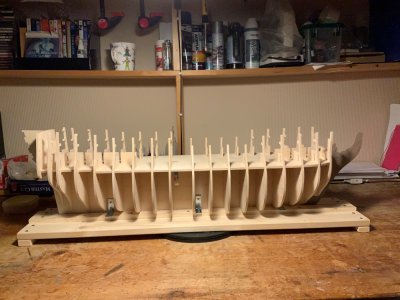
IMG_0416.jpeg

Enough for today, will begin again tomorrow
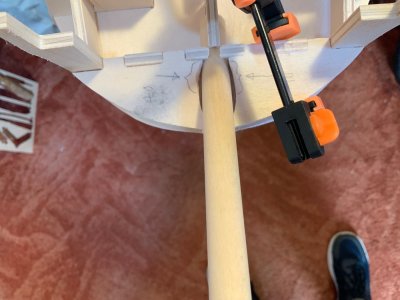
 
Have now added the dummy barrel strips which I first tapered at the ends and lightly sanded the edges, they needed no soaking or pre-bending and although they were a tight fit they went into place with just a few taps on the end with a small hammer.
The inner and outer stern extensions have also been fitted with only a small amount of sanding needed on the lower lugs.

The bow forward supports have also been fitted and some sanding was needed on parts 40 (port and starboard). The arrows on the photo show where this sanding was necessary

IMG_0426.jpegIMG_0428.jpegIMG_0429.jpeg

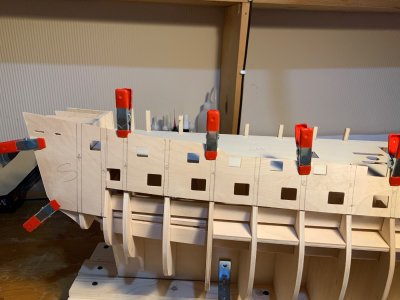
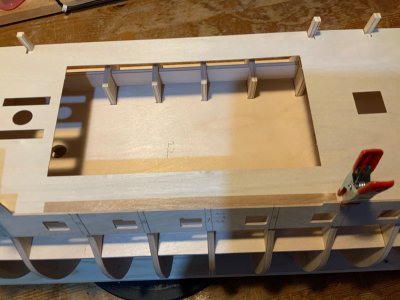
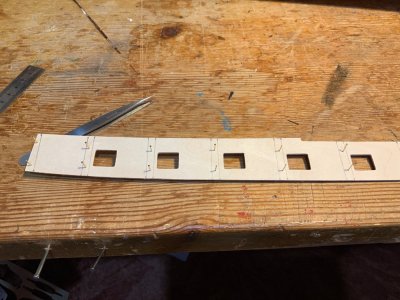
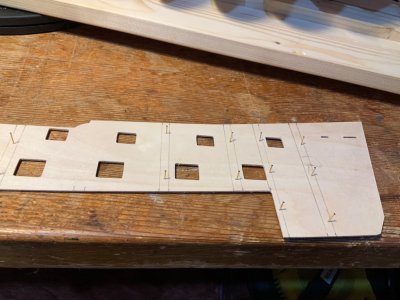
The section of dummy barrel strip between bulkheads 9 & 10 has been removed using a fret saw and the quarter deck has been temporarily pinned in place in order to dry fit the top gun port pattern on both sides

IMG_0430.jpeg

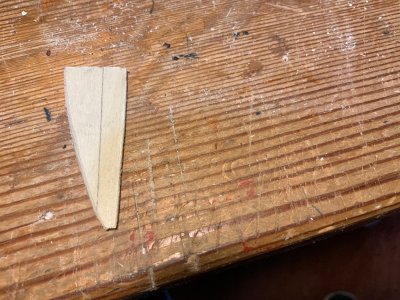
The position of the bulkheads behind the top gun port were marked and then, in order to comply with the instructions and ensure that between bulkheads 6 and 9 the top gun port was 1mm above the quarterdeck i used a 1mm thick strip, layed on the quarterdeck and butted up to the top gun port pattern. (Thanks PaulV as demonstrated in his YouTube video)The bottom of the top gunport pattern was also marked in pencil on each of the bulkheadstop gun ports were removed. Pins were then driven through the top gun port where the position of the bulkheads had been marked ( this will make it much easier
To secure the gun port in place when glue is applied

The photos below show the 1mm strip in place to correctly position the top gunport and also the top gunport with pins in place

IMG_0426.jpegIMG_0428.jpegIMG_0429.jpegIMG_0430.jpegIMG_0435.jpegIMG_0432.jpegIMG_0433.jpeg


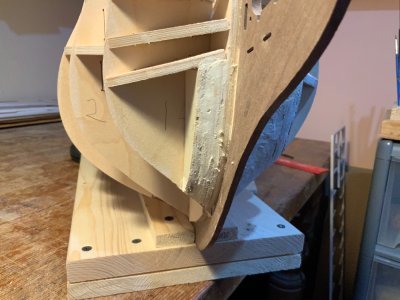
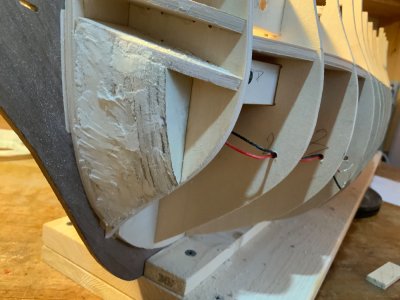
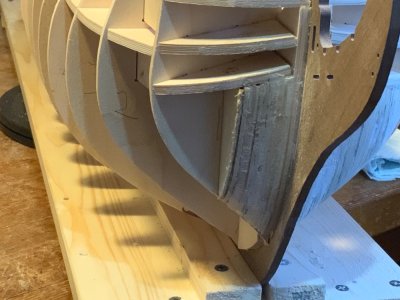
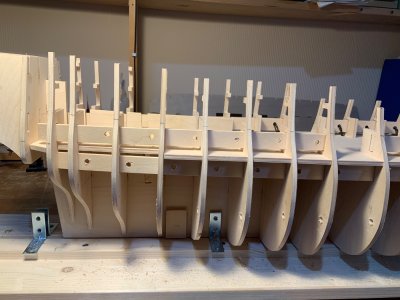
Having looked at a number of other build logs have decided to add filler blocks between the bulkheads at the bow and stern. The only material I had to hand was a few sheets of 2mm thick ply so I started cutting out shapes, gluing them in place and then sanding back to the correct profile, using a little filler where needed (see photos below)

IMG_0436.jpegIMG_0437.jpegIMG_0438.jpeg


IMG_0452.jpeg

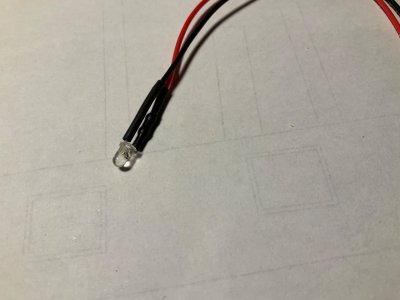
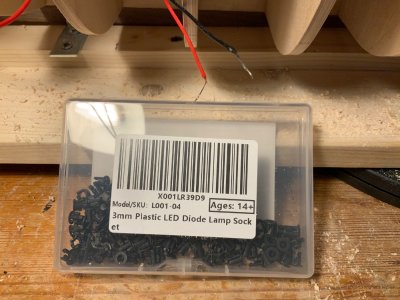
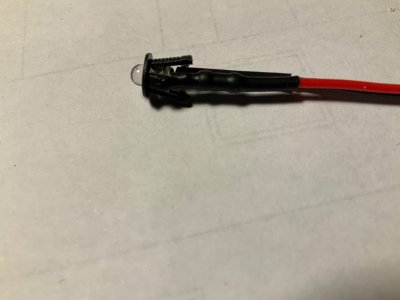
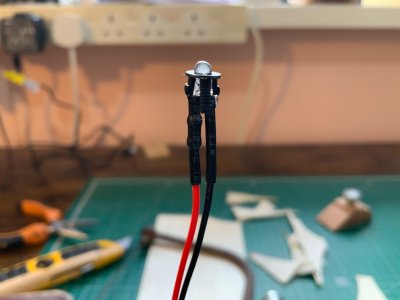
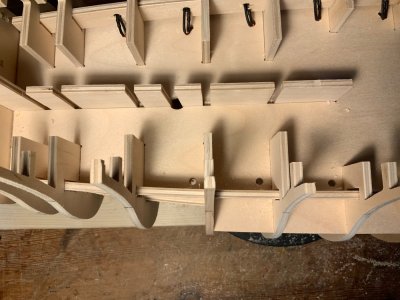
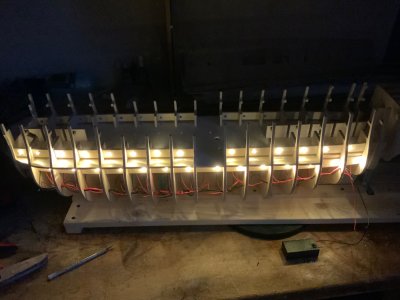
However this was very laborious and took a lot of time so I have ordered some thicker soft balsa pieces which I hope will speed the procedure up. While I am waiting for this to arrive I have started installation of the lights. The LED’s I am using are 3mm warm white flicker/candle effect, 9v/12v and built in diodes. I also purchased a box of 3mm plastic LED diode lamp socks and the first job was to push the sock over the LED and apply a small drop of CA glue to hold it in place
IMG_0443.jpegIMG_0442.jpegIMG_0444.jpegIMG_0447.jpeg

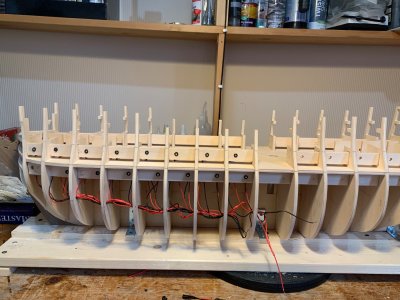
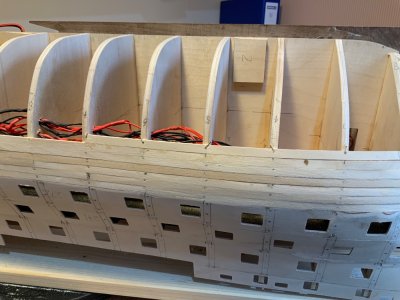
The next job was to drill holes in the dummy barrel strips, the bulkheads and the middle gun deck (22). The holes were drilled with a 5.5mm bit which provided a snug fit for the LED’s with socks on, and also allowed enough room for all the wires to pass through each bulkhead. Care should be taken to ensure that the drilled holes are not in line with the gunport openings on the middle and lower gunport patterns (271, 272)

IMG_0461.jpegIMG_0462.jpegIMG_0463.jpeg

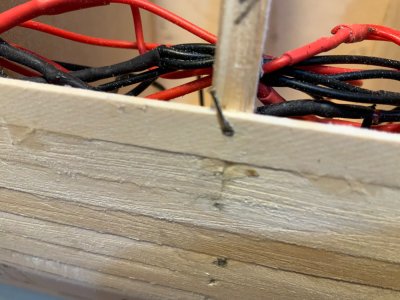
The LED’s can then be inserted into the upper dummy barrel strips and fed down through the holes in the middle gun deck (22) and then the LED’s can be placed in the lower dummy barrel strips. I took a quick course in soldering and use of flux off YouTube and managed to solder all the black wires and then the red wires together but testing the circuit every time a LED was added

IMG_0448.jpegIMG_0464.jpeg

At this point I ran out of LED’s so ordered another batch of the same that arrived last Thursday but unfortunately they were plain warm white and did not flicker. The supplier is replacing them but that won’t be until the end of next week so finishing the lights will have to wait a while now

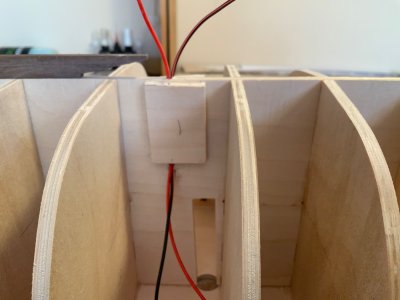
Following the instructions I have drilled 3 holes up into the keel. One between bulkheads 4 and 5, one between bulkheads 9 and 10 and the third between bulkheads 13 and 14. Prior to drilling the holes the keel was reinforced on either side with some scrap 5mm ply.The holes left and right of centre I used a 3mm drill bit and the hole in the centre I used a 3.5mm drill bit. The centre hole was drilled at a slight angle which allowed the drill bit to emerge from the side of the keel just above the 5mm reinforcing piece. This allows enough room for the feed supply for the lights to exit via the bottom of the keel (see photos)

IMG_0465.jpegIMG_0453.jpeg
 
A great start, Andy, on this beautiful project. You'll be able to enjoy it for many years to come. I've been working on mine for four years already and still have a little way to go.

Aren't you worried that there might be too much light in the ship, or can the lighting level be dimmed sufficiently?
 
Hi Wil
Thanks a lot for your kind comments and yes I agree with your thoughts on the lighting.I was a novice regards the lighting when I started this project and I picked up info from a number of other build logs on SOS which meant I ended up with 9v/12 system using 3mm warm white bulbs. When I first lit them up I thought “wow, too bright” and so bought a new battery holder that held 4 x 1.5v batteries. This seemed to help a little bit but will look at ways to reduce the brightness further when I have finished building the ship. I have some more photos of progress made to date and will add them during this week as I am on holiday for 4 days in Whitby and it looks like being a wet few days so I should have plenty of time. One again thanks for your post

Regards

Andi
 
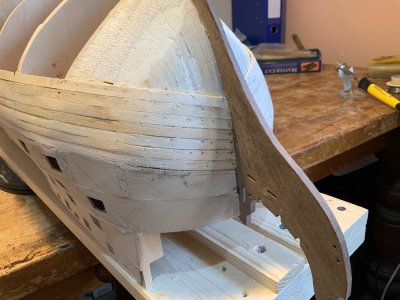
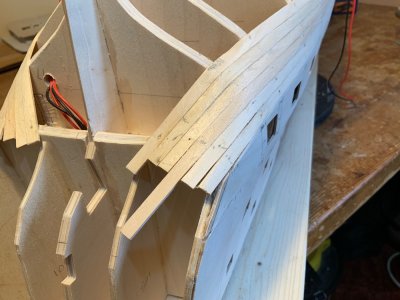
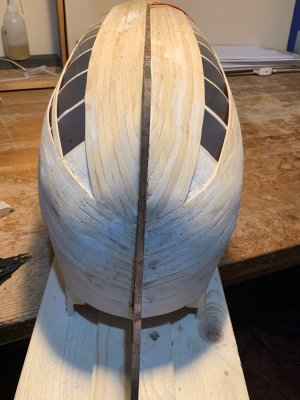
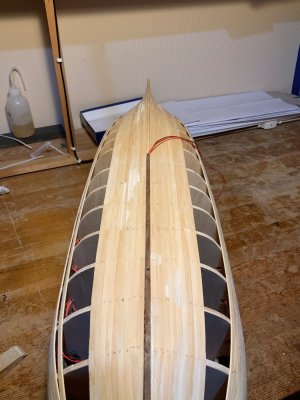
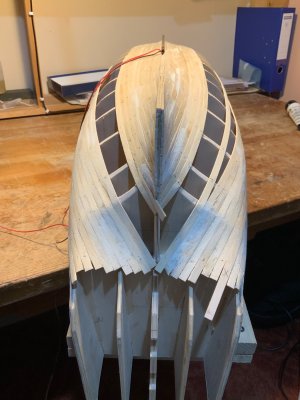
Have now made some decent progress on the build and am now able to add further photos and comments to my build log. I started the first planking using white wood glue (gorilla) and soon found I got a better fit with the planks by putting a nail in about 1/3rd from the top of the plank, knocking it in half way and then bending the nail over so it clamped the plank to the bulk heads

IMG_0480.jpeg

IMG_0482.jpeg


IMG_0483.jpeg
 
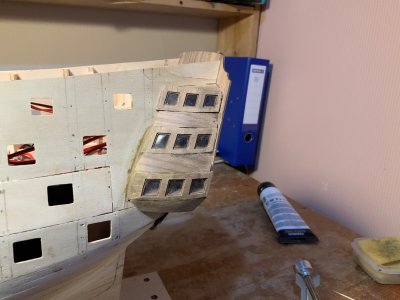
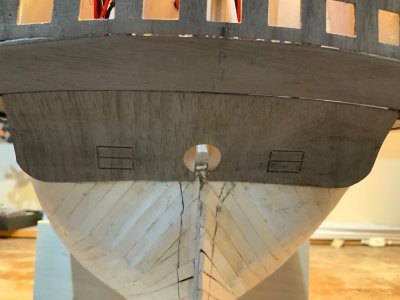
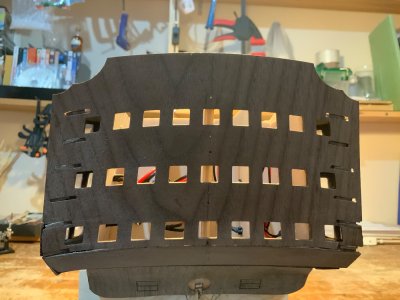
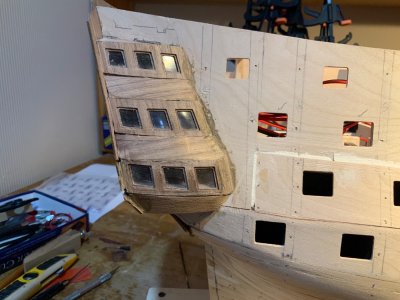
Thankfully, I managed to complete the first planking with very little need to used filler. A lot of care and patience was needed for the next job which was assembly of the quarter galleries. The quarter gallery patterns ( 215 - 224) were difficult to get into the correct position and perhaps could have been done better in hindsight. part numbers 371, 372, and 374 were reasonably easy to fit

IMG_0497.jpeg


IMG_0499.jpeg
IMG_0500.jpegIMG_0501.jpeg
 
Have now made some decent progress on the build and am now able to add further photos and comments to my build log. I started the first planking using white wood glue (gorilla) and soon found I got a better fit with the planks by putting a nail in about 1/3rd from the top of the plank, knocking it in half way and then bending the nail over so it clamped the plank to the bulk heads

View attachment 609829

View attachment 609830


View attachment 609831
IMG_0489.jpeg
IMG_0492.jpegIMG_0492.jpeg
IMG_0493.jpegIMG_0495.jpeg
Sorry, the above photos of first planking should have been before I started the quarter galleries but I don’t know how to insert them there

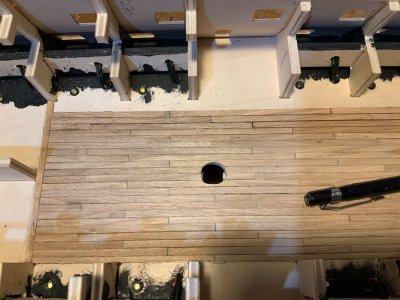
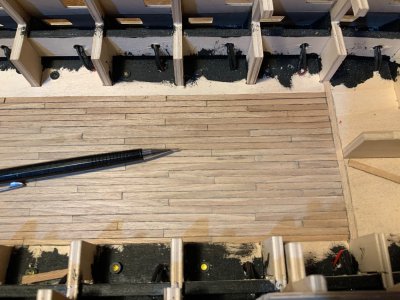
Next was the middle gun deck planking which is between bulkheads 4 and 12 and I decided to use the 4 butt shift system but did not add the rivet marks. Was this a mistake?
IMG_0502.jpeg
IMG_0503.jpeg
 
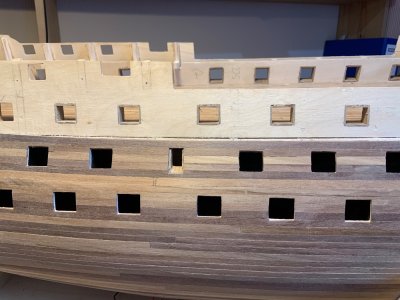
Second planking and adding gunport linings was the next step

IMG_0505.jpegIMG_0506.jpeg
At this stage I also added the upper deck inner bulwark patterns (275)

IMG_0539.jpeg

IMG_0540.jpeg

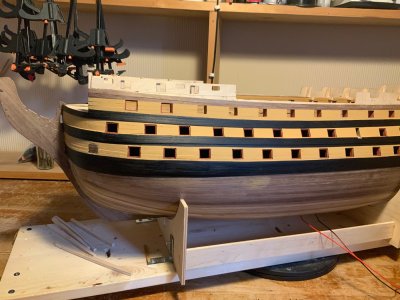
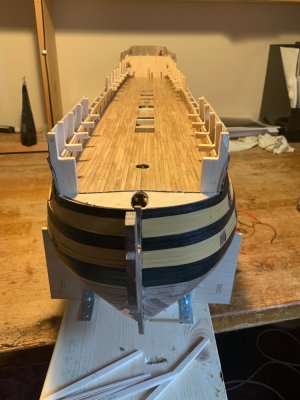
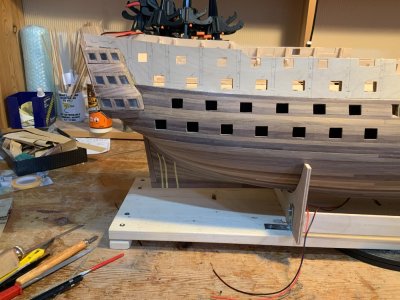
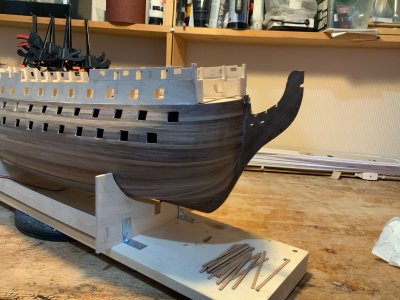
The above picture shows the completed second planking of the hull which I managed to achieve without the use of filler. It may not have been done in the technically correct way but after a small amount of sanding it was very smooth and ready to accept the copper plates.

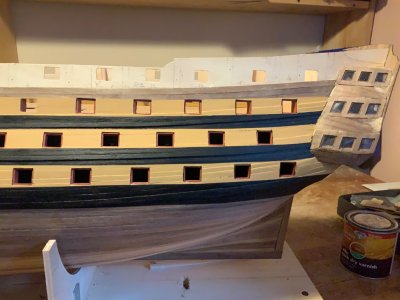
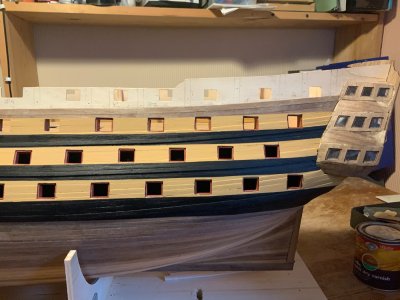
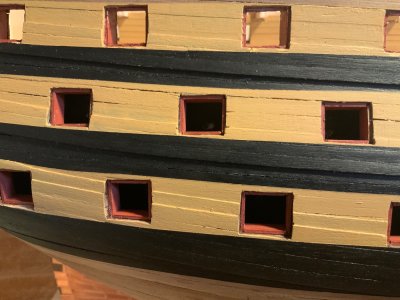
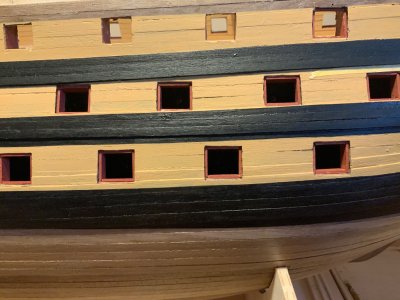
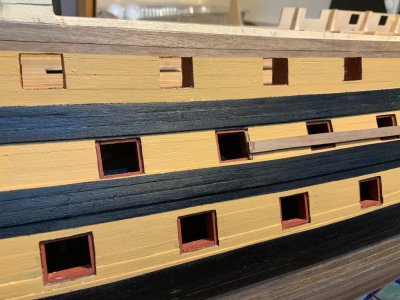
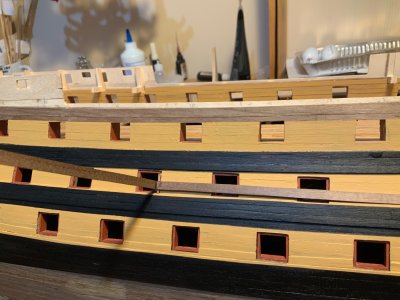
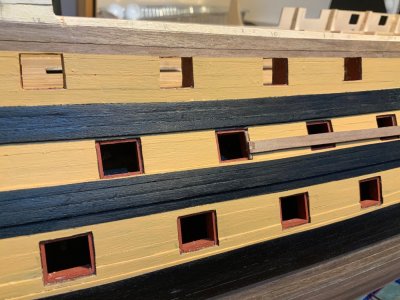
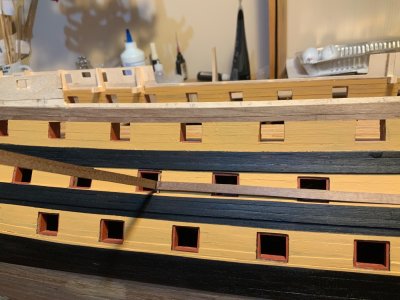
The 16 gunport without lids were then lined and painted redIMG_0509.jpeg

The Wales were added next and the middle and lower gun ports were lined.
IMG_0555.jpegIMG_0556.jpegIMG_0558.jpegIMG_0561.jpegIMG_0562.jpeg

IMG_0563.jpegIMG_0563.jpeg
 
IMG_0565.jpeg
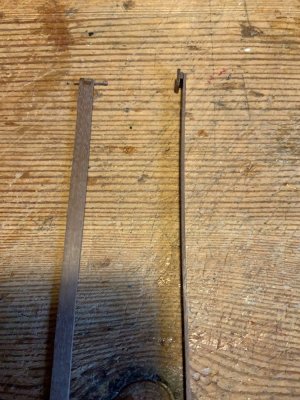
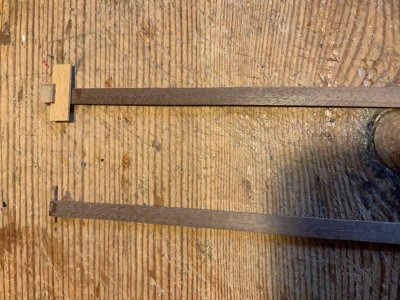
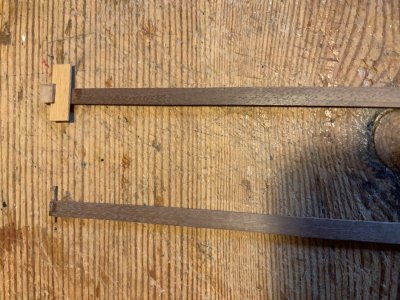
The few photos above show the tools used to position the gunport linings correctly. The tool at the top of the above photo was copied from the one devised and used by PeterV58 in his YouTube build log and the tool below I made up and used to ensure that there was a 1mm space between the edge of the lining and the outer face of the planking
 
IMG_0573.jpegIMG_0576.jpeg
IMG_0565.jpeg

The tool used to place the lining piece was made after watching YouTube video build log by PeterV58 which I think he designed himself. The other tool I build to ensure that there was a 1mm gap between the edge of the gunport linings correctly and the outer face of the second planking, tricky to use both together but after a lot of practice it seemed to work well
 
View attachment 610114View attachment 610115
View attachment 610110

The tool used to place the lining piece was made after watching YouTube video build log by PeterV58 which I think he designed himself. The other tool I build to ensure that there was a 1mm gap between the edge of the gunport linings correctly and the outer face of the second planking, tricky to use both together but after a lot of practice it seemed to work well
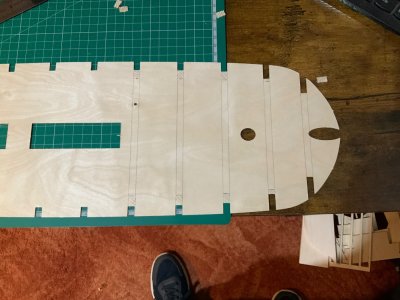
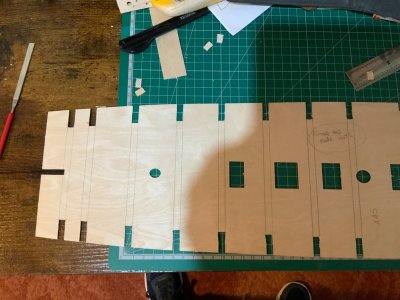
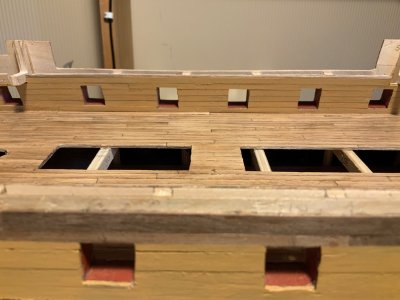
The placement of the upper gun deck was tricky.
The slots to accommodate the bulkheads were made deeper to make fitting easier


IMG_0471.jpeg


IMG_0470.jpeg

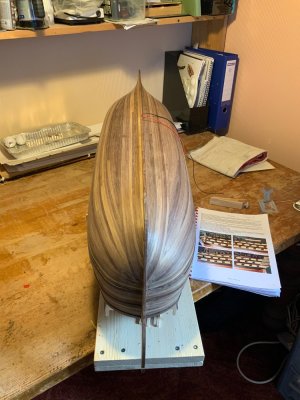
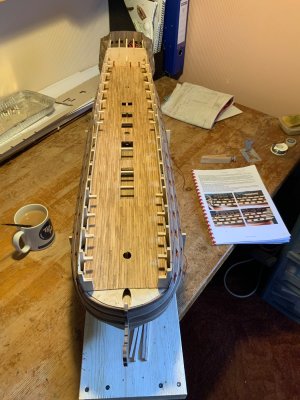
The upper gun deck was then planked using the same 4 butt shift system as on the lower deck

IMG_0538.jpegIMG_0559.jpeg

When the upper gun deck was completed the inner bulwark gunport patterns were fitted and planked
 
IMG_0568.jpeg

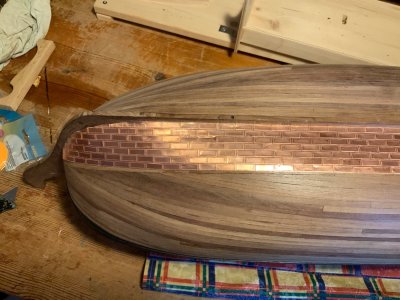
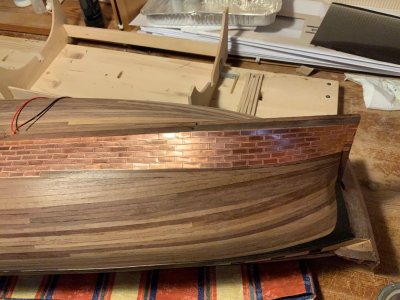
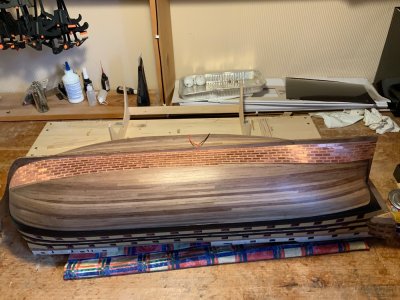
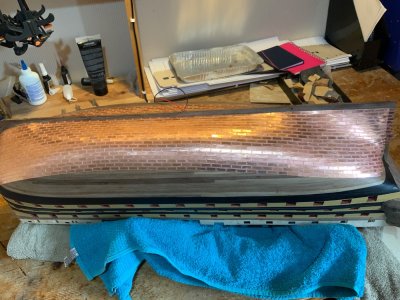
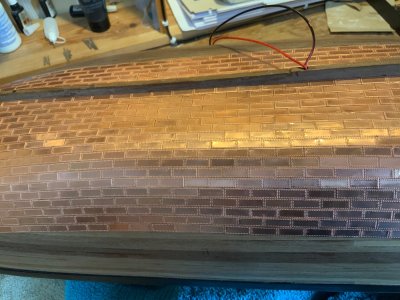
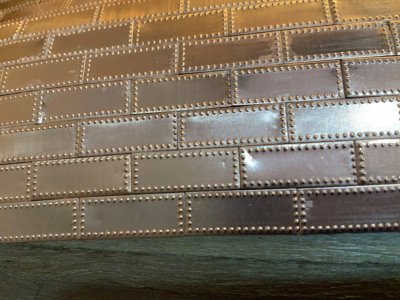
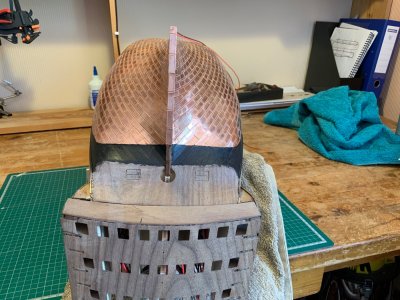
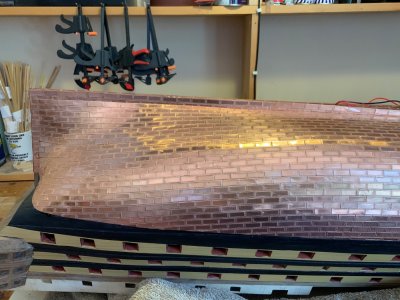
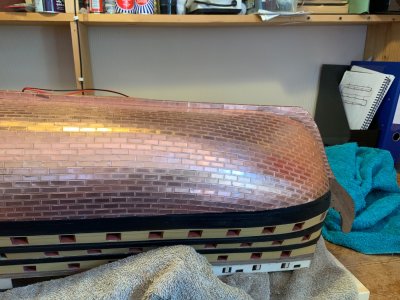
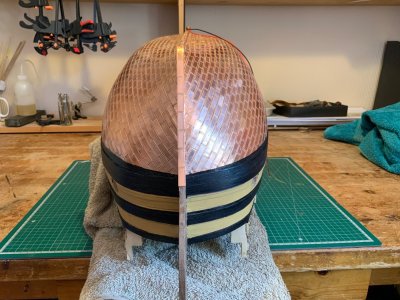
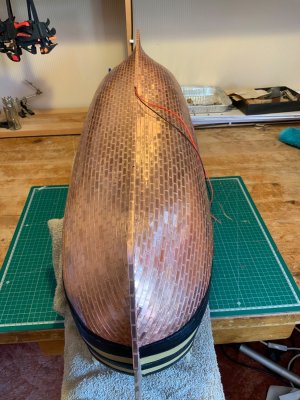
Decided to tackle the copper plating next

IMG_0569.jpeg

IMG_0571.jpegIMG_0572.jpeg
I would imagine I will be spending the next month or so completing the hull if I do both sides. Has anyone any thoughts or guidance as to wether it is better to do both sides or leave one side with just the walnut 2nd planking
 
Back
Top