



- Joined
- Nov 10, 2019
- Messages
- 554
- Points
- 453

@Kurt Konrath
@pugwash
@Holger.Schwarz
Thank you so much for your interest.
And thank you to everyone else for the likes!
Manufacturing Small Metal Cleats
Actually, the plan was to continue with rigging the main yard, since the sling on the yard are already in place and it is currently hanging on the model – secured only by the lifts. However, to keep motivation high, I like to insert other, varied tasks from time to time – especially since precise metalwork gives me particular pleasure.
My attention fell on a small but elegant detail in the stern area: horn cleats.
To belay the boom sheets, main braces, and boom tackles, I still need small cleats for my model of La Créole. In contrast to the large wooden cleats for the sheets and tacks of the fore and main mast, these small cleats were made of metal, as wood would not have provided the necessary strength.
Since the monograph of La Créole contains no information on this detail, I tried to reconstruct these small cleats by studying photo excerpts of the original model and another model from the Musée national de la Marine, the brig Le Cygne (1806).
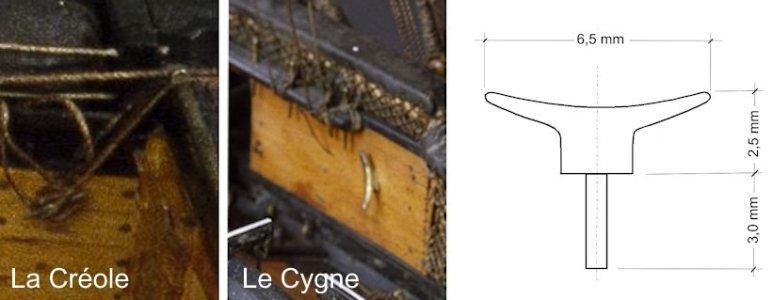
By studying these photos, I was able to understand the shape and size of these cleats. It is also evident that these are metal cleats. In particular, the image of Le Cygne shows an elegant, crescent-shaped silhouette with curved horns – a horn cleat (taquet à cornes).
In model building, it is often speculated whether such delicate small parts were made of hardwood. From a shipbuilding perspective of the era around 1830, however, everything pointed to metal (bronze or iron), since the slender horns would have immediately splintered under the oblique pull of the stern lines along the wood grain.
This shipbuilding logic is supported by an absolute primary source of the period:
In the standard work Dictionnaire de marine à voiles by Baron Pierre-Marie-Joseph de Bonnefoux and François-Edmond Pâris (1847), this is explicitly described under the main term TAQUET on page 684 (following page 685).
Taking into account the standard sizes of cleats according to historical specifications (approx. 30 cm in the original), I chose a cleat length of about 6.5 mm for the model.
Since only a manageable number of cleats were needed, it was no major effort to make them by hand. I sawed them from a 1.5 mm thick brass plate, including a 3.0 mm long mounting pin, using a jeweler’s saw. The cleats were then shaped with various needle files, as shown in the following photo.
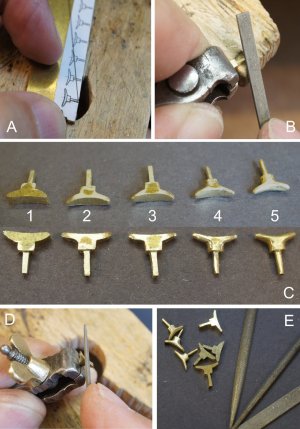
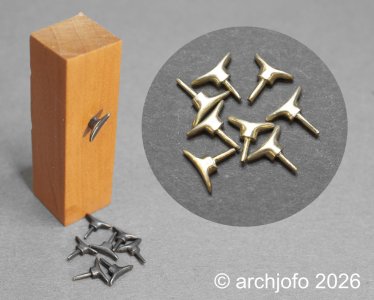
The mechanical work was completed with a fine intermediate and final manual sanding using sandpaper and the finest steel wool. The blackening gives them the authentic dark metallic character of iron.
The next two photos show the result and one already installed horn cleat.
More to come …
@pugwash
@Holger.Schwarz
Thank you so much for your interest.
And thank you to everyone else for the likes!
Manufacturing Small Metal Cleats
Actually, the plan was to continue with rigging the main yard, since the sling on the yard are already in place and it is currently hanging on the model – secured only by the lifts. However, to keep motivation high, I like to insert other, varied tasks from time to time – especially since precise metalwork gives me particular pleasure.
My attention fell on a small but elegant detail in the stern area: horn cleats.
To belay the boom sheets, main braces, and boom tackles, I still need small cleats for my model of La Créole. In contrast to the large wooden cleats for the sheets and tacks of the fore and main mast, these small cleats were made of metal, as wood would not have provided the necessary strength.
Since the monograph of La Créole contains no information on this detail, I tried to reconstruct these small cleats by studying photo excerpts of the original model and another model from the Musée national de la Marine, the brig Le Cygne (1806).
By studying these photos, I was able to understand the shape and size of these cleats. It is also evident that these are metal cleats. In particular, the image of Le Cygne shows an elegant, crescent-shaped silhouette with curved horns – a horn cleat (taquet à cornes).
In model building, it is often speculated whether such delicate small parts were made of hardwood. From a shipbuilding perspective of the era around 1830, however, everything pointed to metal (bronze or iron), since the slender horns would have immediately splintered under the oblique pull of the stern lines along the wood grain.
This shipbuilding logic is supported by an absolute primary source of the period:
In the standard work Dictionnaire de marine à voiles by Baron Pierre-Marie-Joseph de Bonnefoux and François-Edmond Pâris (1847), this is explicitly described under the main term TAQUET on page 684 (following page 685).
Taking into account the standard sizes of cleats according to historical specifications (approx. 30 cm in the original), I chose a cleat length of about 6.5 mm for the model.
Since only a manageable number of cleats were needed, it was no major effort to make them by hand. I sawed them from a 1.5 mm thick brass plate, including a 3.0 mm long mounting pin, using a jeweler’s saw. The cleats were then shaped with various needle files, as shown in the following photo.
The mechanical work was completed with a fine intermediate and final manual sanding using sandpaper and the finest steel wool. The blackening gives them the authentic dark metallic character of iron.
The next two photos show the result and one already installed horn cleat.
More to come …