A good CO2 laser and the correct settings can minimize char and give great results. These were cut on an 80W Trotec CO2 laser.
Very impressive!

 |
The beloved Ships in Scale Magazine is back and charting a new course for 2026! Discover new skills, new techniques, and new inspirations in every issue. NOTE THAT OUR NEXT ISSUE WILL BE July/August 2026 |
|
 |
As a way to introduce our brass coins to the community, we will raffle off a free coin during the month of August. Follow link ABOVE for instructions for entering. |
|
A good CO2 laser and the correct settings can minimize char and give great results. These were cut on an 80W Trotec CO2 laser.
The following expresses my personal preferences on the subject of Laser Cutting and by association CAD, CNC, and 3-D printing as applied to model shipbuilding. It is not intended to imply how readers of my post should build their models or what technology they should or should not use.
Ship model building is supposed to be creative, enjoyable, and to produce something of artistic merit. All of the technologies mentioned above involve computers that I don’t enjoy using. I also dislike computer programs because I don’t like having to follow some programmer’s instructions. I also don’t find work done on a computer to be creative.
Will models built using computer technology be classed in the future the same as those built by hand? It’s too soon to tell but I suspect not.
My personal beliefs. I respect yours.
Roger


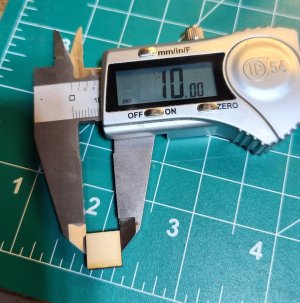
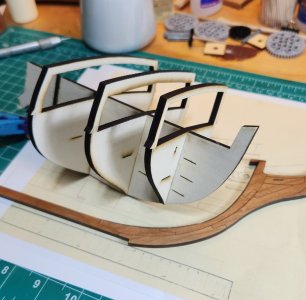
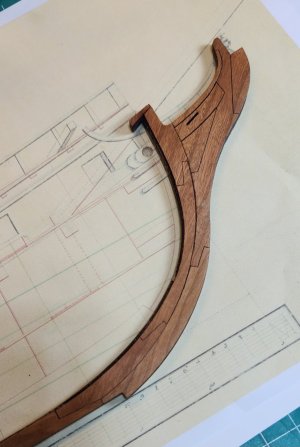
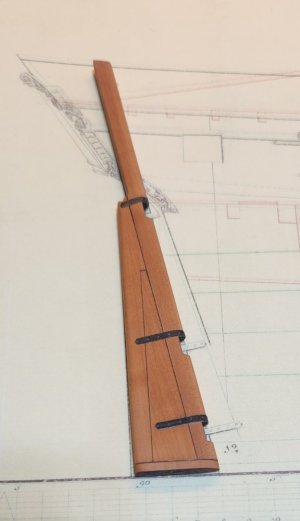
Really wonderful work! That decking on the schooner is amazing!A good CO2 laser and the correct settings can minimize char and give great results. These were cut on an 80W Trotec CO2 laser. It's a pretty expensive production machine that uses proprietary software. The first image shows window frames and mullions for an N scale train shed were cut from 1/16" basswood and polybak respectively with very little char on the wood and almost none on the polybak. Polybak is resin impregnated paper that cuts like butter on the laser. It takes great detail and is strong for its thickness.
It takes a lot of work to dial in the proper settings but with care you can minimize the char. I don't cut much wood thicker than 1/8" very often but as you can see by the rafters in the second image there is very little char. All parts of this train shed were laser cut, windows, framing, rafters, siding etc.
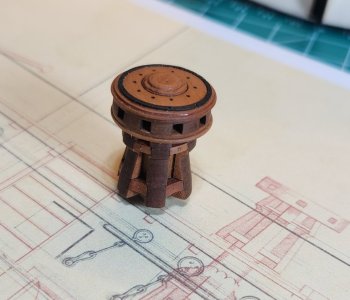
Correcting for the kerf of the laser allows for tight fitting pieces. I really enjoy designing for the laser and fine tuning the results. I also laser cut cannon carriages and a jig to glue them together as shown in the third image.
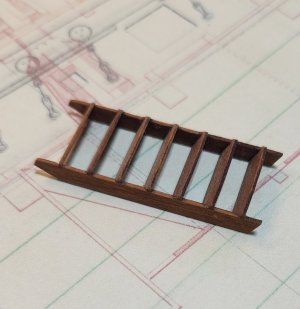
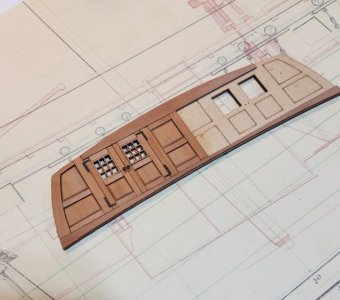
The fourth image shows the deck for the topsail schooner Julia that I laser cut and laser engraved. For the size of it I don't know how I'd do it manually.
Cheers,
Todd
View attachment 606812
View attachment 606814
View attachment 606815
View attachment 606816
Luckily (at least for me) I believe most of us are not doing this for any competition or show where there may be rules.I would add CA, polyurethane, MDF if I were writing the rules. I am not.


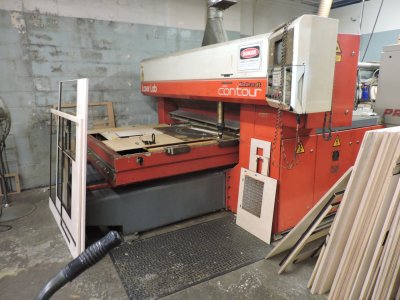



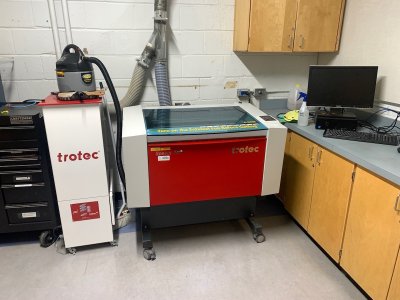
Thanks Dave. Those windows are basswood. Pretty soft. Haven't tried boxwood because until just recently I've not had any. This laser uses a 2" lens, so while we do get the V shape to cuts it's not as pronounced as with a longer lens. A shorter 1.5" lens might reduce that even more. Here's the machine I have access to at work. Trotec Speedy 300 80W CO2 laser. Nice machine for this kind of work. 17" X 29" bed so cannot cut big sheets but it's fine for my needs.nice work Todd i tried to laser cut windows with no success my problem was the lasers i use are industrial size at 800 and 1,200 watts. trying to dial it down to fine cutting just did not work. The laser does not cut square it cuts as an upside down V the beam spreads out. This made the frames and mullions V shaped and trying to clean off the char they just crumbled. Another problem was the wood grain the mullions had a cross grain and extremely delicate. The softer the material the less char but more delicate, harder the material like Boxwood the stronger the piece but more char.
Now a low power laser engraver may do the job i do not know because i do not run a laser just program them.
i use AutoCad because the lasers are open end that is to say it will use any vector file so they will cut from a AutoCad DWG file.
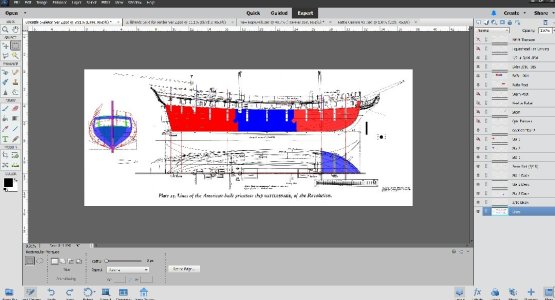
you know there is truth to that in the early days of graphic design we had to draw layouts for web presses and die cutting. i can pick up a layout and instantly know who did the drawings. Later i became aware of the artists mark who did it.Re; Bob Cleek’s post #22 above. As an example of the “hand” involved in manual drafting, Howard Chapelle’s drawings are instantly recognizable even when published somewhere other than one of his books.
Roger



Well! today programs like Light Burn you pay and pay and keep paying for it every year you never own it.
Here is a screen shot of supported files.Gatzby
what files can be imported into light burn like a DWG cad file for example?