• Win a Free Custom Engraved Brass Coin!!!
    As a way to introduce our brass coins to the community, we will raffle off a free coin during the month of August. Follow link ABOVE for instructions for entering.
  • PRE-ORDER SHIPS IN SCALE TODAY!

    The beloved Ships in Scale Magazine is back and charting a new course for 2026!
    Discover new skills, new techniques, and new inspirations in every issue.

    NOTE THAT OUR FIRST ISSUE WILL BE JAN/FEB 2026

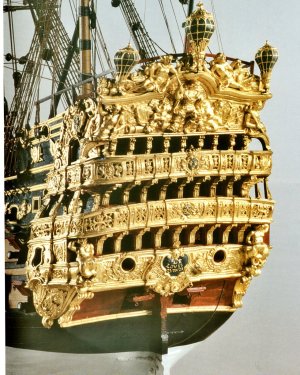
Le Saint Philippe 1693 after Jean-Claude Lemineur (Ancre) in scale 1:48

About two weeks ago I started to fabricate the parts for the second deck - but as I contemplated actually installing that deck I kept running into, "but you have to do this or that thing first." So, here's a few of those things:

The gunports on the stern of the ship (along with the hardware needed on the inner face of all gun port covers):

View attachment 581099

View attachment 581100

The 'boot' that allows the tiller to ride along the tiller sweep (everything is just loose here pending final fitting):

View attachment 581101

Scuppers. On the SP all of the scuppers are square in cross section - the smaller scuppers have a round channel - the larger scuppers have a square channel:

View attachment 581098

View attachment 581104

View attachment 581103

Without the waterway the inboard end of the scupper looks silly - but it is what it is...

Finally...the rule is that you don't get to build a ship model with grandpa until you are five. Well, this little guy is only four, so we had to build a wooden car (it's a kit):

View attachment 581105

I'll be honest - this picture makes my eyes water a little bit. The backstory on this little guy is pretty grim - yet here he is - happiest kid on the planet. I know there are some other guys out there whose grandchildren are facing challenges right now and I feel your pain. Sometimes it works out just fine. God is faithful.
That poor, poor child. If only there was something we could do about his grandpa.
 
A question. I think in those places where a wale crosses over a gunport the wale should continue (that is, it should not stop and restart at the gunport opening).

Right now, I have the gunport covers in place, but the wales stop and restart (they don't run over the gunport cover itself). I assume this is wrong. Am I right that I have done it wrong?

If so - what happens to the hinge that will be installed later? Does it just bend around the wale (simulated wale since I already have already built it wrong and have no desire to build these covers again)?

View attachment 581106

I realize this is the dumbest question you have ever heard on the forum. What you don't know is that I have even dumber questions I don't bother to ask ROTF.
I posted a question in the French forum and this is Gerard's reply. I hope it helps you, Paul.

If I understand correctly, the question is: Are the gun ports cut off the hull sides?

Blaise Olivier explains in his treatise on hull sides:

First hull side (the lowest):

…it is flush with the sill of the second or third gun port from the stern and is cut off by one-third, one-half, or two-thirds of its width by the first gun port from the stern.

Second hull side:

…it is flush with the fourth or fifth gun port from the stern, is cut off by a few centimeters by the third gun port, by half by the second, and completely by the first gun port and the bottle door. – Counted from the stern –

Therefore, your friend's work is perfectly correct if he is following the plan.

IMG_0168.jpeg
 
That’s a very good question, mon ami, and no, you’re not crazy to question it. ;)
You are correct in principle: I believe, on real ships, the wale runs continuously along the hull. It does not stop at the gunport. The gunport opening is cut through the planking and the wale. The wale is typically structural reinforcement; it wouldn’t politely stop and restart around a lid.

As for the hinges, the hinge straps were mounted to the outside planking (obvious), sometimes crossing the wale. If the wale projected, the iron strap would either bend over the wale, or sit slightly proud, or be mounted just above/below, depending on design. There was no elegant recessing; iron straps were mostly practical, but some were practical and decorative.

I think there is no need to rebuild: You can simply add a strip across the lid matching the wale (grain direction, important), thickness. Feather/sand gently, it will visually continue the wale line. But honestly, it is your call. I love her the way she is! :)

And the coper nailing is very convincing. The spacing is disciplined, the rows are consistent, and most importantly, they don’t scream “pattern” and match the scale. That’s usually the trap with simulated fasteners: too perfect, and they look stamped; too random, and they look chaotic. Yours sits in that nice, believable middle ground. You gotta love them!

Excellent, Jim! Thank you for taking the time to offer guidance. And also for your nice review of the nails...
 
Paul,
I have a bunch of period model pictures of the "wale" and "gunport" intersection. I'll post a few below.

1. This is one of the few the made the gunport 3D, to follow the raised wale.
View attachment 581127

2. Most, like this one, just used paint to continue the line of the raised wales.
View attachment 581128

3. Finally, a few had neither paint or a raised piece that followed the rail.

View attachment 581129

I used both, on my scratch Serapis build. I hoped no one would look at both sides at the same time ROTF.

a. On this port side, I left the rail "sliver" off (second from the right), as it would be too fragile/unsupported. the one to the right has the rail continued in 3D.
View attachment 581131


b. In this photo of the same two ports on Starboard, you can see I did 3D on the thin sliver but I'm sure that would be broken off almost immediately, so I left it off the port side.
View attachment 581132

Hope this was helpful in your gunport decisions. I think you can still do any of the three options:
1. No continuation of the wales on the gunport (no paint or 3D).
2. Simulate a continuation of the wales with paint.
3. Add to the cover a piece in 3D to continue the wales. The metal straps would have to be bent to follow this new contour.
This was a surprising post, Brad. I assumed there would be a right way and a wrong way. My question feels less dumb :).
 
I posted a question in the French forum and this is Gerard's reply. I hope it helps you, Paul.

If I understand correctly, the question is: Are the gun ports cut off the hull sides?

Blaise Olivier explains in his treatise on hull sides:

First hull side (the lowest):

…it is flush with the sill of the second or third gun port from the stern and is cut off by one-third, one-half, or two-thirds of its width by the first gun port from the stern.

Second hull side:

…it is flush with the fourth or fifth gun port from the stern, is cut off by a few centimeters by the third gun port, by half by the second, and completely by the first gun port and the bottle door. – Counted from the stern –

Therefore, your friend's work is perfectly correct if he is following the plan.

View attachment 581147
Thanks for taking this to the next level, Tobias. Just so I'm clear - Gerard agrees with Jim that I should lay a thin layer of wood over the port cover to simulate the wale passing through?
 
.​
Thanks for taking this to the next level, Tobias. Just so I'm clear - Gerard agrees with Jim that I should lay a thin layer of wood over the port cover to simulate the wale passing through?

Paul, the problem with Gérard's explanations is that they do not address your issue at all, probably due to the language barrier. Gérard only confirms that the wales could have been cut to a greater or lesser extent by the last few gunports, and not whether the wales continued on the gunport lids themselves. Incidentally, in this regard, besides Blaise Ollivier's explanations from 1736, actually more relevant for your specific 17 cent. case would be the royal decrees of the last decades of the 17 century.

Anyway, there exist several drawings and plans from that era, i.e. from around 1700, and they all show that the wales did not continue on the gunport lids themselves (if you wish, I can reproduce the relevant fragments here).

On the other hand, there is just one case known to me where there is a continuation, specifically in a model of a generic three-deck ship made around 1700, called Louis XV. Below are two relevant close-ups of this model, illustrating this feature (from Modeles historiques. Tome II by Jean Boudriot and Hubert Berti).

And, in general, one gets the impression that this specific aspect seems more important today to us than it did to contemporaries :).


Le Louis Quinze ca 1700 (2).jpg

Le Louis Quinze ca 1700 (1).jpg
.​
 
Last edited:
.​


Paul, the problem with Gérard's explanations is that they do not address your issue at all, probably due to the language barrier. Gérard only confirms that the wales could have been cut to a greater or lesser extent by the last few gunports, and not whether the wales continued on the gunport lids themselves. Incidentally, in this regard, besides Blaise Ollivier's explanations from 1736, actually more relevant for your specific 17 cent. case would be the royal decrees of the last decades of the 17 century.

Anyway, there exist several drawings and plans from that era, i.e. from around 1700, and they all show that the wales did not continue on the gunport lids themselves (if you wish, I can reproduce the relevant fragments here).

On the other hand, there is just one case known to me where there is a continuation, specifically in a model of a generic three-deck ship made around 1700, called Louis XV. Below are two relevant close-ups of this model, illustrating this feature (from Modeles historiques. Tome II by Jean Boudriot and Hubert Berti).

And, in general, one gets the impression that this specific aspect seems more important today to us than it did to contemporaries :).


.​
Excellent, Waldemar! I am so grateful for your shared expertise!
 
No, not really. @-Waldemar- explanation is absolutely correct. Ultimately, Gerard is saying that you did it right.

And besides, there's a saying: there are no stupid questions, only stupid answers.
That's also what I understood from the narrative - it was the highlighted picture that seemed to suggest otherwise. Thanks for the clarification.
 
Turns out my question wasn't so dumb after all!
Not dumb at all — quite the opposite. The fact that you stopped, looked at it, and questioned the construction tells me you’re thinking like a shipwright, not just assembling parts. That’s how better models happen. If anything, it was a sharp observation and a useful discussion for all of us following along.
 
Back
Top