
-

SUBSCRIBE TO SHIPS IN SCALE TODAY!
The beloved Ships in Scale Magazine is back and charting a new course for 2026!
Discover new skills, new techniques, and new inspirations in every issue.
NOTE THAT OUR NEXT ISSUE WILL BE July/August 2026 -

Win a Free Custom Engraved Brass Coin!!!
As a way to introduce our brass coins to the community, we will raffle off a free coin during the month of August. Follow link ABOVE for instructions for entering.


You are using an out of date browser. It may not display this or other websites correctly.
You should upgrade or use an alternative browser.
You should upgrade or use an alternative browser.
L'Orenoque Mamoli 1:100 scale
- Thread starter The Gavel
- Start date
- Watchers 32
-
- Tags
- l'orenoque mamoli


If you look at my post I spoke of 'similar species'. Limewood is basically basswood. It is a soft wood but if you don't stain it it will be a nice creamy color which I believe is what you are looking for.Paul, I don't know what internet you are using, but in my universe no supplier sells dowels made of "swiss pear, castello boxwood, Buxus macowanii (boxwood from South Africa)" I went with limewood. Please tell me I made a good call

- Joined
- May 25, 2020
- Messages
- 1,418
- Points
- 443

It is European limewood - the internet said that it is a hardwood.If you look at my post I spoke of 'similar species'. Limewood is basically basswood. It is a soft wood but if you don't stain it it will be a nice creamy color which I believe is what you are looking for.

In addition to what Paul mentioned, you can make dowels from virtually any type of wood as long as you start with square stock. With a simple jig, even a basic drawplate setup, or using a threading die, you can produce dowels in almost any diameter you need. It’s a very practical solution if you want control over the wood species and grain. I just hope my search engine history (below) still has those instructional videos saved.
- Joined
- Mar 11, 2024
- Messages
- 239
- Points
- 143

my cutty at 1/115 was running 6mm , i generally use 8mm at 1/50-1/65 and 7 on 1/78-1/100 . Let us know when you get to see the plans.Martin! Thank you! Yup - Re-do here we come!
If memory serves (I'm on campus and don't have ready access to the plans) kit-plan gives 5mm for fore and main and 4mm for mizzen. Any other dimensional information re: spars on those plans? Where am I looking and what words am I looking for? I think my L'Orenoque plans may have some info
Blessings.
Chuck

I hate re-drilling mast holes, i wish you luck if that's what you are up for !
On the right hand side of the sail plans , the last column is marked diametre, masts are "mats", but be careful because what we would call a foremast is "misaine", while what we would call a mizzen is "l'artimon" ! Yards are "vergues" , except gaff spars, "cornes"
i have rounded out slightly, no idea what you can find over there, is it all imperial or can you find metric ?
topmasts 4, mizzen topmast 3
main yards are 4.5mm, topsail yards 3.5, topgallants 2
gaff spars 2.5 gaff topsail spar 2
jib boom 3
- Joined
- May 25, 2020
- Messages
- 1,418
- Points
- 443
Jim! Thank you! The google search worked!In addition to what Paul mentioned, you can make dowels from virtually any type of wood as long as you start with square stock. With a simple jig, even a basic drawplate setup, or using a threading die, you can produce dowels in almost any diameter you need. It’s a very practical solution if you want control over the wood species and grain. I just hope my search engine history (below) still has those instructional videos saved.
Blessings.
Chuck
- Joined
- May 25, 2020
- Messages
- 1,418
- Points
- 443
Thank goodness for my spirit-guide on this build! Martin!!! Thank you! I can almost get by with very basic conversational French - serves me right for not following through with French - although I was quite smitten by my 7th grade French teachermy cutty at 1/115 was running 6mm , i generally use 8mm at 1/50-1/65 and 7 on 1/78-1/100 . Let us know when you get to see the plans.
I hate re-drilling mast holes, i wish you luck if that's what you are up for !
On the right hand side of the sail plans , the last column is marked diametre, masts are "mats", but be careful because what we would call a foremast is "misaine", while what we would call a mizzen is "l'artimon" ! Yards are "vergues" , except gaff spars, "cornes"
i have rounded out slightly, no idea what you can find over there, is it all imperial or can you find metric ?
topmasts 4, mizzen topmast 3
main yards are 4.5mm, topsail yards 3.5, topgallants 2
gaff spars 2.5 gaff topsail spar 2
jib boom 3

I can (and just spent $100 for overnight delivery - impatience) get metric.
Blessings. Peace. Gratitude.
Chuck
- Joined
- May 25, 2020
- Messages
- 1,418
- Points
- 443
Martin! I'll reach out after a thorough review of the plans. New mast holes are definitely in the picture. Also I need to finish the bottoms (heels?) of the replacement masts with tenons that fit the mast steps I lovingly fitted before the hull was plankedmy cutty at 1/115 was running 6mm , i generally use 8mm at 1/50-1/65 and 7 on 1/78-1/100 . Let us know when you get to see the plans.
I hate re-drilling mast holes, i wish you luck if that's what you are up for !
On the right hand side of the sail plans , the last column is marked diametre, masts are "mats", but be careful because what we would call a foremast is "misaine", while what we would call a mizzen is "l'artimon" ! Yards are "vergues" , except gaff spars, "cornes"
i have rounded out slightly, no idea what you can find over there, is it all imperial or can you find metric ?
topmasts 4, mizzen topmast 3
main yards are 4.5mm, topsail yards 3.5, topgallants 2
gaff spars 2.5 gaff topsail spar 2
jib boom 3

I should have asked/confirmed - you are reading from the Magellan/Isly plans?
- Joined
- Mar 11, 2024
- Messages
- 239
- Points
- 143
Yes to the plans , the barque sizes, and believe me , even after thirty years here ,my rigging french is still a bit limited !


Could you not find maple? You should also be able to get walnut dowels online, I use those for sheaves in blocks. I don't think you'll get large diameters like .75+ inch, but .5 inch and smaller should be available.Paul, I don't know what internet you are using, but in my universe no supplier sells dowels made of "swiss pear, castello boxwood, Buxus macowanii (boxwood from South Africa)" I went with limewood. Please tell me I made a good call
Who makes spars from dowels anyway?
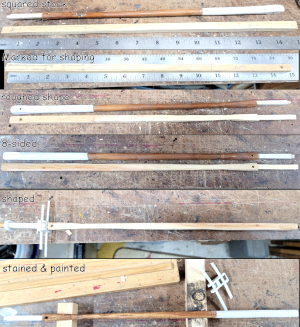
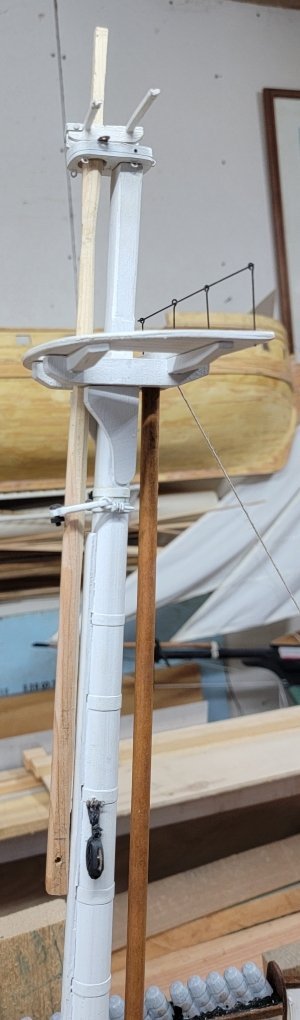
- Joined
- May 25, 2020
- Messages
- 1,418
- Points
- 443
Jerry! Not for immediate delivery. As to your question - the answer is meCould you not find maple? You should also be able to get walnut dowels online, I use those for sheaves in blocks. I don't think you'll get large diameters like .75+ inch, but .5 inch and smaller should be available.
Who makes spars from dowels anyway?
View attachment 580447 View attachment 580448
.Blessings.
Chuck
Last edited:
- Joined
- May 25, 2020
- Messages
- 1,418
- Points
- 443
What ho, shipmates!
The results of tonights study:
The kit plans are off by 1mm on the diameter of the foremast and mainmast. Accurate as to the mizzen. Accurate as to the topmasts.
When I re-measured my masts - my mizzen is accurate. My mainmast is off by 1mm. My foremast is off by 2mm because I decided that the foremast would have less width. Because the lower masts are not accurate the top masts are also not accurate because of my idea to continue the taper established by the lower masts.
The Magellan/Isly plans with the help of Martin and google translate (should have had a V8) are extremely informative and fully explain the appeance that the fore mast is taller than the main. According to those plans the Panama's fore and main masts are identical. Google translate got some stuff wrong. "Basic food" is mainmast. I am assuming that the masts tapered as they rose - so the given diameter is the diameter at the bottom. If anyone posts that the diameter was uniform over the length of the spar, this will be my last post - ever
And since I work at a university - I'll also pay a visit to the romance language department
As to the yards - since I'm rigging L'Orenoque as a barque I'll have to guess at the dimenstions of the yards on the mainmast. There's some logic to the idea that if the fore and mainmasts were twins, their yards would also be twins.
I'm over due for my grog ration and I can hear Dragnet starting on the radio.
Thanks for all of your help today!
Blessings.
Chuck
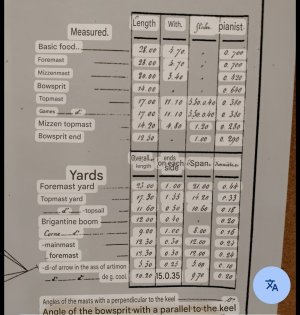
A second attempt with google lens:
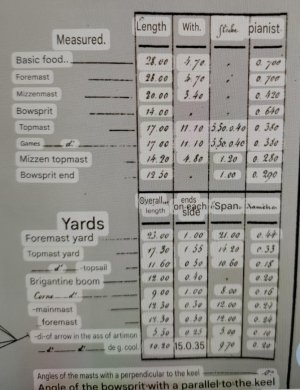
The results of tonights study:
The kit plans are off by 1mm on the diameter of the foremast and mainmast. Accurate as to the mizzen. Accurate as to the topmasts.
When I re-measured my masts - my mizzen is accurate. My mainmast is off by 1mm. My foremast is off by 2mm because I decided that the foremast would have less width. Because the lower masts are not accurate the top masts are also not accurate because of my idea to continue the taper established by the lower masts.
The Magellan/Isly plans with the help of Martin and google translate (should have had a V8
) are extremely informative and fully explain the appeance that the fore mast is taller than the main. According to those plans the Panama's fore and main masts are identical. Google translate got some stuff wrong. "Basic food" is mainmast. I am assuming that the masts tapered as they rose - so the given diameter is the diameter at the bottom. If anyone posts that the diameter was uniform over the length of the spar, this will be my last post - everAnd since I work at a university - I'll also pay a visit to the romance language department
As to the yards - since I'm rigging L'Orenoque as a barque I'll have to guess at the dimenstions of the yards on the mainmast. There's some logic to the idea that if the fore and mainmasts were twins, their yards would also be twins.
I'm over due for my grog ration and I can hear Dragnet starting on the radio.
Thanks for all of your help today!
Blessings.
Chuck
A second attempt with google lens:
- Joined
- Mar 11, 2024
- Messages
- 239
- Points
- 143
Ah well , at least you have an arrow in the ass of your artimon !
- Joined
- May 25, 2020
- Messages
- 1,418
- Points
- 443
Martin! That's exactly where I've always wanted an arrrow.Ah well , at least you have an arrow in the ass of your artimon !
- Joined
- Mar 11, 2024
- Messages
- 239
- Points
- 143
Notice they have deleted the mast rake again.
- Joined
- May 25, 2020
- Messages
- 1,418
- Points
- 443
Martin! I noticed the same thing. Makes me wonder why provide all of the detail inlcuding angles for the jib and indicate 0 rake for the masts. Wierd. I'll go with the rake angles I determined from the Descartes plan. BTW my limewood dowels arrived and they are straight and hard - hard enoughNotice they have deleted the mast rake again.
Don't know how much I'll get done this weekend - 17th Anniversary today! The Admiral and I are going out for an executive lunch as the first celebration. I know that's not a lot of time given the longevity of many of the marriages among our shipmates, but I'm working on it

Blessings. Peace. Gratitude.
Chuck
Congratulations to you two and keep on working "on it"! You're off to a great start!!17th Anniversary today! The Admiral and I are going out for an executive lunch as the first celebration. I know that's not a lot of time given the longevity of many of the marriages among our shipmates, but I'm working on it
Blessings. Peace. Gratitude.
Chuck
- Joined
- May 25, 2020
- Messages
- 1,418
- Points
- 443
Brad! Thank you!Congratulations to you two and keep on working "on it"! You're off to a great start!!
Last edited:
- Joined
- May 25, 2020
- Messages
- 1,418
- Points
- 443
What ho, shipmates! Well - time to start turning the new masts. And no matter what Paul says, I expect a prize for the most do-overs!
Trying to get it right - Origninally I set up the bowsprit with the caps at a right angle to the keel. I felt ok about this, but I was basing that arrangement on my prior experience with Enterprise, Lovely Renee and Harriet Lane. I had noticed in some paintings and drawings of French ships of the era that the arrangement was angled and the martingale was too. Taking a closer look at the Magellan drawing I noticed the same thing. It also looks like the jib boom runs the length of the bowsprit. An enlargement is below. Red arrow is the long jib boom - am I seeing it correctly? Yellow line is how I set up the cap on my other builds. Blue line follows the plan and correlates to historical images. Follow the blue line, right?
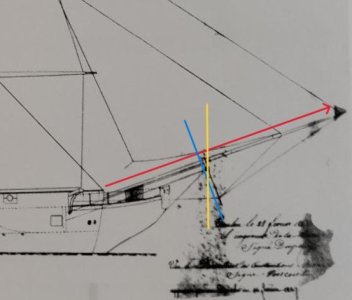
Trying to get it right - Origninally I set up the bowsprit with the caps at a right angle to the keel. I felt ok about this, but I was basing that arrangement on my prior experience with Enterprise, Lovely Renee and Harriet Lane. I had noticed in some paintings and drawings of French ships of the era that the arrangement was angled and the martingale was too. Taking a closer look at the Magellan drawing I noticed the same thing. It also looks like the jib boom runs the length of the bowsprit. An enlargement is below. Red arrow is the long jib boom - am I seeing it correctly? Yellow line is how I set up the cap on my other builds. Blue line follows the plan and correlates to historical images. Follow the blue line, right?
As it is a model hardness is probably not much of a factor and color as mentioned may be more important to you. For comparison, South American castello hardness is 1,810 lbf and European limewood (Tilia x europaea) is from 310–700lbf on the Janka scale.I went with limewood. Please tell me I made a good call
Allan
Last edited: