• SUBSCRIBE TO SHIPS IN SCALE TODAY!

    The beloved Ships in Scale Magazine is back and charting a new course for 2026!
    Discover new skills, new techniques, and new inspirations in every issue.

    NOTE THAT OUR NEXT ISSUE WILL BE MARCH/APRIL 2026
  • Win a Free Custom Engraved Brass Coin!!!
    As a way to introduce our brass coins to the community, we will raffle off a free coin during the month of August. Follow link ABOVE for instructions for entering.

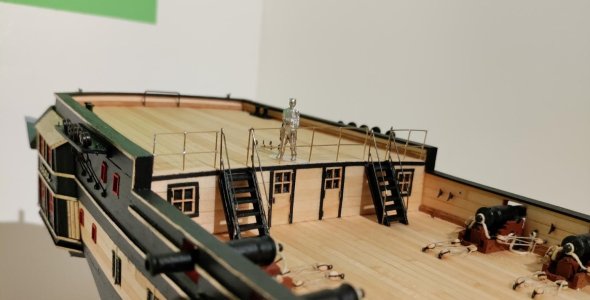
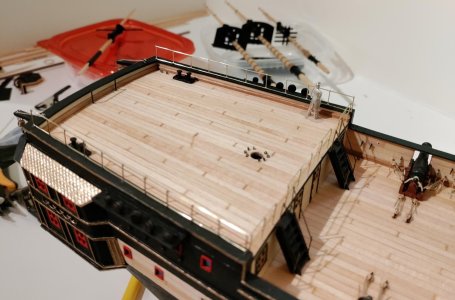
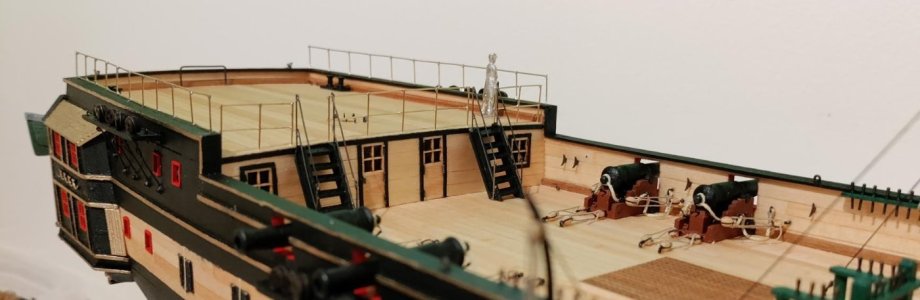
L'Orenoque Mamoli 1:100 scale

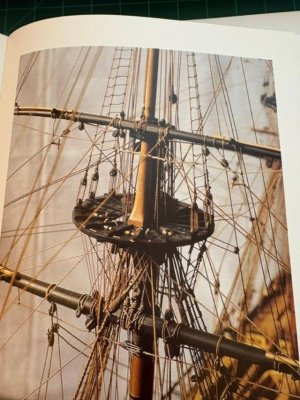
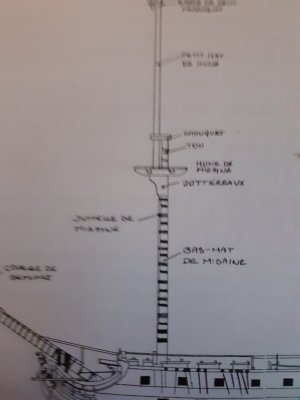
first question , while on the subject of reinforcements, will you be fitting Jumelles? mast hounds ?(wooden battens that support the mast at the point of movement of the yard )These are fitted after the mastbands (which i now have info at width, 1/7 thickness of the mast at a distance of "3 pieds à 3 pieds et demi" so you are about right at 1metre) but then attached with rustures (wooldings) , their height should be equal to between 3/7 and 1/2 the open mast height.? i'll find some photo's
Martin! This is great stuff my friend! Thank you! Short answer is maybe not.

Blessings. Peace. Gratitude.
Chuck
 
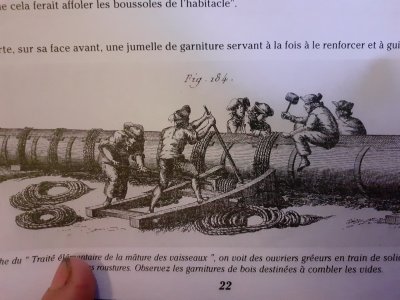
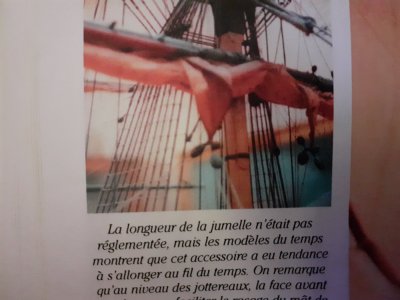
sorry ,i responded when half awake at 5 in the morning Sleep, not really with it ! here's a bunch of busy frenchmen attaching a Jumelle to the mast, it is really to protect it when raisng and lowering the yards and is disposable. the second photo shows a shorter version from 1740 but they gradually got longer until almost reaching the deck, not fitted to the mizzen mast
.20260616_092023.jpg20260616_092117.jpg20260616_091942.jpg

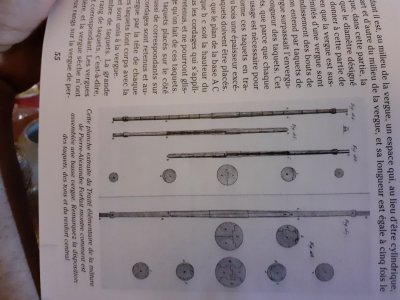
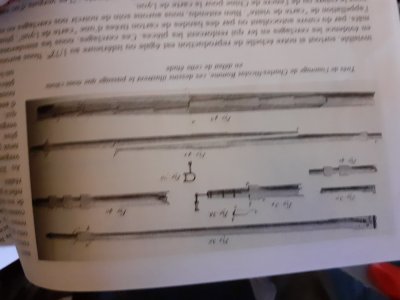
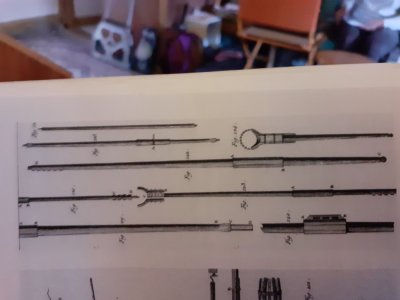
on to yards, everything i have points to them normally being reinforced by the octagonal centre section up until the introduction of steel yards but that would be later than L'Orenoque; dimensions are given as length = 5 times width of the yard, the diameter being 1 inch larger than that of the yard (from "L'art de la Voilure" by Charles Nicolas Romme 1781) i have included some illustrations from his tomes which will give you some clues as to the "taquets" the cleats and jams typically used, and also the iron reinforcing circlets.(1st pic) bit difficult to see but the intricate internal dovetails used to hold the two halves of the yard together are quite something, (2nd pic)
20260616_092202.jpg20260616_092222.jpg20260616_092250.jpg
That should be enough to give you some headaches for now, ROTFif you have any other queries i will see what i can find.
 
Hi Chuck,

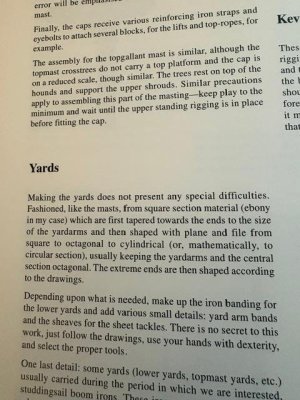
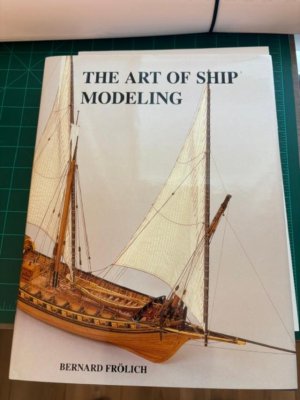
I got my out my book "The Art of Ship Modeling" by Bernard Frolich to what to see what he said about yards on French ships. The book references French ships built between 1680 to 1820. In the it states that the central part yards would be octagonal. I'm not sure if this would pertain to time frame of your ships construction. This information may too early.

Bill

chuck 1.jpg

chuck 2.jpg

chuck 3.jpg
 
everything i have points to them normally being reinforced by the octagonal centre section up until the introduction of steel yards but that would be later than L'Orenoque;
The book references French ships built between 1680 to 1820. In the it states that the central part yards would be octagonal.
Martin! Bill! Thank you both for checking on this for me! L'Orenoque (1847) was part of a building program (arms race with Great Britain more like) that ran from the late 1830's and kept going. There's nothing in my source material on L'Orenoque to show her yards were steel. And, Martin, based on your comments on how far behind the French were, I can't imagine L'Orenoque, of all ships, having them. Martin and Bill, based on your sources seems very safe to conclude that the octagonal section is the period correct choice despite the 1860 diagram that I shared showing the yard center was round.

Mischief managed!!!! Thank you, shipmates!

Blessings. Peace. Gratitude.
Chuck
 
Hi Chuck,

I got my out my book "The Art of Ship Modeling" by Bernard Frolich to what to see what he said about yards on French ships. The book references French ships built between 1680 to 1820. In the it states that the central part yards would be octagonal. I'm not sure if this would pertain to time frame of your ships construction. This information may too early.

Bill

View attachment 612525

View attachment 612526

View attachment 612527
see chuck,"just follow the drawings, use your hands with dexterity, and select the proper tools " ROTF
 
Martin! Bill! Thank you both for checking on this for me! L'Orenoque (1847) was part of a building program (arms race with Great Britain more like) that ran from the late 1830's and kept going. There's nothing in my source material on L'Orenoque to show her yards were steel. And, Martin, based on your comments on how far behind the French were, I can't imagine L'Orenoque, of all ships, having them. Martin and Bill, based on your sources seems very safe to conclude that the octagonal section is the period correct choice despite the 1860 diagram that I shared showing the yard center was round.

Mischief managed!!!! Thank you, shipmates!

Blessings. Peace. Gratitude.
Chuck
by the way i love the parrel tackle in that illustration,have not seen that before but it seems so sensible.
 
I got my out my book "The Art of Ship Modeling" by Bernard Frolich
Bill! This looks like a resource I should have in my library so I went on Amazon to order it only to find that it will cost me $120.00. ROTF ROTF ROTF

Looks like you and Paul are happy to help me spend my $$$$.ROTF

Blessings.
Chuck
 
see chuck,"just follow the drawings, use your hands with dexterity, and select the proper tools " ROTF
Martin! I want to "just follow the drawings, use [my] hands with dexterity, and select the proper tools " but I can't until I get my allowance at the end of the month!ROTF

Blessings.
Chuck
 
Bill! This looks like a resource I should have in my library so I went on Amazon to order it only to find that it will cost me $120.00. ROTF ROTF ROTF

Looks like you and Paul are happy to help me spend my $$$$.ROTF

Blessings.
Chuck
Hi Chuck,
I agree. I think this book is a great resource. I got my copy as a Christmas present from ANCRE. I always try to tie my purchases to birthdays and Christmas and I have a birthday coming up soon. Opportunities.

Bill
 
Being Picky: Prior to the middle of the Nineteenth century, I believe about 1860, Steel was an expensive material, manufactured in very small lots. It would not have been used for a structural application like a ship’s mast and spars. The Bessemer conversion process developed in the second half of the century allowed production of steel in large quantities thereby lowering its cost.

What was available earlier was wrought iron, an amalgamation of iron and slag from the smelting process. While wrought iron can be “welded” by being heated and fused by hammering this would have been difficult for closing the seam in a long tube like a ship’s yard. The seam could be closed by riveting but again difficult on any sort of tube too small for someone to back up the rivet from the inside.

Roger
 
Back
Top