


That's why i'm asking because you're still making thin ropes, others have successfully used and making them on the Domanoff Planetary Ropewalk. A 2-3mm rope isn't thick, it's the normal size for working with the planetary Ropewalk. 2mm is not a thick rope...I don’t understand where you got that info from.
I needed larger ropes first because I’m building large scale ship models. My current build has been on hold for 2 months because I needed good quality rope suitable.
I could have purchased from Rope of Scale. As I had been. Buts it’s costing $200 per model by the time I buy the ropes and pay freight.
I can’t afford to keep paying that per model build.
So I looked into options and have to be honest that first option you mentioned did not work for me. I can give many reasons why. I will not get into them here. Probably never will, because the PL4-4 does have a place if you want to only make smaller ropes and use the appropriate threads.
This rope walk is awesome. Does everything I need and with some practice is very easy to make great looking rope.
It’s a huge learning curve. Making rope. And I’m finally there. With the help of this awesome rope walk.
I’ll be selling the PL4-4

-

SUBSCRIBE TO SHIPS IN SCALE TODAY!
The beloved Ships in Scale Magazine is back and charting a new course for 2026!
Discover new skills, new techniques, and new inspirations in every issue.
NOTE THAT OUR NEXT ISSUE WILL BE July/August 2026 -

Win a Free Custom Engraved Brass Coin!!!
As a way to introduce our brass coins to the community, we will raffle off a free coin during the month of August. Follow link ABOVE for instructions for entering.
You are using an out of date browser. It may not display this or other websites correctly.
You should upgrade or use an alternative browser.
You should upgrade or use an alternative browser.
Making your own Ropes
- Thread starter Phillipsart
- Start date
- Watchers 29

- Joined
- Jun 2, 2025
- Messages
- 345
- Points
- 238

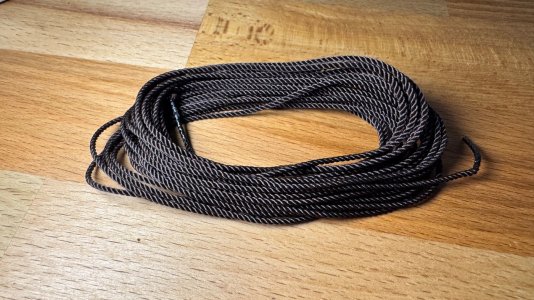
First rope made with a distance of 6.2 meters between Bok and Wein.
Weight 750 grams at 10% in first wind.
Gutermann E151 3x15 1.3mm rope
Finished rope measured at 4.83 meters. Which has surprised me. I thought I would have gotten at least 5 meters.
Maybe too much weight. I will try a bit less weight tomorrow.
The rope looks great. Just need an additional 20cm
Weight 750 grams at 10% in first wind.
Gutermann E151 3x15 1.3mm rope
Finished rope measured at 4.83 meters. Which has surprised me. I thought I would have gotten at least 5 meters.
Maybe too much weight. I will try a bit less weight tomorrow.
The rope looks great. Just need an additional 20cm

- Joined
- Jul 27, 2021
- Messages
- 687
- Points
- 403

Don't lessen the weight. It looks good. I would even use a bit more weight though  But that is a matter of taste I go from 1.75 cm to 1.45 cm approx ;-)
But that is a matter of taste I go from 1.75 cm to 1.45 cm approx ;-)That's the problem.
It's unclear what's going on.
You're still showing tiny ropes that don't have any problems on Domanoff's Planetary Ropewalk, and plenty of people do it, so where's the success?
This rope is 1.3mm, which is less than most 1/48 scale models use for basic rigging.
It's unclear what's going on.
You're still showing tiny ropes that don't have any problems on Domanoff's Planetary Ropewalk, and plenty of people do it, so where's the success?
This rope is 1.3mm, which is less than most 1/48 scale models use for basic rigging.

- Joined
- Aug 8, 2019
- Messages
- 5,874
- Points
- 738

6,2 meters between the hooks will give you rope between 80% and 70% length or less. How thicker how shorter.First rope made with a distance of 6.2 meters between Bok and Wein.
Weight 750 grams at 10% in first wind.
Gutermann E151 3x15 1.3mm rope
Finished rope measured at 4.83 meters. Which has surprised me. I thought I would have gotten at least 5 meters.
Maybe too much weight. I will try a bit less weight tomorrow.
The rope looks great. Just need an additional 20cm
View attachment 590402
- Joined
- Jul 27, 2021
- Messages
- 687
- Points
- 403
Kuba, what’s your problem? He couldn’t get results he liked with the Domanoff machine, which I personally don’t think is suitable for making good rope either, anyway it’s just a matter of taste – and yet you keep insisting. Surely you could just accept that. I don’t understand.
Just be happy for him that he’s happy now and is getting the results he wanted.
Just be happy for him that he’s happy now and is getting the results he wanted.
- Joined
- Jun 2, 2025
- Messages
- 345
- Points
- 238
So. Are you claiming that the PL4-4 can easily make 2 to 3mm ropes?That's why i'm asking because you're still making thin ropes, others have successfully used and making them on the Domanoff Planetary Ropewalk. A 2-3mm rope isn't thick, it's the normal size for working with the planetary Ropewalk. 2mm is not a thick rope...
I call small ropes as 1mm and less. You’re calling small roles upto 3mm. In scale form 1.3 and above in my books is larger rope.
That’s how I interpreted rope sizes. And how I will continue
- Joined
- Jul 27, 2021
- Messages
- 687
- Points
- 403
I strongly suggest stopping this discussion, just let us all be happy making rope
- Joined
- Jun 2, 2025
- Messages
- 345
- Points
- 238
Thank you. Very much appreciated.Kuba, what’s your problem? He couldn’t get results he liked with the Domanoff machine, which I personally don’t think is suitable for making good rope either, anyway it’s just a matter of taste – and yet you keep insisting. Surely you could just accept that. I don’t understand.
Just be happy for him that he’s happy now and is getting the results he wanted.
- Joined
- Jun 2, 2025
- Messages
- 345
- Points
- 238
Totally agree. But this guy was starting to go a bit too far.I strongly suggest stopping this discussion, just let us all be happy making rope
I don't want to argue. I refrained from adding the opinion i had prepared.Kuba, what’s your problem? He couldn’t get results he liked with the Domanoff machine, which I personally don’t think is suitable for making good rope either, anyway it’s just a matter of taste – and yet you keep insisting. Surely you could just accept that. I don’t understand.
Just be happy for him that he’s happy now and is getting the results he wanted.
But, he want truth...
Maybe you're the ones who are insisting and trying to hype him up, saying it's good, when the truth is a bit different?Totally agree. But this guy was starting to go a bit too far.
You even use Domanoff's table for rope diameters and thread thickness to make these ropes? He's the author, right?
Is this deliberately misleading people into thinking it can't be done on another ropewalk?Reading this thread, I'm simply deceived because it hasn't shown anything else that can be done on the Domanoff ropewalk.
Just as you think it's weak, i too can have my own opinion and not accept another solution.Saying something "can't be done" on a Domanoff treadmill and then doing essentially the same thing on another machine is simply hypocrisy. You can have your preferences and not like the machine – but presenting it as the absolute truth is a completely different matter
.
So far, it hasn't performed any better than a typical rope from a planetary ropewalk.
I understand that you have to keep an eye on your customer, but let's not exaggerate.
Perhaps it would be appropriate to say that this rope is bad, too melted on individual strands?
It has been tightened several times, as evidenced by the strand failures?
Let's give people honest information and freedom of choice, instead of imposing a single narrative.
- Joined
- Jul 27, 2021
- Messages
- 687
- Points
- 403
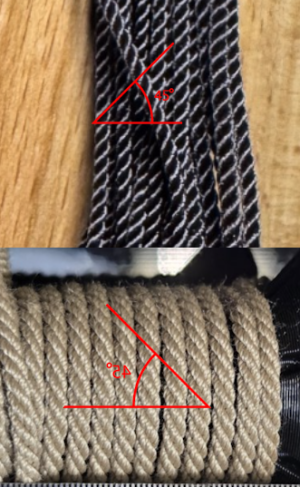
A good "sign" for "good" rope is the angle of the - I don't know the Englisch word, sorry, "Keep". It should be around 45 degrees for the usual hawser rope (there are special cases though!). If it's more then 45 degree use more weight and vice verse.
BTW Kuba your rope is left handed and as it not looks like a cable I am sorry to say not historical correct just change the motor direction
BTW Kuba your rope is left handed and as it not looks like a cable I am sorry to say not historical correct just change the motor direction
Maybe I'll explain it to you sometime in the future. I have a few private messages, i posted this on purpose.A good "sign" for "good" rope is the angle of the - I don't know the Englisch word, sorry, "Keep". It should be around 45 degrees for the usual hawser rope (there are special cases though!). If it's more then 45 degree use more weight and vice verse.
BTW Kuba your rope is left handed and as it not looks like a cable I am sorry to say not historical correct just change the motor direction
View attachment 590564
Thank you for writing this, I'm very grateful. You summed up the problem completely, which is something people don't believe me.
After all, a cable is just a rope. Literally and verbally.
Keep fooling yourselves

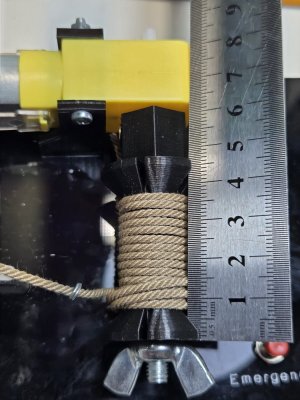
Look at this photo, the rope is wound in the opposite direction to the winding direction of the planetary ropewalk, the end is lying on the bottom, glued with CA glue, it is not even attached to the ropewalk.
It doesn't matter what I post, it doesn't matter what I write. The narrative is still one-way.
This rope has to have the right angle, it has to have the right name, it has to be the right color, and it has to be on this ropewalk.
Last edited:
- Joined
- Jun 2, 2025
- Messages
- 345
- Points
- 238
Looks like mine is perfect than. Exactly at 45 degree angle.A good "sign" for "good" rope is the angle of the - I don't know the Englisch word, sorry, "Keep". It should be around 45 degrees for the usual hawser rope (there are special cases though!). If it's more then 45 degree use more weight and vice verse.
BTW Kuba your rope is left handed and as it not looks like a cable I am sorry to say not historical correct just change the motor direction
View attachment 590564
I have some Ropes of Scale ropes and I can not separate the two. Both mine and ropes of scale looks the same.
Ropes of scale ropes is where I judge ropes . In my oppinion he is the master at making scale ropes. And to have my ropes look exactly the same is awesome.
I know I’ve done this right.
Being able to wind more than one yarn per thread. In this case 15 is a critical step in making rope.

A good "sign" for "good" rope is the angle of the - I don't know the Englisch word, sorry, "Keep".
The English word for the spiral grooves between the strands of a twisted rope is "cuntline."
- Joined
- Jun 2, 2025
- Messages
- 345
- Points
- 238
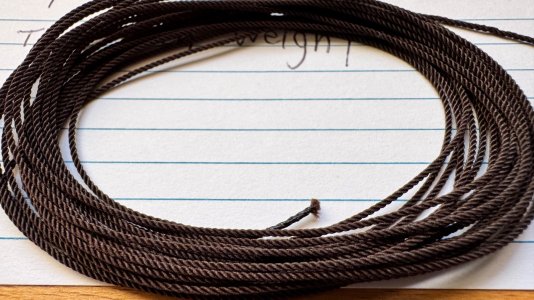
Made 1mm rope 3x8. Used 734 grams of weight on the Bok. Way too much weight. The end results do look good.
- Joined
- Aug 8, 2019
- Messages
- 5,874
- Points
- 738
Better use the word contline, that is more sophisticated to use and better translated by online translators.The English word for the spiral grooves between the strands of a twisted rope is "cuntline."

Definition of CONTLINE
the space between the strands on the outside of a rope; the space between the bilges of two casks stowed side by side… See the full definition
Better use the word contline, that is more sophisticated to use and better translated by online translators.
Definition of CONTLINE
the space between the strands on the outside of a rope; the space between the bilges of two casks stowed side by side… See the full definitionwww.merriam-webster.com
Real sailors got no use for sissified online translators! Talk like a pirate, not a girlie-man!

There's no such word as "cont." "Contline" is just some fooking cont's poor imitation of an Irish brogue!
It's all a legacy of Victorian prudery when tables had "limbs" instead of "legs." Real mariners use the proper nautical terms regardless of lubberly sensibilities. See: BOWDLERIZE: https://www.merriam-webster.com/dictionary/bowdlerize
Last edited:
- Joined
- Jun 2, 2025
- Messages
- 345
- Points
- 238
Here’s the latest. Made these this afternoon. One thing I’ve noticed is the thinner the rope the tighter I had to wind them.
1mm and 1.3mm ropes
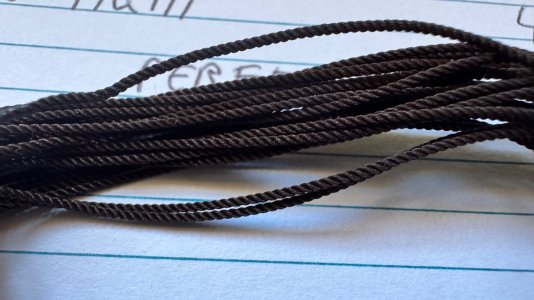
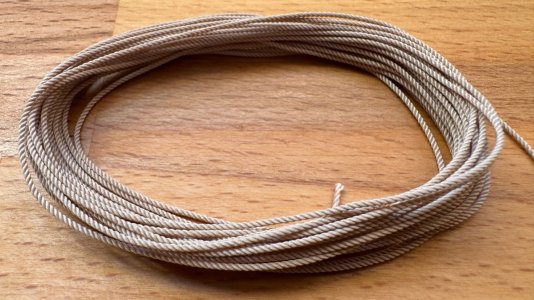
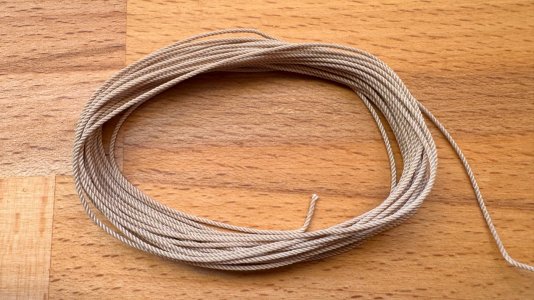
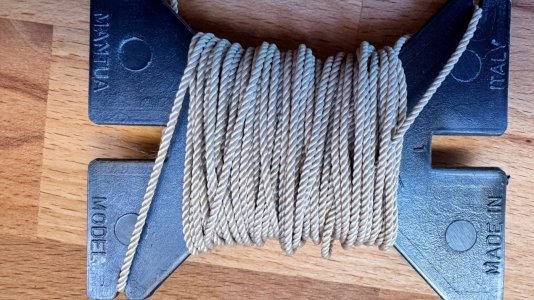
1mm and 1.3mm ropes