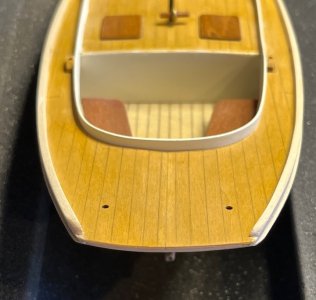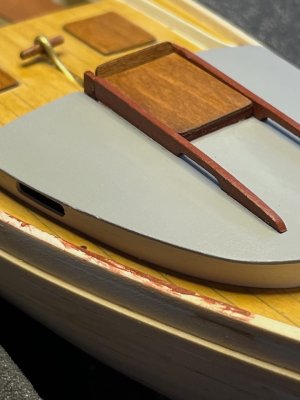

Muscongus Bay Lobster Smack from Model Shipways by DocTom - Build Log [COMPLETED BUILD]

Joined
Mar 19, 2026
Messages
98
Points
78

Location
Stockbridge, MA
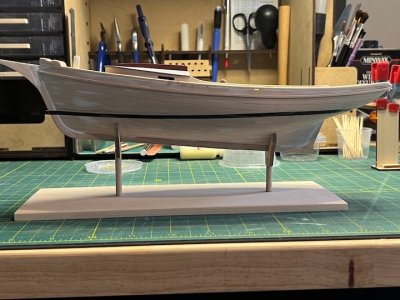
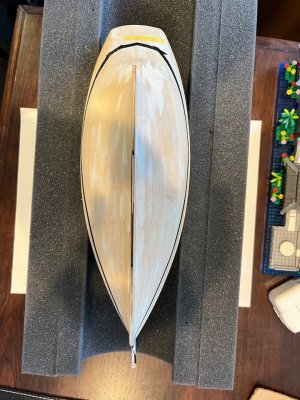
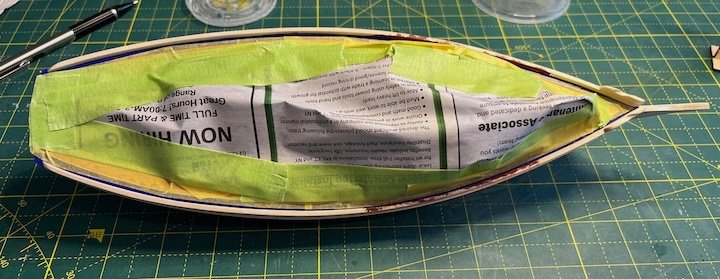
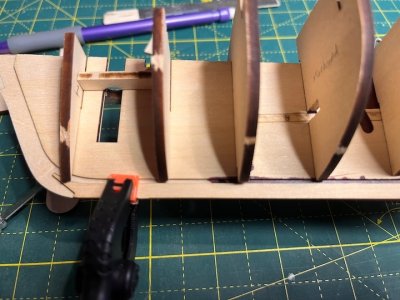
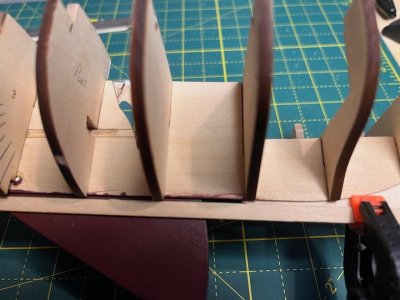
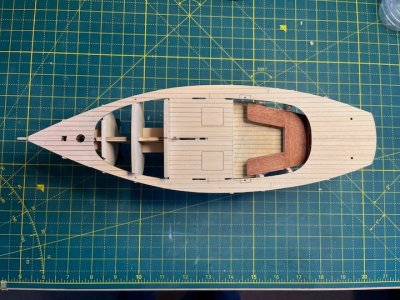
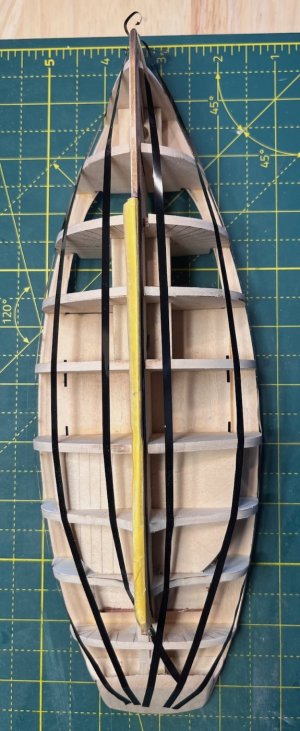
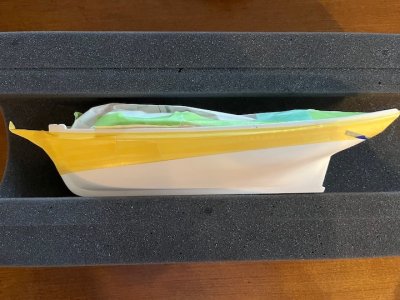
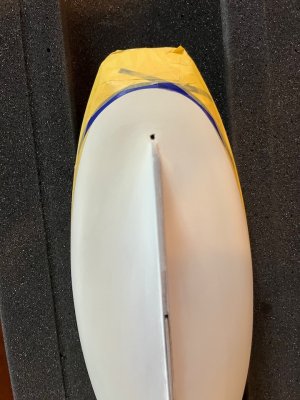
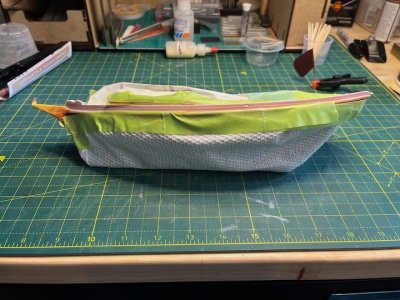
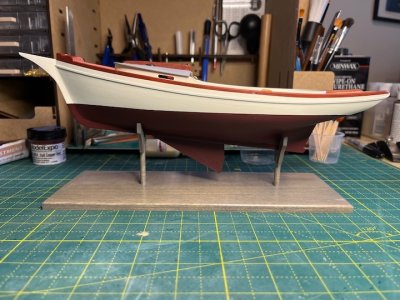
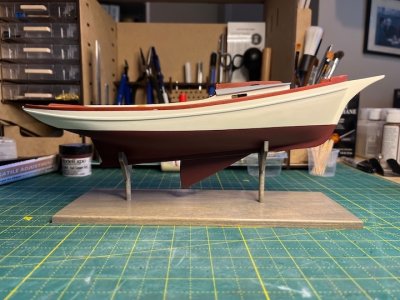
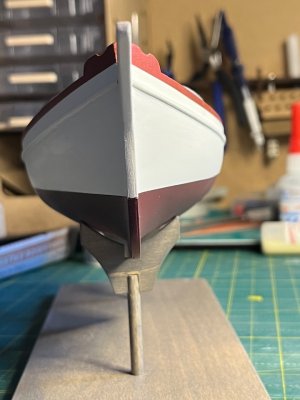
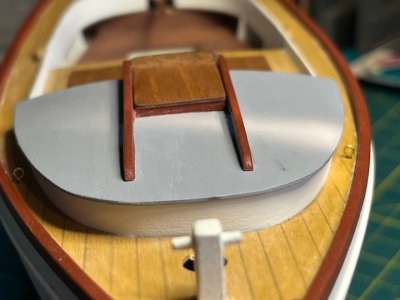
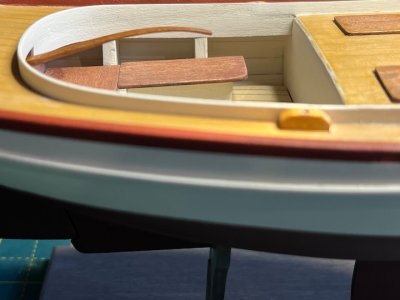
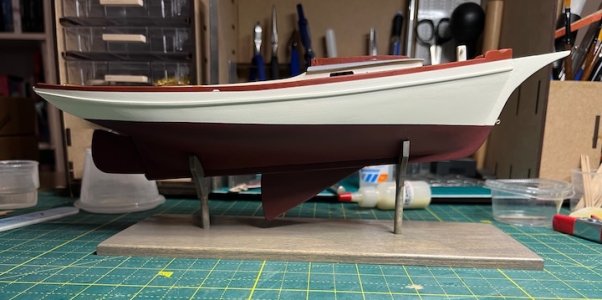
I am in the middle of building the lobster smack, my 3rd model. I was posting a build log on Model Ship World, now tragically gone. But you can't let the bastards win, so I continue here. I am at the point where I have started the process for priming and painting the hull. I started out by figuring where the water line should be. I used the plans in Chapelle's "American Small Sailing Craft" to try and figure out where it should lie. I think I came up with a good approximation.
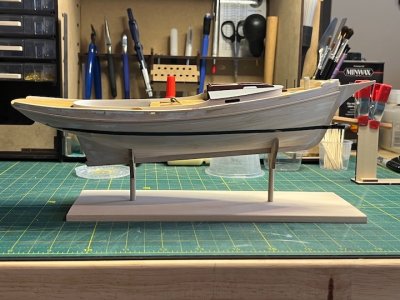
Starboard view.jpeg Port view.jpeg Bottom view.jpeg

I then masked off the deck

IMG_5052.jpeg

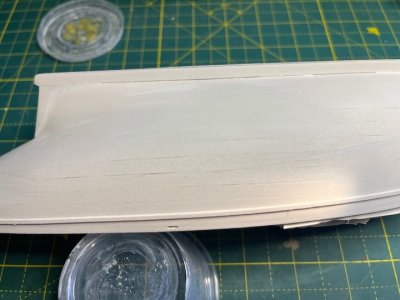
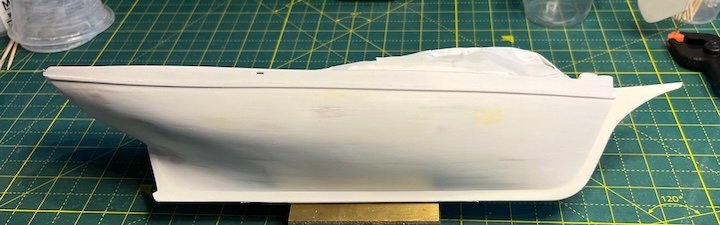
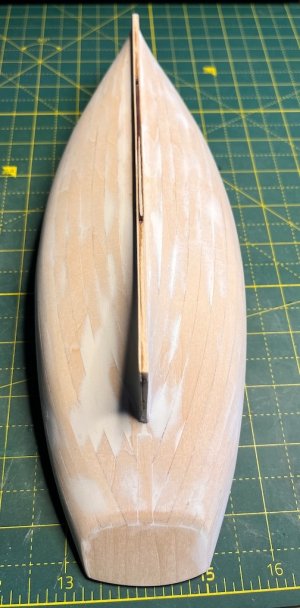
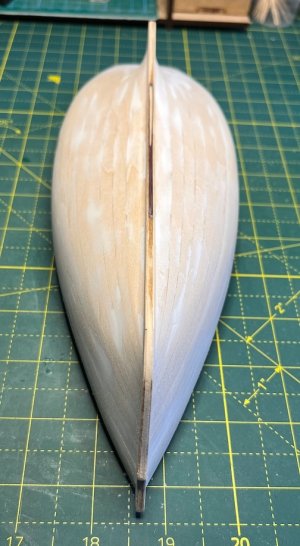
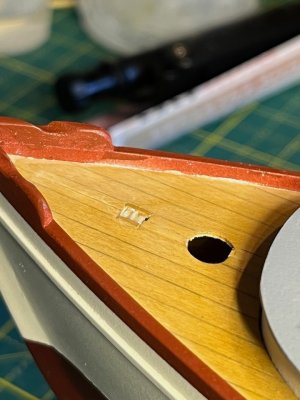
and applied the primer, oil-based from a rattle can. This revealed no major bumps or depressions, but many cracks - maybe from too aggressive sanding or beveling of the planks when I installed them? This was my first attempt at planking a POB hull, and I thought I had done a good job - amazing how some primer can humble the mighty!
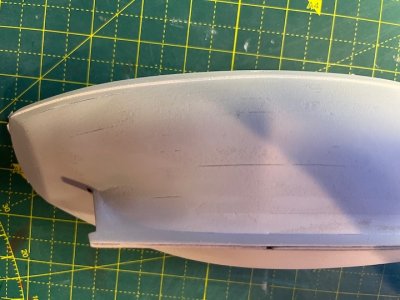
IMG_5053.jpeg

IMG_5054.jpeg

Next step is to fill them. I've been using Occre crack filler, but plan to experiment with Durham's Rock Hard Water Putty, to see if I like it better. I plan to airbrush the hull. I have never used an airbrush, so I've been watching YouTube videos between building sessions.

Any insights/critiques would be greatly appreciated. I'm here to learn
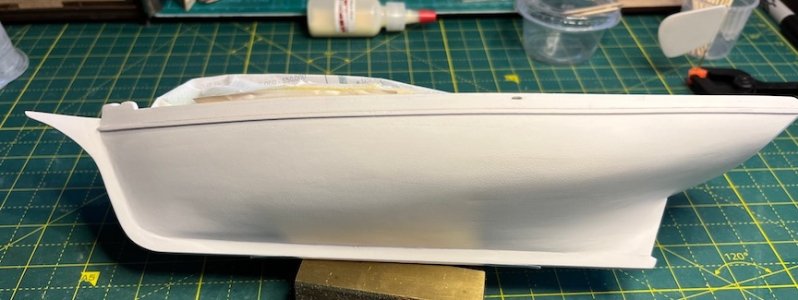
 
Post 2 - Priming finished.

A quick update. I used Durham's Water Putty for the first time, and really liked it. I found it much easier to work with than the Occre putty - much less crumbly, and it sanded and feathered beautifully. I think I will use it from now on. After filling and sanding, I applied a second coat of primer. The port side looked pretty good

Port primed.jpeg

Some imperfections, but I think it will pass the 3 foot test. There were still some issues on the starboard side, so I applied more Durham's and sanded

Starboard primed.jpeg

I'll give that another swipe with the primer tomorrow, and pracitce airbrushing while it drys. My plan is to use the Model Expo Warm White and Hull Red supplied with the kit, and do the toe rail in the Hull Copper Red. Overall, I'm pleased with how my first attempt at fairing and planking a hull has turned out.
 
Post 3 - Out of the Past

I thought I would try to recreate some of my build log of blessed memory, highlighting the issues and solutions I ran into that might be of help to someone else starting the Lobster Smack kit. I'll try to organize it by major tasks/areas of build. One thing I realized early on is that the model pictured in the instructions is not the model provided in the kit. It was clearly a prototype. Why can't they update the illustrations?

The central spine:
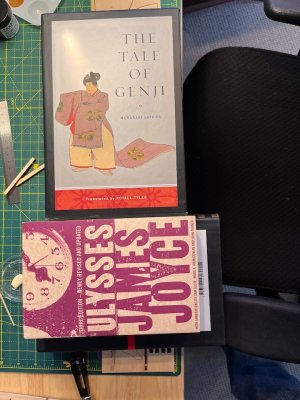
The first issue with the spine is that the pieces are very thin, and the water in wood glue can curl them. You need to weigh down the pieces as you glue them. I used the weightiest (in every sense) tomes I own
IMG_4711.jpeg

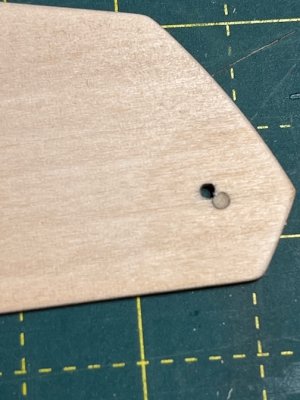
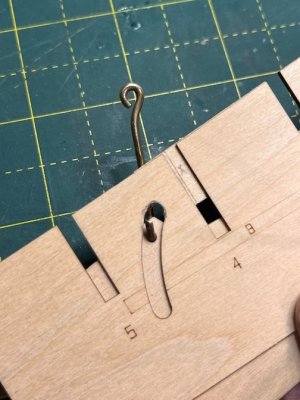
The other issue is that the pivot hole for the centerboard is incorrectly placed. There are several solutions to this. I decided to fill and move the hole, rather than widen the slot for the pull rod
IMG_4698.jpeg After holadjusment.jpeg

The bulkheads:
My major problem was that my bulkheads all seemed too big compared to images in multiple build logs.
1,2 & 3.jpeg

4, 5 & 6.jpeg

And it turned out they were. I contacted Model Expo Online, who sent me a replacement sheet. All the bulkheads were several mm shorter. By the time they arrived I had already glued and sanded down the bulkheads to fit.

The cockpit:
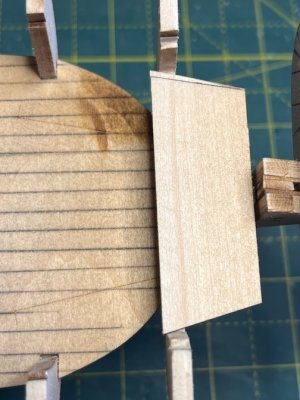
I tried my first attempt at kit bashing by scribing planks on the cockpit floor and deck. The main issue with the cockpit is the stern sheets are asymmetrical - clearly a fault with the laser cutting. I added a shim to the affected side, which isn't visible after I "stained" it with a thin wash of craft paint.
IMG_4779.jpeg Cockpit seating.jpeg

The deck:
Many build logs report decks that are too narrow, but mine was fine. I had to sand down the side of Bulkheads 3 & 4 where they protrude above the deck, and of bulkhead 2 to make space for the cabin walls.
Deck glued.jpeg

Fairing and planking the hull:

This was my first attempt at fairing and planking a POB model. This was one of the thinks that always intimidated me about wooden ship models when I was younger - How did people know how to shape the curves? What I discovered, which I have found true of many things about modeling, is that what seems intimidating and complicated in the abstract becomes obvious when you have the wood in your hands. In the end, I really enjoyed the process - probably my favorite part of modeling so far. It appeals to my obsessive tendancies, and I find sanding and checking very therapeutic. I didn't understand, though, just how much wood you have to remove. Even though I thought I did a good job, and checked with artists tape and planks

Checking the fairing.jpeg

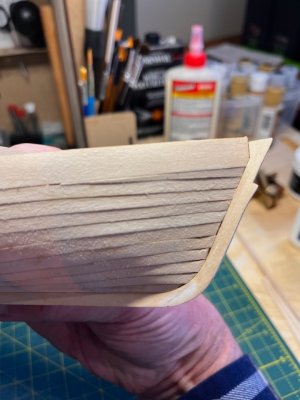
I still had to do a lot more fairing of bulkheads 1, 8 & 9 when I started test fitting the planks. Planking took me almost 2 weeks. I could manage one set of strakes a day. The biggest issue with the preformed strakes is that they don't quite cover the hull, unless you faired it exactly like the prototype. I had to add stealers at the stern and bow to get the shear strake even with the deck. The other option would be to add a 10th strake.
Starboard bow stealer.jpeg

Although the pictures make it look terribel, I was pleased with my first attempt at this process. After sanding and filling, it looked pretty good:

Filled and sanded (1).jpeg Frot view.jpeg

The coaming and cabin walls:

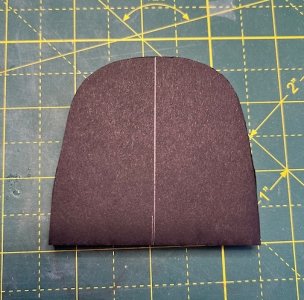
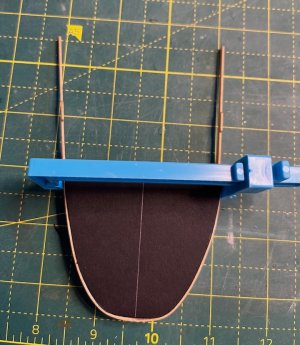
Adding the toe rails, rub rails and fairleads went according to instructions. Instead of forming the coaming and cabin walls on the model, I made forms from poster board, using the empty frets from the deck as patterns. I checked that my planking tool would not ignite the poster board!

Coaming form.jpeg

Bending Cabin walls.jpeg

They fit perfectly
Bow.jpeg
Stern.jpeg

I also "stained" the deck with a paint wash, folllowed by shellac.

The cabin roof and companionway:

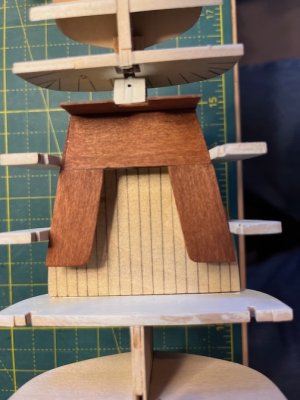
On my model the indentation at the aft end of the companionway roof was too deep. I added a shim to compensate. I also raised the sliding hatch cover by 1/8" so it looked a little less two dimensional. I also cut down the cabin bulkhead so the companionway hatch would abut the sliding hatch. I stain/painted the hatches and painted the rails with Model Expo Hull Copper Red.
hatch in place.jpeg

The beakhead:

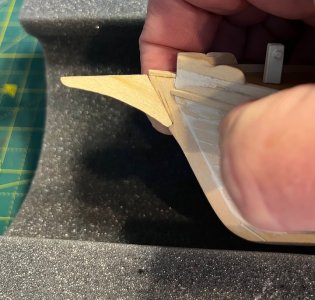
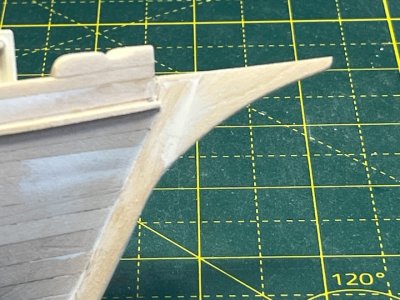
As I said in my original build log, my beakhead as provided was a sad and droopy thing:

Saggy beakhead.jpeg

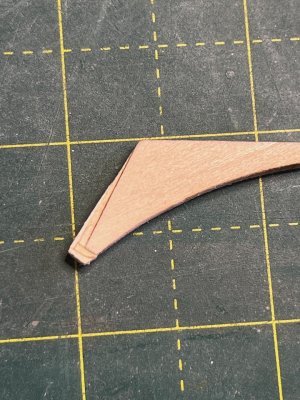
After mulling over options I elected to add shims to the bottom and rear

Shims and dry fitted.jpeg

which left it looking much perkier

Filled and sanded.jpeg

And that brings me back to the future.
 
Last edited:
Nice details. Documenting some of these issues is going to be invaluable for anyone building this kit in the future. It’s a shame that most of the logs for these three kits (the dory and the pram included) were lost in the MSW crash. I didn’t realize it was the single biggest collection of logs for them.

I don’t remember if you mentioned it in your other log, but how did you finish the deck? If I recall, you used an acrylic wash, it almost looks like a dory buff.
 
Post 4 - A Quick Update

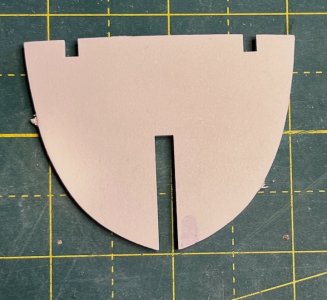
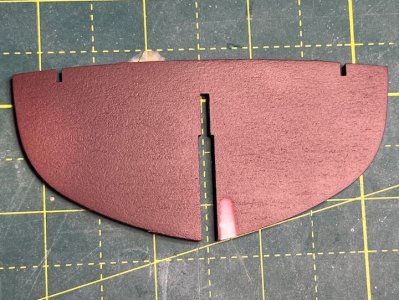
I've spent the past 5 days teaching myself the rudimentary techniques of using an airbrush. Lots of YouTube videos (Modelkit Stuff has a very helpful playlist) and lots of experimenting with different paint mixtures and air pressures. As a result, I've gotten very good a cleaning my airbrush! I bought an Iwata Eclipse CS (based on a recommendation from one of my fellow modelers on MSW), a Gaahleri Serenair table top compressor and a portable spray booth. Started off practicing on paper and cardboard with leftover paint from my Dory build. However, I wanted to test the two paints I will be using on my model, Model Expo Warm White and Hull Red. I have an extra set of bulkheads for the kit, so I primed and sanded two of them for a test run. I started off thinning them far too much, based on all the advice on YouTube. After much trial and error I ended up diluting the paint about 2:1 (two parts paint to one part water) with some flow improver thrown in. The results:

Warm white.jpeg


Hull red.jpeg

I think they came out pretty well, and I feel ready to put some paint on my smack tomorrow. This was the first time I ever used an airbrush, and I think I will enjoy using it, although I will clearly need to upgrade the compressor at some point.

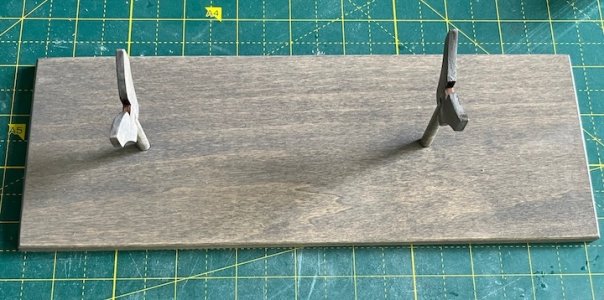
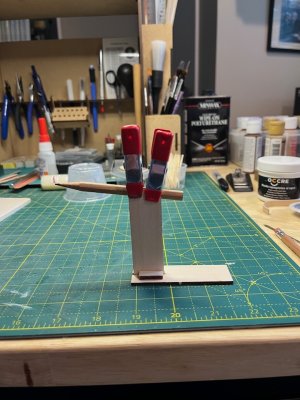
In between airbrush sessions I managed to make my base.

IMG_5064.jpeg

That's it for now.
 
Maybe jumping in late, find the cracks inevitable because the bulkhead is curved and the plank face flat.

Filler can fill the crack, and the wood grain, leading to an uneven finish - wood has grain - filler does not. So minimize filler on the face of the plank by applying masking tape along the crack.

Put a glob of filler on wax paper, Take thin slices with an xacto blade and fill the cracks. Remove the tape, and a light sanding should do the job.

I embrace some small cracks, they let the viewer know the model is made of wood. Once showed my mom a fully filled in, primed and smoothed, then painted hull, she asked if it was plastic.

Find cracks are less visible when the hull is stained.

Your work is nice. Thanks Tom.

-Rich
 
Post 5 - Painting the hull

I spent the weekend painting the hull of my smack in between garden chores. After spraying on the Warm White and letting it dry for 24 hrs I marked the waterline using the jig provided in the kit.

The jig (1).jpeg

This turned out to be the hardest part of the whole process. I had determined where the waterline should be on the hull before I primed it, based on the plans in Chapelle's book "Small American Sailing Craft," so the jig was at the appropriate height, but no matter what combination of rubber bands, shims and masking tape I tried, I couldn't get the model to sit level and stay still in the display stand. I finally ended up keeping it in a fixed position with one hand while scribing the line with the other. I measured the distance from the top of the toe rail to the waterline at several points to make sure it was symmetrical. I used Tamiya 5 mm tape for most of it, and 3M 3mm tape for the curve at the stern. Ended up with what I think is a close approximation of Chapelle's plan:

Maked off for painting lower hull.jpeg

stern (3).jpeg

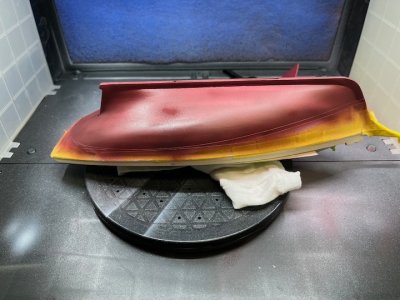
I then applied the Hull Red

In the spraybooth.jpeg

I masked off the lower hull so I could paint the toe rail with the Hull Copper Red I had used on the sliding hatch rails. I again measured from the top of the toe rail at multiple points to make certain the masking was an even 3mm below the top of the rail.


Maked off for toe rail.jpeg


After I nervously peeled back the multiple layers of tape, newspaper and paper towel I found this:

Port.jpeg

Starboard.jpeg
bow (1).jpeg
Stern (2).jpeg

I need to do some touch up on the stem, and on inside of the toe rail, mainly at the bow where I just didn't spray it thoroughly.

touch up needed.jpeg

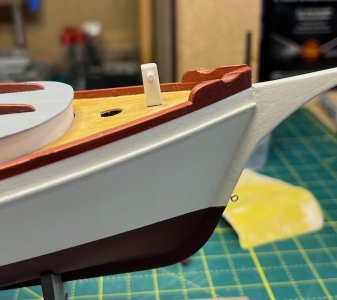
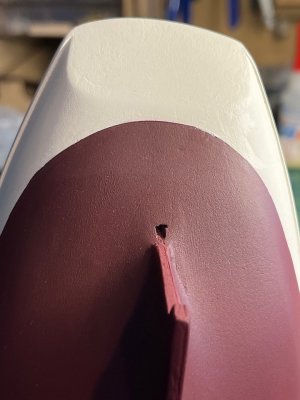
As you can see, I also managed to break off the samson post, again! I think I will have to either drill hole for a metal pin, or ream out the hole and start over with a piece of hardwood - that probably makes more sense. As per instructions, I also remembered to pant the rudder!
rudder (1).jpeg

This was my first time using an airbrush, and my first time painting a hull with two colors. I have to admit to being very pleased with myself! Once I figured out how to thin the paint properly (about 2 parts Model Expo paint to 1 part water with a few drops of flow improver) I found the airbrush quite easy to use. The whole process seemed very intimidating before I actually tried it, but now I feel I have overcome another of the mental hurdles I had created for myself, and have a new skill that will improve my modeling.

Now that I'm almost done painting, I get to go back to making things
 
Post 6 - Hull Stuff
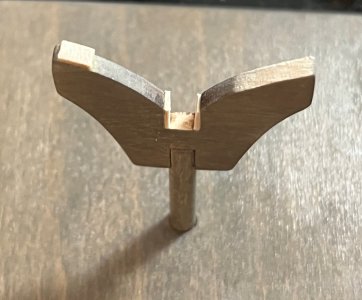
I spent the morning touching up the paint on the toe rail and stem. I then re-attached the samson post. This time (the third) I drilled two holes in the bottom of the samson post stump, and inserted the business ends of 2 brass pins that I had cut down. I pushed these into the remains of the tab in the deck to anchor it while the CA glue dried. I also inserted the bobstay eyebolt.


Samson post reattached.jpeg

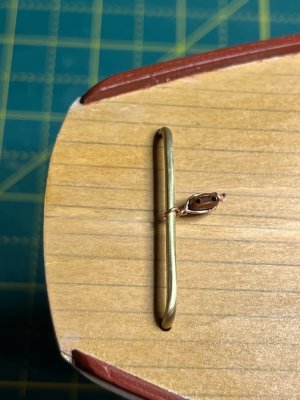
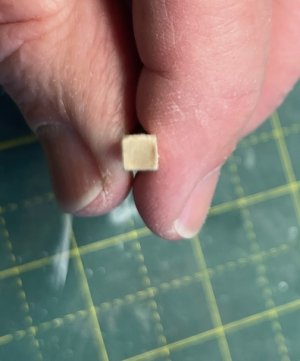
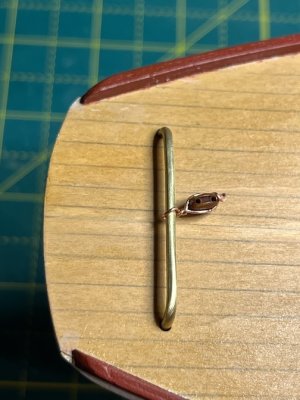
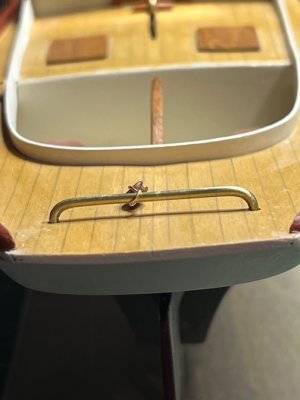
I then glued the hull to the stand using CA glue (I maybe should have used epoxy). After that, I annealed the brass rod for the traveler. Of course, the pattern supplied in the instructions is too short. When I built the Norwegian Pram, it turned out the printed instructions were shrunk about 3% from the originals; if you printed out the online instructions they were full-sized. I presume the same is true here. I didn't check, because you can measure the size needed from the holes in the deck. I bought 5 mm blocks from Syren Ship Model Company to try on this build. They are about the same size as the supplied blocks would be if you sanded them down. I used the brass rod to form the loop, but it was a bit tricky to get the block stropped. Not perfect, but OK. There's got to be something better than copper wire that you can use for this.

Traveler.jpeg traveler stern view.jpeg

Next came the fairleads,
fairleads (1).jpeg

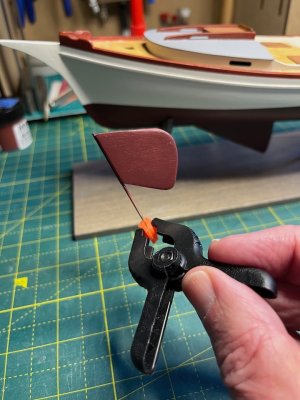
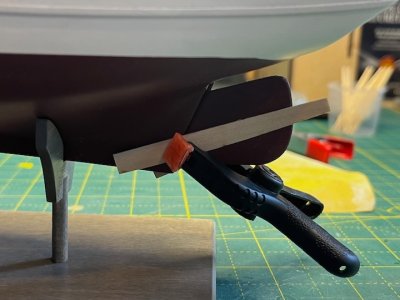
followed by the rudder and tiller. I cleaned up and rounded the tiller per instructions, and paint/stained it using Art Deco Espresso mixed with a little Hull Copper Red. I clamped the rudder in the centerline while I attached the tiller.
steady as she goes!.jpeg

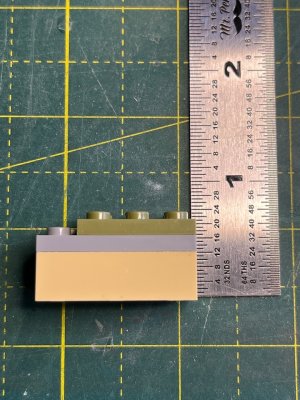
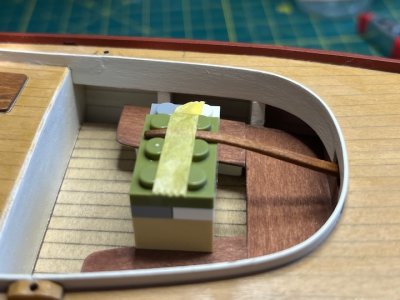
The instructions call for a block of wood 5/8th inches high to rest the tiller on while the glue dries. I didn't have one, but luckily, I also build Legos, and two Lego plates on top of a Lego block are exactly 5/8th inches high!

5-8ths.jpeg

I somehow managed to get the tiller glued to the rudder post on my first try. I used CA glue.
Gluing (1).jpeg

It looks good, and works.
Tiller.jpeg

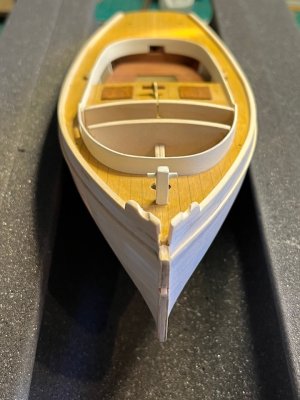
So here's how she looks at present

IMG_5092.jpeg

Fairly elegant, I think.
 
Post 7 - Bow Stuff

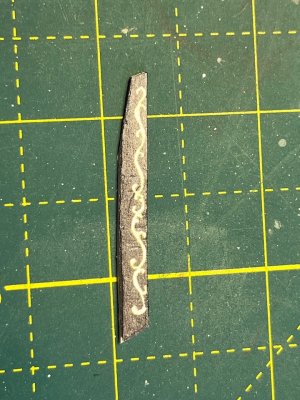
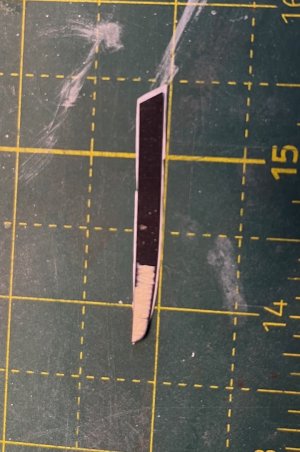
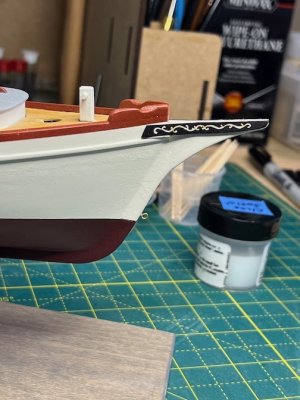
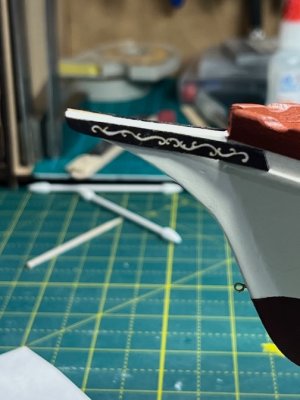
I follow a YouTube channel called HillBilly Modeler. He is an expert plastic modeler who is making his first wooden ships with these Model Shipways kits. He has quite detailed videos of every step of the build. I watch them before I move on to the next mini-project. He ended up hand painting the scroll work on the trail boards, because of the mention in the manual that the appliqué ink might run when glued, and his concern that the paper would wrinkle when bent. There is no way I was going to paint the scrollwork, so I used the appliqués. I started off by doing a proof of concept. I printed out page 2 of the manual, cut out a scroll, "painted" a scrap piece of thin wood black with a sharpie (afraid that paint would curl it), glued the appliqué, and gave it a coat and Model Expo Clear Satin. I then test fitted it on the model. It worked! No smearing, no wrinkles.
Proof of concept.jpeg

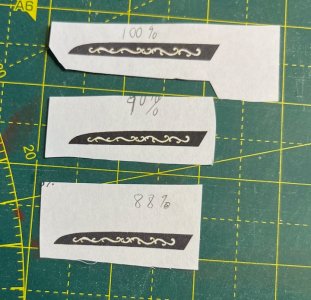
The major issue with using the appliqués is that they are too large for the trail boards. After measuring the appliqués and the basswood, the basswood pieces are 88% as long as the appliqués. I used my printer to print out page 2 at 90% scale, so I'd have some wiggle room.
Size matters.jpeg

I trimmed one down and glued it to the trail board
Pinting with marker.jpeg

I then trimmed the excess off with a fresh Xacto blade, and touched up the edges with my Sharpie. After that, onto the model. After I made sure it would all work, I did the other side.
Trial boards port.jpeg Trail boards starboard.jpeg

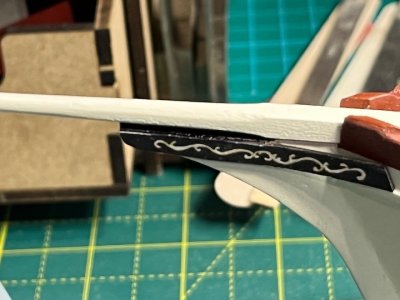
The instruction manual has a cryptic exhortation to paint the top of the beakhead. From the pictures, it looks like it is painted black starting with the octagonal portion of the bowsprit, so I did that.

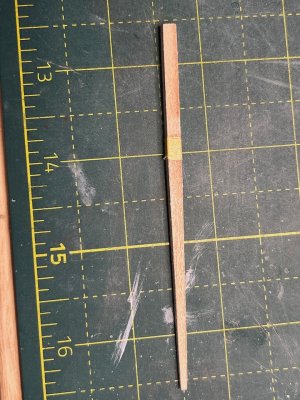
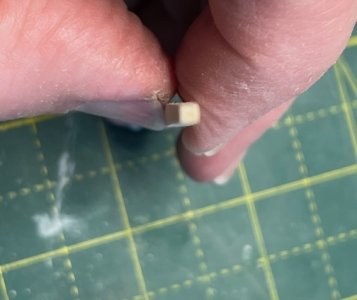
Turning to the bowsprit, the manual has you taper the outer portion until the end is square. What they don't say is that the un-tapered inner portion also needs to be square, and the supplied piece is rectangular. After marking the bottom, I sanded off the sides until it was square (4mm at the aft end, 2 mm at the forward end).
Square butt.jpeg Square butt.jpeg

I then placed some tape at the junction between the square and octagonal section. I tried to use the 7-10-7 guide provided, but it was all too small. I ended up re-using my spar jig from the pram, and just sanded off the corners until it looked octagonal. I then rounded off the end (also taping off the transition). I found it easiest to spin the bowsprit with one had while pinching sandpaper over the end, rather than putting it in a vise and rubbing sandpaper over it. I decided to paint it Warm White, taping off the bottom where it would contact the deck.
IMG_5106.jpeg

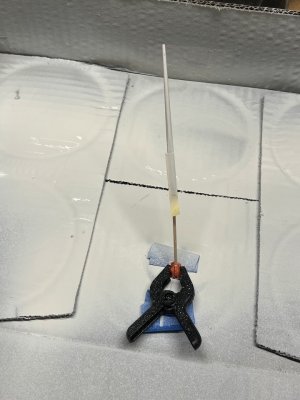
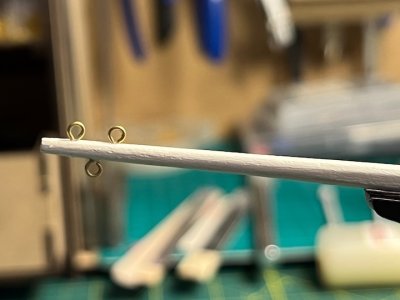
Eyebolts came next. I forgot to drill the holes before I rounded the spar, but it worked out. I marked the location of the holes off the plans. I only drilled one of the holes all the way through! Used a 0.7mm bit. The supplied eyebolts are very easily bent. Fixed them in place with CA glue.
eyelets.jpeg

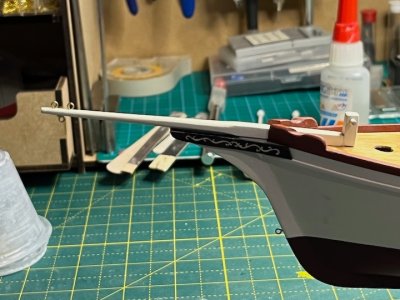
I had to sand my fairleads a bit to get the bowsprit to fit. I scraped the shellac off the deck to give the glue something to grab. The result:
Bowsprit installed.jpeg

You can see where I painted the beakhead black:
painted beak black.jpeg

Overall, she's looking pretty ship shape.
Ship Shape!.jpeg

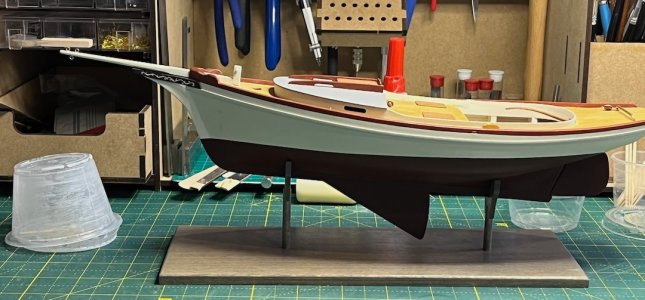
One thing I am going to have to do is afix her more firmly to the stand. The points of contact are scant, and I'm afraid she will come off while handling her during rigging. HillBilly Modeler drilled holes in the stand and inserted brass pins. I may need to do something similar, or try to shim the stand so there is more contact with the hull.

That's it for now. Thanks for taking a look.

Squared off.jpeg

Square end.jpeg
 
Post 8 - Two steps backward, one step forward.

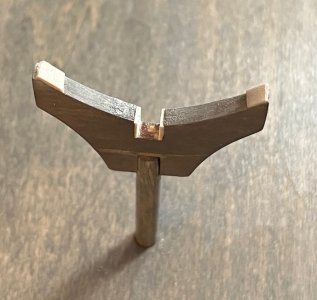
As I anticipated, the model came loose of the stand. There just weren't enough points of contact for the CA glue to hold. I should have realized this when I did it, and once again got bitten in the rear end for rushing. After mulling options, I decided to add some shims to the slots for the keel, and to the tops of the brackets to get more contact
Front stand.jpeg
Rear stand.jpeg

I stained the edges of the shims, and used 5 minute epoxy to glue the model back on, with a level to keep her, well, level. Much more secure situation.

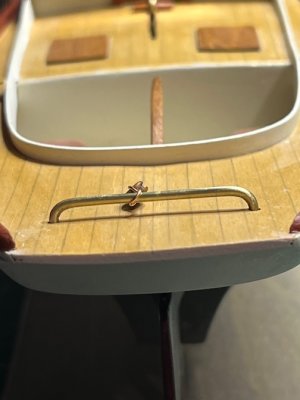
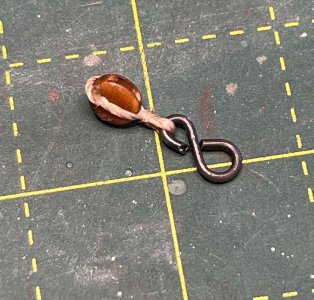
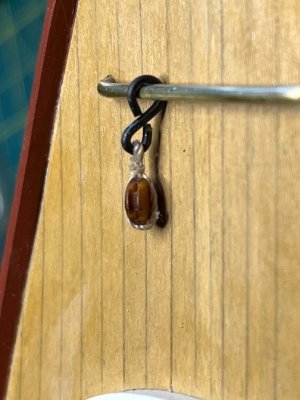
While I was in the mood to redo things, I started to think about the traveler block, as I was unhappy with the copper wire stropping. I stumbled across Chuck Passaro's tutorial on stropping blocks with thread, which seemed doable. I wasn't sure how to handle the loop around the traveler bar. I assume the original smacks had some type of thimble. I posted a query in the Masting, Rigging and Sails forum on MSW, and got great responses. I borrowed JacquesCousteau's example, and made an S hook from 19g pre-blackened steel wire (what a find!) and stropped my 5 mm Syren block with 0.5mm tan thread left over from my Pram, following Chuck 's instructions.
Stropped block.jpeg

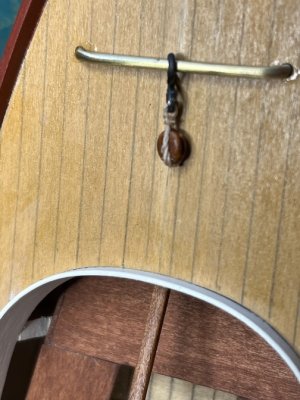
The plans call for 0.7mm rope, and I had to widen the holes with a broach for it to thread through. I then removed the traveler, added my new, improved, block, and reattached.
In place.jpeg Looks better.jpeg

I'm much happier with the result, compared to the copper:
Traveler.jpeg traveler stern view.jpeg

I plan to do the rest of the blocks this way. Should give me good practice for manipulating thread and tying knots with tweezers.

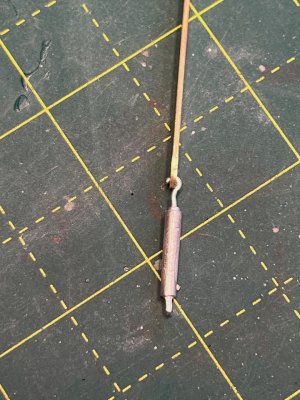
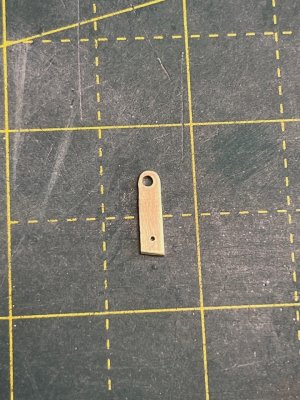
After retracing some steps, I moved ahead with the chainplates. I used my Proxxon rotary tool to round the end of the annealed brass, and then drilled a 53g hole for the turnbuckle and a 70g hole for the pin using my Proxxon drill press. I then checked to make sure a turnbuckle would fit in the chainplate

Testing fit of turnbuckle.jpeg


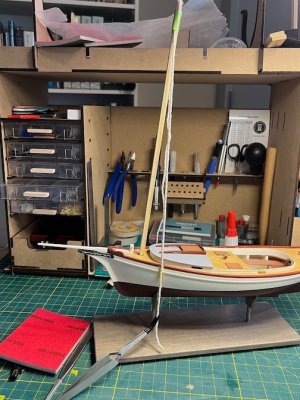
I then created the "jig" using a square dowel and butcher's twine
IMG_5124.jpeg

I marked off 2.25 inches from the end of the port trail board and marked it with a piece of Tamiya tape:
Te jig.jpeg

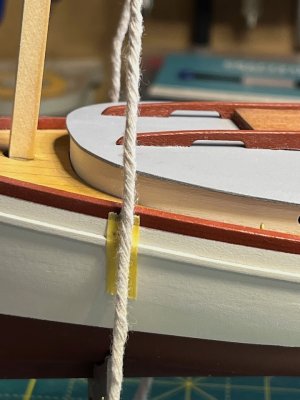
I taped the brass strip with the chainplate on the end at the correct angle, marked and then snipped the bottom. It will now hopefully sit flush against the rub rail
Chainplate Port.jpeg


I'll work on the starboard side tomorrow, and hopefully center the holes better! Will also need to clean the flashing off the cleats. Any recommendations on how to do that?
 
Hi Tom,
A general question: is there a reason why the ropes aren't waxed?
To me, they look a bit fluffy.
By the way, your ship looks absolutely stunning!
 
Thanks for the kind words. I just forgot to wax the stropping, although I have read that some modelers don’t do it because it can attract dust. The ropes attached to the mast are just temporary, to mark the angle of the chainplate.
 
Thanks for the kind words. I just forgot to wax the stropping, although I have read that some modelers don’t do it because it can attract dust. The ropes attached to the mast are just temporary, to mark the angle of the chainplate.
OK, thanks Tom, that makes sense. So there can be practical reasons why others don't wax. I have yet to start my ship, but I’m going to do some tests with different types. In the past, an antiquarian tipped me to treat antique cast iron items with shoe polish. This was to prevent rust and it could be buffed to a beautiful shine. I might run a test with that later on.
 
Back
Top