



• Win a Free Custom Engraved Brass Coin!!!
    As a way to introduce our brass coins to the community, we will raffle off a free coin during the month of August. Follow link ABOVE for instructions for entering.
  • PRE-ORDER SHIPS IN SCALE TODAY!

    The beloved Ships in Scale Magazine is back and charting a new course for 2026!
    Discover new skills, new techniques, and new inspirations in every issue.

    NOTE THAT OUR FIRST ISSUE WILL BE JAN/FEB 2026

Prins Willem V.O.C 1651 from Corel.

Hey Heinrich.
I'm not stopping the log for real it was just a bad joke. I'm just angry about corel for ther bad drawings. I know it's a learning process but taking the hole hull apart and replank the hole ship?
And I know that all of the people on the forum want to help me.
So I'm absolutely not angry about them.
In a couple of weeks I finished the airbrush clinics and can reset my shipbuilders mind. ( it a Christmas present from my best friend who is a artist in airbrushing) Then I can start with a fresch mindset. So the PW has to wait a little while before I smash it against the wall ROTF( joke again).

For all of you guys.. thanks for trying to help me.
Re-plank the whole hull? Oh no. Just the section that has the problem, the area that has the hard bend, and 1-2 frames forward and aft of that. It's a patching process. When you are ready to begin this process, we can step you through removing a section of the hull without disturbing the rest of it, adding balsa blocks between the frames of the problem area, sanding those to shape, and re-planking the area to form a new shape for the bow.

We understand the disappointment that comes with learning that the instructions have gaps in the process of building. EVERY kit has that problem. It's something no one tells you when you start building wooden model ships. In plastic model ship instructions, you aren't told where and how to use filler to hide seams or use airbrushing in layers to achieve a professional level of color, detail, and weathering. The pitfalls in wooden ship kits are totally different, and act as pit traps for the new builder. One of the greatest purposes of this forum is to help guide builders through the process of learning the techniques not taught in the instructions. All of us here have had to stop a project that has jumped the tracks and rework a part of the ship or rigging. The question becomes, do I have the patience to learn how to back up and rework something? Do I have a strong enough desire to overcome huge setbacks, and recover? If these models were easy in this regard, there would be a lot more of them. Like Heinrich said, the model teaches you more about yourself, your strength of will, and your patience to work through tough problems doing something you have never done before. If you can work through an entire build with devotion to research and problem solving, you will not have a greater fan base than the fellow builders who are here on this forum, because we are all on that same ladder of learning at different levels, all climbing slowly ever upward.
 
Hello everybody,

It was a long time ago that I was active on the forum. I was busty with other projects. I made a diorama of a Indian god and a couple of plastic kits.
I bought a 3D printer and that cost me some time to learn this.
The Prins Willem was a forgotten project.
But a couple of weeks ago, I was visiting @Steef66 and I brought my PW with me. We looked, and talk about the ship and what was the best option to restore it.
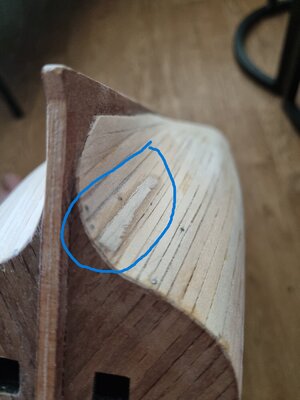
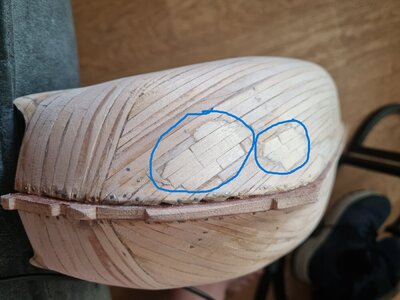
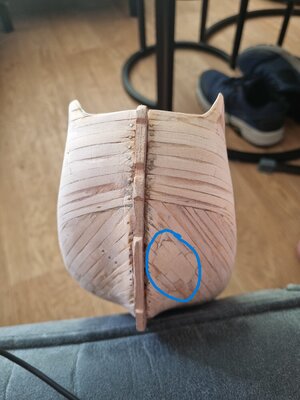
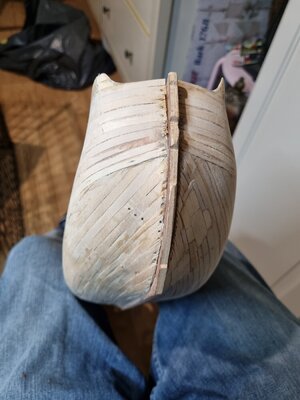
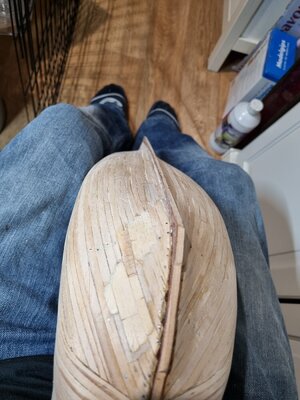
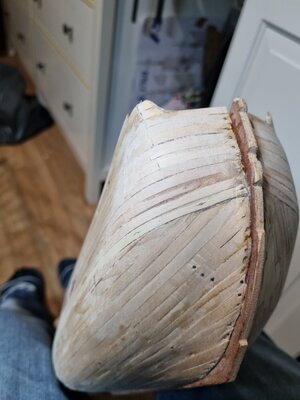
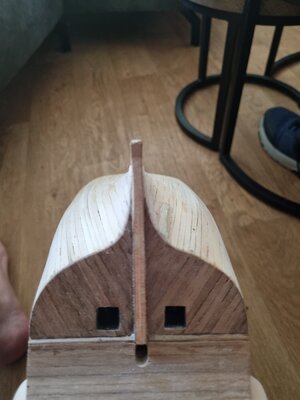
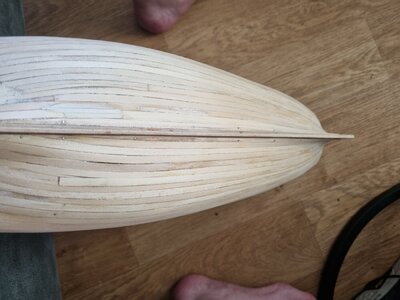
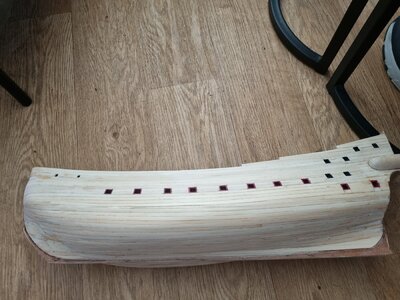
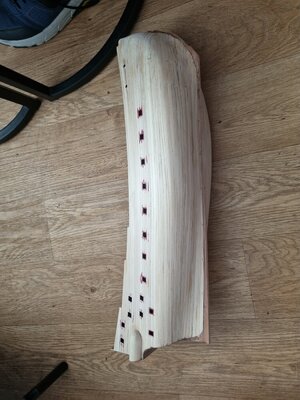
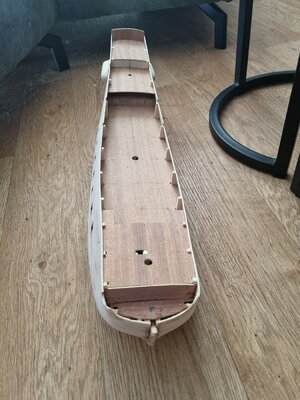
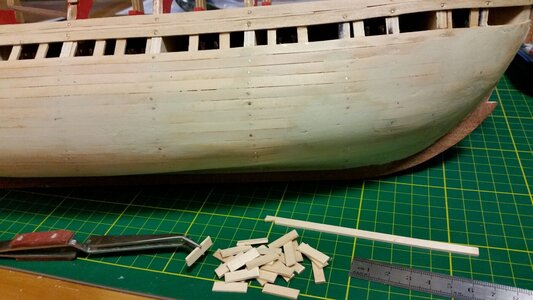
There were a couple of spots that need some attention. We mark the spots, and when I was back home I repaired this spots with the same wood. Sanded The wood down and this is the result. It's not a very nice view, but there comes a 2nd layer of wood on top.
17a.jpg19a.jpg21a.jpg

All the other oddities I closed with Wood glue and sawdust. And sanded the hole hull

2.jpg3.jpg16.jpg18.jpg20.jpg23.jpg2.jpg

I

24.jpg

26.jpg
 
Last edited:
What the first layer of planking looks like doesn't matter as long as the hull form is smooth with no hard bends or flat spots where there shouldn't be. After you add the final planking veneers, all the patchwork and filler will not be visible. Take lots of time filling in flat spots and sanding the filler to fair it into the curves of the hull. This model is perfectly workable.
 
Last edited:
Hello Dirk, I for one am very happy to see you back on the forum and busy with the Prins Willem again. There is nothing that beats the help of an experienced modeler. I am very happy to hear that @Steef66 Stephan helped you to close the hull. Now you have a solid base from which you can continue!
 
Real good job Dirk, looks real great. Like I said before.

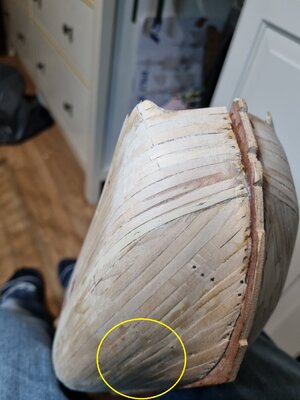
On these pictures I see something I didn't see on whatsapp.
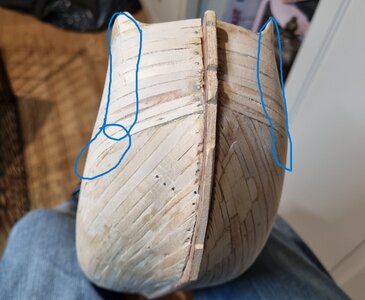
Just give a little bit attention to the bottom (yellow marking) because I see some planks lying lower then the next to it. Just sand it down to same high. It is better when you put your next layer of planks on it. When the glue is dry after the second layer, on these spots there could come bubbles in the planking (because there was a bad glue connection). The Newport I'm making came to me with these bubbles under the planks, that's why I redo the planking on it.

16.jpg

Also there where the first layer hits the keel needs always attention. Make sure that the transition to the keel is seamless. This will be save a lot of work on the second layer.

The best way to see if planks are on the same high is when you hold the scraper on it, you see the light under the blade on places where it needs some attention.
 
Real good job Dirk, looks real great. Like I said before.

On these pictures I see something I didn't see on whatsapp.
Just give a little bit attention to the bottom (yellow marking) because I see some planks lying lower then the next to it. Just sand it down to same high. It is better when you put your next layer of planks on it. When the glue is dry after the second layer, on these spots there could come bubbles in the planking (because there was a bad glue connection). The Newport I'm making came to me with these bubbles under the planks, that's why I redo the planking on it.

View attachment 324582

Also there where the first layer hits the keel needs always attention. Make sure that the transition to the keel is seamless. This will be save a lot of work on the second layer.

The best way to see if planks are on the same high is when you hold the scraper on it, you see the light under the blade on places where it needs some attention.
I agree Stephan. I would use a coarse grit sandpaper (I use 80) and sand cross-grain at an angle of approximately 45 to 60 degrees to eliminate the highs and lows of the first layer.
 
Just give a little bit attention to the bottom (yellow marking)
It's rare to say, but when I look at it from here it looks smooth but feels bumpy.
Alot of gaps I closed with woodglue and sawdust and then sanded it.
It looks like shadow between the planks but is't closed and Smooth.

In overall of the hull I will do it again with the scraper knifes. This works verry fast and finished everting smooth as a mirror.
Thank for the tip.Thumbsup

Also there where the first layer hits the keel
Thumbsup


Hello Dirk, I for one am very happy to see you back on the forum and busy with the Prins Willem again
Thank you. I have some other project that pays my attention so I won't post every week on the forum.
I have 2 dioramas to build so my time on the Prins Willem is limited. :(
But the fun is back and I'm happy building again.:D
 
the hull form is smooth with no hard bends or flat spots where there shouldn't be.
There were some hard bends but with a scraper and some sandpaper I limited them to a minimum.
Better then this I can't get it because the wood gets to thin and will crack.
Thanks for the tips
 
There were some hard bends but with a scraper and some sandpaper I limited them to a minimum.
Better then this I can't get it because the wood gets to thin and will crack.
Thanks for the tips
Aside from sanding the planking to half its thickness and risking puncturing the hull, the only other option at that point is to add filler to either side of the high spot and fair the whole area into the overall hull shape. If that isn't enough, then the frames themselves are too far out of shape. With the first planking, you can still take the extreme measure of cutting the planks between a set of frames, shim and reshape the frame edges, then patch over the gaping hole with plank strips, re-sand and fair the patch, and finish waves and dips with filler. An extreme case like this should have been detected much earlier, but a beginner can sometimes mis-shape frames when fairing them and end up with a problem he or she thinks is unsolvable. A mistake like that is a valuable learning experience, in addition to being a royal pain in the ass. ANY shape or structural problem at this early stage can be corrected with sticks, glue, sanding blocks, and PATIENCE. If you have problems with hull shape AFTER final planking, THEN you have a real problem.

ARRRRRrrrrr!!!! Pirate Flag Ship-1
 
Last edited:
It's rare to say, but when I look at it from here it looks smooth but feels bumpy.
Alot of gaps I closed with woodglue and sawdust and then sanded it.
It looks like shadow between the planks but is't closed and Smooth.

In overall of the hull I will do it again with the scraper knifes. This works verry fast and finished everting smooth as a mirror.
Thank for the tip.Thumbsup


Thumbsup


Thank you. I have some other project that pays my attention so I won't post every week on the forum.
I have 2 dioramas to build so my time on the Prins Willem is limited. :(
But the fun is back and I'm happy building again.:D
You want the hull to appear bumpy (because of all the color variations) but feel like smooth glass before you put on the final planking. This is the parts where you fill, sand, inspect, fill, sand, inspect, fill, sand, inspect, fill, sand, inspect, fill, sand, inspect, fill, sand, inspect, fill, sand, inspect, fill, sand, inspect, fill, sand, inspect, fill, sand, inspect. you get the idea. Work patiently. If you don't, your hull will look bad.

Don't worry about the gaps. Fill them. This hull is glass smooth after sanding with 80, then 100 grit, and this is the second to the final filling pass. I found a couple more flat spots using sunlight to reveal them. It LOOKS bumpy because of the colors of the green filler and wood, and the variations in thickness of the filler. But if you close your eyes, it feels like a baby's butt. Your hull will look similar. It will surprise you how much area filler will need to cover, but don't let that discourage you. You won't see it later. You can see how random the low spots were, where the filler is thickest and the wood planking completely hidden. The brass pins were sanded flush since digging them out with the tip of a razor knife proved unnecessary. Small depressions made by pin heads have no effect on the final planking, and most were filled.

There were small bends at different angles and shallow spots from the middle are of the hull as it transitioned to the bluff bow just below the waterline. The planks both bend and twist in this area, and they individually just don't want to do both at the same time. After filling and sanding, during inspections, watch for asymmetry between port and starboard by looking down each end of the hull.
071 Install Side Planks.jpg

The transition area at the third frame forward from the transom created a hard bend across the frame.
067 First Sanding of Filler.jpg
 
Last edited:
Hi Dirk, I have just stumbled on your build and fully agree with the advice of others.I would add one thing, when sanding irregularities out, I keep checking over the hull with finger pressure.With practice, you will soon know when the planking is getting thin by how easy it flexes with finger pressure.When you have any area that gives under light pressure, stop sanding and crack the filler out and build the low spots up.

Kurt is quite right in what he says, your hull looks perfectly useable and with work, will be the ideal base for the next layer.The key is PATIENCE.When you think you have it perfect, walk away and inspect it again a few days later,I guarantee will will find an area you have missed.
 
Kurt is quite right in what he says, your hull looks perfectly useable and with work, will be the ideal base for the next layer.The key is PATIENCE.
I know wat I have to do. And I know he's right.
In my last post, in the last rule, I'm saying...
I'm sill checking and sanding.
The pictures you see ar from 6 months ago
Only my last 2 posts are from yesterday.
I'm sill checking and sanding,
checking and sanding,
sill checking and sanding,
checking and sanding,
sill checking and sanding,
checking and sanding,
sill checking and sanding,
checking and sanding.

The pics from yesterday ar not the end results of the hull.
 
Last edited:
The top bends may be okay, depending on hull design, but the lower ones should certainly be considered smoothing.
I know that. I'm not finished smoothing the hull..
Let me explain the hole situation again...
Because people (maybe) better understand

I started the build of this ship in a 2000% motivation mode.
When I posted the picturs of the hull alot of people complain abouth it because ther were alot of big errors in the hull. And they were right..
I tried to fix them but it din't work at that time.
I was frustrated and kicked the ship into the closet.
I was so angry abouth it that I never want to work on this ship again and sale it.
So I focused myself on other types of modeling..Dioramas, Historical Tanks and 3D printing.

But......
I have good contact with @Steef66 and we made an apointment to see what... and how... I can do abouth it..
He helpt me out, he marked some spots on the hull and told me how to fill the big foul on the frondsinde of the hull.
I fixed tis error and it took altot sanding and scraping.
I was glad and super motivated that this error was almost completely gone.
@Steef66 gives me advice on the lowerside of the hull in one of my last posts. (We use scraping tecnics with some sort of razorblade to make the planks flat.
Thats why we talk about scraping instead of sanding).

Now... (almost)everybody comment abouth the lower side of the hull. And that the planks has to be sanded..
But...... ik know that already and I'm working on that.

Thanks again for all the tips.
 
I know you are Dirk, all I am saying is be careful how much sanding you do, too much and you will go through the planking, been there done that along time ago, and had to add another layer of planking.
 
I GUARANTEE YOU that if you expect to complete your first ship without mistakes, your expectations will STOP you from finishing this model and starting your second one, the one where you have enough confidence to correct mistakes using scratch building techniques, learn that your second ship took 2/3 of the time your first ship required to build. You should EXPECT and ACCEPT mistakes on your first ship. It's the only way you will progress and develop your skills, and your second ship will be 200% better than your first one in all regards. Just to put things in perspective, here is a comprehensive list of all the mistakes I made on my first wooden model ship, La Couronne:

1) The violin blocks are not installed upside down on the cargo lifting pendant tackles on the fore mast and main mast, port and starboard.
2) I forgot to install the decks and cannon carriages for the escape guns on the stern. Had to use some clever means of lowering the deck pieces with glue on them into the ship's stern from the top on the end of a stick. So, this mistake was corrected through cleverness.
3) Sail reinforcement bands for the reef points go on the rear side of the sails, not the front surface.
4) Tying running rigging lines first to belaying pin racks on the bulwarks behind the shrouds, letting the lines hang off the side of the hull, and wasting countless yards of line cutting them to the proper length when you're ready to rig them up in the masts is a better way than trying to belay lines onto easily broken pins using rigging tools through the holes in the shrouds. And, it's a LOT faster. I did La Couronne's rigging 100% the HARD WAY, one line at a time. Start at the bottom when running lines!
5) CA glue doesn't allow wood to stain. Get the staining of all wood done BEFORE assembly. Blotches of unstained, light colored wood on the tops had to be painted over to hide them.
6) Many blocks (all Corel ones) were stained after rigging. Some of the standing rigging was stained black with leather dye after rigging. I'll make sure to use the correct color line and blocks from the same sources next time. Model Expo "beautiful blocks" and Falkonet blocks should replace crappy Italian kit blocks.
7) the decks should be sanded smooth, or better yet scraped smooth with a razor blade scraper, before making trenails with a pen or pencil and varnishing. You can feel the planks edges on the decks on La Couronne. Using a pencil instead of an ink pen for the trenails on the deck planks would make them a lot more subtle and realistic, because they stand out too much.
8) Using a Sharpy pen to blacken the edges on all sides of the deck blanks makes pitch sealing lines betwen planks far too dark and noticeable at 1:100 scale. Use graphite pencil next time to make deck lines subtle, and only darken one edge of each plank. That's all that is necessary to make plank seams stand out.
9) Change the sewing stitch method for bonnet and drabbler lacing to a simpler, less bulky stitch, so it appears to scale better.
10) Use CA glue on rigging more sparingly. It stains line and sails and turns lines into concrete. Use PVA instead unless you need quick drying of the glue.
11) Make custom sized kevels, and don't use the monster oversized kevel parts provided in this kit. The kevels extend far above the gunwale, which is really ridiculous.
12) Don't use CA glue anywhere near the clear plastic used for windows because the fumes fog them permanently. "Cockpit cement" used for plastic models is a good alternative. Using CA glue caused some fogging in some of the window panels.
13) The robands which tie the sails to the yards must be inboard of the brace lines where the brace lines are tied to the yardarm ends. Many of my sails came out too wide, and some of the robands lie outboard of the brace lines.
14) Never insert your shears or scissors into the tangled web of rigging with them open, or lines will mistakenly get sliced. I mistakenly sliced 5 lines, including a backstay which was hard to rig again. God help you if you slice a shroud line after ratlining! That's really difficult to splice.
15) The breech rope loops on all the cannon cascabels are upside down. I learned later that there were some cases in which rigging them that way was correct.
16) I forgot to add knee brackets for supporting the channels and a fishing davit on the forecastle deck for helping raise and secure the anchors. These were added near the end of this build log.
17) After more careful study of the charcoal drawing of La Couronne from the 1620's, It became apparent that the stern castle did not have an open balcony across the stern. Instead, the stern appears to be been fully enclosed along the rear, and the balcony may have been windowed or open with vertical supports (such as found on Soleil Royal) in the style of other baroque men of war.
18) The bottom of the ship should be dirty white from the "white stuff" used to coat hulls during this period of history. I left the hull as stained mahogany as builder's choice because the wood looked too pretty to paint over.

NONE of these stopped me from tackling the next model. The average viewer would detect NONE of them. Only the builder knows all the mistakes on their model, and they seem far larger than they really are. The only successful ship models are those in which the builder pressed on even after discovering the 7th or 18th mistake while building. That is the truth of it.
 
Back
Top