• SUBSCRIBE TO SHIPS IN SCALE TODAY!

    The beloved Ships in Scale Magazine is back and charting a new course for 2026!
    Discover new skills, new techniques, and new inspirations in every issue.

    NOTE THAT OUR NEXT ISSUE WILL BE MARCH/APRIL 2026
  • Win a Free Custom Engraved Brass Coin!!!
    As a way to introduce our brass coins to the community, we will raffle off a free coin during the month of August. Follow link ABOVE for instructions for entering.

School for Shipmodel Building School for model ship building

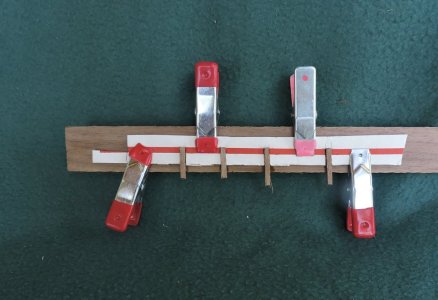
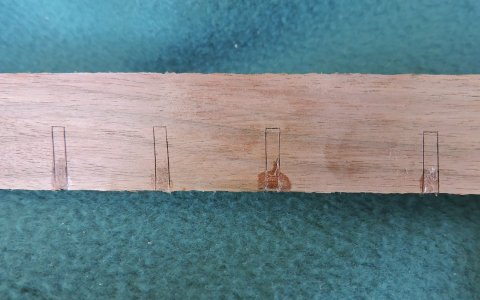
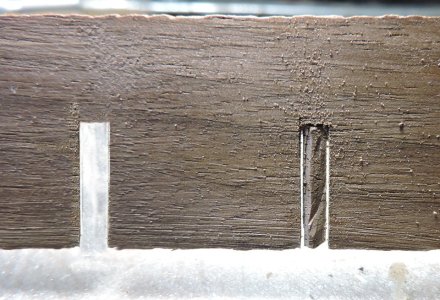
The cardboard pattern is the starting point and it has soft edges which you may cut into or undercut. Rather than chance a wrong cut i glued scrap pieces from the stanchions in the slots giving me a sharp hard edge to follow.

cap rail 18.jpgcap rail 19.jpg

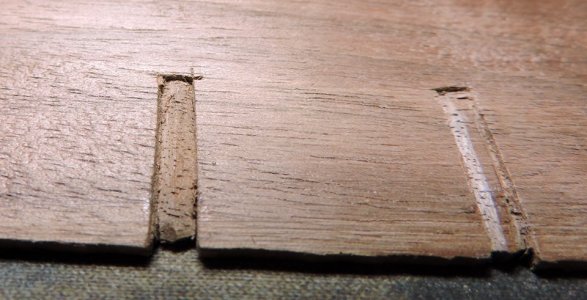
now i can cut with a new sharp blade along the edges


cap rail 20.jpg
 
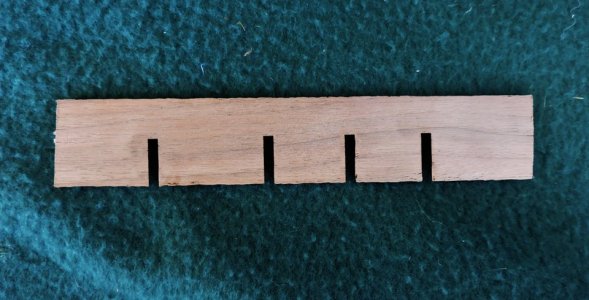
When you're making a piece such as this any wrong cut or loose-fitting joinery there is no fixing it short of starting over. This can be frustrating after scrapping hours of work and starting again even worse at the third time. This is only four slots some cap rails may run the length of the ship with 20 slots now that is scarry having messed up number 14 and starting again. It is the mind set here are you trying to teach yourself fine woodworking or just trying to get the model done. You need to stop and plan your approach to the job at hand trying to minimize errors.

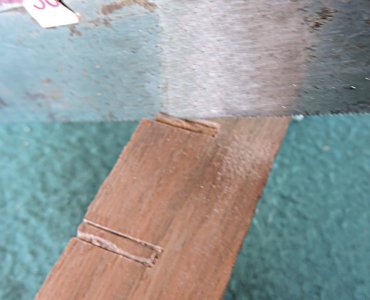
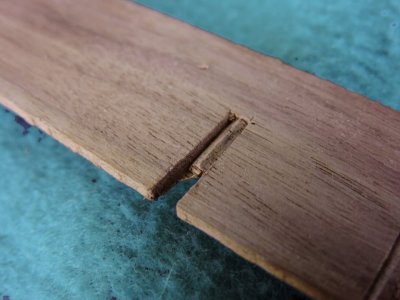
I have the slots marked with a knife cut and once again i start in the middle and make an angle cut to the edge cut

cap rail 21.jpg

What i am doing here is making sure the cut from the razor saw follows the edge and does not wonder.With the V cut it guided the saw.


cap rail 23.jpg

You will get a clean perfect cut along your original knife cut.

cap rail 24.jpg

i have tried cutting the slots with just a knife by making angle cuts to the edge. Then cut the edge a little deeper and keep doing it until all the material is removed

cap rail 22.jpg

the finished piece

cap rail 25.jpg
 
Last edited:
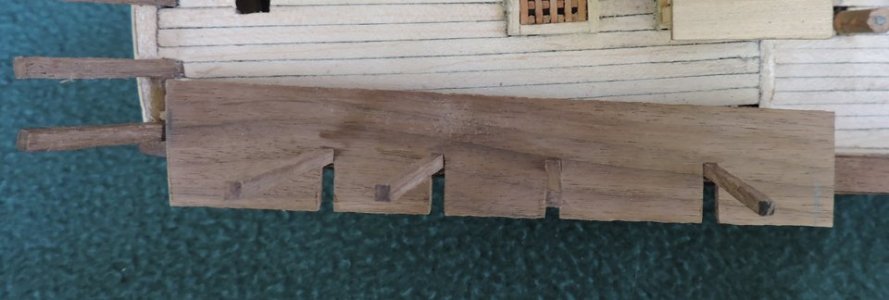
The first concern was getting the stanchions fitting into the slots. Now i do not know if you can make a loose fit and fill between the stanchions and the slot in the cap rail with caulking. A very small detail which would go unnoticed ever by the experts. I have a tight fit

cap rail 27.jpg

This may of been a little over kill in size and you could make the width of the cap rail a bit closer to the final size. As was done at the bow i used the side of the hull for the shape of the cap rail.

cap rail 26.jpg

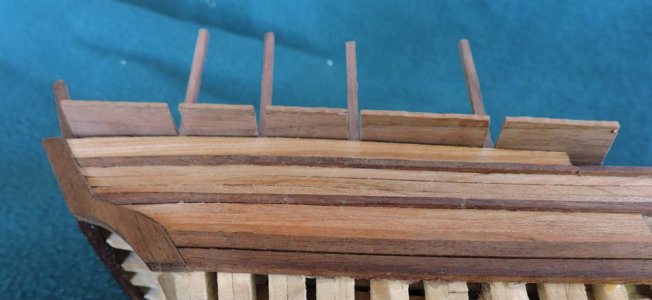
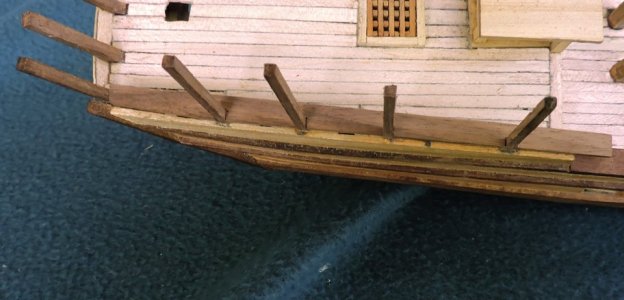
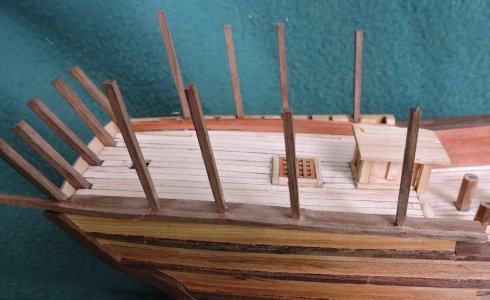
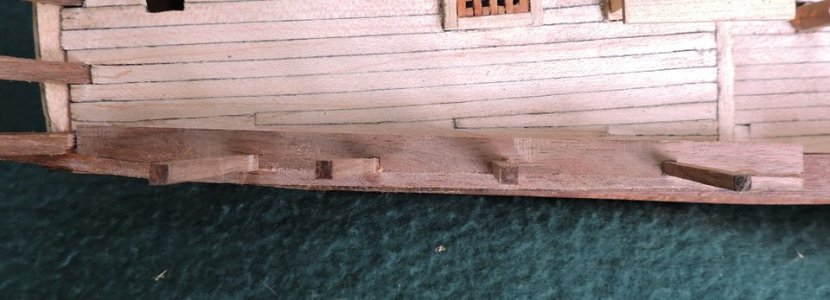
However here where stanchions come through the cap rail to support a railing the edge of the cap rail does not follow the outer hull the cap rail stops at the edges of the stanchions.


cap rail 28.jpg

A molding finishes the outer edge of the cap rail

cap rail 29.jpg

cap rail 30.jpg
 
Last edited:
As my colleagues here in the school will let me and everyone else know what i build may or may not apply to what you're building. As Roger pointed out not all decks used black caulking some used lead.
I read at some point somewhere about the battle of Lake Erie the Lawrence was disabled and the Niagara lagged behind. Perry accrued the Niagara of laying back out of the battle. Captain of the Niagara in his defense the Niagara was caulked with lead and much heavier and unable to keep up with the rest if the fleet. True or not i really do not know. but interesting.

When i build i will research methods used in real ship building if it applied to the model i am building is iffy we can never know as the ship is long gone. But it does show a building method was in fact used in ship building. so why did i do the cap rail and stanchions the way i did?

you can see the molding along the outer edge nailed to the molding below it


pic8.jpg

and in this fuzzy image you can see a nail pounded into the cap rail

pic19.jpg
 
Last edited:
That's all for today in school this week i have to do it all over again for the other side cap rail. At least i did it once so maybe it will be a little quicker a second time.

Next class it will be a step harder than the cap rail it is time for railings which are very delicate and to be quite realistic about it i do not know how i will approach it. This is the fun of building models is the holy crap how am i going to do that?

Do not fear the lack of kit instructions use your imagination and logic it will come together. As you progress in the hobby toss out the instructions and rely on your own skills and knowledge and Ships of Scale for information. A step to building it your way.
 
good morning class today starts with a lecture.

The school is not a place for public debate nor is it just a build log of putting parts together, what is covered is not only about hands on work in the shop but also the why do it? should i do it? What's the point? This week i wrestled with an idea and how to do something or if i should even bother with it.

paraphrasing from a public discussion i find it relevant to todays class.

Many experienced modelers can spot details that others overlook. However, what may seem obvious to you, or others. perhaps. may go completely unnoticed by thousands of other hobbyists who simply admire the model as a whole. to view a model or any work of art starts with the overall impression and the closer you look, it is the details that draw you in closer and closer and the more you begin to appreciate the finer details and craftsmanship. A builder does not skip over details thinking why bother no one will notice it anyway.
Obviously, a less knowledgeable viewer is not going to be able to make as sophisticated and accurate an assessment as an experienced one. So what if thousands of other hobbyists who don't know what they are looking at. Ascribing credibility to the judgments of thousands of modelers who don't know what they are looking at poses the significant risk that an ever-increasing pool of novice modelers are going to be led to believe that the standard for what is a good model is far lower than it should be. Of course, this dumbing down or skipping over finer details greatly reduces the entire hobby and art of model ship building to "well in general it looks like a ship model, overall, at a distance so good enough."


So what is the problem?
a tiny detail so small yet so outstanding it boggled my mind as to how to do it. Those little dots in the railings are pegs. A tiny detail that some suggest just goes unnoticed. But when you do notice them it is a big wow factor the builder not only included a real detail but has the skill to pull it off.


peg1.jpgpeg2.jpg
 
First thing i did was go to the teacher lounge where things are discussed unfiltered then i asked if i could include the discussion here
Absolutely. Go for it. One of my biggest pet peeves is when people think there's no reason for them to ever learn anything because all they have to do is ask for an answer on the internet, and it's getting a lot worse with the expanding availability of AI, which is just "Google on steroids." It's presumptuous and rude and, pray tell, if you don't know the answer, how are you going to know whether the one (often out of many) that's given is anywhere near the correct one?
This "internet dependency" really needs to be explored and combatted. I remember when I was a young "boatyard rat" years ago hearing the following exchange between a potential customer and the yard owner, a master boatbuilder who had served a formal union apprenticeship long before.
Customer: "Can I change the cutless bearing on my boat myself?"
Master Boatbuilder: "I expect so."
Customer: "Can you show me how?"
Master Boatbuilder: "I'd be happy to. Come on over to the office and I'll write up a work order and price estimate. Once we've got the paperwork out of the way, I'll get right on it, and you can watch me."
I don't build ship models for a living, so, unlike the old school tradesman, I'm not as adverse as they were to sharing "tricks of the trade," but I am no less offended when people believe themselves entitled to be shown how to do what so many of us "paid our dues" to learn by self-study and experience. These guys who expect us to look up stuff that is readily available in expensive books that we've collected over the years and to tell them how to do this or that and then get all huffy when we suggest they buy a book or a necessary tool because "not everybody can afford a big shop full of expensive power tools" are really too much.
On the other hand, I don't mind the "sincere student" kind of guy at all. He's the one who explains what he's done on his own to solve his problem and admits that after making a determined effort, there's still something he's missing, or that he's come up with his own solution and is asking for a "second opinion" whether it's okay. However, the absolute worst are the ones who say they've got a solution to their problem and ask what everybody thinks. Everybody tells they they've got their head up where the sun don't shine, and then they argue with them and do it anyway! I mean, some of these guys have the manners of a telemarketer.
Pure conjecture here, Dave, but in real life full-size construction, one way the rail may have been joined to the stanchion could have been by drilling a hole down the top face of the stanchion for a trunnel which would be driven into the stanchion with a blind wedge (like a trunnel) and then the rail with a matching hole drilled in it placed over the protruding peg which was then wedged and the peg (trunnel) and wedge planed fair with the top of the rail. In real life construction, the stanchions were very often separate pieces fastened sister-fashion to the top of the frames which were cut flush with the top of the clamp and shelf assembly. These separate stanchions were "semi-sacrificial" in that it was common for fungal decay to occur over time in the stanchions either in the end grain at the top or at the covering board joint, or a stanchion be broken either by battle damage or collision with another vessel rafted alongside or along a dock or quay. They were designed so the broken stanchion could be unbolted from it's "sister' frame top and extracted upwards through the covering board and a replacement dropped back in witthout having to tear up the major framing timbers all around the stanchion.

For scale construction a small measuring jig can be made to align the drill bit with the center of the stanchions. This would be a block with cutout "forked legs" that would straddle the sides of the stanchions and an "L"-shaped angle at the top that would lay over the top of the rail with the rail aligned in place on top of the stanchion. An aligned guide hole is drilled in the top of this jig to ensure that the hole is drilled through the top of the stanchion straight and dead center into the stanchion. The drilled hole is filled with a glued wooden peg and faired to the top of the cap rail.

Just thoughts. Hope they help.

I would design a jig to site the dowels - if a dowel showing on the top of the railing is how you intend to build.

The jig would be a piece of wood longer and wider than the rail.
Place the rail in the center of the long axis of the jig.
Glue a strip of wood to the jig that forms a tight slot for the rail.
Remove the rail.
Flip the jig and place it on top of the stanchions.
Find a strip of wood that is the thickness that centers the stanchion tops between the rails when a strip of it is between the slot and stanchion on either side. a long flat shim.
Fix to each slot with Duco. It should be a push fit for the stanchion tops - no wiggle.
Remove the jig.
With a #70 drill bit in a pinvise drill a shallow hole in the dead center of each stanchion top.
Place a very short piece of the pointy end of a #70 steel pin in each hole such that maybe ~1/16" ? of the pin tip is above the stanchion top.
Set the jig back in place over the stanchions.
Give it a tap over each stanchion.
When you remove the jig - the steel pin pieces should come off stuck to the jig.
Remove the tips and take the jig to your drill press and thru drill a hole at each marked point.
Acetone the shims off. Insert the rail. You can drill a hole thru the rail or a blind hole part way. The rail now has holes perfectly sited over each stanchion top. If it is thru -the actual rail is your pinvise guide for a deeper hole into the stanchion.
If it a blind hole - you have to freehand the deeper hole into the stanchion.
Make sure that the fore end and aft end of the rail (and jig) are defined. Sure as shit it will get rotated if you don't mark either one.

I would not bet much that the same jig will work for both sides.


and that ends the lecture so lets go in the shop and see what's going on

 
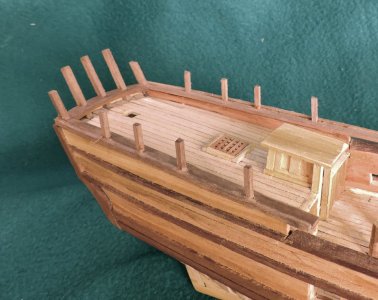
last week i installed the cap rails on both sides and across the stern which is not actually a cap rail more like a transom

cap rail 33.jpgcap rail 34.jpg

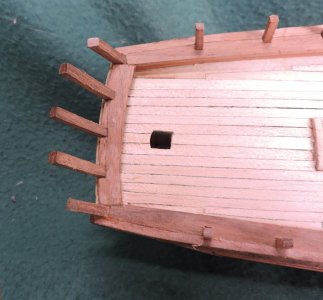
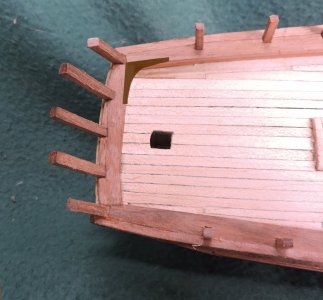
and in keeping with todays lecture on details there should be a knee that joins the side cap rail to the stern piece. Here i drew it in i did not put one on the model. Shame on me just drawing it and not really doing it. But if you want to please do it if you intend on building the model
.

cap rail 35.jpg

But if you do not know if one should be there it would not be missed. But now you know knees tied the stern pieces to the side pieces.

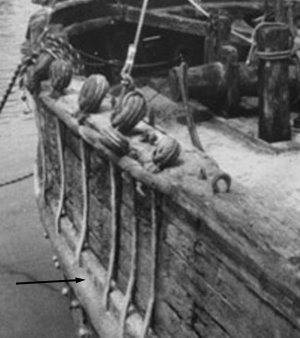
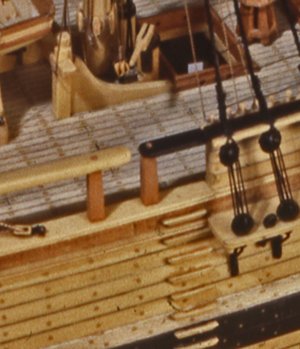
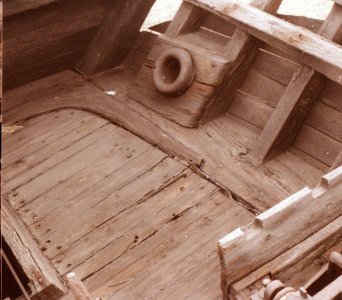
Where are the knees?


Dscn0356.jpg

do you see them?

waterway03.jpg2hannah65.jpg
 
in the shop

now that the cap rails are in place i have a surface to start with and i can now cut down the stanchions. Again with the cardboard as a template


cap rail 36.jpg

The railing in place and i can just use a dab of glue on the top of the stanchions and call it a day. Or go the extra mile and add little details.

cap rail 37.jpg

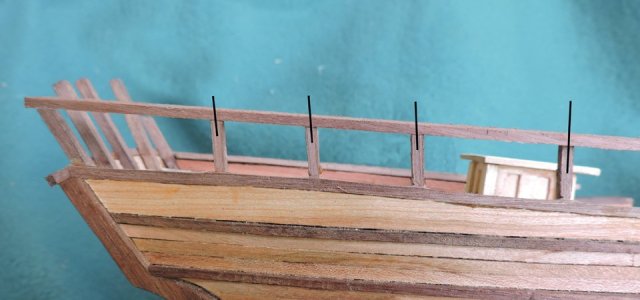
The problem i can not see the stanchions from the top

cap rail 40.jpg

but to add a pin i have to know exactly where the center is from side to side and front to back and i have to do it 13 times without a miss 5 times per side and 3 at the stern and to make it even harder the stern pins are at an angle. OH MY!

cap rail 38.jpgcap rail 39.jpg
 
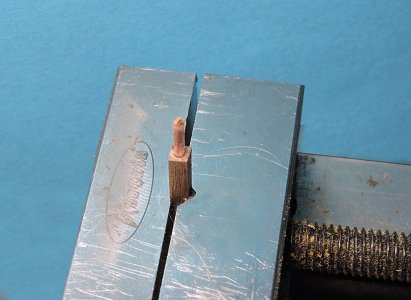
Testing ideas first i am thinking on using copper wire as the color of copper is a nice compliment to the Walnut railing. I also thought of little brass nails. I want the pin to be seen but not overpowering just enough to be noticed. I think the sample in the pictures is a bit too large.
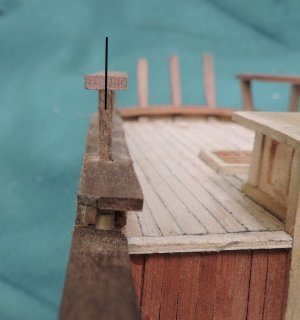
So i can drill the stanchion and glue in a peg. Matching it up with a hole in the railing well i need to work on that.

cap rail 41.jpgcap rail 42.jpg
 
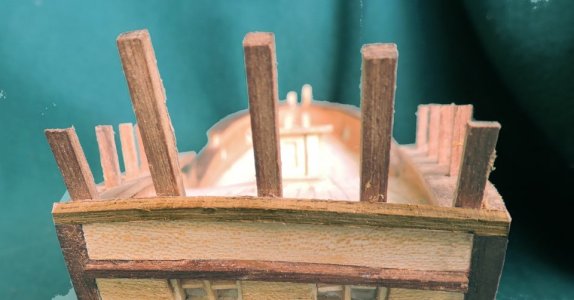
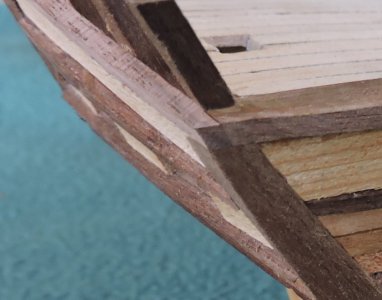
Before ending class today let's go back to the cap rail and the stern the final top molding of the stern sits on the end stern timbers and finishes off the top section
cap rail 44.jpg

taking a close look at the corner where the cap rail, side molding and stern molding all come together.

cap rail 43.jpg
 
in closing today's discussion on adding details no matter how small is not exclusive to scratch building, adding details to kit building is just as impressive and a step above just assembling a kit. However, a builder has to know about the details being added, if they have no clue how ships are built they would not know what to add. Kit instructions are about the assembly of what's in the box and for the most part has little to do with how ships are build so a builders has to go in search of information. Let the builder beware just because you see in a build log a deck with 2 inch plank lengths and a lot of butt joints may or may not be the correct way, a 2 inch plank at 1:48 scale is 8 feet deck planks might be 20 or 30 feet in length. This is the why we have the higher end builders to provide such information so we do not continue to repeat the same errors over and over. If your going to spend 200 hours building a model why not do the best you can rather than good enough it's just a hobby

and that's all folks class dismissed see you next Saturday and see if the problem gets solved on securing a railing to stanchions
 
Those little pins in into the stanchions are not just decorative. To use a clique it’s belt and suspenders. They might keep the rail from separating from the stanchions years from now if the glue fails.

Roger
 
Excellent discussion on the importance of small details in model ship building. It's often those subtle touches, like the pins in the stanchions, that elevate a model from good to truly impressive. The explanation of planning, precision, and craftsmanship was especially valuable for builders looking to improve their skills. For those interested in quality construction techniques and detailed project inspiration beyond ship modeling, you can learn more. Great lesson as always looking forward to seeing how the railing solution develops.
 
Back
Top