

• Win a Free Custom Engraved Brass Coin!!!
    As a way to introduce our brass coins to the community, we will raffle off a free coin during the month of August. Follow link ABOVE for instructions for entering.
  • SUBSCRIBE TO SHIPS IN SCALE TODAY!

    The beloved Ships in Scale Magazine is back and charting a new course for 2026!
    Discover new skills, new techniques, and new inspirations in every issue.

    NOTE THAT OUR NEXT ISSUE WILL BE MARCH/APRIL 2026

Syren 1803 1:64 Model Shipways

Boat bash completed /:

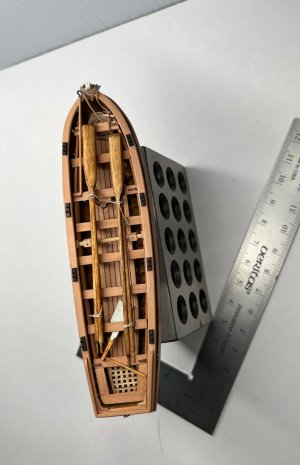
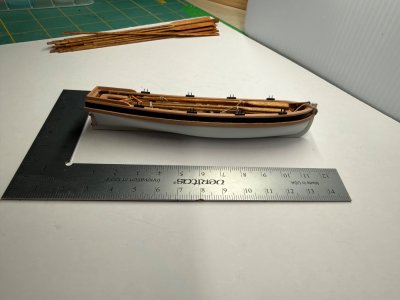
A long overdue update with, unfortunately, very slow progress as I battle prolonged health issues. Nevertheless, I have finished the 25 foot longboat.

As mentioned previously I decided to make it mostly from pear instead of the supplied kit basswood, using the lift method for hull construction. Although I did use a few laser cut parts from the kit, such as the keel, stem and sternpost when I was having a lazy day Sleep.

For fun I have added some small items in the boat including a toggle painter, boat hook, additional line etc. I lashed the oars in pairs but ignored the additional lashings securing them to thwarts. The oars would have been made from ash, beech or fir. I decided on fir and stained them to simulate a darker wood. I think a lighter AYC simulating ash would have been better but it is what it is.

The longboat will be mounted on the gallows bitts between the sweeps. The manual says to not worry about chocks but I think I’ll make them anyway, for additional security in place. The 16 sweeps have also now been sanded to shape and stained to simulate a darker fir. I believe the wood of choice for ships’ sweeps was fir.

I continue to be unpleasantly surprised at how close-up photos show every blemish. Something a lot of us are familiar with (except Paul @dockattner ROTF). Of course at 11cm in length the boat looks better when viewed from further away.

Hopefully back to the main build from hereon. Thanks for using some of your valuable time to follow my progress.
IMG_1755.jpeg

IMG_4522.jpeg
 
I like how your lifeboat came out. If I remember correctly, I may have skipped them in my Syren model. But I am not skipping them in my Constitution model. I have 4 to make.

Thanks Jack, the manual mentions the Syren may have had a longboat, pinnace and jolly boat. I’m going to stay with just the longboat I think. I need to move on to other fixtures. I don’t envy you making four, I have no doubt they will turn out really well.
 
Thanks Jack, the manual mentions the Syren may have had a longboat, pinnace and jolly boat. I’m going to stay with just the longboat I think. I need to move on to other fixtures. I don’t envy you making four, I have no doubt they will turn out really well.
A Pinnace, 2 whale boats, and a Gig. I don't really know what the difference is between a gig and a whale boat, but that;s what they call it...
 
That is a lovely-looking small boat, Roger. I really appreciate your subdued choice of colors on it - enough to make it stand out when viewed on its own, but not so lavish that it will detract from the main ship's stunning appearance.
 
Hello Heinrich, good to hear from you and thanks for your always welcome comments. I can’t claim the choice of colours for the longboat hull. I used the suggested white and black from the manual. However, I too like the subdued look and also feel the boat will quietly blend with the rest of the vessel.
 
A good question for Allan @AllanKP69 with his ever helpful access to endless resources :).

Gig
A status symbol for the commanding officer.
  • Kept clean, polished, and ready for official duties.
  • Not used for heavy work.

Whaleboat
The ship’s “pickup truck.”
  • Used for:
    • Landing parties
    • Towing
    • Recovering men overboard
    • General chores
  • Extremely common on U.S. Navy ships (including USS Constitution).
 
Good morning Roger. Firstly I hope your health issues improve soonest. My thoughts are in line with Heinrich. A fabulous boat which will look awesome on your Syren. Very cool. Cheers Grant
 
Good morning Roger. Firstly I hope your health issues improve soonest. My thoughts are in line with Heinrich. A fabulous boat which will look awesome on your Syren. Very cool. Cheers Grant
Hi Grant, thanks for your supportive post, it’s much appreciated. That fiddly little boat had its challenges but turned out well enough after all. It was a good learning experience that allows for future improvement.
 
We are traveling so most of this is from memory or files on my laptop. From what I can remember whale boats were double ended boats that were sometimes used on English warship starting about 1815-1820. Steel's scantings do not mention whale boats or gigs, but captain's gigs were small and definitely found on some ships. I am not sure if these were the Captain's choice and if he had to pay to have one.

Syren likely had a launch or longboat, pinnace, and a cutter or two.

Going with the long boat or even a launch, they were double banked, and the pinnace would have been single banked The photos above are neither so a bit confusing;:) Every thwart had a thole, two for double banked, one on alternating thwarts for single banked boats. The photos above show thwarts with no tholes at all which was not done. This is seen in a number of models and I am sure it is because the contemporary drawings can be misleading if further study by the kit designer is not done. The main thing is that there are no thwarts without at least one thole. You can always add the missing six tholes if you want to.:)

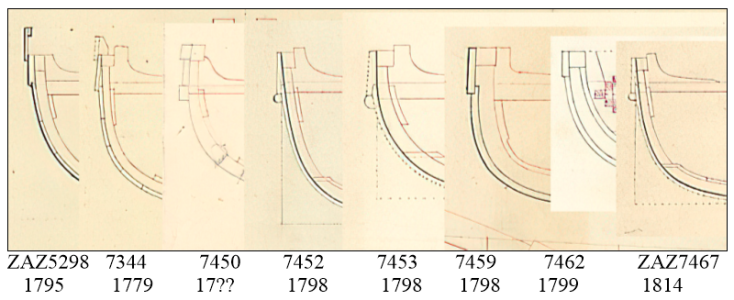
The below drawings of the gunnels may be interesting as well. The scantlings can be found in Boats of Men of War, Elements and Practice if Naval Architecture, and Scantlings of Royal Navy Ships. There are no cap rails per se.

1772023839591.png
 
Last edited:
Hello,
Question for you. How did you make the gunnels? Did you have to side bend the wood?
They look great and I want to make sure I do mine justice.
Tks

Thanks for the question Jack, no side bending necessary.

As you know I used the suggested lift method of layered hull construction. Once carved and sanded to about the necessary hull thickness I inverted it and made a photocopy of the gunwale of the hull. I then cut out the overall paper shape and added a suitable amount for the width for the cap rail. (Please note I followed the manual when referring to the term ‘cap rail’ not ‘gunwale’.)

I made sure my paper template fitted the hull then glued it to a 1mm (5/128”) pear sheet I had milled and sanded. For ease of construction I decided to cut the cap rail in one piece using my scroll saw. Of course at that thickness it kept splitting and cracking so repeats were necessary ROTF. I cut outside the lines of the paper template then sanded carefully to the required width for the boat. Aligning was simply a matter of placing the completed cap rail on my board, inverting the glued top edge (gunwale) of the hull and adjusting to fit. Then secured it in place till the glue was dry.

For the mouldings each side I cut them in one length, soaked in warm water, then gently bent to approximate shape to dry. Using light touches of CA I gradually fitted the mouldings in place by doing an inch or two at a time to get the correct bend/shape.

I hope what I have described makes sense and is helpful.
 
Thanks for the question Jack, no side bending necessary.

As you know I used the suggested lift method of layered hull construction. Once carved and sanded to about the necessary hull thickness I inverted it and made a photocopy of the gunwale of the hull. I then cut out the overall paper shape and added a suitable amount for the width for the cap rail. (Please note I followed the manual when referring to the term ‘cap rail’ not ‘gunwale’.)

I made sure my paper template fitted the hull then glued it to a 1mm (5/128”) pear sheet I had milled and sanded. For ease of construction I decided to cut the cap rail in one piece using my scroll saw. Of course at that thickness it kept splitting and cracking so repeats were necessary ROTF. I cut outside the lines of the paper template then sanded carefully to the required width for the boat. Aligning was simply a matter of placing the completed cap rail on my board, inverting the glued top edge (gunwale) of the hull and adjusting to fit. Then secured it in place till the glue was dry.

For the mouldings each side I cut them in one length, soaked in warm water, then gently bent to approximate shape to dry. Using light touches of CA I gradually fitted the mouldings in place by doing an inch or two at a time to get the correct bend/shape.

I hope what I have described makes sense and is helpful.
It was very helpful, thanks.
 
We are traveling so most of this is from memory or files on my laptop. From what I can remember whale boats were double ended boats that were sometimes used on English warship starting about 1815-1820. Steel's scantings do not mention whale boats or gigs, but captain's gigs were small and definitely found on some ships. I am not sure if these were the Captain's choice and if he had to pay to have one.

Syren likely had a launch or longboat, pinnace, and a cutter or two.

Going with the long boat or even a launch, they were double banked, and the pinnace would have been single banked The photos above are neither so a bit confusing;:) Every thwart had a thole, two for double banked, one on alternating thwarts for single banked boats. The photos above show thwarts with no tholes at all which was not done. This is seen in a number of models and I am sure it is because the contemporary drawings can be misleading if further study by the kit designer is not done. The main thing is that there are no thwarts without at least one thole. You can always add the missing six tholes if you want to.:)

The below drawings of the gunnels may be interesting as well. The scantlings can be found in Boats of Men of War, Elements and Practice if Naval Architecture, and Scantlings of Royal Navy Ships.

View attachment 580690

Thanks Allan.
 
Back
Top