

• Win a Free Custom Engraved Brass Coin!!!
    As a way to introduce our brass coins to the community, we will raffle off a free coin during the month of August. Follow link ABOVE for instructions for entering.
  • PRE-ORDER SHIPS IN SCALE TODAY!

    The beloved Ships in Scale Magazine is back and charting a new course for 2026!
    Discover new skills, new techniques, and new inspirations in every issue.

    NOTE THAT OUR FIRST ISSUE WILL BE JAN/FEB 2026

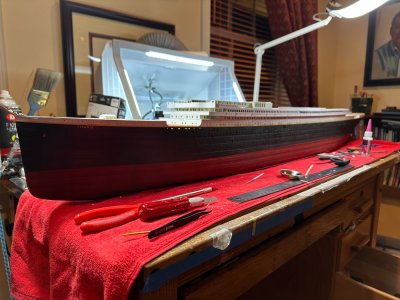
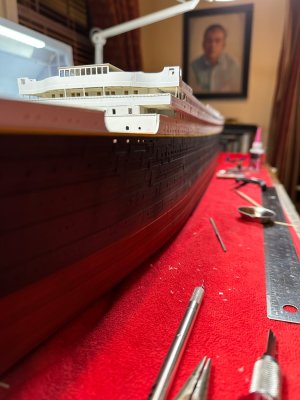
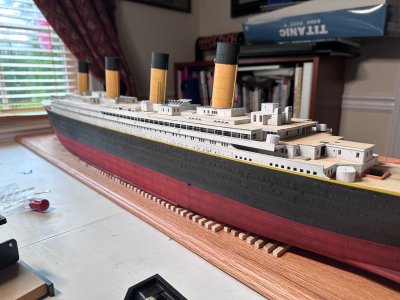
Titanic Trumpeter 1/200 by InkMot

Installing The Boat Deck​

This is a quick post to tie-off my Boat Deck work and installation.

The Boat Deck mounts on top of the A Deck structures, but it lacks any alignment pins or slots. You have to look for alignment around the stair case openings and check around the top edges of the A Deck structures. This is particularly important with the Woody’s Model Works beam set. I spent time ensuring that the beams weren’t getting caught on the top edges of the A Deck structures. I also checked to see if the Boat Deck and A deck were aligned. This is critical to ensuring that the Woody’s A&B deck superstructure PE will align correctly on the outside later on.
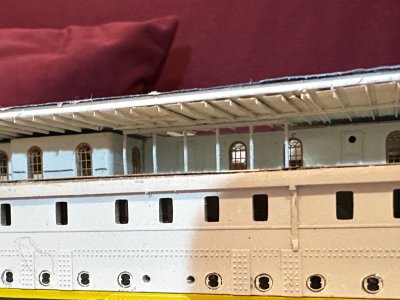
IMG_0743.jpeg
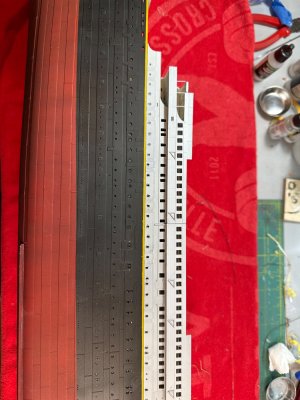
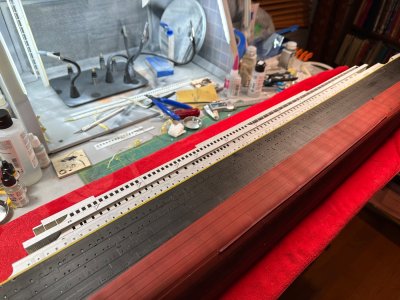
Looking at the underside of the Boat Deck to check alignment with A Deck structures.

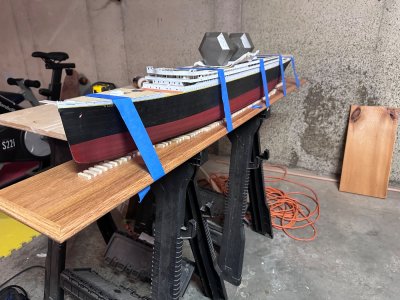
I used standard Tester’s model cement to secure the boat deck. I like this stuff - reminds me of my youth. ;) It also forms an excellent bond and stays wet long enough to make adjustments. I piled a ton of weight on top of the Boat deck to ensure that it fit snugly.
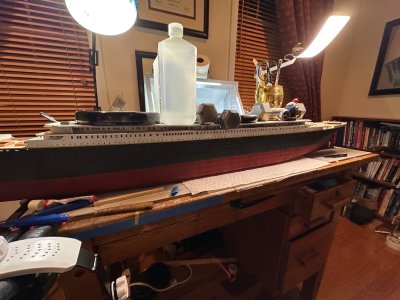
IMG_0745.jpeg
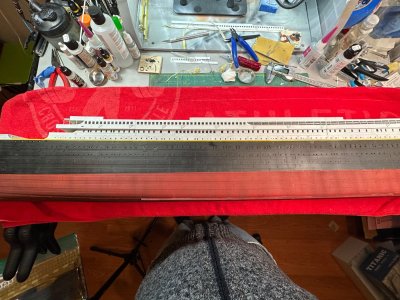
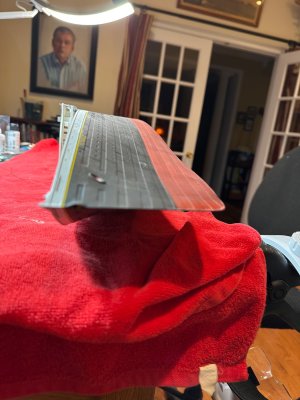
Boat Deck being held in place with pretty much everything that I could find to weigh it down.

With this step done, it’s on to installing the Woody’s A&B Deck superstructure and the Bridge!
 

Pre-Installing the Bridge

The Woody’s Model Works A&B Deck Superstructure kit included the forward bridge structure. I think this makes a nice upgrade what is provided with the kit. I considered whether to install the bridge first and then install the A&B Deck superstructure sides second. I ended up shaping and pre-fitting the bridge structure and then switching to installing the sides, returning to glue the bridge in place later. In retrospect, I should’ve glued the bridge in place first and then attached the sides, since they’ll but up against the bridge when they’re installed.

I will describe the work as I accomplished it.

IMG_0755.jpeg
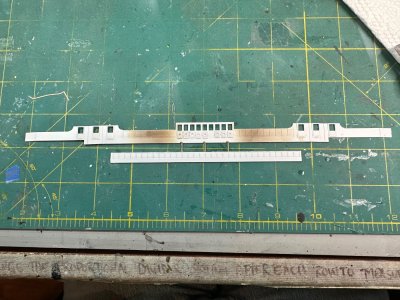
Painted bridge halves cemented together and annealed. Note the burnt paint.

The kit provides the main bridge superstructure in two pieces: front and back. I glued mine together using E6000. I pre-painted my parts by spraying them while still in the photo etch sheets. I’d recommend that you hold off on painting until everything is assembled. You’ll want to anneal the bridge superstructure to make it easier to shape the curves on the forward edge of the Boat Deck. As you can see in the photo, annealing a painted part gets messy. I created more work for myself sanding off the burnt paint, primering, etc.

IMG_0774.jpeg
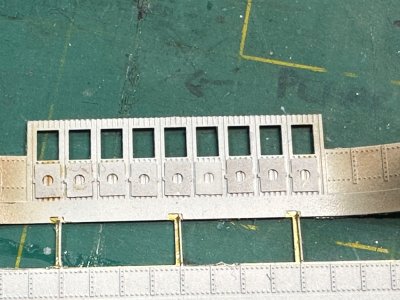
The kit includes storm shutters that must be glued below the bridge windows. For some reason, my version of the kit only provided 8 shutters and I had to make the 9th from styrene (I realized later that the MK1 detail kit also contains shutters). The substitute shutter is the fourth one from the right.

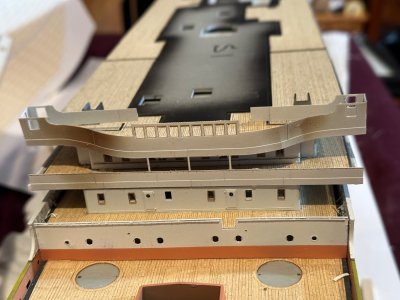
To install the Woody’s bridge, you will need to use the lower half of the kit bridge - the B-Deck superstructure. There is a molded line where you need to cut it. I didn’t photograph this. It’s an important link in the assembly.

IMG_0756.jpegIMG_0757.jpeg
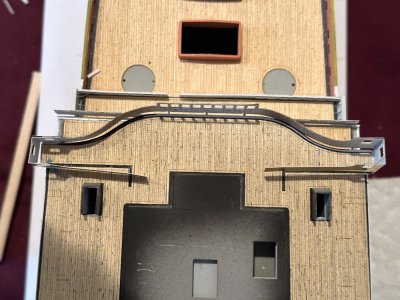
Bridge superstructure shaped and set loosely into place. Check your curves using the teak steps included in the kit. This will matter later. Also ensure that the bottom edge fits flush against the top edge of the B-Deck superstructure.

IMG_0768.jpeg
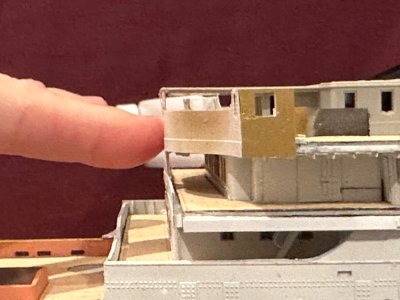
Another alignment to check is the vertical alignment from the side (this picture makes my alignment seem tilted forward). I also checked that the vertical alignment continued along the face of the B-Deck superstructure.

IMG_0763.jpeg
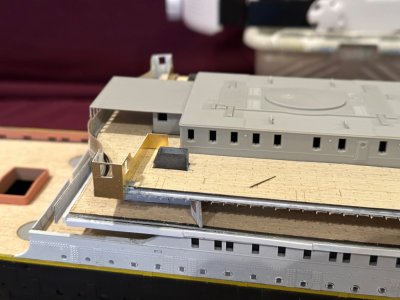
Dry fit the forward boat deck structure / wheel house to ensure that the top edge of the bridge windows aligns precisely with the bridge roof.


After I was satisfied with the shape of my bridge, I spent time sanding off the burnt paint, and re-spraying with primer and white paint.

IMG_0792.jpeg
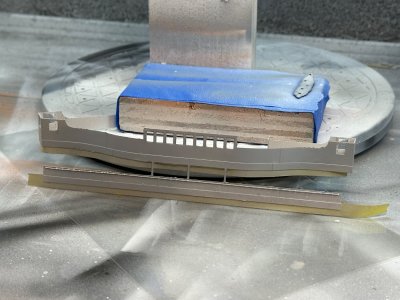
Re-sprayed bridge superstructure showing masked areas to protect bare brass gluing areas from paint.


Next Steps:
  1. Installing A&B Deck Side Superstructures
  2. Completing the Bridge Installation
  3. Bridge Details
 
Installing Woody’s A&B Deck Superstructure

I pre-painted my parts while still on the metal sprue. I don’t recommend doing this because of all of the assembly that remains before installation. It’s easy enough to paint everything after assembly and before installation on the model - as Step 21 of the instructions CLEARLY suggests that you do. ;)

The first part of the assembly involves glueing the inner and outer halves of each part together. I used a thin layer of E6000 for this and sealed up the edges with CA glue. I’ve covered anything unsightly with Tamiya putty.

IMG_0793.jpegIMG_0807.jpeg

I cut strips of acetate to create windows for the enclosed promenade windows. The real ones slid up and down and were occasionally seen open in pictures. I chose to model all of mine closed. The strips were inserted between each half of the forward sections. While it did make it a bit more difficult to assemble and close the edges, I’m happy with the final appearance.
IMG_0927.jpeg
Forward, port superstructure section showing the coal outriggers and window glazing.

There are perhaps hundreds of tiny stiffeners that need to be installed on the inner side of the bulkheads. My preferred technique is to put a drop of CA on some scrap material and dip the edge of the stiffener into it using tweezers. I was able to work up to a decent pace with this approach.

IMG_0808.jpegIMG_0827.jpeg
The vertical stanchions need to be turned out (they point inward of the ship). This is a nice detail, but you need to be careful with them once they’re turned. I needed to insert CA between the inner and outer halves of each to keep them together.

IMG_0830.jpeg

There is also a nice, detailed set of coal outriggers. They needed to be folded and glued on with CA.
IMG_0923.jpegIMG_0926.jpeg

I gave everything a coat of white and a coat of semi-gloss clear. Be sure to mask the edges where you’ll be gluing the superstructure to the Boat and A Decks. Again, I had to scrape off the paint I applied earlier before I masked. The sunshade cable along the promenade should be painted gun metal at this time.
IMG_0924.jpegIMG_0838.jpegIMG_0915.jpeg

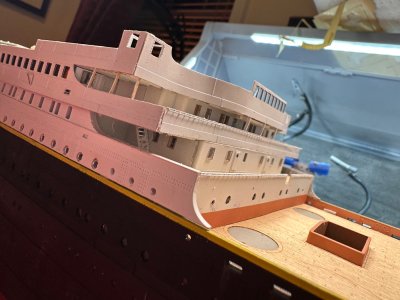
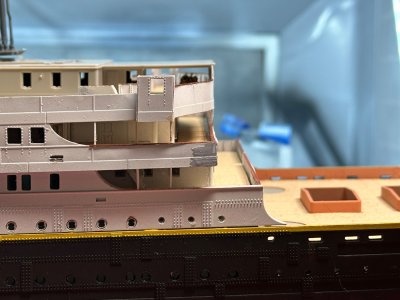
I used epoxy to secure the superstructure to the side of the ship. I spent a lot of time dry fitting to ensure that everything lined up. I checked to ensure that the forward sections butted up against the PE bridge wings and that the top edge aligned with the Boat Deck and the bottom covered the outer edge of A-deck.

IMG_0997.jpegIMG_1001.jpeg

I also ensured that all three sections butted against each other well. Beveling the inside edges of each with a file helped to close up the seam a bit.

IMG_1002.jpegIMG_1003.jpeg

Here’s where all of the work ensuring that the Boat Deck and A-Deck were aligned paid off. I was pleased that I had good vertical alignment for and aft.

IMG_1010.jpegIMG_1064.jpeg
 
Last edited:
Clean-Up and Alignment

I went into a clean-up phase after installing the A&B Deck superstructure. A key area of concern were the gaps where the superstructure joined with the forward bridge bulkheads at the corners. There are a lot of gaps that I don’t like on this project, particularly the gap between the hull and the superstructure, and I do my best to choose my battles. I didn’t want to overlook the gaps at the corners, however.

IMG_1066.jpegIMG_1127.jpeg

The forward, port superstructure section needed to be removed and reattached to correct the alignment issue. This is where taking your time with dry fitting and gluing pay off. Tamiya putty was used to fill in the gaps. I took my time sanding, finishing up with 600 grit sand paper, priming and sanding smooth again. The attempt to brush on paint was a failure (see photo below), so I masked and re-sprayed on the model (sorry, no photos). Various stains and marks on the paint were corrected at this time.

IMG_1193.jpegIMG_1194.jpegIMG_1195.jpeg

Another part of clean-up was re-making the B-deck stanchions. You can see in a previous post (https://shipsofscale.com/sosforums/threads/titanic-trumpeter-1-200-by-inkmot.13004/post-460195)
where I removed the incredibly thick kit stanchions and replaced them with styrene strips. These were damaged during construction, necessitating replacements. The up-side was that I was able to base the size of the new ones off of the Woody’s PE versions. Now both decks look alike.

A1014E08-A1ED-413F-8511-F1037B3C79E5.jpeg
Photo showing new B-Deck stanchions and failed brush painting on A-Deck bulkhead corner (yuk!). Note Boat deck structures being dry-fitted.


Next Up:
  • Building the Navigation Bridge
  • Prepping the Model Monkey Funnels
  • Prepping Boat Deck Structures
 
Last edited:
Building the Navigation Bridge (Part 1)

My strategy has been to postpone installation of little fiddly bits to as late as possible in the build, to avoid knocking them off during construction. The time has come, however, to install the Navigation Bridge engine order telegraphs and wheels.

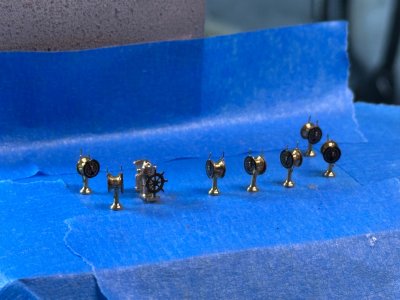
The MK1 kit provides some detailed telegraphs with about seven parts for each: pedestal, body, faces (x2), control arms (x2) and a forward lever (forget what it’s name and function is). I found it best to secure some painters tape, stick-side up, to hold the pedestals while I glued the parts on them using CA.
IMG_1132.jpegIMG_1133.jpeg
Pedestals secured by tape allowing telegraph bodies and accessories to be glued on with CA. Note: Extra equipment to be used later on the Docking Bridge, located on the poop deck.

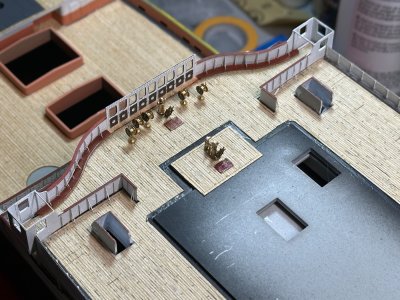
I found a few reference guides that describe the placement of the engine order telegraphs and wheels on the bridge. They’re not just in a straight line nor are the numbers symmetric on either side of the ship’s wheel. The telegraphs, wheels and compass houses where secured to the deck with CA.

IMG_1140.jpeg

I used the MK1 - supplied wood decking for the floor of the wheelhouse, even though I believe this was a tiled floor. Since I’m not lighting the model, this would be invisible.
 
Building the Navigation Bridge (Part 1)

My strategy has been to postpone installation of little fiddly bits to as late as possible in the build, to avoid knocking them off during construction. The time has come, however, to install the Navigation Bridge engine order telegraphs and wheels.

The MK1 kit provides some detailed telegraphs with about seven parts for each: pedestal, body, faces (x2), control arms (x2) and a forward lever (forget what it’s name and function is). I found it best to secure some painters tape, stick-side up, to hold the pedestals while I glued the parts on them using CA.
View attachment 578530View attachment 578531
Pedestals secured by tape allowing telegraph bodies and accessories to be glued on with CA. Note: Extra equipment to be used later on the Docking Bridge, located on the poop deck.

I found a few reference guides that describe the placement of the engine order telegraphs and wheels on the bridge. They’re not just in a straight line nor are the numbers symmetric on either side of the ship’s wheel. The telegraphs, wheels and compass houses where secured to the deck with CA.

View attachment 578533

I used the MK1 - supplied wood decking for the floor of the wheelhouse, even though I believe this was a tiled floor. Since I’m not lighting the model, this would be invisible.
Beautiful work.
 

Prepping Model Monkey Funnels (Part 1)​


The funnels that come with the kit aren’t accurate. If you care about such things and want to use them, you have to modify the rivet pattern, raise the line separating the black top area from the buff bottom, and also change the order that you place them on the ship - plus some other things that I’m forgetting about. After all of the other modifications I’ve done to this point (see previous posts), i decided on a 3D-printed alternative. As far as I know, your choices are between China 3D and Model Monkey, but I’m sure there are others. Model Monkey has the most straightforward ordering process and they from within the US, which is best for me. I received them two weeks after I ordered them.

IMG_1174.jpegIMG_1175.jpegIMG_1176.jpeg
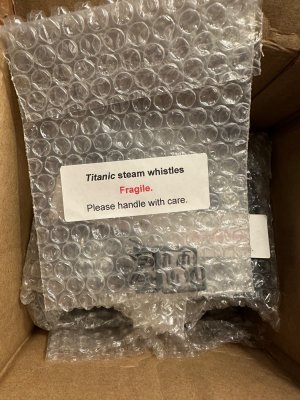
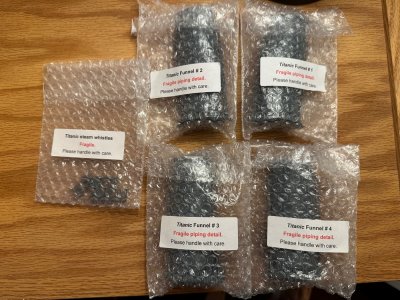
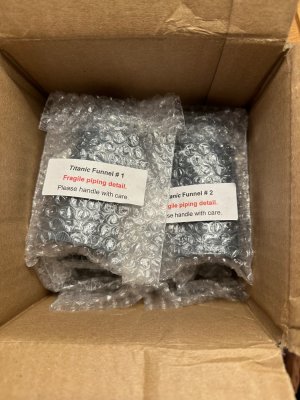
The funnels well-packed and arrived in perfect shape. I received four funnels with pipes and two sets of steam whistles. Nice!
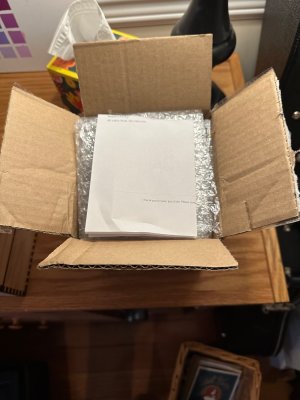
IMG_1177.jpeg
I liked how everything was individually wrapped and well-labeled. You don’t want to mix up your funnels because they’re all different.

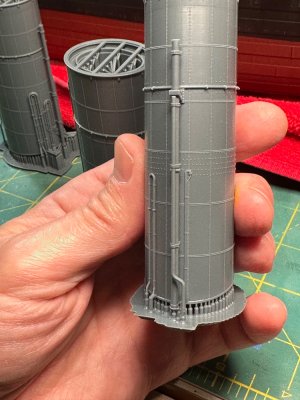
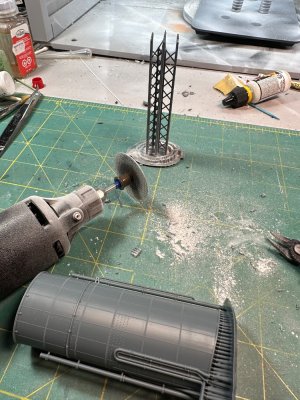
The up-side with 3D-printed funnels is that they’re basically all assembled and there’s not as much to build. The downside is that the requirements of 3D-printing encases the part within a framework of plastic sprue from which it must be freed. In the case of the Model Monkey funnels, and I think also China 3D, you must cut deeply along the base and also carefully under the delicate cross bars at the top of the funnel. Model Monkey recommends a hot knife. After trying it this way, I recommend a Dremel tool with a cutting wheel, combined with a sharp cutting knife. The hot knife not only makes a mess, it creates awful (and probably dangerous) fumes.

IMG_1189.jpeg
Each funnel arrives attached to a base at many points on the outside and inside.


IMG_1524.jpegIMG_1530.jpeg
A Dremel tool with a cutting wheel seems to be the most effective way to remove the funnel from its base.

IMG_1523.jpeg
Detail view showing how many points connect the funnel to its base. It is attached at the bottom and the top.
IMG_1530.jpeg
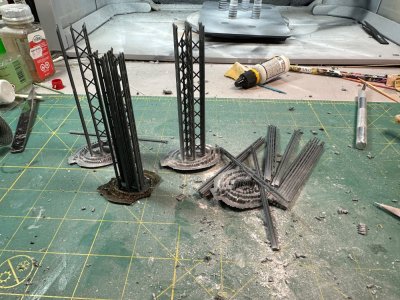
I removed one funnel using a hot knife (blackened, soot-covered) and the others with a cutting wheel. Note dust and debris. I suggest wearing a mask to prevent breathing in dust.

IMG_1531.jpeg
The bottom of the funnel needs to be cleaned and shaped to fit on your model.

**Pro Tip! Label the inside of each funnel with a Sharpie as soon as you free it to avoid mixing them up. This saved me grief later.**

IMG_1537.jpegIMG_1538.jpeg
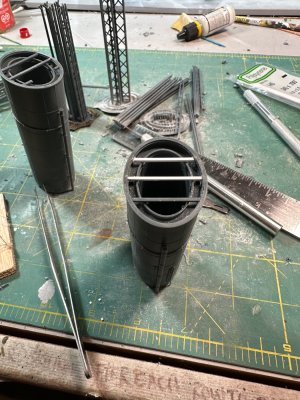
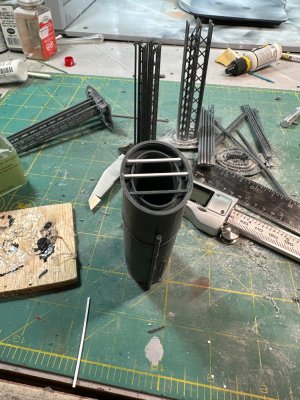
i found it impossible to avoid damaging the cross bars on funnels 1 and 2. Funnels 3 and 4 came out fine.

IMG_1542.jpegIMG_1541.jpeg
The damage was repaired using styrene strips and CA.

IMG_1526.jpeg
Test fit because, why not? ;)

IMG_1572.jpeg
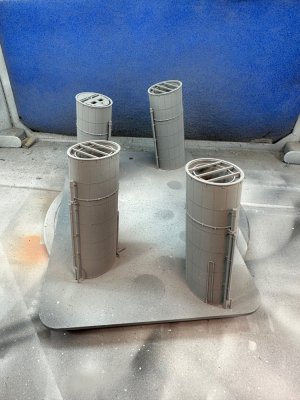
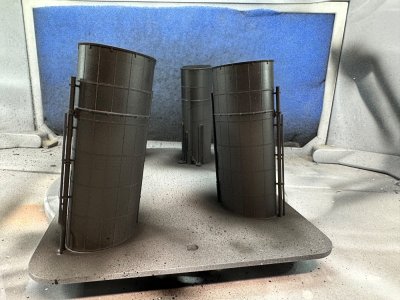
Each funnel received a coat of primer.

IMG_1579.jpeg
And a coat of black, followed by a coat of semi-gloss for the top section.

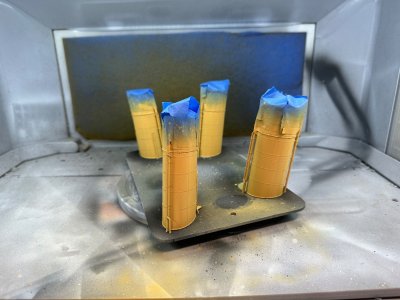
IMG_1584.jpeg
Masking to paint the White Star Buff took some time. Since the funnels come with the pipes installed, I needed to fish tape around them. I used the Vallejo Faded Yellow for this.

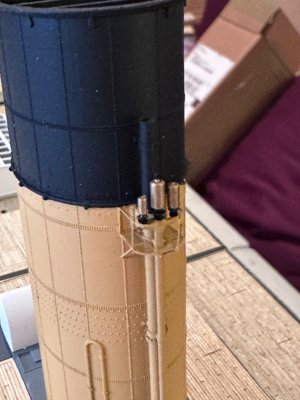
IMG_1745.jpeg
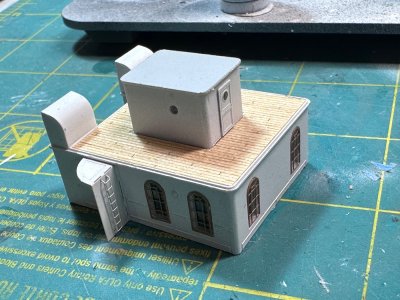
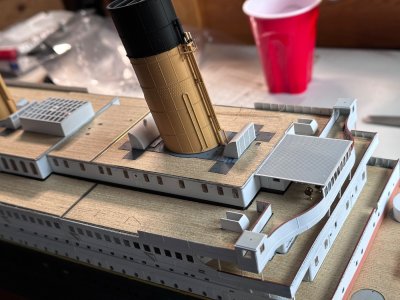
Example funnel, showing steam whistles and part of the service platform installed. I’m holding off on the ladders until later.


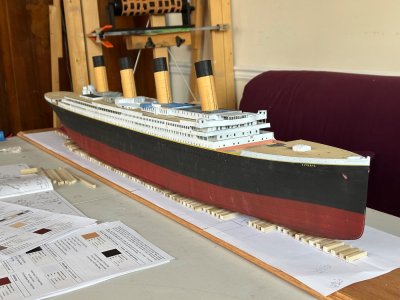
IMG_1604.jpeg
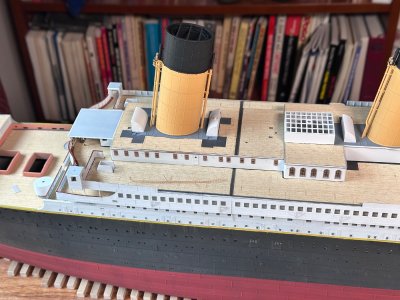
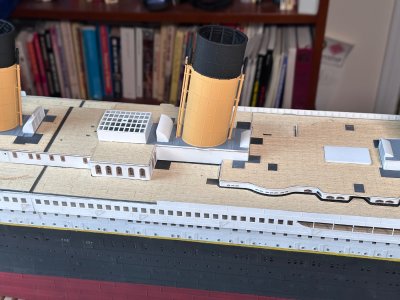
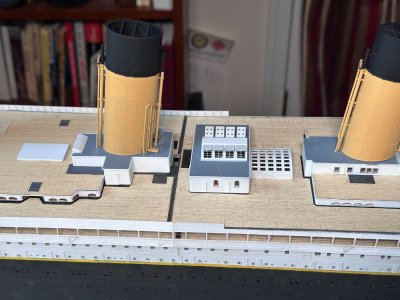
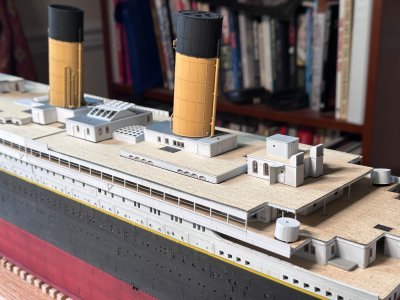
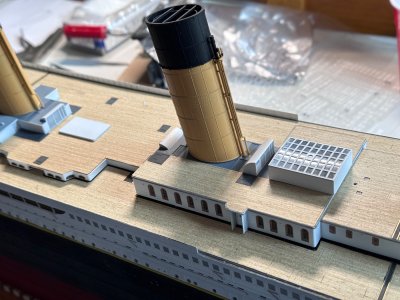
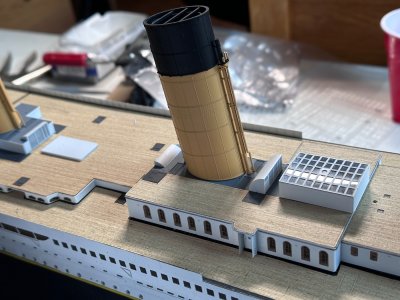
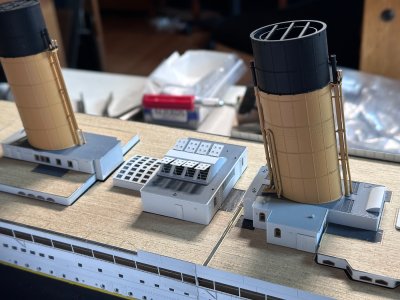
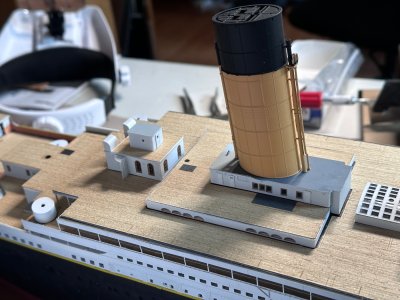
View of my model with painted funnels sitting in place. I need to complete the Boat Deck structures and secure the model to its base before glueing on the funnels.
 

Prepping Model Monkey Funnels (Part 1)​


The funnels that come with the kit aren’t accurate. If you care about such things and want to use them, you have to modify the rivet pattern, raise the line separating the black top area from the buff bottom, and also change the order that you place them on the ship - plus some other things that I’m forgetting about. After all of the other modifications I’ve done to this point (see previous posts), i decided on a 3D-printed alternative. As far as I know, your choices are between China 3D and Model Monkey, but I’m sure there are others. Model Monkey has the most straightforward ordering process and they from within the US, which is best for me. I received them two weeks after I ordered them.

View attachment 579242View attachment 579243View attachment 579244
The funnels well-packed and arrived in perfect shape. I received four funnels with pipes and two sets of steam whistles. Nice!

View attachment 579245
I liked how everything was individually wrapped and well-labeled. You don’t want to mix up your funnels because they’re all different.

The up-side with 3D-printed funnels is that they’re basically all assembled and there’s not as much to build. The downside is that the requirements of 3D-printing encases the part within a framework of plastic sprue from which it must be freed. In the case of the Model Monkey funnels, and I think also China 3D, you must cut deeply along the base and also carefully under the delicate cross bars at the top of the funnel. Model Monkey recommends a hot knife. After trying it this way, I recommend a Dremel tool with a cutting wheel, combined with a sharp cutting knife. The hot knife not only makes a mess, it creates awful (and probably dangerous) fumes.

View attachment 579537
Each funnel arrives attached to a base at many points on the outside and inside.


View attachment 579239View attachment 579236
A Dremel tool with a cutting wheel seems to be the most effective way to remove the funnel from its base.

View attachment 579238
Detail view showing how many points connect the funnel to its base. It is attached at the bottom and the top.
View attachment 579236
I removed one funnel using a hot knife (blackened, soot-covered) and the others with a cutting wheel. Note dust and debris. I suggest wearing a mask to prevent breathing in dust.

View attachment 579235
The bottom of the funnel needs to be cleaned and shaped to fit on your model.

**Pro Tip! Label the inside of each funnel with a Sharpie as soon as you free it to avoid mixing them up. This saved me grief later.**


View attachment 579233View attachment 579234
i found it impossible to avoid damaging the cross bars on funnels 1 and 2. Funnels 3 and 4 came out fine.

View attachment 579229View attachment 579230
The damage was repaired using styrene strips and CA.

View attachment 579241
Test fit because, why not? ;)

View attachment 579228
Each funnel received a coat of primer.

View attachment 579227
And a coat of black, followed by a coat of semi-gloss for the top section.

View attachment 579224
Masking to paint the White Star Buff took some time. Since the funnels come with the pipes installed, I needed to fish tape around them. I used the Vallejo Faded Yellow for this.

View attachment 579221
Example funnel, showing steam whistles and part of the service platform installed. I’m holding off on the ladders until later.


View attachment 579541
View of my model with painted funnels sitting in place. I need to complete the Boat Deck structures and secure the model to its base before glueing on the funnels.
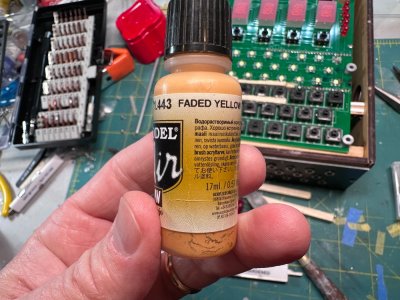
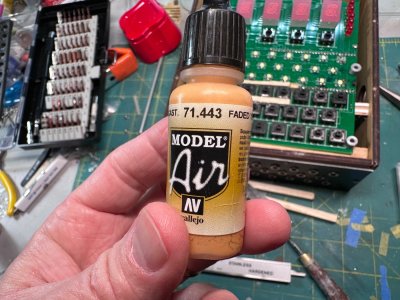
Just some amazing work and, in removing the funnels from their supports, incredible patience. Do you have the number for Vallejo Faded Yellow? Is it part of the Model Air range? The colour looks really good in the photo above showing the steam whistles.
 
Just some amazing work and, in removing the funnels from their supports, incredible patience. Do you have the number for Vallejo Faded Yellow? Is it part of the Model Air range? The colour looks really good in the photo above showing the steam whistles.
Thank you!

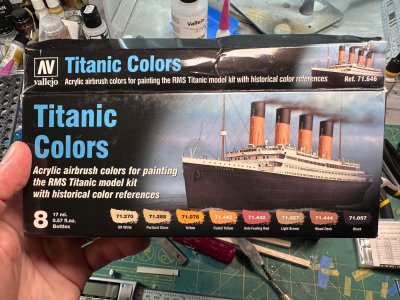
I used the Vallejo Faded Yellow 71.443. It came with their Titanic Paint Set.


IMG_1992.jpegIMG_1991.jpegIMG_1990.jpeg
 
Thats a fantastic looking model. I must consider this for a future build myself.
Thank you!

It's a good model. Probably the best plastic version of the Titanic. It also has a healthy aftermarket industry for detail kits and a large community of builders.
 
Back
Top