• SUBSCRIBE TO SHIPS IN SCALE TODAY!

    The beloved Ships in Scale Magazine is back and charting a new course for 2026!
    Discover new skills, new techniques, and new inspirations in every issue.

    NOTE THAT OUR NEXT ISSUE WILL BE MARCH/APRIL 2026
  • Win a Free Custom Engraved Brass Coin!!!
    As a way to introduce our brass coins to the community, we will raffle off a free coin during the month of August. Follow link ABOVE for instructions for entering.

USS Constitution - Model Shipway’s 5/32” = 1 ft. (1:76.8) Kit No.: MS2040

So true Jon. I'll definitely have to think about it. Working at 1/76 would be great, but the BJ kit was given to me and besides, I have no idea where I would put a 4 foot model
I try not to add anything that I don’t think will stay within scale. If it doesn’t look realistic, it just creates unnecessary clutter.
 
Frank, it's not just a 4-foot model, but the case and table you need to display the model properly. I figure at least a 5 x 2-foot table. I'm not sure where I'm going to put it. And that's another expense. I don't have the tools nor the wood working experience, to build one myself which means I'll have to buy (or have made) the table and case.

Jon
 
The Spar Deck Capstan

I was ready for something different and fun after rigging all those carronades, and the capstan looked like a nice little project. I checked the practicum and other build logs to see how they fabricated the capstan. They were fairly consistent but each with their own flavor. I have my own ideas for the capstan recipe.

Constitution-0094.jpg
 
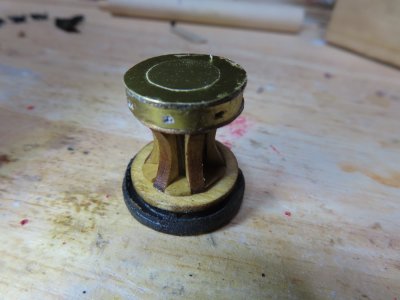
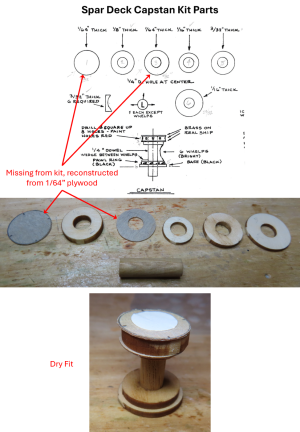
Sheet 5 of the MS plans identified the six laser cut pieces for the fabrication. But because of the different thicknesses of the various pieces, they are located on separate different laser-cut pieces of wood. However, I could not locate the two 1/64” thick pieces. I couldn’t find any piece of laser cut wood 1/64” thick, or wood with those shapes. I realize there are a lot of laser-cut circles, but none had the proper dimensions. No problem, these were easy enough to make out of 1/64” plywood. All the kit capstan parts were dry fitted to check for fit. Note the white circle on top of the capstan in the image below is paper representing the slight raised area on the brass top.

Spar Deck Capstan Fabrication 01.png
 
As an aside, I have many times iterated that for the beginner and even the intermediate ship modeler, Bob Hunt’s practicum is a wonderful source and guide for building a model. What it is not, is THE authority on how to build a model which you will read in a moment. Most of you already know this.

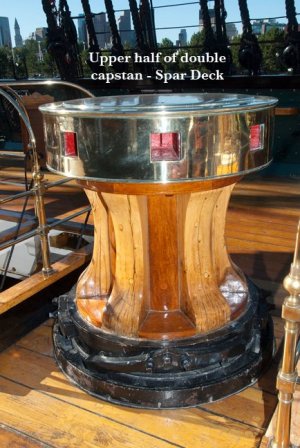
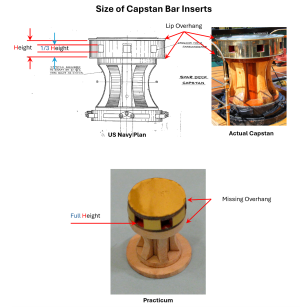
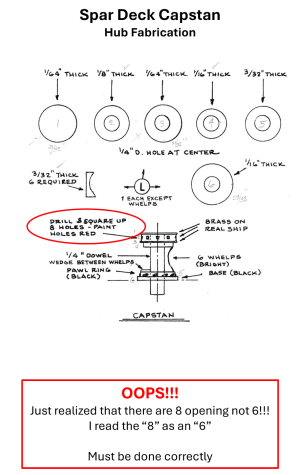
Comparing the MS plans (which the practicum followed) with the US Navy plans, I noticed numerous differences. If I followed the practicum verbatim, the resulting capstan square bar holes would be oversized. They encompassed the full height of the 1/8” “wheel” hub. Per the US Navy plans, the square bar holes are 1/3 the height of the hub. The hub is a sandwich; a thick 1/8” center section with square opening inserts and very thin top and bottom covers that extend just a bit over the center section. This hub is just the upper portion of the capstan.

Spar Capstan Bar Insert Size.png
 
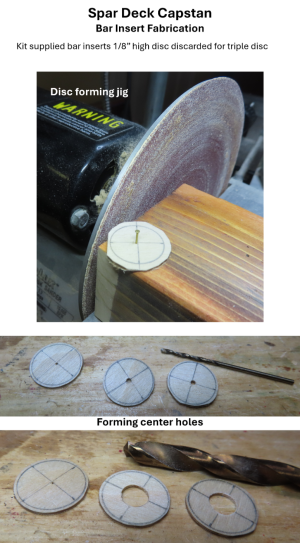
There are several ways of creating square bar holes. The one I plan on using is to replace the solid kit supplied 1/8” tall hub with three-1/32” plywood disc layers, a sandwich within a sandwich. For the center section of the inner “sandwich,” I made three discs just slightly wider in diameter than the original hub. This was to provide material for sanding and final shaping. Following Mustafa’s lead, spinning the plywood pieces in front of my disc sander.

Small holes were initially drilled into two of the fabricated discs centers with progressively larger drill bits until a diameter of ¼” was reach, just large enough for the ¼” dowel to pass through. The third disc that will have six notches for the bar inserts will eventually fit between the first two just drilled. This was to create smaller realistic square openings inserts with the slight overhangs of the top and bottom of the spindle shown in the plans and photos.

Spar Deck Capstan Fabrication 02.png
 
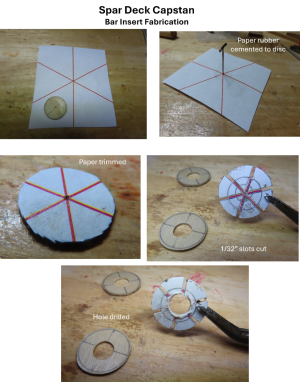
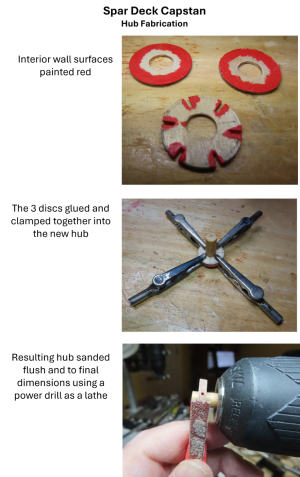
Basically, the capstan bar inserts/notches were fabricated generally in the same manner as shown in the practicum. To create the notches, instead printing the six-side hexagram provided by the practicum, I printed a pattern of six equally spaced lined lines radiating from a central point. This was pasted onto the plywood disc with rubber cement and trimmed. The radiating lines indicated where the notches were to be located. Two circles were drawn on the disc to represent the future center hole and the depth into the disc the notches would be cut. That was about mid distance from the edge of the disc and the center hole circle. To create square inserts, the notch width had to be the same as the disc’s thickness, 1/32”. The six 1/32” wide notches were then cut from the outer edge of the disc to the limit circle with my razor saw. Finally, the center hole was cut as the other discs. It was my belief that this sequence would put the least amount of stress on the plywood to avoid it breaking. The discs were cleaned up to remove stray fibers, then the notch interiors were painted red. The other two discs were also painted red in their notch areas to create the top and bottom notch interior surfaces. After all this effort, it is unlikely that anyone will realize that the interiors of the notches are colored red due to the size.

Spar Deck Capstan Fabrication 03.png
 
The three disc were glued together and when dried into a solid piece, the ¼” dowel was inserted and placed into a power drill. Using the drill as a mini lathe, the disc was filed and sanded making the side flat and uniform in size as well as the proper diameter. The side of the new notched hub was then coated with a couple coats of polyurethane to create a smooth surface to enable brass tape to stick.

Spar Deck Capstan Fabrication 04.png
 
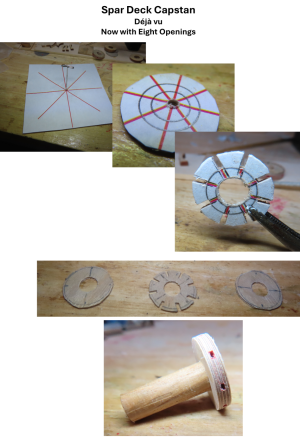
It was here that I ran into another one of the reasons NOT to follow the practicum blindly. If you study the US Navy plans and the photographs, which I did, and I still missed it. THE CAPSTAN DOES NOT HAVE SIX BAR OPENINGS, IT HAS EIGHT. It even says so on the MS plans, in the instruction booklet, and is shown in photographs. I was misled by the practicum showing six, the fact there are six whelps in the capstan. and my poor eyesight for fine print. Because of the tiny print in the plans and instructions, I saw the “8” as a “6”; It was what I expected to see. I discarded the newly created hub and had to start all over again to fabricate the eight bar inserts hole hub which I did.

OOPS.png

Spar Deck Capstan Fabrication 05.png
 
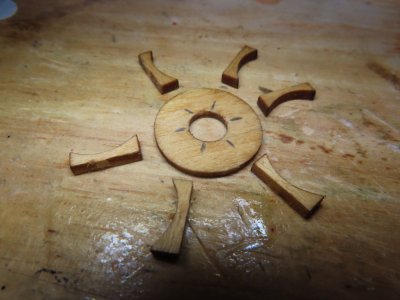
The Whelps were next and straight forward to assemble. Once more I marked where the whelps were to be located with the six radial lines. And yes, I did check to verify there were only six. The only thing you had to be careful of was make sure the small disc was on top and the narrow end of the whelps were on top. These were glued into place.

IMG_3006.JPG

IMG_3007.JPG
 
For the capstan base, I got to play with a new toy, the Proxxon Dividing Attachment. After reading several build logs where this tool was used to great effect, I overcame my reluctance to spend money on additional tools as I expect this model (of this complexity) to be my last. I will be in my eighties by the time I’m done. Even though I don’t have a true drill press, let alone a milling machine, I do have the Proxxon X-Y table which the divider is designed to fit. In the past, I’ve been able to jerry rig my Dremel drill stand and rotary tool to emulate a drill press... mostly.

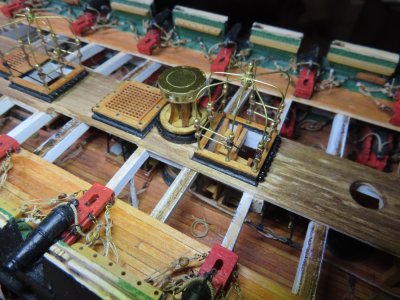
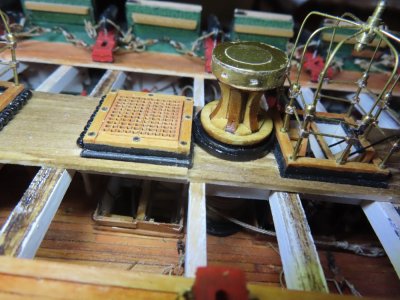
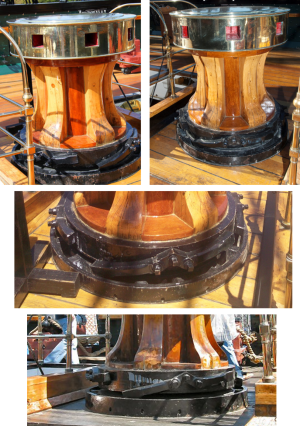
Once more, if you look at the actual capstan, its base does not look like the practicum’s capstan due to the real one’s complexity. I thought I would try to make something that suggested the look of the real one. I decided to just cut a trough around the base where the ratchet mechanism tracked. Trying to add the gear teeth and the rachets was too much, too small, and would not be seen as everything is colored black. The hard part for me was setting the vertical height of the router bit. There aren’t any fine vertical adjustment controls for the Dremel drill stand. Using a piece of actual USS Constitution oak wood leftover from when I used it on the model’s keel, I drilled a ¼” hole in it, inserted a dowel, and mounted it into the divider. It was used just because it happened to be the right size. After a couple of false starts, I got the divider to cut a circular trough. The outside wall ended up being very thin and fragile, which I reinforced with CA glue. Some unintended holes were patched with sawdust and CA glue. The base was then painted black. Once everything was coated with polyurethane and dried, it was installed.
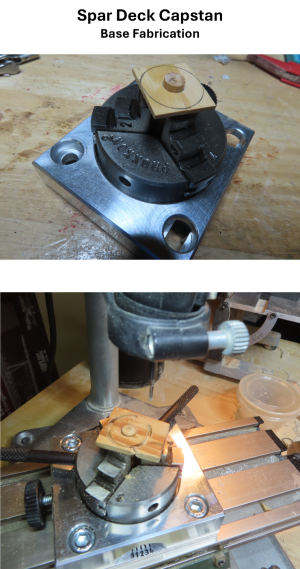
Spar Deck Capstan.png

Spar Deck Capstan Fabrication 06.png

IMG_3008.JPG

IMG_3009.JPG

IMG_3010.JPG
 
The Ship’s Wheels

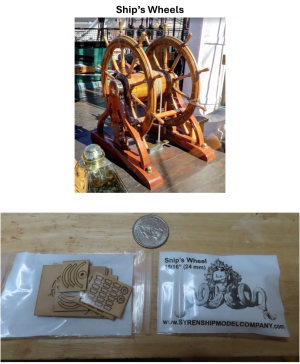
The MS kit supplies only two precast Britannia ship’s wheels; their base and frame must be scratch built. However, I don’t like metal painted to imitate wood. It just doesn’t look right to me. A few other model builders made their own wheels using skills and tools I don’t have, so I could not easily follow in their footsteps. As it so happens, Syren Model Ship Model Co. offers two laser cut kits sizes to make a wooden ship’s wheel. I chose the 15/16” (24 mm) diameter kit. The other choice was 1 1/14” (31.75mm). The detailed instructions for assembly were downloaded from Syren’s webpage.

Ship's Wheels Fab 01.png
 
Last edited:
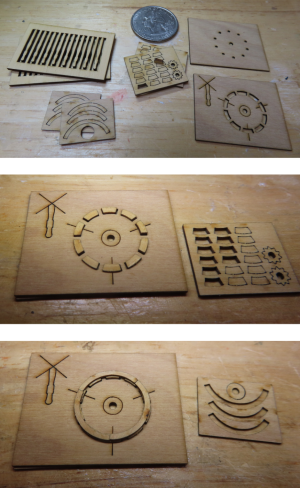
The process was quite simple, all that was needed were basic hand tools, precision, and patience. First the ten inner wheel rim segments were easily punched out of their parts board and inserted into the provided wheel jig once any excess wood char and wood were cleaned off. (A backing board with little holes was provided to push the assembly off the jig once the component was completed.) Then the three-boxwood ring segments which will form a wheel face, were positioned on the ten wheel segments. The instructions were emphatic that “yellow” (or PCV/wood) glue be used here in lieu of CA glue because time was needed to properly position the three ring segments.

Ship's Wheels Fab 02.png
 
Last edited:
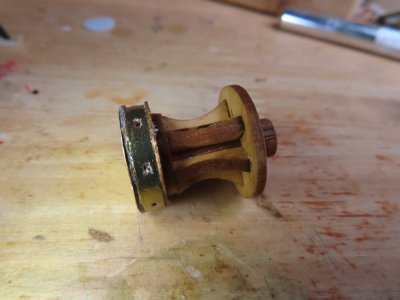
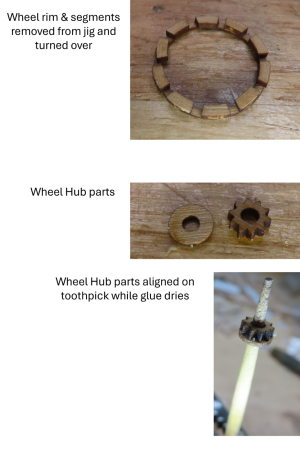
Once those pieces dried, the rim and wheel segments were removed. Image below shows the component flipped over. The partial wheel hub, which consisted of the first hub cover disc with a center hole and a star shaped hub piece also with a center hole was assembled. A toothpick was used as a temporary axial to ensure these pieces were properly centered on each other when glued.

Ship's Wheels Fab 03.png
 
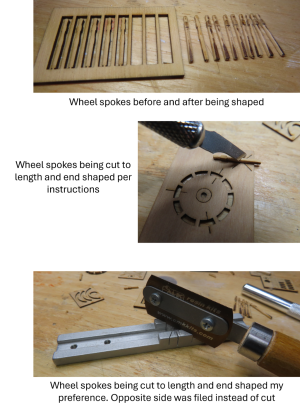
Now it was time for the wheel spokes. The kit assumes you are going to make mistakes, so it provides six extra wheel spoke blanks among other extra parts. The kit was made from boxwood which is much stronger than the woods normally used for laser cut kits. So, the instructions suggested a few ways to shape the spokes. The laser cut spoke pieces have a slight curvy shape that can be used as is or embellished to form the spoke shape. Basically, you are converting a square stick into a round one. I chose simplicity and control over speed (Dremel as a hand-held lathe) and complexity and used only sanding sticks and files. As a result, I only broke one spoke.

The jig also provided a wheel spoke diagram showing how to cut the raw wheel spoke to the proper length and shape. If you follow these instructions, you must use virgin very sharp cutting blades because the pressure required to cut the spokes with a blade can also crush the delicate boxwood ends as well. Two cuts are called for to produce a point that will fit into the star hub. Even with fresh blades, I was not getting the clean cut I wanted. I chose instead to use my razor saw and miter box for a cleaner initial angle cut and a sanding stick to create the opposing angle cut to create the required point. Once the spokes were glued and set, I carefully and slowly popped the wheel component out of the jig.

Ship's Wheels Fab 04.png
 
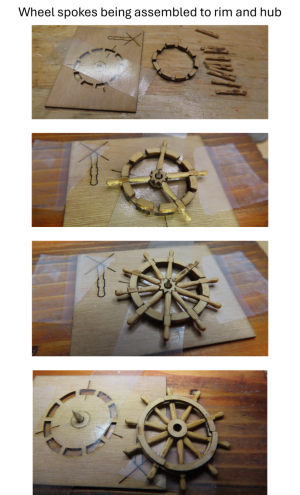
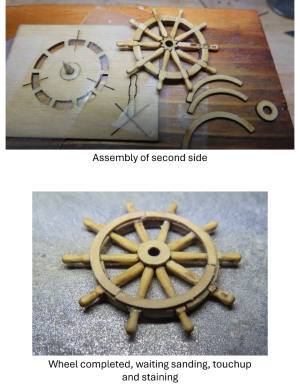
Now it was time to assemble the 10 spokes and hub into the wheel rim. That’s a bunch of small loose pieces which needed some stability control. I believe it was Peter (Der Alte Rentier) who suggested using some double-sided tape to hold down the wheel and hub while the spokes were added, which I did. In addition, I also wanted to ensure that the hub component was where it was supposed to be so I drilled a small hole in a block of wood so a little nail point would stick up through the center of the jig to perfectly alight the hub to the center of the wheel.

Ship's Wheels Fab 05.png
 
Now it was time to assemble the 10 spokes and hub into the wheel rim. That’s a bunch of small loose pieces which needed some stability control. I believe it was Peter (Der Alte Rentier) who suggested using some double-sided tape to hold down the wheel and hub while the spokes were added, which I did. In addition, I also wanted to ensure that the hub component was where it was supposed to be so I drilled a small hole in a block of wood so a little nail point would stick up through the center of the jig to perfectly alight the hub to the center of the wheel.

Ship's Wheels Fab 06.png
 
Ship’s Wheels Frame

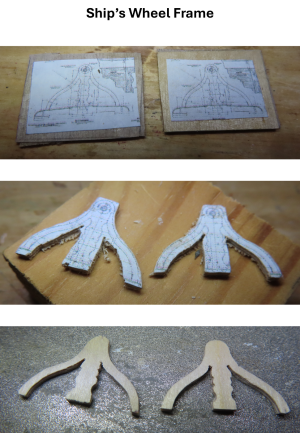
The MS kit does not provide any Britannia or laser cut parts for the frame, so they must be scratched built. I reduced the US Navy plan of the frames to scale and based on that plan; the frames were to be 3/64” thick. I realized right away that even though I was going to make this out of boxwood, they would be extremely fragile and would probably break during fabrication. I had 3-ply sheets of 1/64” and 1/32” plywood. What could be better than plywood for strength? I laminated an appropriate size of 1/64” plywood to a piece of 1/32” plywood and made two boards of strong piece 6 ply sheet plywood 3/64” thick twice, once for each frame side. Scaled US Navy images of the frame were rubber cemented to each piece. Using my 50yr old Dremel scroll saw, I rough-cut the frames out of the plywood boards. Then with needle files and sandpaper, the frames were slowly coaxed out of the board. There was no doubt in my mind that I would have broken the frames many times due to the handling of cutting, filing, and sanding if they weren’t as strong as I made them.

Ship’s Wheel Frame.png
 
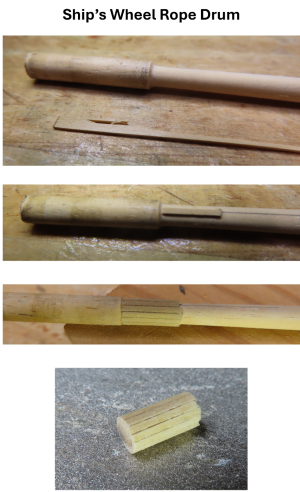
Ship’s Wheel Rope Drum

The next component to be fabricated was the wheel’s rope drum. Per the US Navy, the drum was about 13/32” long between the two wheels at scale while the MS plan (which the practicum followed) showed it to be 8/32”. If in doubt, go with the source material. What’s a difference of 5/32” among friends?

Starting with a 3/8” dowel, I reduced its diameter to 0.1425” approximately 9/64”. This allowed me to add 1/32” wide x 1/64” thick slats around the drum to bring it to its final diameter 0.1755” approximately 13/64” at scale per the US Navy plan. This was done while the drum was still part of the dowel for ease of handling. When completed and the glue thoroughly set, it was cut from the dowel. Now I realize at this scale, actually seeing this detail, especially when most of it will be covered by rope, is almost nonexistent, I did it anyways…because I could easily do it… and I felt better about it.

Ship’s Wheel Rope Drum.png
 
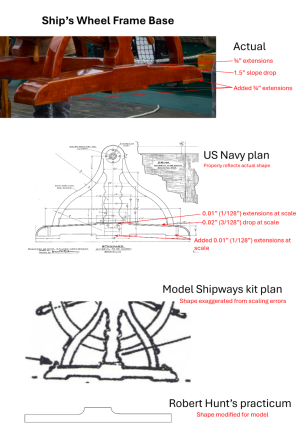
Ship’s Wheel Frame Base

The wheel’s frame bases are part of the frame but were fabricated as separate pieces. On all the plans and in the images, the bottom of the base has cutouts between the ends and the center to give the appearance that the end and center support legs have extended feet. In actuality, there were no cut outs. The effect is the result of three added ¾” thick extensions pieces fastened to the bottom on the wheelbase. These can be clearly seen in the photo below.

At scale, they are 0.01” tall openings, the thickness of card stock, and would not be seen on the model. The practicum does not attempt to model them, but it does show an apparent extension on top of the base frame to the center support. That base profile does not exist on the actual ship. The MS Plans shown a sketch of the base at scale, but it is useless to try and obtain any accurate measurements Also, there is a subtle slope of 1½” from the center support extension to end of the wheelbase, but at scale that is only 0.02”, again not noticeable. Unlike the rope drum’s slats, I didn’t feel it was worth the effort to replicate.

At the start, I was ready to attempt to convert my Dremel drill stand and Dremel tool into a pseudo milling machine, but after all this analysis, I’m just basically made two plain sticks 3/32” W x 5/64” H x 25/32” L.

Ship’s Wheel Frame Base.png
 
Back
Top