Follow along with the video below to see how to install our site as a web app on your home screen.
Note: This feature may not be available in some browsers.
Ships of Scale has incorportated an extra level of security when you log In. Please follow
on-screen prompts to acknowledge that you are not a robot via a "Check Box" or a "Pictorial Check Box Puzzle". This is needed due
to higher level of AI Activity Security.
The beloved Ships in Scale Magazine is back and charting a new course for 2026!
Discover new skills, new techniques, and new inspirations in every issue.
NOTE THAT OUR NEXT ISSUE WILL BE July/August 2026
Win a Free Custom Engraved Brass Coin!!!
As a way to introduce our brass coins to the community, we will raffle off a free coin during the month
of August. Follow link ABOVE for instructions for entering.
I had read on someone’s blog (I’m sorry I forgot where) about different uses for miscellaneous deadeyes. I had been given a bunch of odd fittings including some deadeyes from a model train hobbyist friend of mine who had no use for them, so I tried to see if I could use a couple.
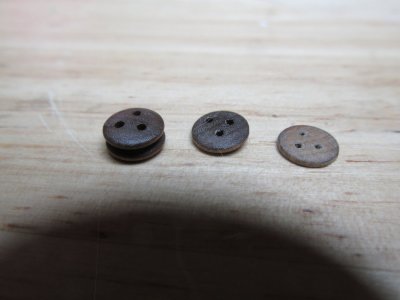
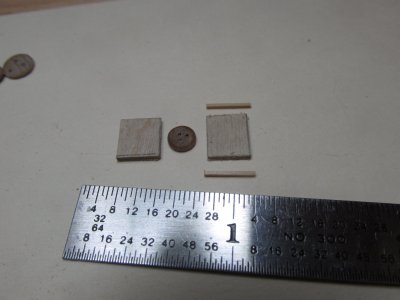
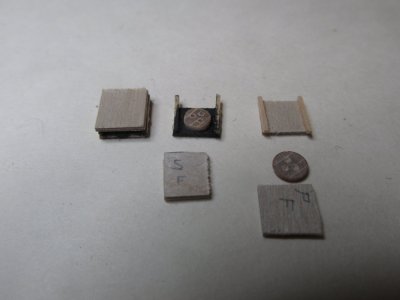
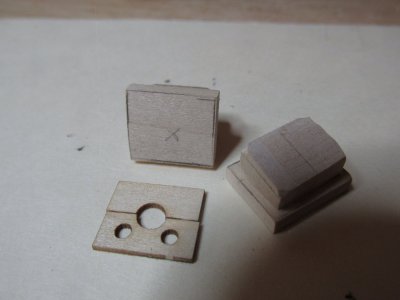
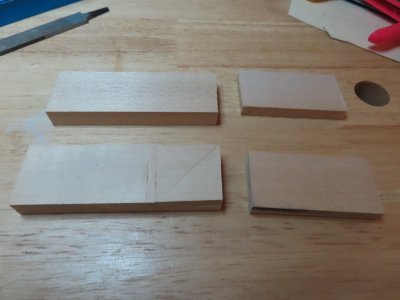
Using two 5mm Mantua deadeyes, I sliced them into halves and sanded both sides of each of the four slices till they were 1/32” thick. Then using 1/32” plywood, two rectangular pieces were cut for each of the four deadeye slices. These were to become a sandwich 3/32” thick. The plywood was used because it was convenient and only the edges would be visible, and these would be painted. Two pieces of 1/32” x 1/32” stock were used for the sides of each sheave completed the housing. The housing interior and the edge facing the deck were painted black, and the parts glued together. There was no effort made for the pulleys to rotate because they didn’t need to.
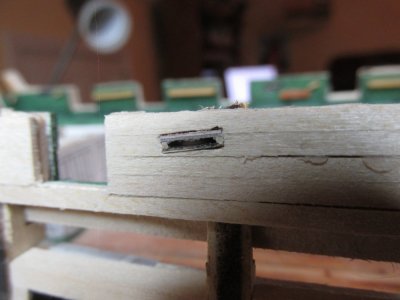
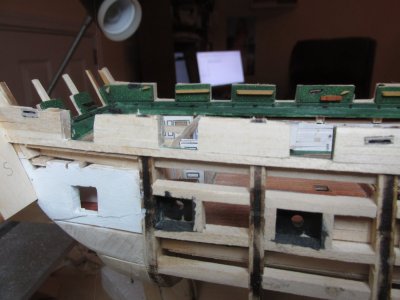
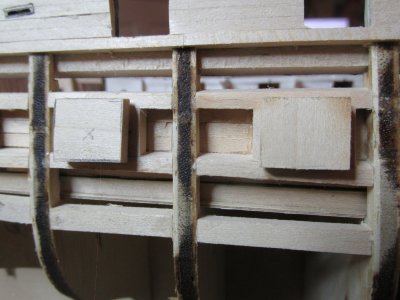
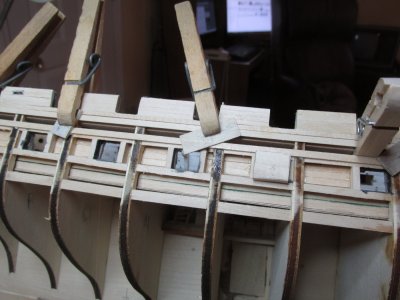
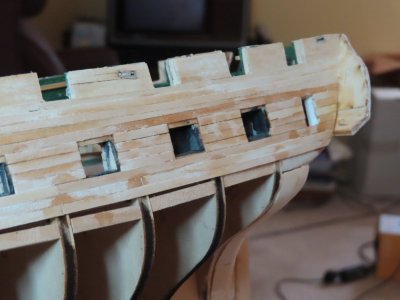
After detail filing each sheave and hull sheave openings so the sheaves would easily slide into place, they were glued in flush to the interior bulwark wall. On the hull side, they were filed flush.
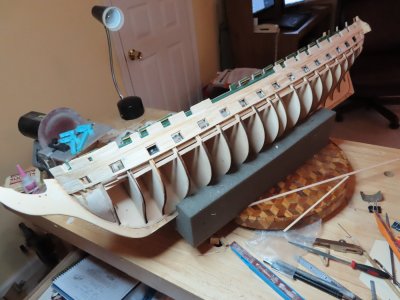
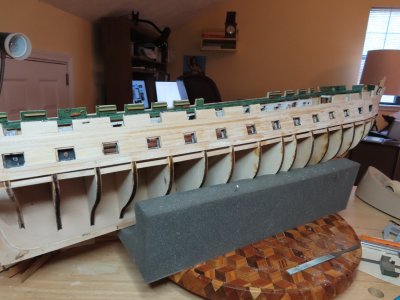
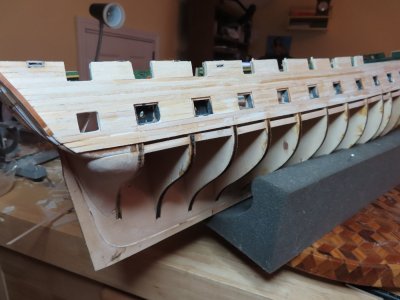
The next band of planking was the area of the gun deck ports. These are straight forward enough except that a 1/32” space must be provided around the gun port openings for the gun port lids. A simple jig was fashioned from the spacer block that was used to form the openings in the first place. A short piece was cut off and a second piece with the exact dimensions of the lid was made. The two were glued together so that when the jig was inserted into the gun port, it would create a void in the planking big enough for the lid to fit. It would also create a smooth border. Two were made.
The first line of planking for the gun deck ports was started at the top of the ports with a line of planking resting on the jigs. Then three additional lines of planking were fitted above that so they were snug against the spar deck gun port planking. Next is planking in between the ports and just below them.
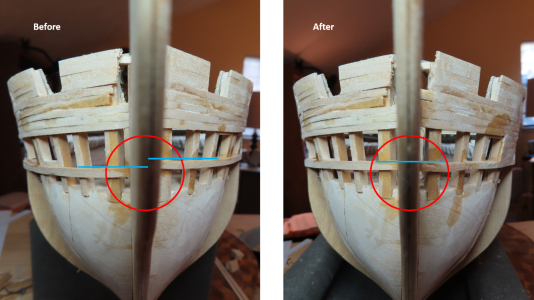
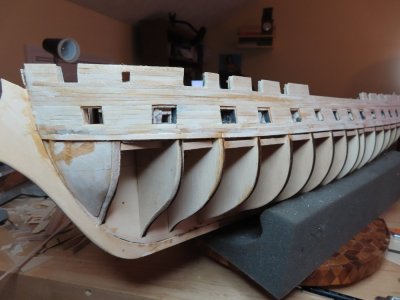
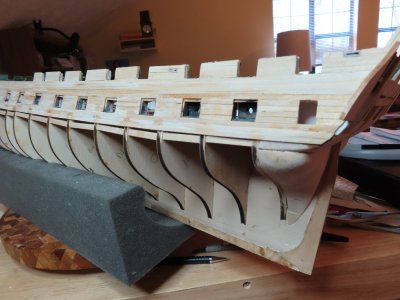
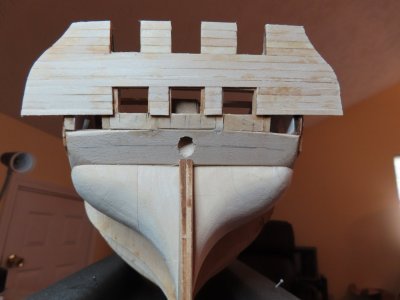
Continuing with the hull planking, I added the gun deck, gun port, sill planking on each side of the hull. As final check before I started to plank in between the gun ports, I noticed that I wasn’t careful enough with how I place those planks. Looking from the bow, one could see they didn’t line up. I had to carefully cut out a couple of inches worth of the sill plank on the port side and do it again.
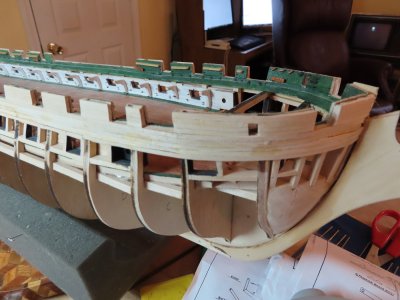
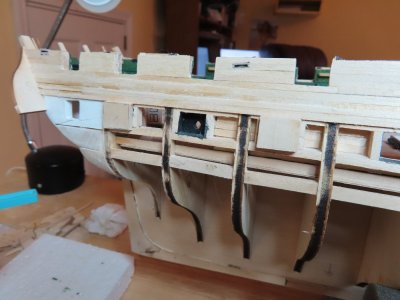
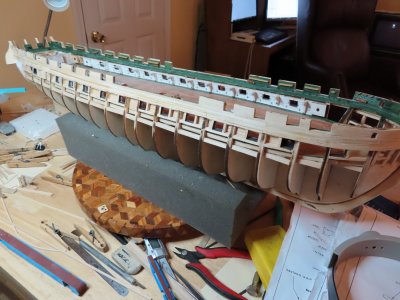
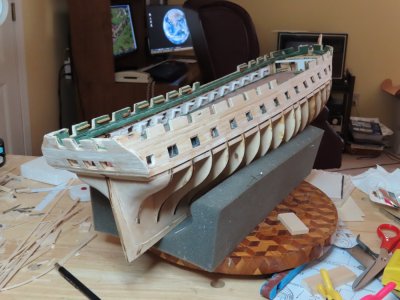
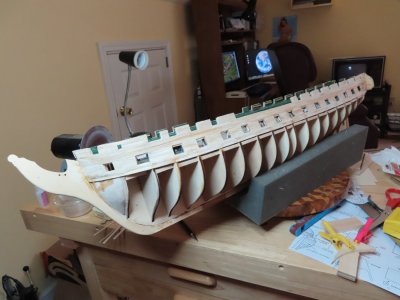
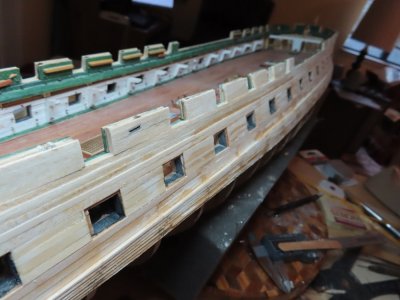
I finally finished the gun port planking plus three additional planks below the ports. The planking will work as it will be painted covering up all the “uglies.” If this were to be a natural wood finish, I would not be too happy. My only excuse (and not a good one) is that this is only the second hull I’ve ever planked.
Finally, I got to work on the transom and the quarter gallery structures. Here, I am paying close attention to Robert Hunt’s practicum because the quarter galleries are a complicated construction.
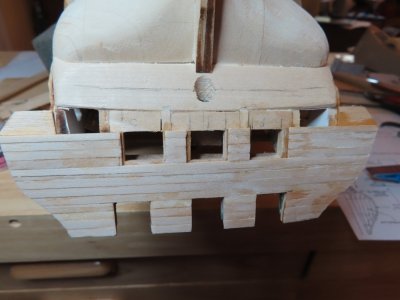
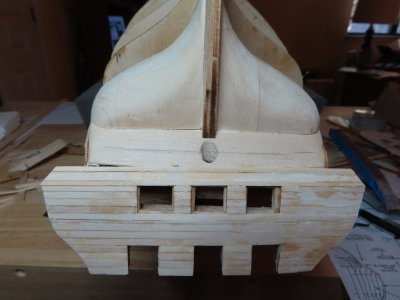
First the transom gun port areas (spar and gun decks) were planked.
Now for the hard part: The Quarter Gallery Structures. Following the practicum, Mr. Hunt indicated that the kit does not provide enough basswood billets, which I found true. The kit provides one filler block 3/8” x 1” x 3” for the lower side area and one ¼” x 1” x 2” filler block for the upper side of the quarter gallery. That’s only enough for one quarter gallery, there are two. So, he tells the builder to buy more wood. In normal times buying wood is easy, just run down to the hobby store and buy some. But in this newly strange world of the pandemic that’s not possible especially when you live in a small town and all you have is Hobby Lobby. I could have ordered on-line but that adds too much cost due to shipping and you have to wait.
However, I did have scrap wood, so I made the additional billets by lamination.
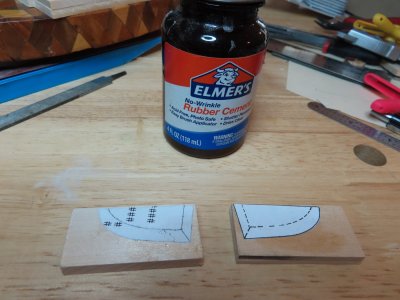
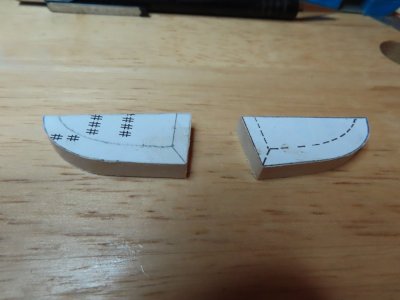
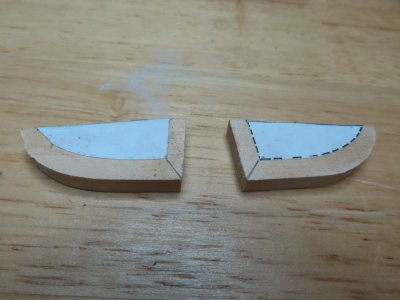
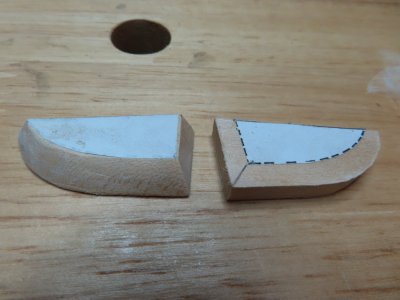
Templates for the bottom filler pieces were made from the plans. First the larger of the two templates and cemented to the billets and cut out. Then a second set of templates were cemented to the bottom of the just cut pieces. Using my disk sander, files, and sandpaper, the bottom filler pieces were formed.
That went off without a hitch…so something must be wrong. It’s never that easy. It didn’t take me long to find out what. When I dry fitted the fillers into position, the troubles I had with the transom came back to haunt me.
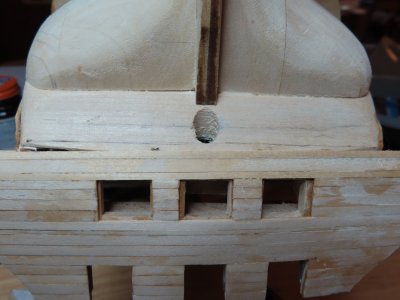
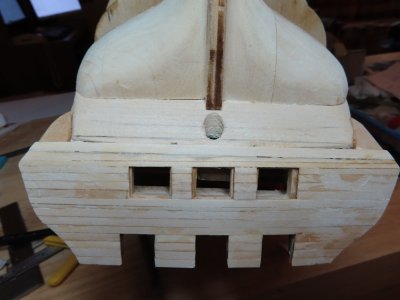
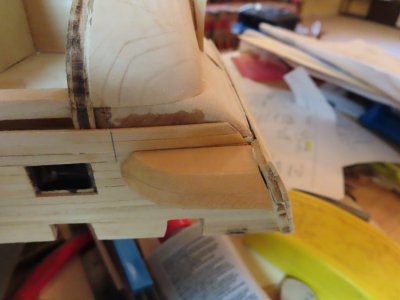
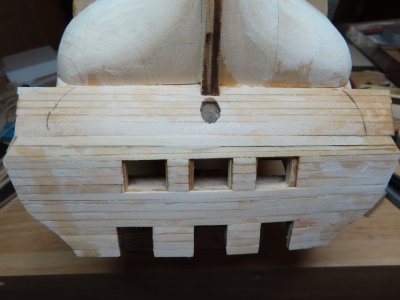
My model is close to following the plans but not exact enough it seems. The back end of this model has virtually no straight edges from which to measure and the structure is full of curves. My transom seems to be just a bit narrower than the plans so that the filler blocks are a bit too wide to fit as I had cut them out (see my pencil marks on the filler piece). In addition, either my transom is a bit crooked or the area below it is a bit off. See the line I drew just below the rudder post opening. Either way, I’ve got some work to do.
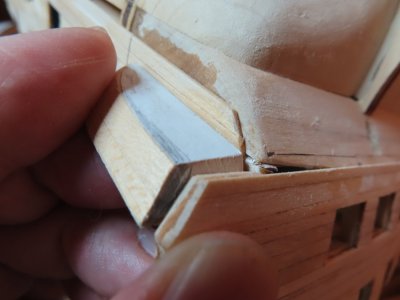
I was able to pry off the bottom two transom planks without too much effort. The new planks were shaped and glued in their place so that at least from the transom point of view, it now level at the bottom edge.
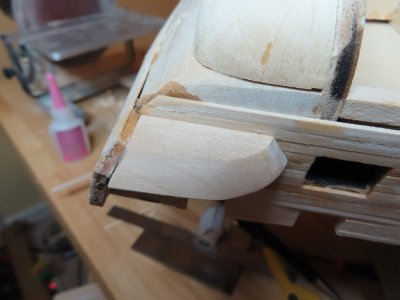
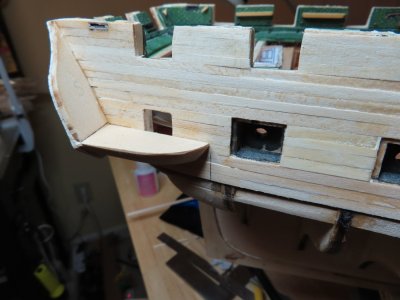
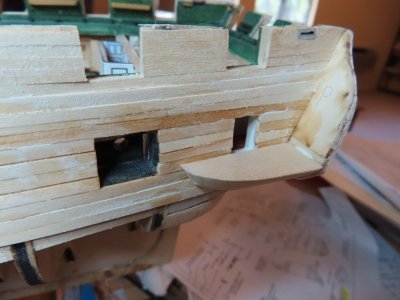
The bottom quarter galley filler pieces were then trimmed slightly and then glued into place as described by the practicum. Hopefully any errors that remain, and I’m sure they do, are small enough that they can be handled without too much consternation.
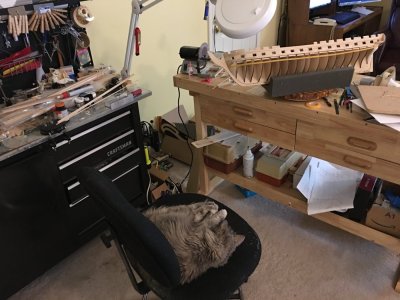
As many of you know, molasses on a cold day or ketchup pouring from a bottle are faster than I work on my model. One of my excuses is illustrated below.
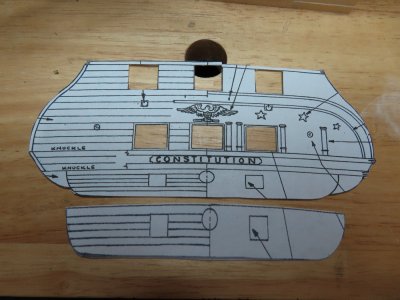
If one takes that statement at its face value, you will run into a problem. The plans show an elevation view. The lower counter is angled away from the viewer and thus is foreshortened. I had to stretch the image vertically so that its height matched the true length of the counter as seen from the side. I ran into this identical problem with the transom when I built the Rattlesnake. I’ve traced out the trim line onto the lower planks but am reluctant to do the trim until I have completed the wale, which it butts up against. Note, there are still two windows which need to be constructed below the gun deck gun port.
The wale is the next band in the hull planking process. The wale is made of seven 3/23” wide x 1/8” thick planks. According to the practicum, these planks have no variation in width from the bow up until bulkhead N where they begin to narrow.
I tried to use the tick strip method but that had problems. The variations of the plank widths is 3/32" wide to 3/64" at the narrowest width. The pencil tick marks themselves are relatively thick in comparison to variation in plank widths and I better be damn accurate in the tick spacing on the bulkhead edges. I even tried painting the edges white so I could see the tick marks better.
I've seen demonstrations both live and on YouTube and they make seem so easy. That comes with practice, lots of practice and this is only my second planked model!
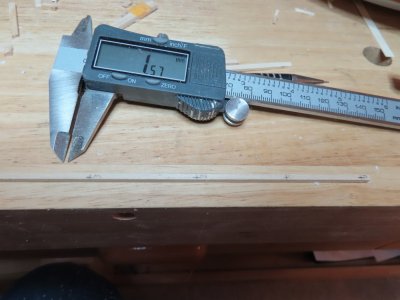
I opted for a different method, a variation of the tick strip. Instead of marking ticks on the bulkhead edges, I marked the planks with the bulkhead position lines and the corresponding width at those locations. Then I sanded down the widths and verified the width dimensions with a digital micrometer at each bulkhead location. Finally, the whole plank was smoothed to make a nice clean transitioned as the plank narrowed.
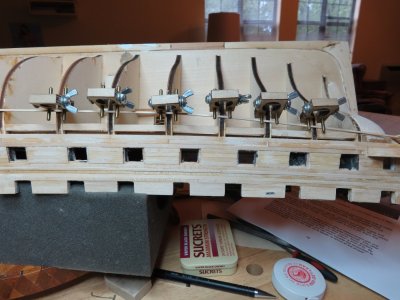
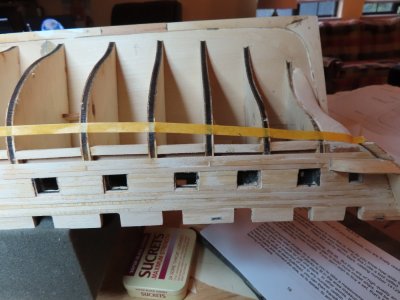
In order to determine the various plank widths, I initially tried laying a planking strip down on the bulkheads and letting it naturally curve up into the transom. To do this I tried using some plank clamps I bought from Model Expo many years ago when I was building the Rattlesnake to hold the plank in position. They were useless then and they were useless now. They are just too clumsy. So, I went to tape.
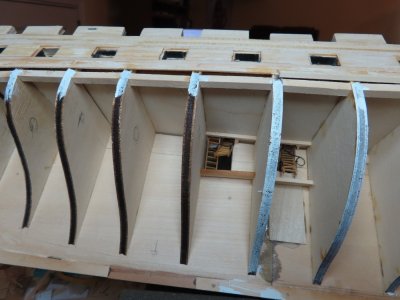
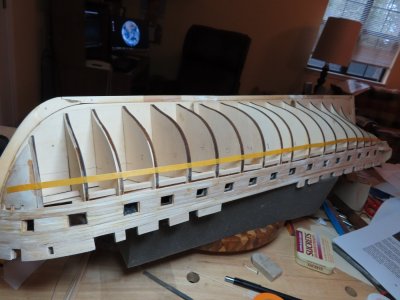
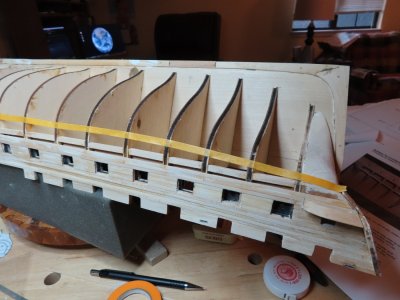
Tape was fragile because there isn’t much surface area on the bulkheads for it to stick to, so I marked the bulkhead where the bottom lowest plank edge had to follow as indicated by the tape. The pictures above were taken before I painted the bulkhead edges so I could see the tick marks and had to lay out the tape a second time after I paint them. I measured the distance from the bottom of the lowest plank from the gun port band of planking to the tape at each bulkhead from bulkhead N aft and divide by seven, the number of planks that had to fit in that space. That became the individual plank width corresponding to that bulkhead. This took some time
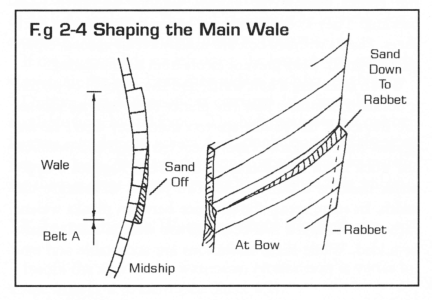
Finally, I got all the wale planks installed. But I still have one more thing to do before the wale construction was completed. I had to taper the wale to the stem rabbet as well as to the hull planking below the wale as indicated in the instruction booklet.