• SUBSCRIBE TO SHIPS IN SCALE TODAY!

    The beloved Ships in Scale Magazine is back and charting a new course for 2026!
    Discover new skills, new techniques, and new inspirations in every issue.

    NOTE THAT OUR NEXT ISSUE WILL BE MARCH/APRIL 2026
  • Win a Free Custom Engraved Brass Coin!!!
    As a way to introduce our brass coins to the community, we will raffle off a free coin during the month of August. Follow link ABOVE for instructions for entering.

USS Constitution - Model Shipway’s 5/32” = 1 ft. (1:76.8) Kit No.: MS2040

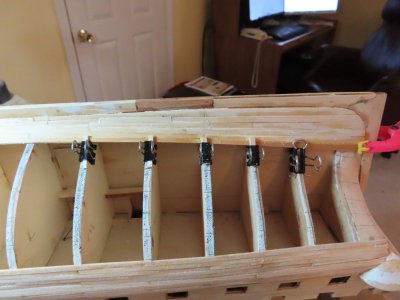
The stanchions made from music wire for the ladders going down below the gun deck, were all knocked off over time due to the manipulation of the hull in the building process. They could not be fastened strongly enough due the very small contact surface area between the music wire and the ladders. Should they get knocked off again, which is probably likely, repairing them would be difficult especially once the hull planking gets below the gun deck level. Therefore, once I decided this detail had to be sacrificed, they were permanently removed. Now I was free to work once again planking the hull without fear of future repairs.

This is only my second attempt at planking a hull, the first was the Rattlesnake. So, I’m going to take my time and hopefully avoid too many screw-ups.

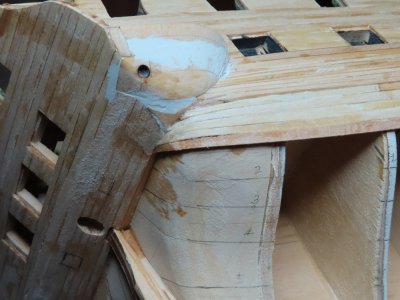
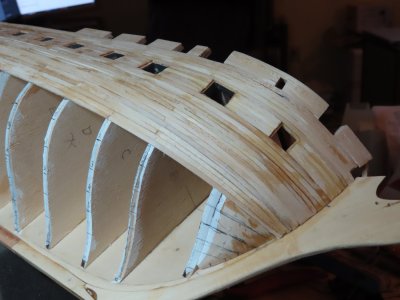
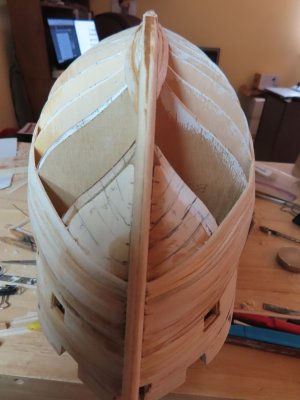
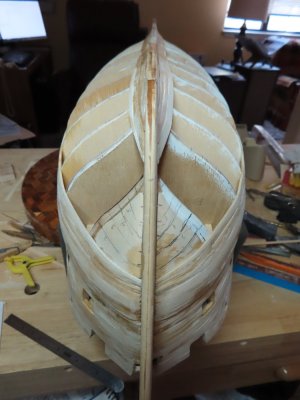
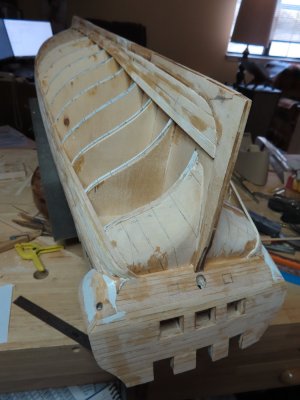
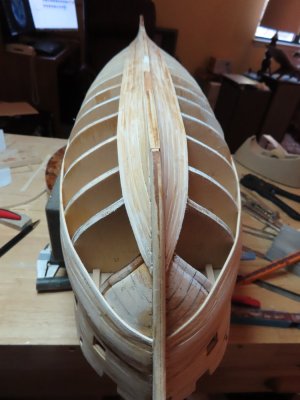
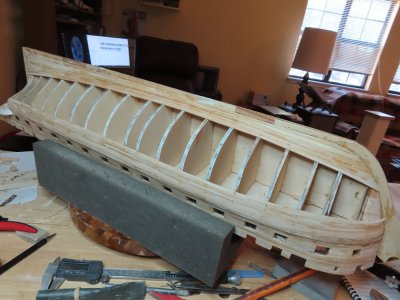
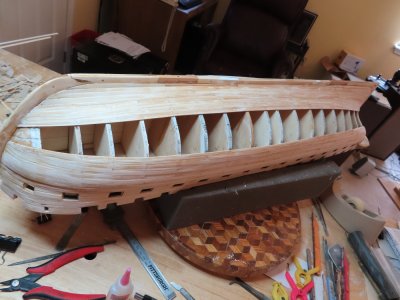
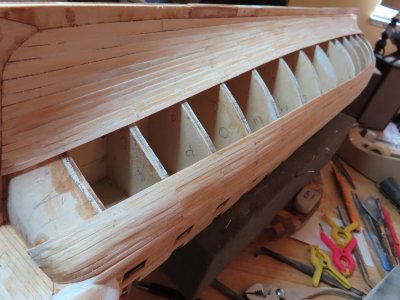
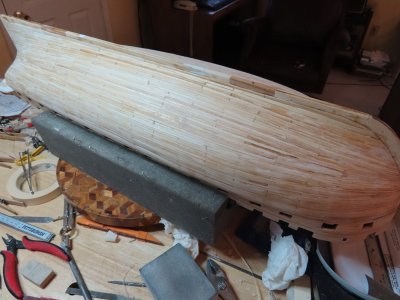
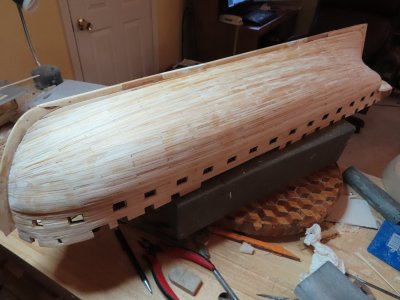
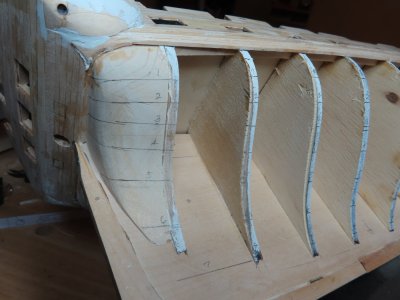
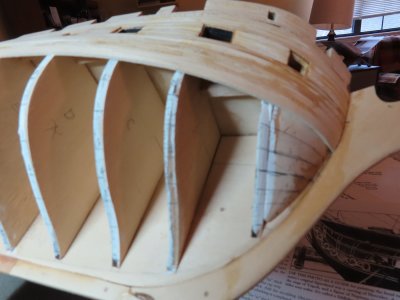
Following the instructions of Robert Hunt’s practicum, 7+ bands of five planks width each at midship position were laid out, tapering as required as they were extended to the bow and stern. Contrary to Mr. Hunt’s process of planking one side completely and then doing the other, I am alternating side to side as the bands are planked. Additionally, Mr. Hunt worked straight down from top to bottom, I other hand will work a top band first then alternate with a bottom band meeting in the middle. Should any corrections be required, I hope they will be easier in the middle somewhere rather than at the bottom where I believe it might be more difficult to correct.

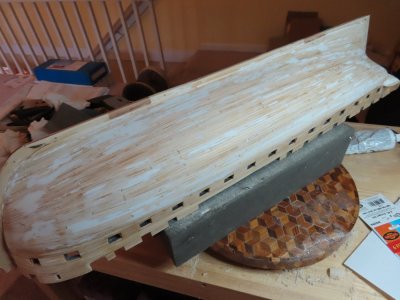
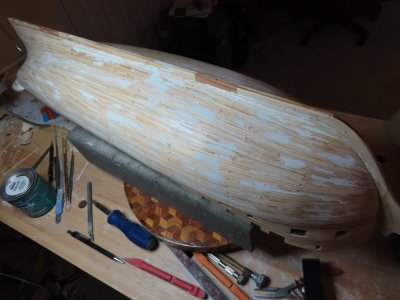
The first band has been completed. I can already see that a lot of sanding and wood fillers are going to be required. Thank goodness the hull is going to be painted and will hide most of my poor planking techniques. This gives me greater appreciation to those builders who can do this cleanly and without any paint.
IMG_1821.JPG

IMG_1822.JPG

IMG_1823.JPG

IMG_1824.JPG

IMG_1825.JPG

IMG_1826.JPG

IMG_1827.JPG

IMG_1828.JPG

IMG_1829.JPG

IMG_1830.JPG
 
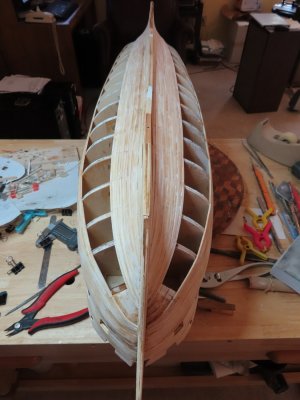
An update: As I mentioned earlier, I would do, I switched from planking down towards the keel and started planking from the keel up, hopefully to meet neatly in the middle.

IMG_1831.JPG

IMG_1832.JPG

IMG_1833.JPG

IMG_1834.JPG

IMG_1835.JPG

IMG_1836.JPG
 
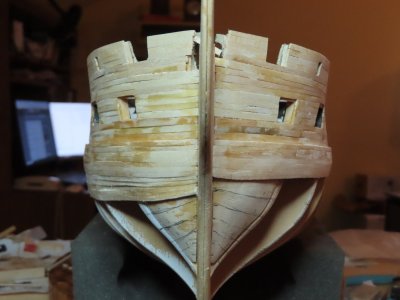
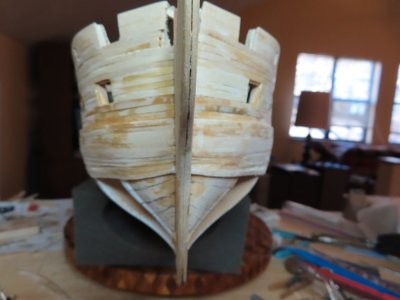
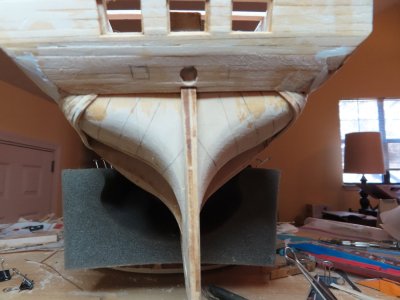
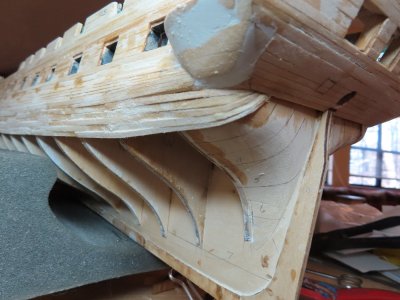
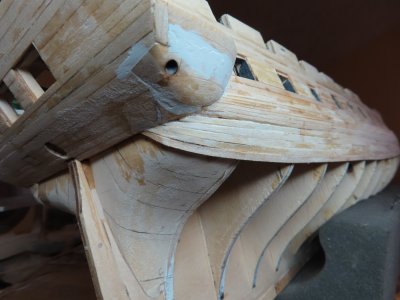
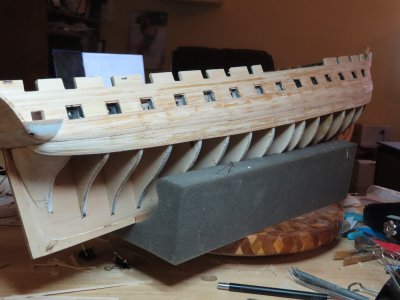
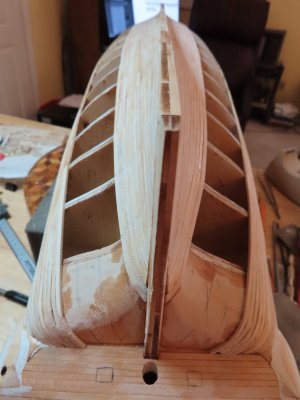
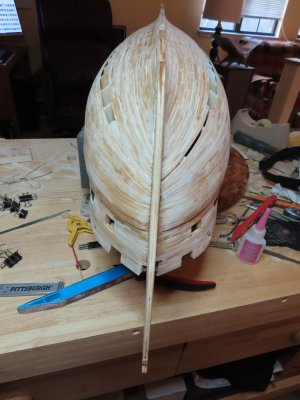
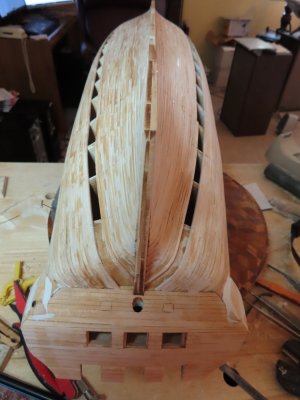
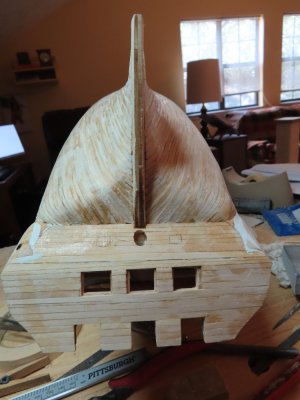
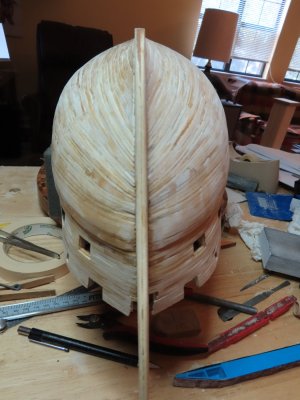
The last hull plank has been installed. As I’ve mentioned before, this is only my second hull planking and it’s a lot better than my first (Rattlesnake). Here at least I think I knew what had to done. I came close but there was a bit more stealer joints used than I had planned for. A fine model builder and kit designer, Chuck Passaro once said that if you plan the planks right, you won’t need any stealers. Well, I needed them.

That’s all a moot point because the hull has to be sanded, touched up to fill some voids, sealed, and prepped for copper plating, and painting, which will cover the planking imperfections from the critical eye.

IMG_1851.JPG

IMG_1852.JPG

IMG_1853.JPG

IMG_1854.JPG
 
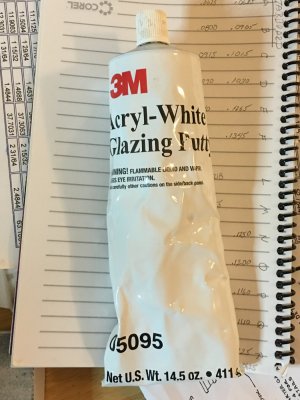
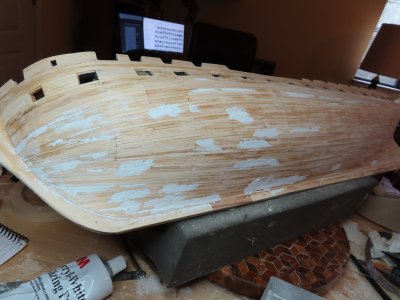
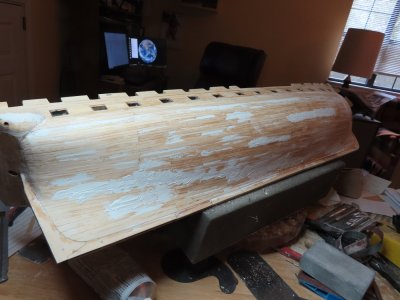
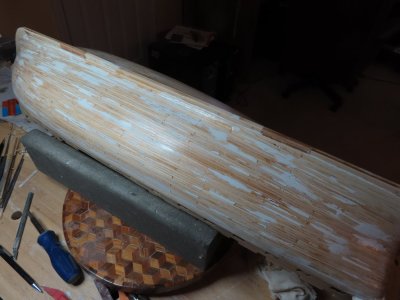
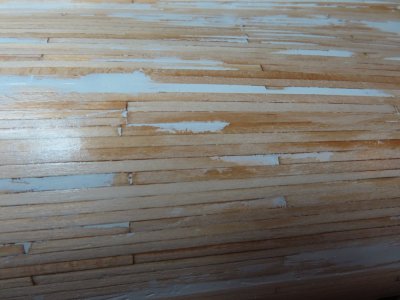
I have spent considerable time cleaning up the imperfections on the hull planking. To fill in voids, dings, dips, valleys, etc. I used 3M Glazing Putty which was recommended by Ken Forman (xKen) to a question I asked when I was following his Constitution build log on ModelShipWorld.

3M Glazing Putty.jpeg
 
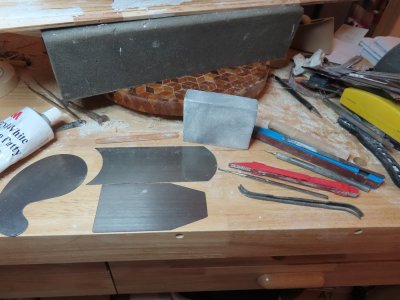
The stuff sets up in about 30 minutes, but I would wait as a minimum of four or more hours just to be sure. It becomes hard but easy to sand. Then the areas were scraped and sanded. Because the putty shrinks slightly upon hardening, I used more than one coat in many areas and repeated the process and repeated again till satisfied. Here are the instruments of removal: scrapers, sanding sticks, files, and a sponge sanding block.

IMG_1855.JPG
 
Well, here is the hull smooth as a baby’s butt for copper plating, The smoother the surface, the easier it is to plate…or so I’ve read. The part of the hull that’s to be painted, a minimum of wood filler was used as the real ship does have a slightly bumpy surface.

IMG_1859.JPG

IMG_1860.JPG

IMG_1861.JPG
 
Gun Port Hull Bolts

Before upper hull is painted, there are numerous accruements that I want to install first, such as scuppers, port windows, bolt heads, etc. They will all be painted black. If it can be avoided, don’t want to glue to painted surfaces.

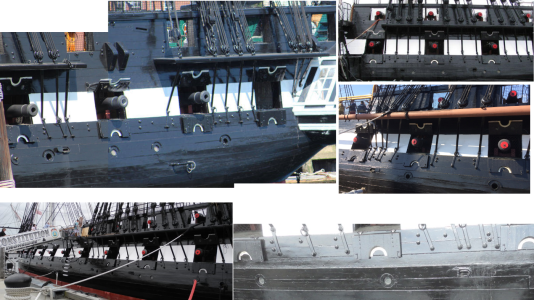
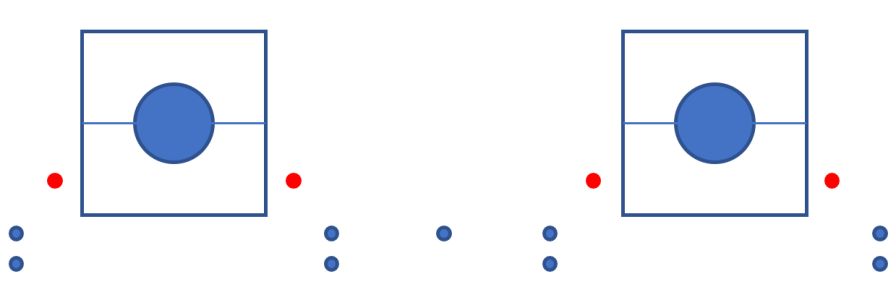
First up are the bolts that protrude from the hull around the gun ports. These are the bases of the ring bolts for the cannon’s rigging. These are NOT shown on the kit’s plans but can be seen on the actual ship. Based on the photos, I made a pattern to follow. The actual dimension varies slightly from gun port to gun port.

Edit: I’ve added additional bolts (shown in red) to indicate that these bolts are only on the spar deck level. Why, I don’t know.

Gun Ports.png

Gun Port Hull Bolt Pattern.png
 
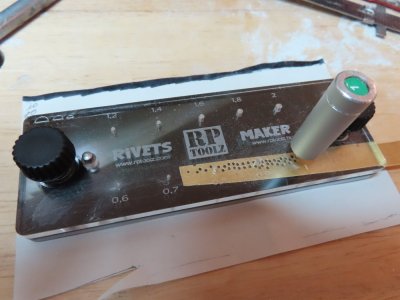
Like I did bulwark bolt heads, I punch out hull pseudo bolts heads from 0.005” brass sheet with my Rivets Maker using a 1 mm punch in contrast to the 0.6 mm punch I used for the bulwarks. This was based on visual inspection of images of the real bolts. In other words, I made a wild ass guess.

IMG_1862.JPG
 
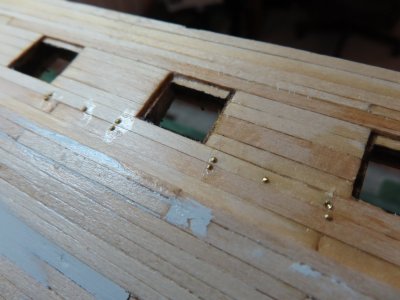
The pseudo bolts were applied using the same Min-Wax Polyacrylic sealer used to seal the hull. A very thin layer of the sealer was applied to the appropriate hull area with a small brush. Using an X-acto knife with a fine drop of sealer on its tip, the knife, by just touching a brass “bolt head”, picks it up and transfers it to the hull. The pseudo bolts were pushed into position while the sealer was wet. The picture below shows the port side hull, gun deck level with the pseudo bolts installed. The spar deck and the complete Starboard side have yet to be done. By the time the hull is painted black, these “bolt heads” will practically disappear. So why bother? It may not be apparent to the casual observer why one model looks better than another, but I believe subconsciously the fine details are perceived even if not overtly observed. So, the closer you look, the more you should see.

IMG_1863.JPG
 
The hull gun port “bolt heads are all installed. I had to make 350 pseudo bolts heads including ones I lost or were mis-formed. I didn’t take an overall picture because they would be difficult to see. The previous close up gives you an idea of what they look like.

Display Mount

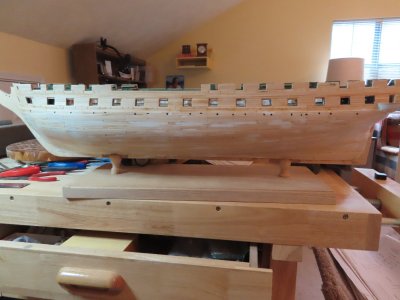
And now for something completely different: The display mount. If any of you can remember when I was building the keel, I made mounting provisions in the keel. Specifically, I incorporated two pieces of original wood from the actual ship into the keel. Within those pieces I inserted a brass tube to accept a pin from the pedestals that were to be mounted on the base board. Originally, I thought the pedestals were going to be screwed into place.
I tried buying brass pedestals from Model Expo or any other model supplier, but none had a brass pedestal with ¼” slot for the keel. I don’t have a metal lathe nor the skills to use one, so that left wood as my most practical choice.

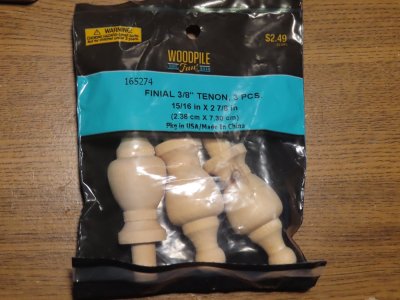
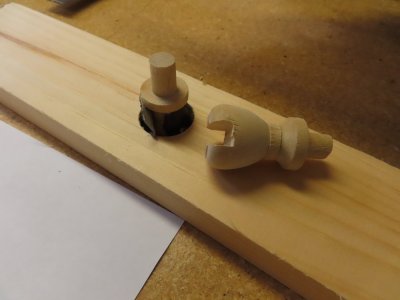
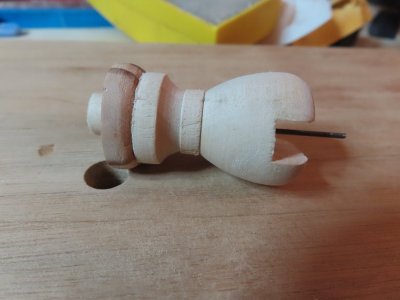
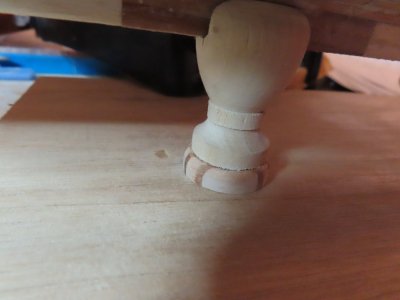
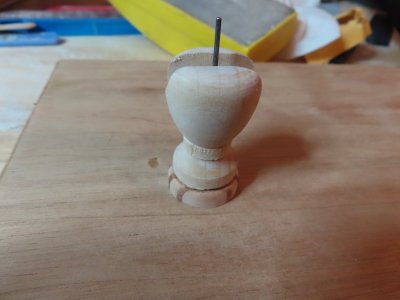
As it happened, I ran across wooden finials at Hobby Lobby which is more of a crafts store than a hobby store. But it’s all I have within 35 miles of me. The advantage of these finials is they have a tenon which means I don’t need any screws, just glue.

IMG_1864.JPG
 
OK, now I need a board so I asked a friend of mine who used to do a lot of wood working, if he knew where I could buy some hard wood. No such luck, Home Depot and Lowes just don’t sell the fancy woods, at least where I live, but he said he would check his scrap pile. What was found was a 30 year old, 11 foot long piece of White Walnut almost an inch thick and a foot wide. Yes, that would work!

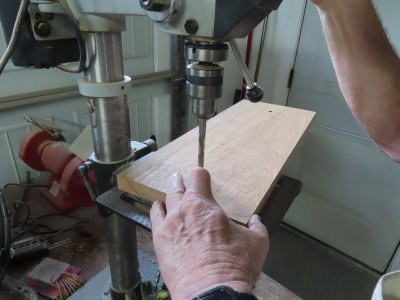
Because he was a wood worker, he had all the big toys. In no time flat we cut a piece of the board to 19” x 7.5” and drilled two 3/8” holes 13.75” apart to match the boat openings. The edges were routed, and sides sanded.

IMG_1870.JPG
 
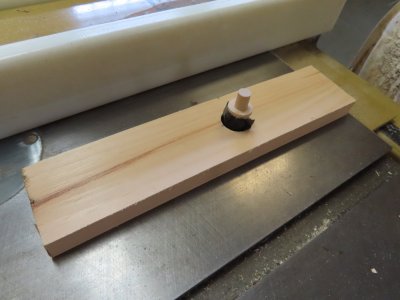
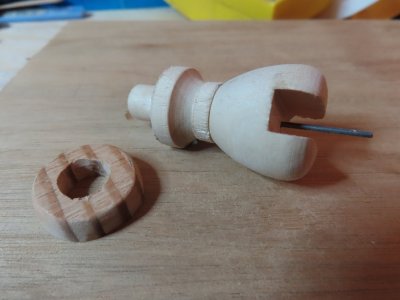
A jig was made from a scrap piece of wood by drilling a hole so that the pedestal would fit into it, top side down. A piece of tape was wrap around the pedestal to make is snug in the hole as it had no vertical surfaces. Then it was run through the table saw a couple of times to cut a slot. The results were a little rough, but nothing that couldn’t be refined. The only thing left to do was to drill a 3/64” hole down through each of the pedestal slots for the pin.
IMG_1873.JPG

IMG_1874.JPG
 
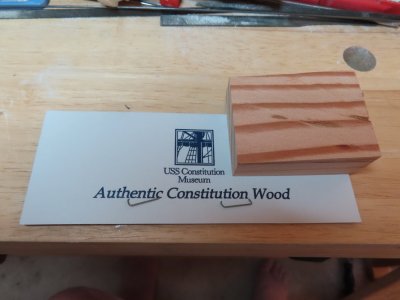
Looking at the plans, the builder will notice that the keel angles up towards the bow. The difference in height between the forward pedestal and the aft is 7/32” at the pedestal positions. This means the forward pedestal slot must be raised up. I chose to use another piece of my very limited supply of USS Constitution wood. I bought my wood around 2015-16 when it was still available to the public. I thought there would be a new supply after the ship’s last renovation in 2017, but I have not seen any for sale to the general public since.

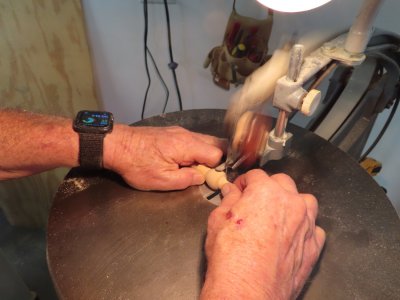
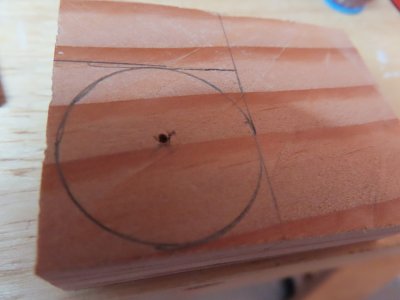
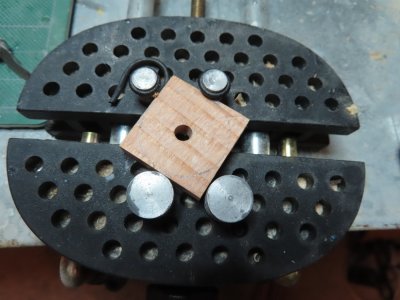
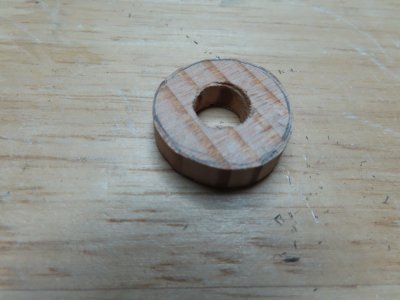
I cut a piece of the precious wood about 1” dia. and ¼” thick. I drilled a pilot hole first, then used the 3/8” bit. I hand sanded the resulting wooden “washer” so that it had a round over top edge and the proper thickness.

IMG_1875.JPG

IMG_1876.JPG

IMG_1878.JPG

IMG_1879.JPG
 
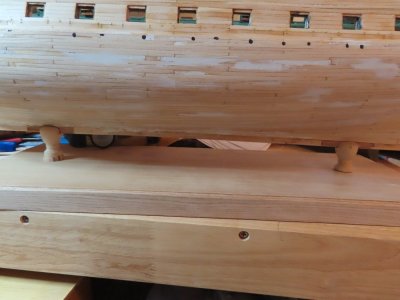
Using 3/64” dia. music wire for its strength and stiffness, two 1¼”pieces were cut using a scissor type wire cutter and inserted into pedestal. As indicated in the dry fit images below, to my surprise, it worked.

IMG_1886.JPG

IMG_1884.JPG

IMG_1885.JPG

IMG_1882.JPG

IMG_1881.JPG

IMG_1880.JPG
 
This is a complicated area of the boat. The bench must fit in a corner with sloping sides coming to an apex at the stern post. Between the stern post and the bench there is supposed to be a covered area with a grating on top, a backrest behind the bench, all sitting on a platform that has a ring assembly accessible when the grating is removed. I chose to make this platform separate from the bench although in hindsight, I could have made both the bench and platform from one piece of plywood. Here are the two components-stained mahogany before installation and glued into place.

View attachment 598350

View attachment 598351
That’s a lot of work for a boat!
 
Back
Top