• SUBSCRIBE TO SHIPS IN SCALE TODAY!

    The beloved Ships in Scale Magazine is back and charting a new course for 2026!
    Discover new skills, new techniques, and new inspirations in every issue.

    NOTE THAT OUR NEXT ISSUE WILL BE MARCH/APRIL 2026
  • Win a Free Custom Engraved Brass Coin!!!
    As a way to introduce our brass coins to the community, we will raffle off a free coin during the month of August. Follow link ABOVE for instructions for entering.

USS Constitution - Model Shipway’s 5/32” = 1 ft. (1:76.8) Kit No.: MS2040

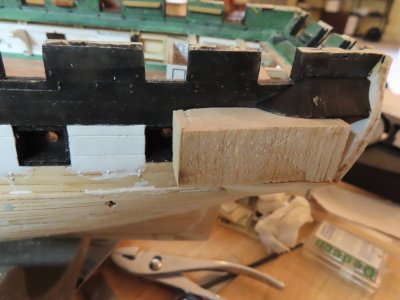
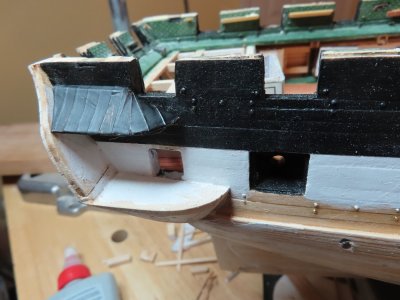
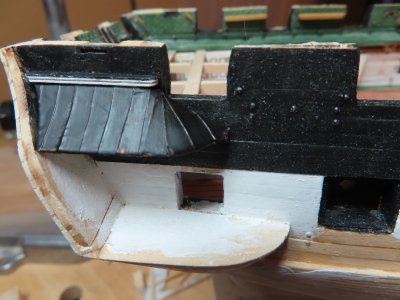
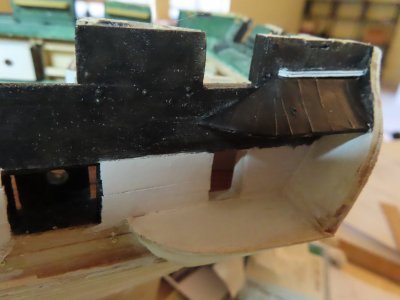
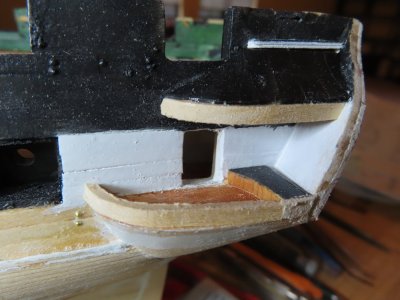
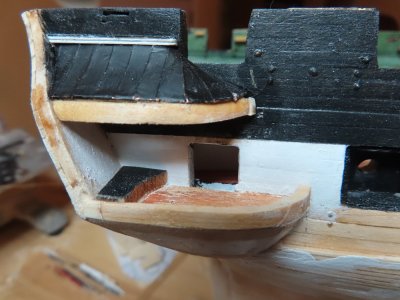
Once I made the molding, I had all my parts for the quarter galleries’ roof. The roof molding was cut and painted first. Using the gallery spacer block, the roof pieces were glued into place level with the gallery floor. Touch up painted was added to the remaining exposed transom wall. Finally, the roof molding was added to the roof. So far, so good.

IMG_1918.JPG

IMG_1917.JPG

IMG_1919.JPG

IMG_1920.JPG
 
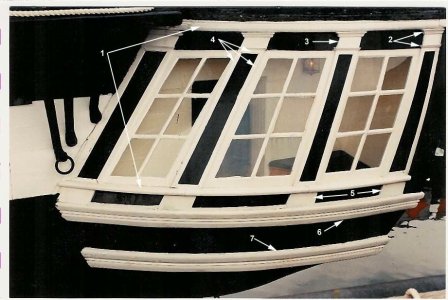
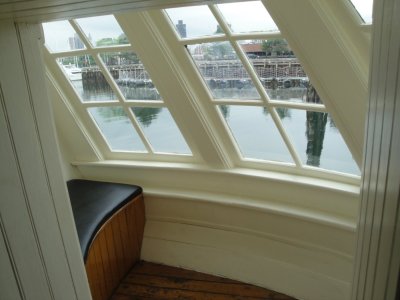
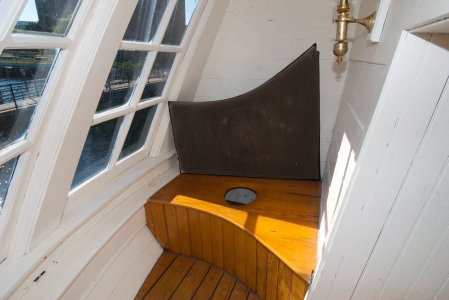
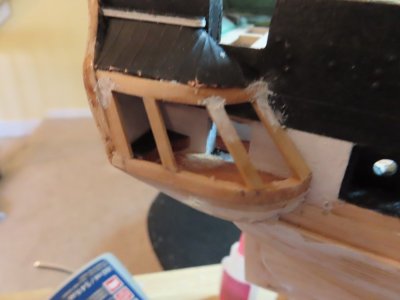
Nobody, as far as I know, has attempted to place anything inside the quarter galleries. So here I go again. In the practicum there is a photo (HP7.2.5.-1) of the port quarter gallery annotated with numbers for the instructions of the practicum. It also shows that an outside viewer can see the interior of the quarter gallery. What can be viewed is a bench seat, which on the starboard side lifts to reveal a privy, and a wall sconce light. The bench seat is easy to make, the sconce is not. If I was adding interior lighting, I might have considered it, but since I have no electrical skills, the light is out (pun intended).

HP7.2.5-1.jpg

Interior - Port 02.jpg

Interior - Starboard 02.jpg
 
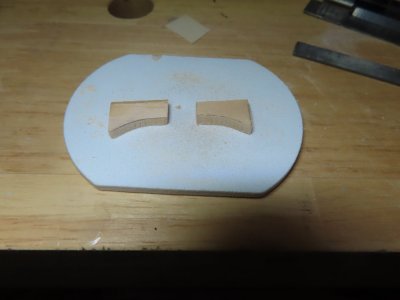
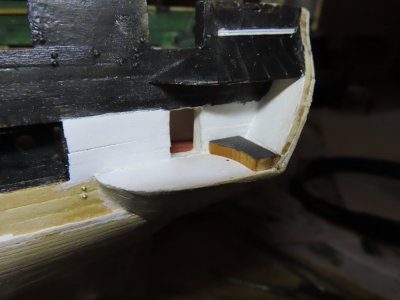
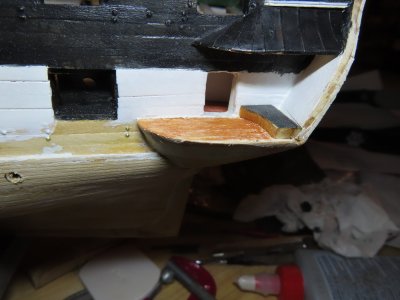
Constructing the bench seat was straight forward. Using the Starboard image with the privy revealed, I eyeballed the shape and height of the bench. The base was scored to give the impression of vertical boards. Also, the image revealed that the floor had to be repainted as I had initially painted interior completely white. This meant scraping the white paint off with an X-acto blade and staining the wood. By the time the windows are installed, I doubt any fine details will be visible, but the viewer will know something is in there. Again, my philosophy, the closer you look, the more you see. It keeps the viewer engaged.

IMG_1922.JPG

IMG_1923.JPG

IMG_1924.JPG

IMG_1927.JPG
 
Quarter Gallery Windows

The key to Quarter Galleries, as I see it, are the windows whose sides aren’t necessarily parallel, nor perpendicular to the sill, and are different shapes from each other. Get those dimensions right, and everything else will fall into place, get them wrong, well…. To make matters a bit more challenging, the kit plans do not show true dimensions of the windows and nor could I find a US Navy plan that showed them either. The kit does supply laser cut windows, but their dimensions don’t consider the side view distortions resulting from curved surfaces of the galleries printed on a flat piece of paper. Additionally, the practicum states: “they are much too thick. If you do use them, you will need to sand them down to about 1/16" to 1/32" thickness” If anyone plans to use the kit’s laser windows, I just can’t see how they would fit properly.

Every build log I have looked at has galleries built slightly different from each other and the plans, some better, some worse. I’m pretty sure my gallery dimensions are different from everyone else’s as well including the practicum and the US Navy’s so. as an initial crack at figuring out the dimensions, I’ll use the practicum and the US Navy plans only as guides not gospel. The 1926 US Navy side view plan of the galleries has cross sections from which I hope will help me figure out the approximate dimensions. I will let my model dictate the final dimensions.

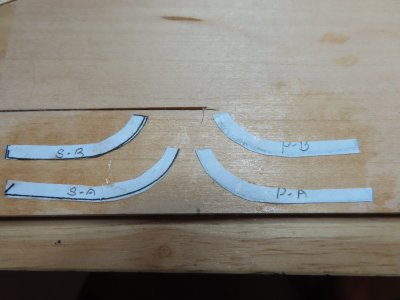
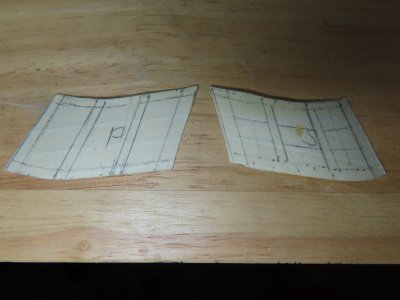
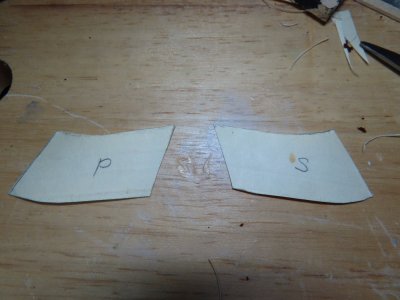
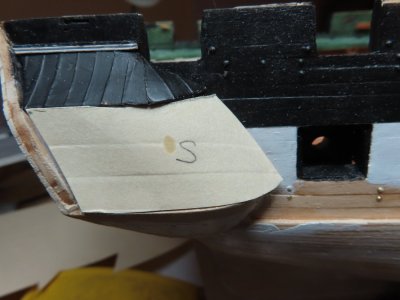
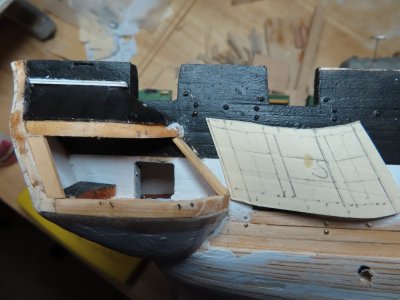
My first attempt, hopefully not my first of many attempts, was to make a card stock template of the surface of the gallery window area. What makes this this a bit tricky is the template is three dimensional as it curves around. Based on the US Navy plans, the windows have a slight vertical bow although the plans did not show a view to indicate whether there was a horizontal bow. The vertical bow was so slight, I don’t think it would be discernable at model scale. My template does not capture that bow. It will be used mainly to get the overall window positions and dimensions.
IMG_1925.JPG

IMG_1926.JPG
 
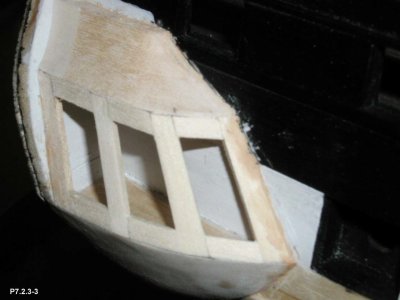
The practicum would have you install the vertical posts first then install the window headers and sills. That is six horizontal pieces that must align perfectly. Mr. Hunt came very close to achieving that. Kudos to him, but I don’t know if I could do the same.

P7.2.3-3.jpg
 
I chose instead to construct the headers and sills slightly differently. Instead of installing the posts first, I decided to install the headers and sills as one piece each, guaranteeing the horizontal lines are true. Since the verticals don’t have to line up with each other, any slight error with those will be unnoticeable, at least that’s the plan.

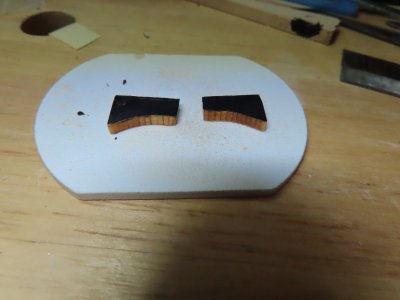
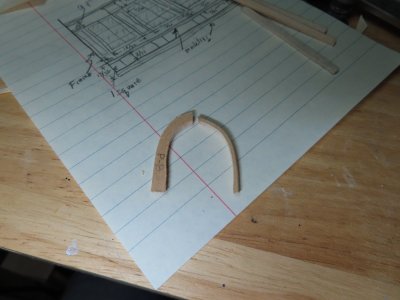
To make the sills and headers, I initially tried to bend the wood with disastrous results, so I cut them out as blanks. Then they were carved to their final shape by trial fitting, filing, and sanding. As it turns out, I was a little short in length, so I had to fill the gaps with additional wood (color change).

IMG_1928.JPG

IMG_1929.JPG

IMG_1930.JPG

IMG_1931.JPG
 
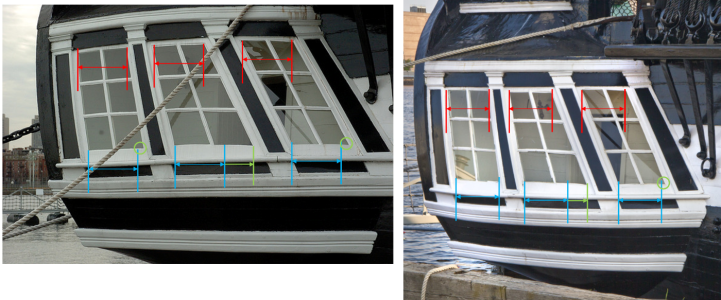
While I was fiddling with the headers and sills, I kept looking at images of the quarter galleries trying picture in my mind their true shapes. Using images that were taken at an angle to show their proper shapes better, I noticed something about their dimensions. All three of windows have the same width for their header (as measured from the glass panes). The vertical elements of course are at different angles. The sills of the outer windows are very close to being the same width, but not quite. The center windowsill is approximately a half to two thirds of a pane of glass wider. I checked this on two separate images with the same results.
In the picture below, the red dimensions are all the same as each other as are the blue ones per photograph. The green dimension indicates dimensional differences. The kit supplied windows do not even come close to these proportions. Now I have an idea as what my model windows should emulate.
Quarter Gallery Views.png
 
Using the window template, I made earlier to help me get a handle on what the windows should look like on my model, I sketched out the window frames by eye. Not surprisingly, when laid out flat, you can see the complexities of the window frames.

IMG_1932.JPG
 
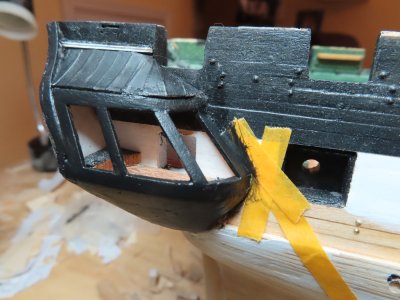
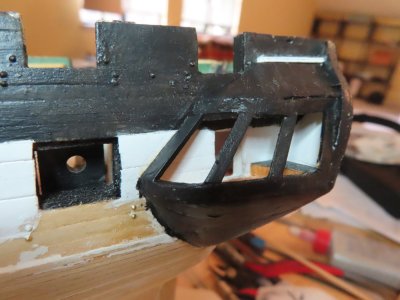
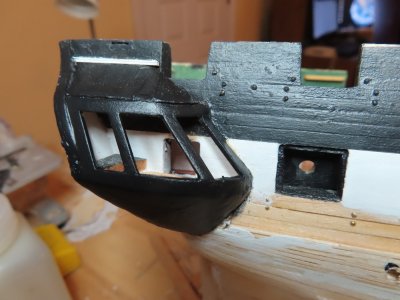
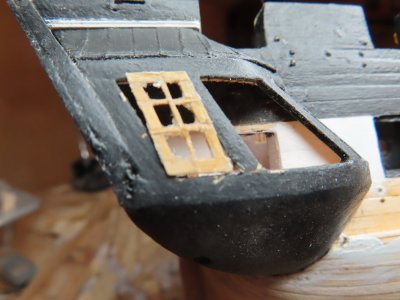
Based on the template, the vertical window posts were added to the outside edges of the galleries. Then using the template marks, I made on the sill and header as a guide, the two inner posts were added. Where there were some minor gaps, filler was used. Once everything was sanded, per the practicum three coats of polyurethane were applied and sanded. Finally, a couple of coats of black hull paint.

IMG_1933.JPG

IMG_1934.JPG

IMG_1935.JPG

IMG_1936.JPG

IMG_1937.JPG
 
The Quarter Gallery Window Sashes

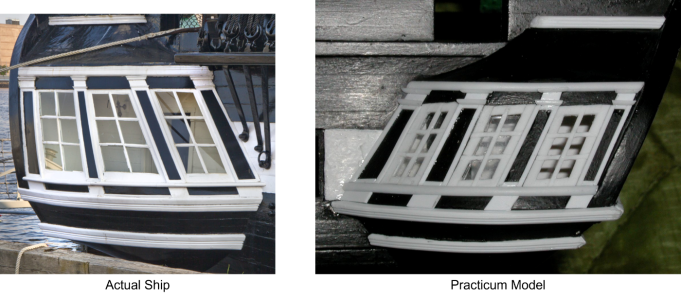
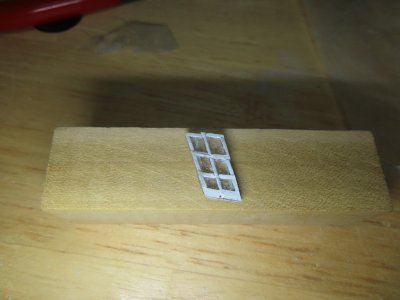
For the skill level of builders Mr. Hunt was aiming his practicum at, he chose throughout his practicum, to make certain tasks easier, but being the masochistic model builder that I am, I’ve chosen to take the path less traveled…again. Instead of using styrene strips indicated in the practicum to fabricate the sashes, I decided to stick with wood. Because he chose styrene strips, he had to use the strip sizes available to him, which in my humble opinion, were too large for the scale of the model as one can see in the comparison below. The header and window stiles (side frames) are much wider than what is shown in the actual photograph. Additionally, the sills on the actual ship appear twice as wide as the stiles and header. Don’t get me wrong, without a side-by-side comparison I would be very satisfied if my model looked anything like Mr. Hunt’s. But I do have a side-by-side comparison sooooo… I’m going to try to get my window sashes as close to looking like the real ship as I can.

Quarter Gallery Window Comparison Model v Acual.png
 
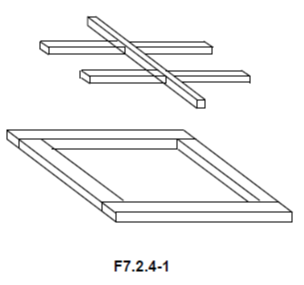
For the sashes I am using 1/64” birch plywood for its strength. My second choice would have been boxwood, Since the final product will be painted white, no one will know what kind of material was used. The sill will use 1/16” x 1/64” plywood. The stiles and header will be 1/32” x 1/64” plywood. And the muntin (sash bars) will be 1/64” x 1/64” plywood. All these strips of plywood will be cut from a 1/64” birch plywood sheet using the Byrne’s saw. The plan is to follow the practicum’s method of construction…for the most part.

F7.2.4-1.png
 
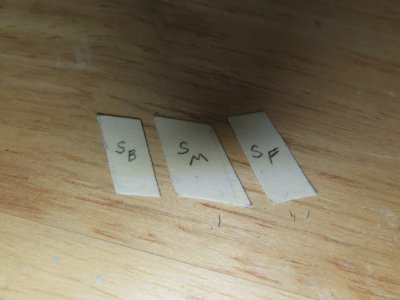
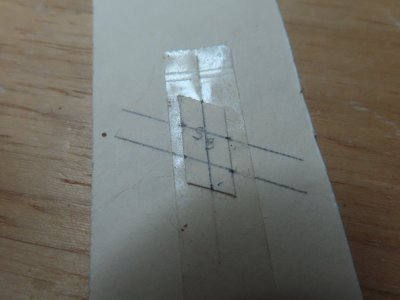
The first thing the practicum tells you to do is make a template for each window opening, which I did. It then has you double side tape the template to a piece of card stock, which I did…wrong. I laid down the tape on the card stock and then stuck the template on the tape, so it was card stock tape, then template. That left the template without a sticky top surface, which was the whole point of the double-sided tape. Got it right on the second attempt.

IMG_1938.JPG

IMG_1939.JPG
 
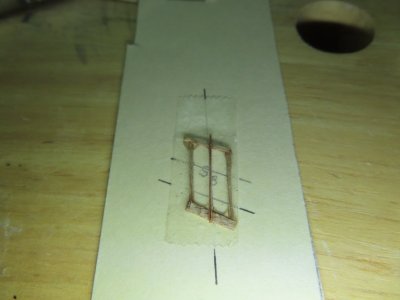
The sill, header and styles were laid down on the tape which held them fast. Next came the vertical muntin which was laid down very carefully into position. Most of the pieces were made a bit long so they could be handled easier. The excess would be filed off later. A few fine drops of CA glue at the joints and everything was what it should be…or not. Here is where my cunning plan started to fall apart.

IMG_1940.JPG
 
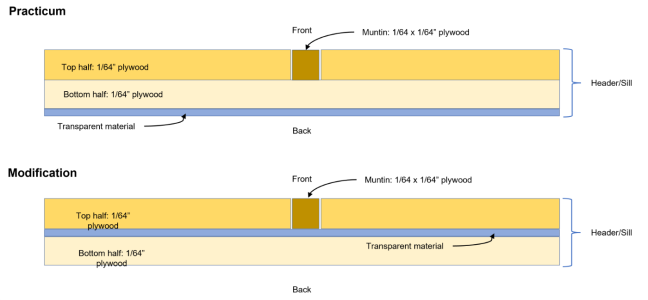
Because Mr. Hunt used styrene, he didn’t have to think about painting. I knew that I had to paint the sash before the last step installing a transparent material (not determined yet) for the windowpanes. Additionally, I noted that Mr. Hunt’s windows had a gap between the muntins and acetate he used for the panes. When he finished constructing his sash, he’d flip it over and apply the acetate to the inside surface of the window border. Therefore, his muntins were 1/64” above the acetate. This required that I modify his method slightly.

As shown below, the modification would require that the transparent material be sandwiched between bottom and top elements of the window border pieces. This would also increase the gluing surface for the muntin installation thus increasing the structural integrity of the window sash… Or so goes the theory. Next immediate steps: remove the vertical muntin, remove any excess glue, smooth the surface, and paint the outside border of the partial sash white.

Sash Modification.png
 
It’s been about 10 days, and I am still working on the first sash, and it’s been a b*tch of an effort. I contemplated what material to use for the “glass” panes. Some years ago, I spoke with the master builder, David Antscherl at one of the NRG (The Nautical Research Guild) yearly conventions. He’s also authored numerous ship modeling books. I admired one of his models he had on display and asked what material he used for his windows. He replied that he used mica. A friend of his had given him a large quantity of mica scraps which David said would last him a lifetime. Well, here was my opportunity to try that out. Not having a friend with excess mica to dispose of, I found what I needed on www.etsy.com for a reasonable price. When I received the package, the mica was all that I hoped it would be, free of defects, crystal clear, and very thin.
IMG_1942.JPG
 
Following my plan, by laying down the inside frame pieces on the template which was fastened down with double sided tape once again. These were glued together at the joints with CA glue. I tried to only paint white the inside surfaces of the muntins. I wanted the gluing surfaces bare wood. I tried sanding off the excess. It looks worse in the photos.
IMG_1941.JPG
 
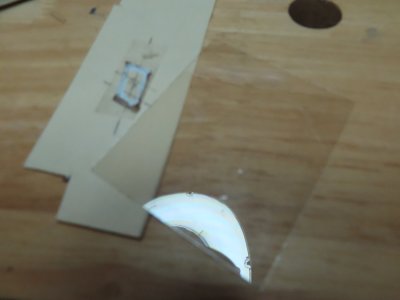
Next came the mica. Using just scissors, a slightly oversized piece was cut from the main sheet. I planned to trim everything at the finish. CA glue was applied along the top surface of the frame and the mica laid on top.

IMG_1943.JPG
 
It was at this point; I saw the major flaw in my modified cunning plan. I didn’t have a sticky surface anymore to hold the remaining 16 pieces to complete the sash. Everything now had to be glued to the slippery mica. Mica is very smooth and CA glue needed something to grip to. Even worse than that, because the sash pieces were very short, thin, and narrow, they tended to jump from the surface of the mica to my CA needle applicator due to surface tension of the liquid CA. Needless to say, there were numerous “do overs.” I should also point out that all the pieces had to be pre-painted while still a stock of wood, then cut to size.

IMG_1944.JPG

IMG_1945.JPG
 
Finally, I was able to get everything glued together. Peeling the completed sash from the tape was a delicate maneuver which didn’t go as smoothly as I would have liked it. The mica surface lifter off the inner frame which had to be glued back down…again.; some sash pieces had to be reglued into place.

Finally, I was able to trim the excess and smooth the edges. I had a complete window sash with just one minor problem…It didn’t come close to fitting the window opening. Somehow through all the machinations of gluing, parts coming apart, re-gluing, etc. the vertical angle of the side of the sash changed. But I proved the concept through trial and lots of errors.

To make things slightly easier (not simpler), my next attempt will attempt to build the window sash from the outside, inward as opposed to the way this one was made, inside outward. All 15 pieces of the outside sash component will be placed on the tape first and glued all at once, then the mica, and finally the four larger pieces of the inside sash. Hopefully this will work better, go faster, and everything will be cleaner, neater, and remain glued together.

IMG_1946.JPG
 
Well, Plan B failed. I did what I intended, built the sash in reverse and it was easier than I had hoped, but like Plan A, not practical nor accurate. This time the problem was removing the partially constructed sash from the tape without breaking it. I thought I would be able to paint it before the mica was attached and secured with a backing bringing the total thickness to about 1/32”, but when I checked to see if it even fit properly in the window opening, well you can see what I saw in the image below. I hadn’t even cleaned it up, no point.

I believe the basic problem is that the component is so small and delicate, any error compounds and magnifies any distortion. I still have at least Plans C (another method), D (jacknastyface2 method*) and E (Practicum’s method). So, it’s off to Plan C where I will forgo using a template and get my sash shape directly from the window opening. Stay tuned to the next installment of “Crash & Burn or Possibly Survive.”

* jacknastyface2 is a fellow model builder on another site

IMG_1981.JPG
 
Back
Top