



• SUBSCRIBE TO SHIPS IN SCALE TODAY!

    The beloved Ships in Scale Magazine is back and charting a new course for 2026!
    Discover new skills, new techniques, and new inspirations in every issue.

    NOTE THAT OUR NEXT ISSUE WILL BE MARCH/APRIL 2026
  • Win a Free Custom Engraved Brass Coin!!!
    As a way to introduce our brass coins to the community, we will raffle off a free coin during the month of August. Follow link ABOVE for instructions for entering.

USS Constitution - Model Shipway’s 5/32” = 1 ft. (1:76.8) Kit No.: MS2040

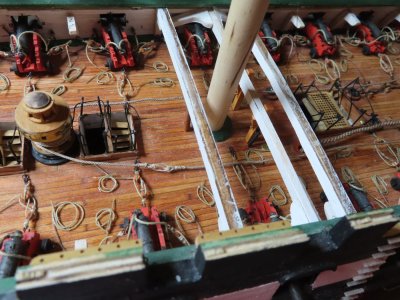
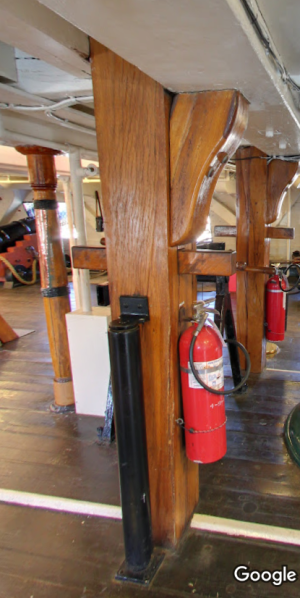
Gun Deck Main Mast Bitts

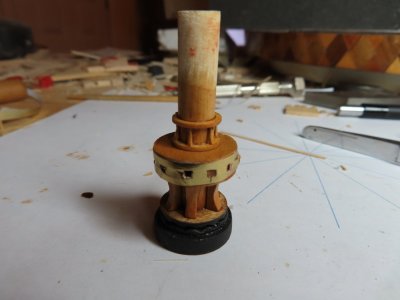
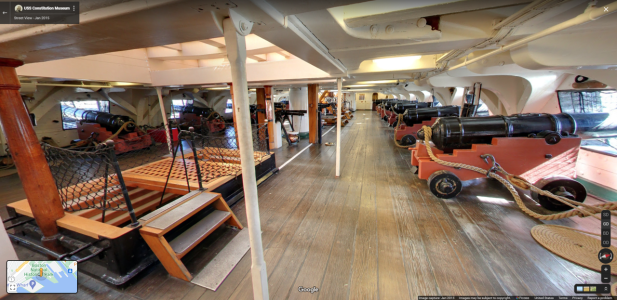
The bitts next to the main mast are similar in function to the foremast bitts, but a little different design.

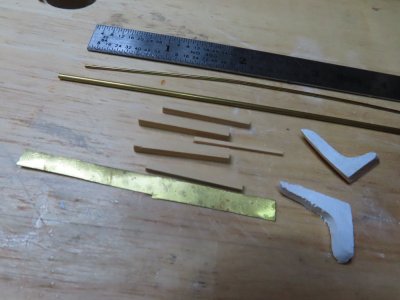
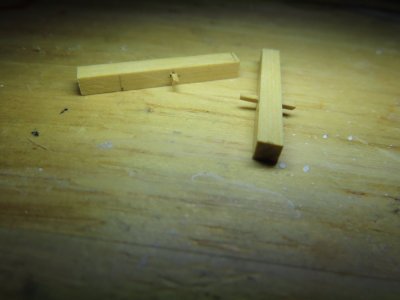
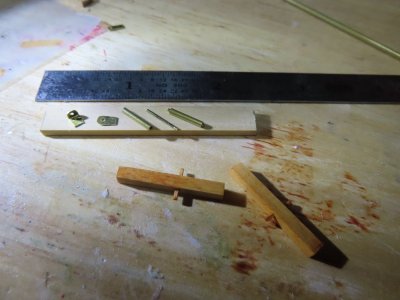
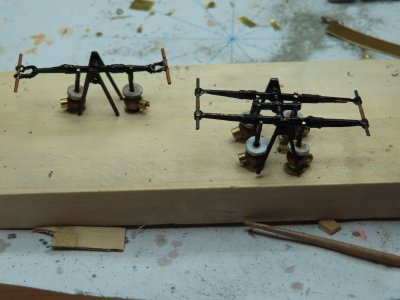
The bitts’ vertical posts cross sections were measured from the US Navy plan as 1/16”x1/16” (scale). The remainder of the dimensions were “eyeballed.” All wooden parts were boxwood. Parts:
  • Vertical post 1/16”x1/16”
  • Diagonal braces 3/32”x 3/32”
  • Horizontal beam 3/64”x3/64”
  • Brass roller bracket 0.010” thick plate
  • Brass roller pin 0.032” diameter rod
  • Brass roller tube 1/16”

Main Mast Bitt - Gun Deck 05.png

IMG_2659.JPG
 
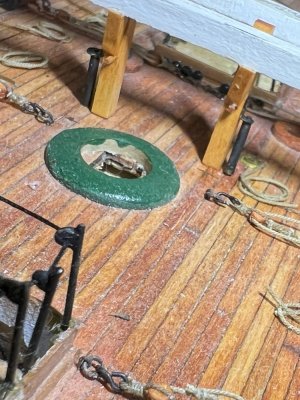
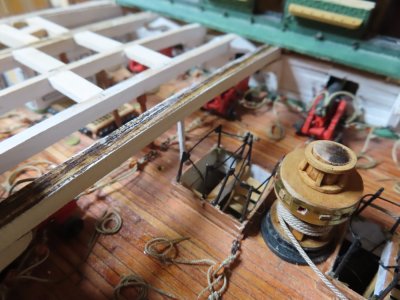
Another spar support beam was added complete with diagonal knees at the bulwarks where the bitts are located. The bitts in actuality, passes vertically through the planking of the spar deck. This wasn’t done on the model as they won’t be seen as a continuous structure and would just add another layer of complicity to the build. Therefore, the vertical column stopped at the top surface of the spar deck support beam. If all goes well, the bitts on the spar deck will be glued directly over the gun deck bitts without any adjustment. If not, there will be some wiggle room, and any slight misalignments won’t be noticed (if all goes well).

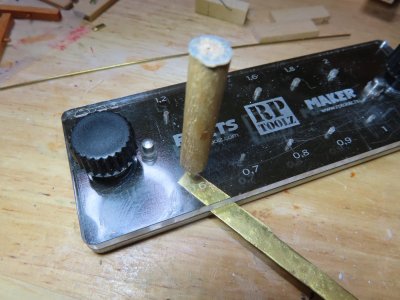
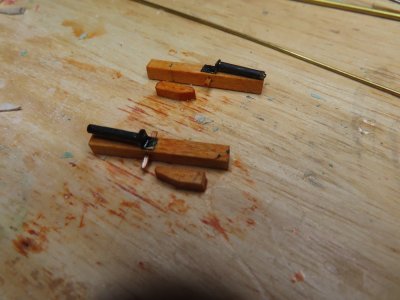
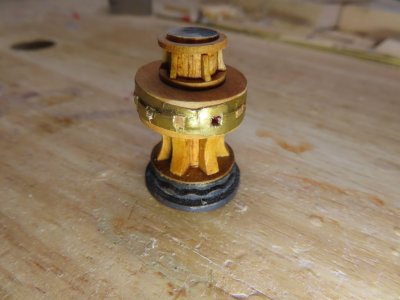
The rollers were constructed as before for the foremast bitts. A hole was drilled to accept the cross beam. The brass rod slips inside the brass tube. The brackets were made from the brass sheet after a hole was punched into it for each bracket. Then the brass sheet was cut to size and bent to shape. Each wooden bitt was made of two pieces of stained (gunstock) boxwood cut to shape. The vertical pieces with the roller assembly were installed first. Once the glue dried, the diagonal braces were added to ensure a proper fit to the vertical and horizontal surfaces.

IMG_2663.JPG

IMG_2664.JPG

IMG_2666.JPG

IMG_2667.JPG

IMG_2670.JPG

IMG_2668.JPG

IMG_2669d.jpg
 
I ran into a couple of surprises that although I had thought about before, I overlooked in the end. When the capstan is engaged, anything that would interfere with the capstan operation and anchor cable/chain are in the clear, like hatch covers are in place and ladders are stowed away. In my case, I fabricated the hand ropes and stanchions for the ladders going down to the berth deck next to the gun deck capstan. As built, they would interfere with the messenger cable wrapping around the capstan. Also, I forgot to create the ladders going up to the spar deck for the open capstan hatchway, which I took care of.

One of the infamous Murphy’s Laws states: that no matter what you must do, you must do something else first. In this case I must install more supporting spar beams and their associated diagonal knees at the bulwarks as well as their support columns. But the more beams I install, the more difficult it becomes to install other items on the gun deck. Therefore, I’m constantly checking the sequence of fabrication and installation.

While I’m doing this, I decided it was time to lay down an anchor cable and an anchor chain. There are three anchors that came with the MS kit. One will be attached to the anchor chain, the second one to the anchor cable, and the third will be stowed on the deck.

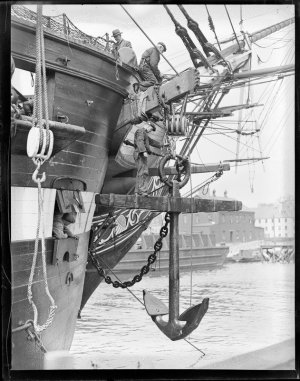
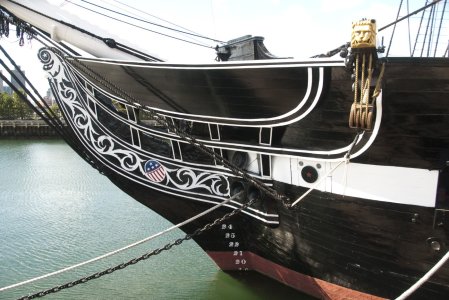
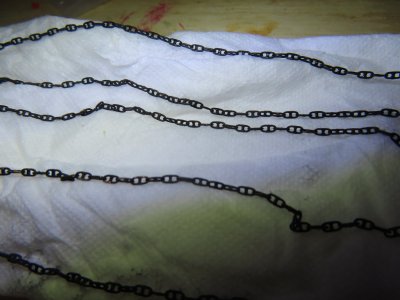
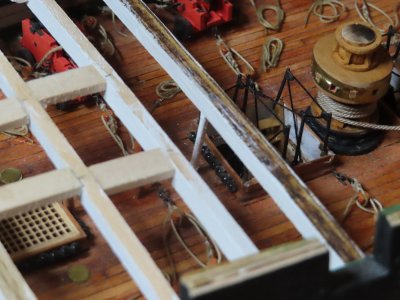
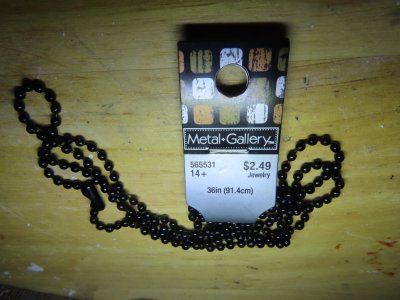
The anchor chain that came with the kit has single links, but according to the photographs of the ship when she last used her anchor in the 1930s, she had a cross-linked chain. Today those chains are being used for mooring. I bought such a chain off the internet a year or so ago and unfortunately neglected to record where I purchased it from. The chain metal appears to be copper which required that it be blackened. The picture below shows the chain after it was blackened and drying.

1931 05May 12 - Leslie Jones.jpg

e7467622838b82dd6fe6c7323a46a9c2.jpg

IMG_2674.JPG
 
Determination of the Anchor Cable and Messenger Rope Size
The question arose: what size is the messenger cable? First, I had to determine the size of the anchor cable. Step one as indicated below, I found on another builder’s log who was quoting one of the historical ship building books of old. Sorry, didn’t record that either.
  • “The Circumference of the anchor cable = 0.62 the Diameter of the mainmast”
  • Main Mast Diameter (US Navy plans) = 32” (full scale)
  • Anchor cable Circumference = 0.62 x 32” = 19.84” (0.258” scale)
  • Anchor cable Diameter = C/π = 0.258”/3.14159 = 0.082”
  • Guestimate that the messenger cable is ½ the Diameter of the Anchor Cable = 0.041 (3” full scale)
I could not find the rule for messenger cable size, so it was assumed the messenger cable diameter had to be small enough to wrap around the capstan and still be strong enough to pull either the cable or chain.​

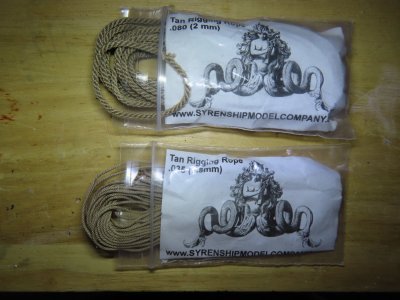
In my stock, I have Syren Ship Model miniature tan rope sizes 0.080” and 0.035” for the anchor cable and messenger cable respectfully which should work for the model.

IMG_2681.JPG

IMG_2680.JPG
 
When I last worked on the gun deck capstan, I left it in such a manner that I could fine tune its height to the proper length when I knew how long it had to be. With the spar beam dry fitted above it, the capstan was cut and sanded to its final height and installed (shown without the spar beams).

IMG_1718.JPG

IMG_2671.JPG
 
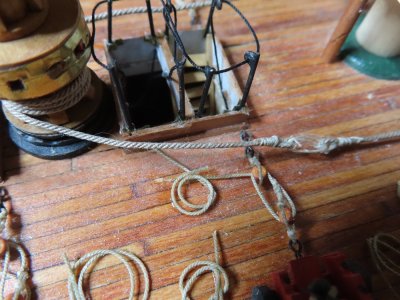
The messenger rope was installed first since it was wrapped around the capstan. A spliced loop end was created for each end of the messenger rope first. Then the rope was wrapped around the capstan three complete times. The rope went along the gun deck to the bow around a support and back again towards the capstan. There would have been a roller mechanism for this at the apex of the turn in the actual ship, but that will not be seen in this model. The two end loops of the messenger rope were then lashed together. The lashing had to be done using needle and thread in the confined space of the model and was a bit delicate to do.

The anchor cable and anchor chain were inserted through their respective hawser holes in the bow, down the length of the deck using anchor chain guides previously installed, and into the pipe in the gun deck. Neither ends of the cable nor chain were permanently installed pending attachment of their anchors at a later date.

Oh, I also installed the framework for the main mast so it has a rake of 3.5 degrees.

IMG_2682.JPG

IMG_2683.JPG

IMG_2684.JPG

IMG_2685.JPG
 
Getting back to the ladder hand ropes, I left the messenger rope loose on the deck as if it had just been released from the cable or chain and the ladders were put back in place. Technically, either the messenger is in place, or the hatch covers and ladders are in use, not both at the same time. In either case, it’s all going to be difficult to see and the layman certainly won’t know anything looks out of place.

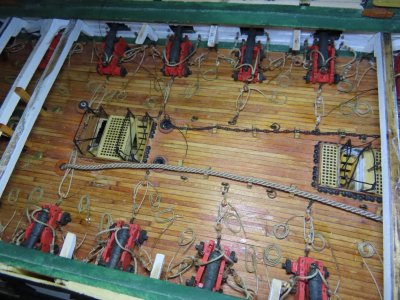
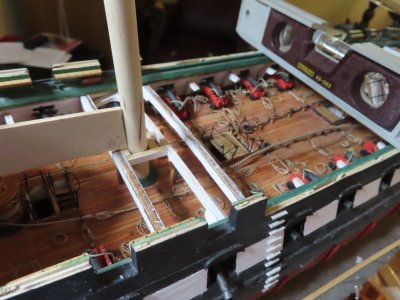
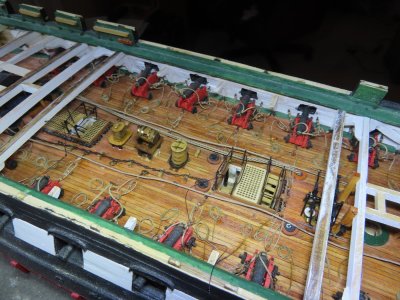
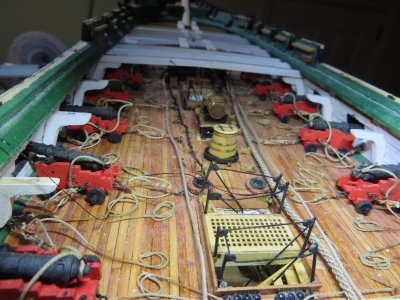
Next, more spar deck supports and their associated diagonal knees at their bulwarks were installed aft of the capstan. Additionally, some “temporary” (as marked on the US Navy plans) supports (painted white) were added as well. It’s getting really crowded on the gun deck.

Picture24.png

IMG_2686.JPG

IMG_2687.JPG

IMG_2688.JPG
 
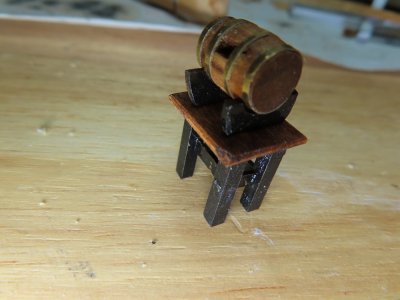
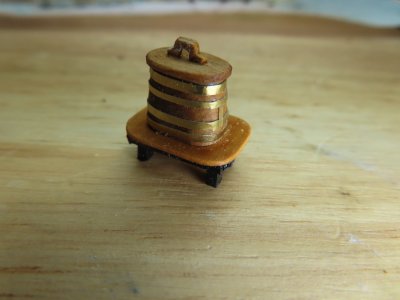
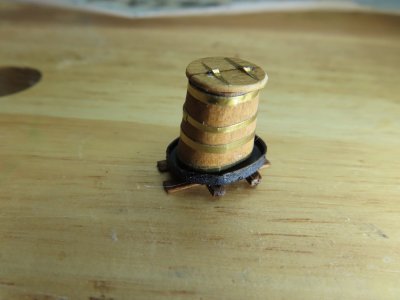
At this point I installed the last of the gun deck furniture previously made four years ago:
  • double pump
  • quad pump
  • sea chest
  • scuttlebutt & table
  • grog cask & table
  • harness cask
Still to come, the remaining spar beams and associate accoutrements to support the main hatch.

IMG_1766.JPG

IMG_1768.JPG

IMG_1801.JPG

IMG_1816.JPG

IMG_1817.JPG

IMG_2691.JPG

IMG_2692.JPG

IMG_2695.JPG
 
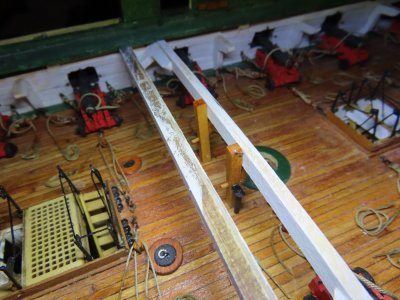
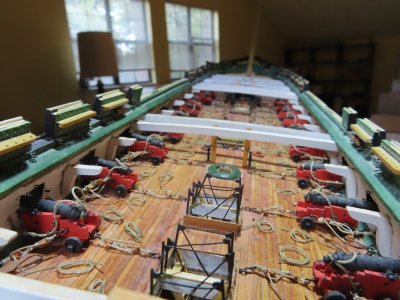
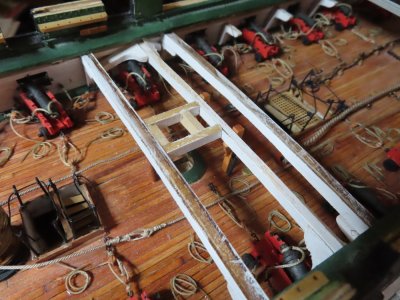
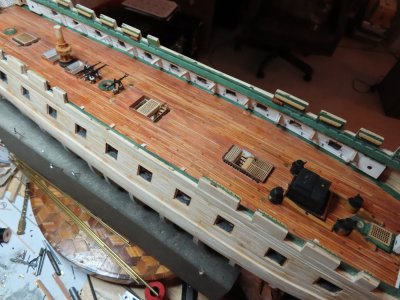
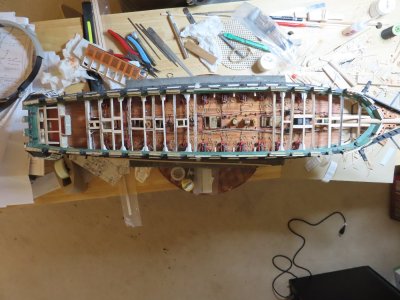
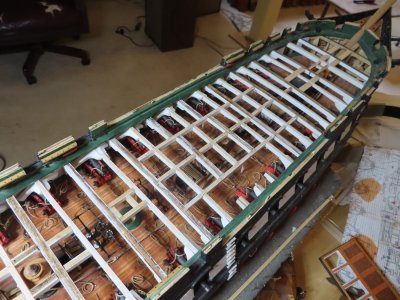
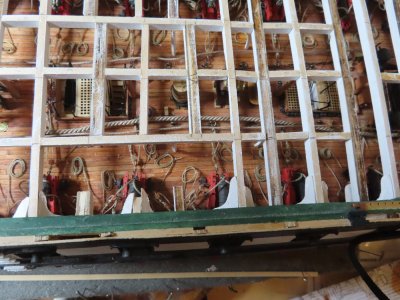
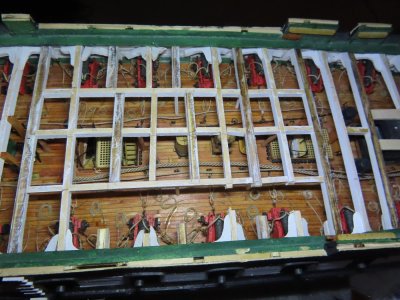
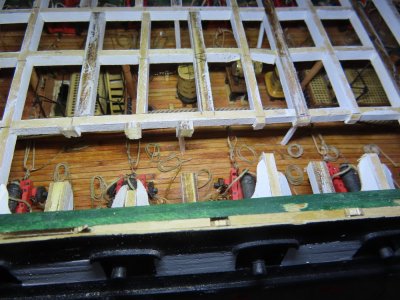
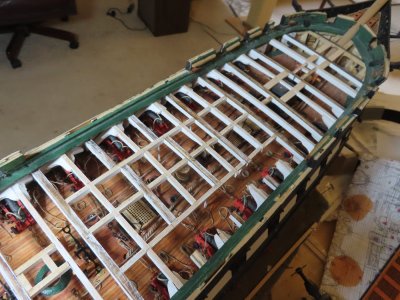
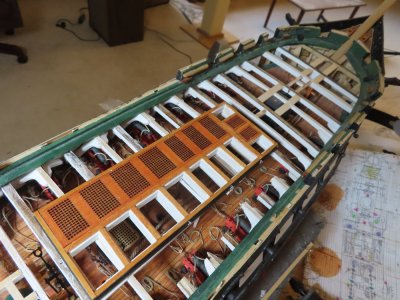
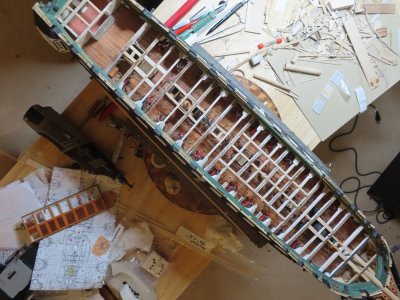
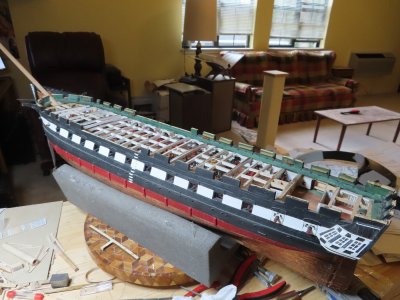
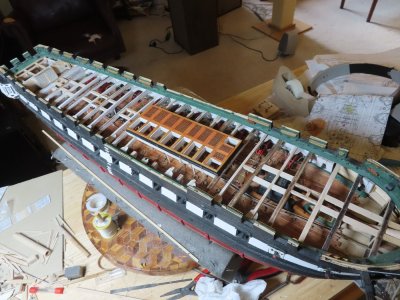
This post shows more of the same. I added more spar deck beams, gun deck columns, both the white square cross section ones and the natural wood round ones, knee braces, and the main hatch framing support beams. You will notice that the starboard side is missing some beam sections. I realized that even though I did not add all the spar deck structure, viewing the gun deck was getting a bit obscure. To alleviate this a little, I made it look like the beams were cut out. However, I made this discission after I had installed three whole beams supporting the main hatch. The beams were cut, the leftover stubs were left in place. Where I intentionally installed partial beams, I added little stubs to make it appear they were cut after most of the picture were taken.

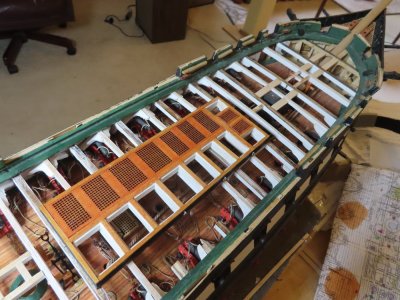
Additionally, you may have noticed that the beams under the main hatch do not run straight across. This is my solution to the problem I discussed in an earlier post about the structure of the main hatch. The laser cut grids making up the main hatch do not conform to any plan I’ve seen including the kit plans. In keeping with the idea of the cut-away look, the top surfaces of the structural beams and supports were not painted so it would look like the spar deck planking was removed revealing raw timber below. A side effect of this is where there will be planking and other things items attached to them, the glue works better on bare wood.

Some of the pictures below show the main hatch dry fitted in position

IMG_2696.JPG

IMG_2697.JPG

IMG_2698.JPG

IMG_2701.JPG

IMG_2707.JPG

IMG_2699.JPG

IMG_2700.JPG

IMG_2703.JPG

IMG_2704.JPG

IMG_2705.JPG
 
Completing Hatchway Fabrication

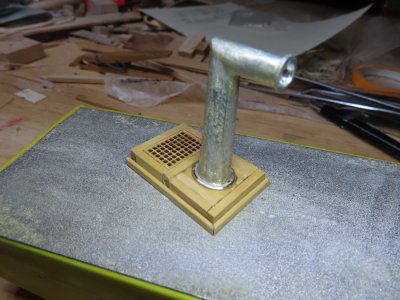
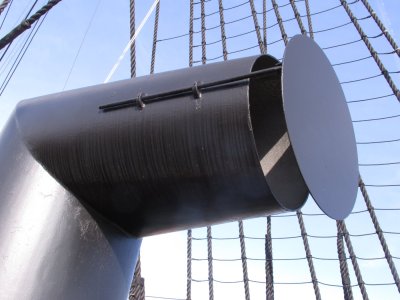
I did not complete putting the finishing touches on some of the hatchways before, so I started with the stove pipe hatchway, it still required eyebolts, paint, and modification of the precast metal pipe and attachment of the spark suppressor:

IMG_2617.JPG

IMG_2616.JPG

IMG_2623.JPG
 
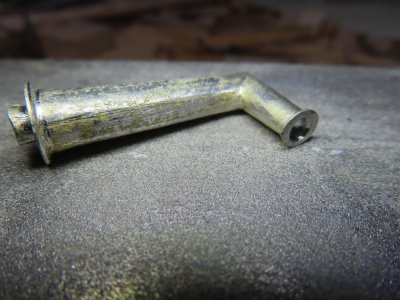
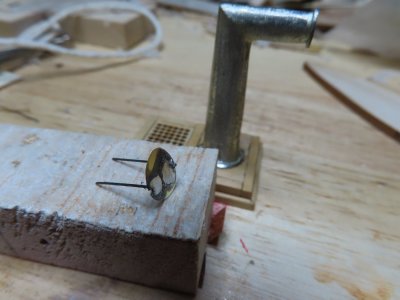
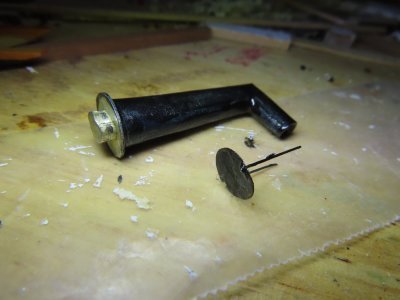
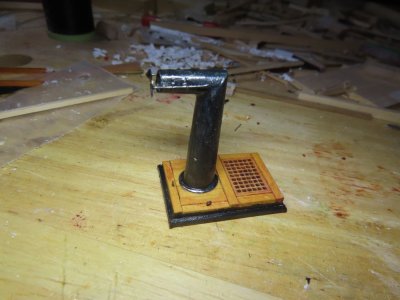
When I fabricated the spark suppressor, I did not realize at the time that the precast pipe was cast with a pseudo suppressor but the gap between it and the pipe was filled in solid, so it looked like part of the pipe. You can see, the pseudo plate is a lip at the end of the cast pipe opening. Therefore, I ground off the lip, hollowed out more of the pipe, and reduced the diameter of the spark plate I had created. The plate and pipe were then painted black.

IMG_2708.JPG
 
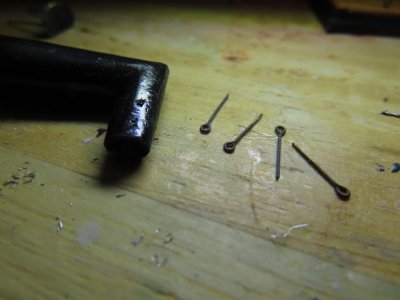
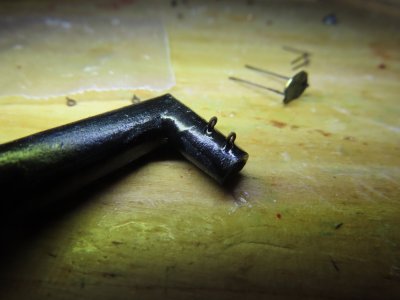
The next problem was how to attach the spark suppressor plate’s support rods onto the pipe? Obviously, I couldn’t use solder as it would end up as a hot puddle of metal. The gluing surface was very narrow, so what glue to use? I had three choices, white PVA, CA, or epoxy. Then I had a flash of inspiration from the actual pipe. I wouldn’t use glue directly but use eyebolts just like the actual stack to mechanically secure the rods. Two 1/32” eyebolts per side supporting the rods threaded through them. A touch of CA glue to secure the eye bolts into predrilled holes in the pipe and a touch of CA glue to secure the rods in the eyebolts. It worked like a charm.

IMG_0515.JPG

IMG_2709.JPG

IMG_2710.JPG

IMG_2711.JPG
 
According to the kit’s plans, “shot storage rack: Note all fwd. racks not installed in 1997.” Why, I don’t know. I wanted all the gun crews on my model to have something to load into their guns and shoot. Why should only the aft gun crews have all the fun? So, I installed all the shot racks including the ones omitted from1997. Once again as I did on the gun deck, used a black ball chain. I just sniped off the number of balls I needed off the chain as a unit and glued them into place. The racks themselves are implied as they are way too small to fabricate or see at scale.

IMG_2713.JPG
 
The bowsprit hatch was completed by carving the forward insert around the dowel that would eventually become bowsprit. It was then painted white and dry fitted into place. The unit was then glued to the deck. The dry fitting was necessary so the insert can be removed to allow the dowel to be fitted into the model as it is fabricated and adjusted to its final configuration. Once the bowsprit is secured into place, the insert will be glued in as well.

2022 - Avi02.jpg

IMG_2606.JPG

IMG_2714.JPG

IMG_2715.JPG

IMG_2716.JPG
 
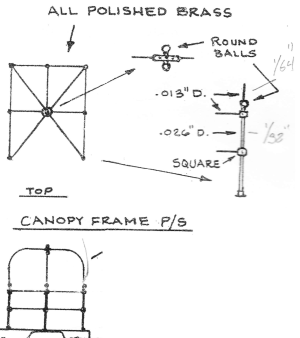
The only thing left before most of the hatchways are installed on the spar deck, are their canopy stanchions. These I want to fabricate off-ship as I expect it to be “easier” than on-ship. Obviously, the material of choice is brass rods and tubes, I try to fabricate things to exact scale within my skill set. Conveniently, the frame’s full-size dimensions (US Navy plan No. 6005106002) were simplified a bit as was necessary and reduced to scale on the MS plans.

Canopy Frame - MS Plan.png
 
Below is what MS plans call for and their nearest equivalent K&S Engineering brand brass standard stock size:
  • 0.026” dia. rods for the vertical stanchions = K & S No. 9860 (0.020” / 0.50mm)
  • 0.013” dia. rods for the arching frame = K & S No. 5087 (1/64” / 0.410mm)
  • 0.013” dia. rods for the horizontal rails = K & S No. 5087 (1/64” / 0.410mm)
There are additional ball ornaments, block connectors and finials which the MS plan does not assign dimensions. Based on the US Navy plans, these elements were simplified and reduced to scale as:
  • 2.375” connecting blocks scaled to 0.03” = K & S No. 5082 (1/32” / 0.80mm) rod
  • 3” ornament ball scaled to 0.039” = K & S No.815035 (1/32” / 0.800mm) tube
However, in practical terms, if one constructs the canopy frames with brass components at actual scale dimensions, the frame would be extremely fragile. Just one errant bump, and the whole construct could bend out of shape. The brass is too malleable, not stiff enough. Another option is music wire. Unfortunately, it’s the wrong color and very hard to cut and bend to shape to the exact dimensions required. Therefore, I must choose a slightly oversized scale just for strength as follows:
  • 0.032” dia. rods for the vertical stanchions = K & S No. 8160 (1/32” / 0.51mm)
  • 0.020” dia. rods for the arching cover = K & S No. 9860 (3/128” / 0.800mm)
  • 0.020” dia. rods for the horizontal rails = K & S No. 9860 (3/128” / 0.800mm)
The additional ball ornaments and block connectors oversized to:
  • 2.375” connecting blocks scaled to 0.03” = K & S No. 5083 (3/64” / 1.190mm) rod
  • 3” ornament ball scaled to 0.039” = I purchased 1.0mm (0.04”) brass beads from etsy.com.
  • For the finial, I think I can fabricate a simple facsimile
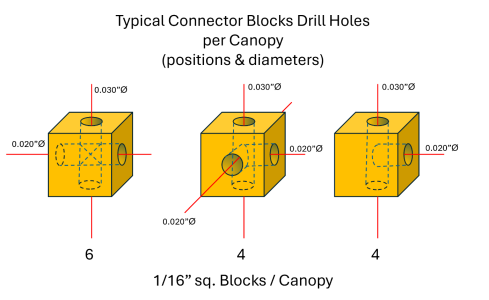
I made a couple of forms to bend the arched brass cover pieces and planned the drill pattern for the connector blocks.

IMG_2717.JPG

Connector Block Plan.png
 
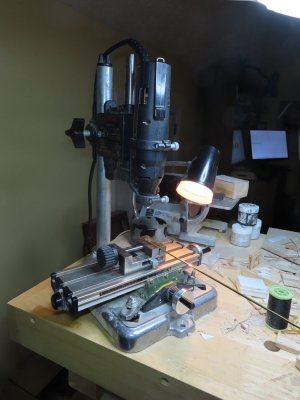
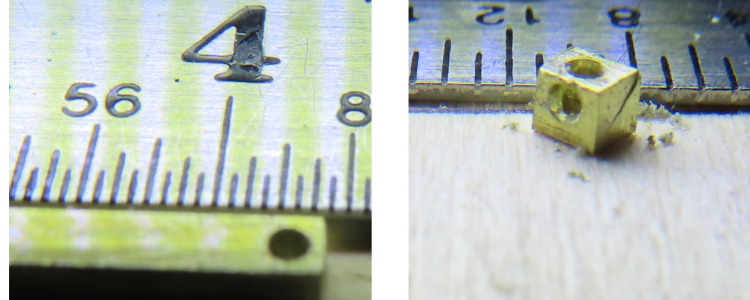
The connector blocks ae to be made from 1/16” square brass bar stock. Now my old nemesis reared its ugly head once again: drilling holes into the brass. Brass tends to grab the drill bit unless it’s a bit designed to work with brass. I had a discussion with fellow builder Unegawahya (post 104,106,107, 108) who was successful drilling into the brass stock. Basically, he stated that the rotation speed needs to be slow, and the drill bit needs to be sharp, which he sharpens with a honing stone. Once more it comes down to having the proper tools which it appears I do not possess. I have a variable speed Dremel tool, a corded one-speed Dremel tool, a Dremel drill press stand, an X-Y table, an X-Y table vice, and a bunch of #67 (0.0320”) and #75 (0.0210”) twist drill bits. I also have problems. My cordless variable speed Dremel does not fit on my old Dremel drill press, so I am forced to use the corded one speed.

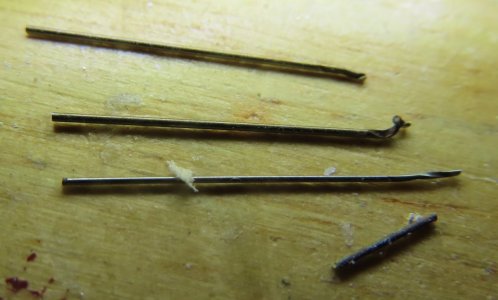
I attached the vice to the X-Y table which was attached to the drill press and mounted the one speed on the drill press stand. I proceeded to make a 1/32” hole through some 1/16” square stock with the #67 drill bit. Because I could not slow down the rotation speed, I was lightly touching the metal by moving the rotary drill up and down with the stand’s lever so not to overheat the surface or the bit. It worked, but after I made 2 trial blocks, I couldn’t cut any more with either bit after the initial dimple was cut into the metal. Bits snapped in two, one literally untwisted itself and others bent sideways or into a zigzag shape. I tried sharpening the bit as suggested, but I didn’t have a honing stone and even if I did, the bit’s tip was so small, I could not see which face I was grinding even with my magnifying headset. All I had was a fine file and sandpaper so that didn’t work.

IMG_2722.JPG

Brass Connector Block.png

Broken Drill Bits.jpg
 
I had mentioned to Unegawahya that maybe the problem was that I had cheap drill bits, and they weren’t properly hardened, so I ordered new (and hopefully better) bits for both sizes I was using. I am waiting for them to arrive.

In the event, the new bits are not helpful, I have a Plan B, substituting plastic stock in lieu of brass. Specifically Evergreen Polystyrene No. 153 (1.5mm / 0.060” square). It’s easy to cut, drill, and its surface is very smooth like metal, but it needs to be painted. Since these fabricated parts will be very small, I am hoping the change in material won’t be too noticeable. And I have a Plan C, tight grain hardwood like Boxwood, but wood must be cut to size and pieces that small are very easy to split..

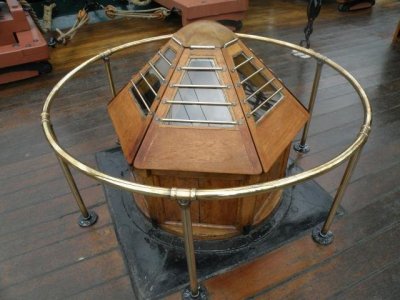
While I waited for the new drill bits to arrive, I put the canopy stanchions on hold and started to work on the captain’s skylight. This took longer than I had expected, and the time was also interrupted with my annual Thanksgiving weeklong trip to my sister’s home where the family gathers for the holiday.

I studied the practicum method, xKen’s method and others. Since I am a glutton for punishment, I chose not to take the simple route. I wanted transparent windowpanes and close to scale details which meant, I would be using Ken Foreman’s as a guide more than Bob Hunt’s. Also, Bob did not fabricate the brass railing surrounding the skylight which Ken did.

P5250065.jpg
 
As usual, the first thing I did was gather my materials needed for this endeavor. One of the items was brass wire for the horizontal 3/8” brass bars protecting the glass windows. This scaled down to 0.005” or 36-gauge brass wire which Mr. Hunt did use on his construct. However, try as I might, I could not locate 36-gauge identified brass wire to purchase. I did find Infini Model Micro Fine Brass Wire 0.1mm IBW-1000 (0.004”) online at A-Z Toy Hobby in Texas. I don’t think anyone will notice the 0.001” difference in thickness.

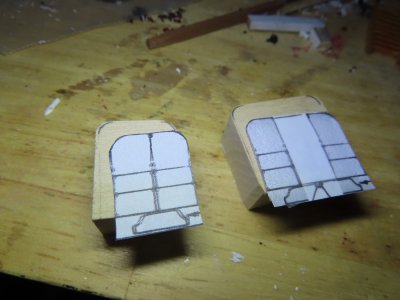
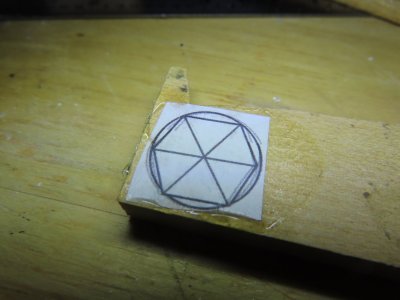
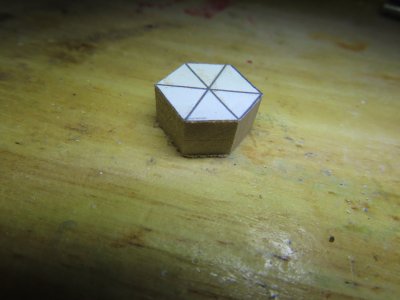
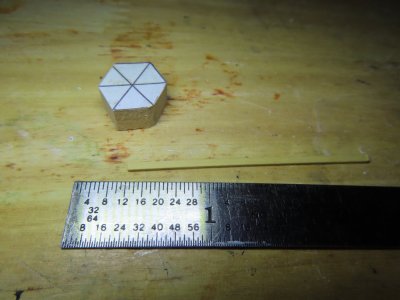
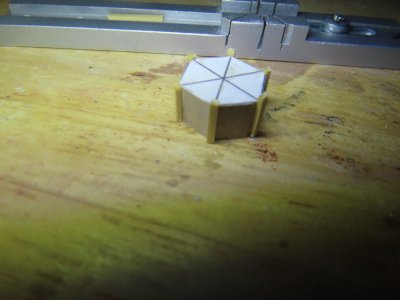
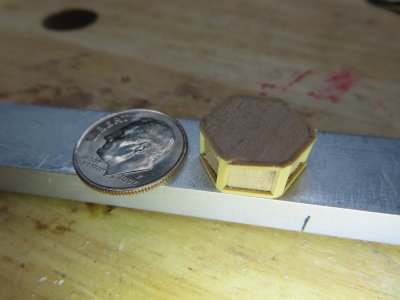
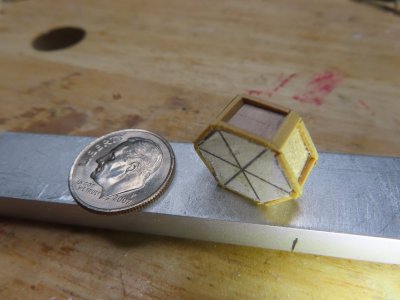
Using the template from the practicum, the skylight base core was cut from ¼” thick basswood stock.

IMG_2724.JPG

IMG_2725.JPG
 
Back
Top