• SUBSCRIBE TO SHIPS IN SCALE TODAY!

    The beloved Ships in Scale Magazine is back and charting a new course for 2026!
    Discover new skills, new techniques, and new inspirations in every issue.

    NOTE THAT OUR NEXT ISSUE WILL BE MARCH/APRIL 2026
  • Win a Free Custom Engraved Brass Coin!!!
    As a way to introduce our brass coins to the community, we will raffle off a free coin during the month of August. Follow link ABOVE for instructions for entering.

USS Constitution - Model Shipway’s 5/32” = 1 ft. (1:76.8) Kit No.: MS2040

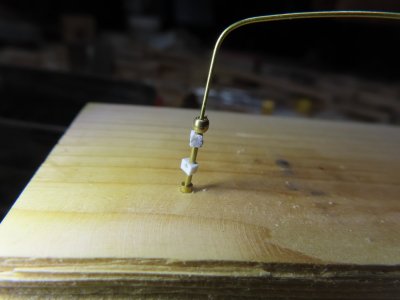
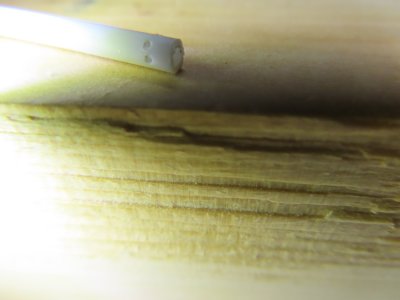
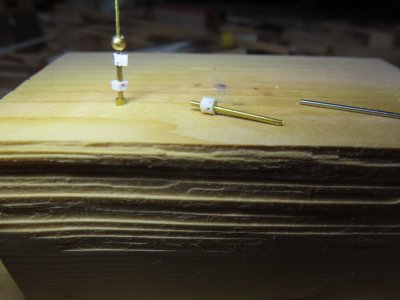
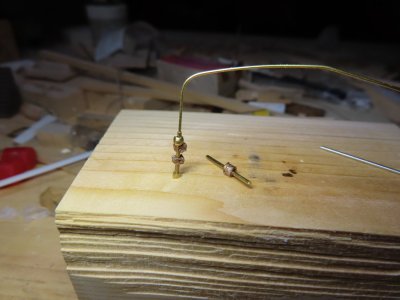
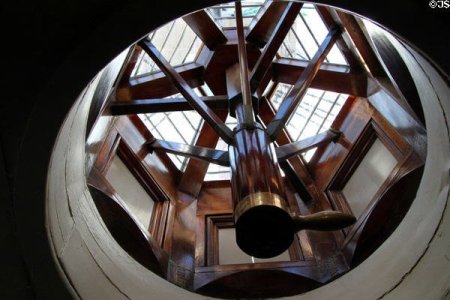
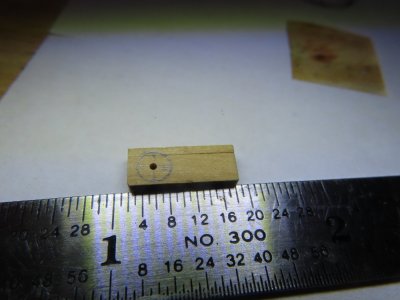
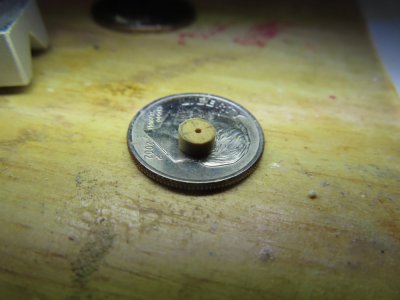
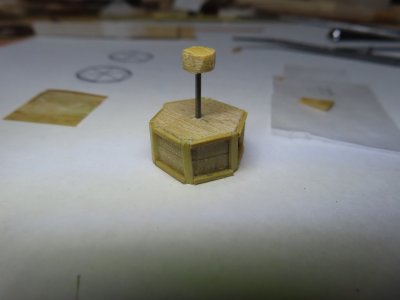
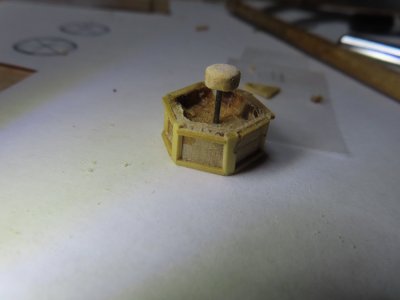
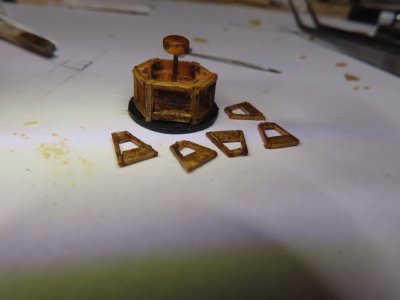
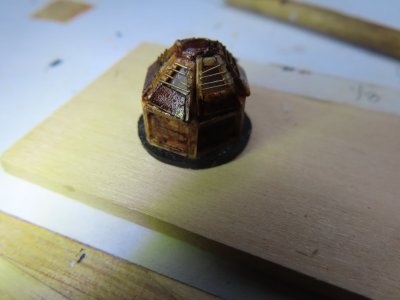
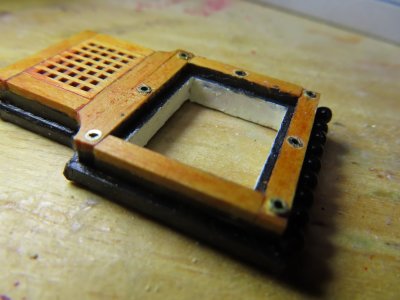
The skylight windows invited numerous methods from a variety of builders depending on whether the skylight was solid wood mimicking a glass enclosure or an actual framework. My method is also a bit unique. Because I intended to make actual windows with a frame and glass (mica), the window frame would only be supported at the base and top of the window frame. Therefore, I had to create a “floating” top support. The actual skylight has a wood dome with an internal mechanism to facilitate the opening and closing of the windows. So, that inspired me to have my dome supported by a pole paying homage to the real thing. An extended dome was fabricated out of boxwood with a hole drilled about halfway through to accept a piece of music wire. Another hole was drilled through the base to support the wire. The dome was stuck on the wire, inserted into the base, tweaked so that the top of the dome was ½” from the bottom of the base.

Underside 02.JPG

IMG_2730.JPG

IMG_2731.JPG

IMG_2734.JPG
 
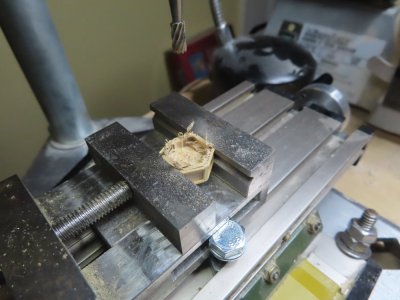
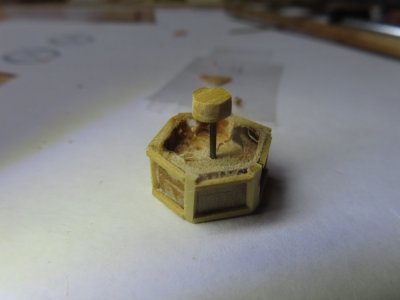
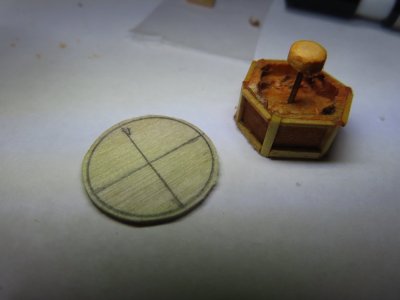
Then, the wire and dome were removed, and the base was hollowed out halfway down. This was done to create the illusion that the base was totally hollow. The top piece was rounded off to create the roundness of the dome. Now, when the base, wire, and dome were assembled, I had a solid structure to support the windows. According to the US Navy plans, the dome was made from mahogany. No mention what type of wood the rest of the structure was made from, so I assumed it was the same. However, the photo images seem to show the skylight was the same color as most of the wood on the spar deck which was not mahogany. The mahogany stain I had gave a deep reddish tone, almost black looking which I didn’t want. Therefore, I initially stained the wood with Miniwax Gunstock, then applied a light coat of Miniwax Red Mahogany.

IMG_2735.JPG

IMG_2736.JPG

IMG_2737.JPG
 
The skylight sits on a 1” thick round platform protruding about 1” wider than the skylight structure footprint. Because this component will be painted black, be mostly covered by the skylight, and I didn’t have a readily available piece of 1/32” basswood or boxwood wide enough, I used 1/32” plywood.

NOTE: The practicum calls for the round platform to be painted Bulwark Green. Why, Mr. Hunt chose this color I don’t know because I could not find any images showing a green platform, just black.

IMG_2738.JPG
 
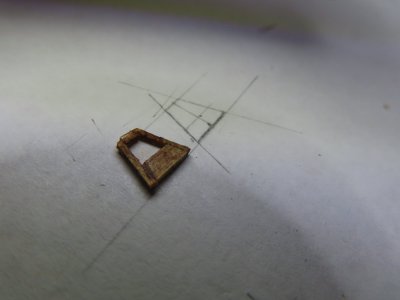
The skylight’s side and top window framing was made from 1/32” x 1/32” boxwood stock. The bottom was made from 3/32” x 1/32” stock. An outline was drawn on paper and covered with wax paper. The frames were lined up with drawing and fastened with PVA glue so the parts could be adjusted before drying.

IMG_2743.JPG
 
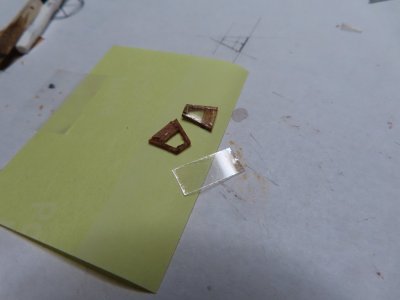
The windows panes were made from mica cut to size and fastened on the backside with CA glue. Just a fine drop was all that was needed for capillary action to suck in the glue between the wood frame and mica lying on it

IMG_2739.JPG

IMG_2740.JPG

IMG_2741.JPG
 
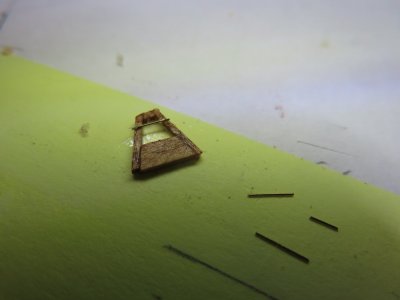
As I was about to add the Infini Model Micro Fine Brass Wire 0.1mm IBW-1000 (0.004”) wire to protect the windows, I realized that the 0.1 mm wire I ordered was not the wire I received. I got Infini Model Micro Fine Brass Wire 0.2mm IBW-2000 (0.010”). Although technically a bit oversized, as it turned out it looks better for the model and that is what counts.

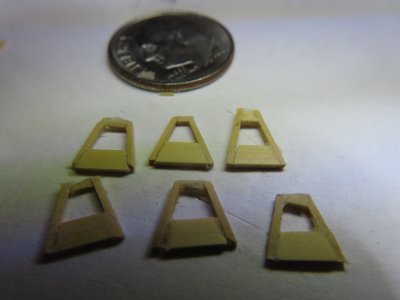
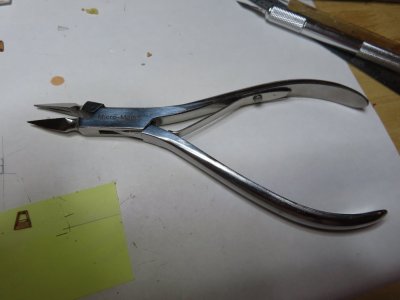
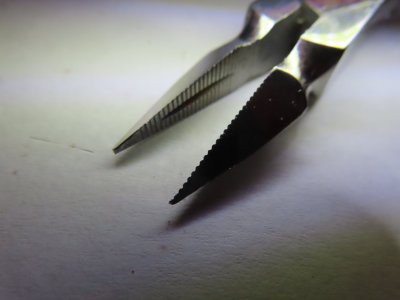
The four cut wire parts per panel were of four different short lengths due to the trapezoidal shape of the windowpanes. They were very thin which made it difficult to pick up. My two forceps tweezers were just about useless. Compared to the working space on the panels, the tips of the tweezers looked like tree stumps in comparison, and I couldn’t pick up the wire pieces off the workbench surface due to their rounded tips. I ended up using my rarely used sharp but relatively heavy needle-nose pliers I had bought some years back. It was a bit awkward to use, but it got the job done.

IMG_2745.JPG

IMG_2744.JPG

IMG_2746.JPG

IMG_2747.JPG

IMG_2748.JPG
 
With lots of tenacity and patience, I was able to place the four wire pieces in ascending order, longest to shortest, from base to the top of the windowpane. The wires were initially held in place with a very fine drop of PVA glue at one end of each wire. This glue was used so I had time to maneuver the wire into their final positions. Once the glue set up, CA glue was used to secure the wire at their other ends.

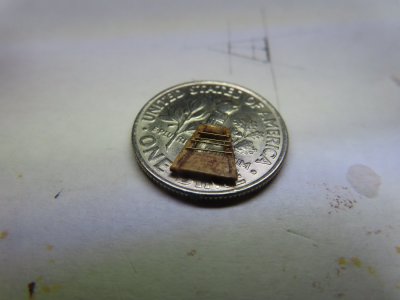
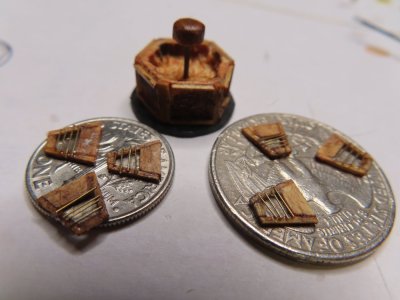
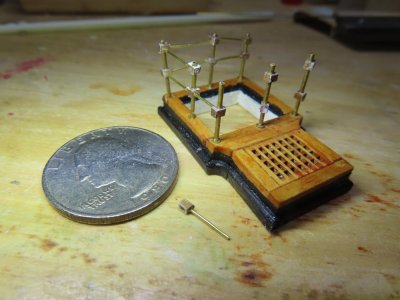
In the end, the skylight which fits on a US quarter coin, is comprised of 82 separate parts:

1 Base with six faces
  • each base face - 4 base frame pieces x 6 f aces = 24 pieces
  • 1 Dome support wire
  • 1 Dome
  • 1 base plate
6 Window panels each consisting of:
  • 4 window frames = 24 pieces
  • 1 piece mica = 6 pieces
  • 4 pieces wire = 24 pieces
I’m not trying to make excuses, but with 82 separate parts, those tiny precision errors add up. On this scale, my novice workmanship is showing with these closeup images. It’s something I’ll have to live with it. The skylight will put aside till it’s time for its installation. Now, back to working on the canopy frames.

IMG_2749.JPG
 
Just a quick update. I finally got to play with my new drill bits (which I put aside while making the skylight) and they work just fine drilling into brass, so I'll working on the canopy frames once again.

Another quick update on brass drilling. Yes, the new bits drilled through the brass...until they didn't. If you look back, I made a diagram of how I was going to the drill brass blocks. Basically, each block requires two holes, some passing all the way through the block, and others only halfway. Each block required two set ups on the drill press. I was lucky if my new drill bits lasted two blocks before they quickly dulled up or broke. On moment they were drilling, the next they weren't. One didn't even drill from the start. I actually bought bits from three sources, my original bits from either Model Expo or Micro-Mark, a full set from AliExpress, and two Gyros #75 packages and one Gyros #67 each containing 12 bits/pkg. The AliExpress #67 bit broke immediately upon touching the brass and the #75 went dull. The Gyros went dull after a couple of holes. I was using a light touch, not jamming the drill into the brass.

After all this, I don't have much to show for my efforts, just two cleanly drilled brass blocks. So I will admit defeat and go to plan B, Styrene plastic. The drill bits cut through in seconds, and cutting the blocks off from the bar requires just a sharp knife instead of a fine tooth saw or cutting disk. Hopefully, the brass painted blocks will blend in with all the brass rod that make up the canopies.

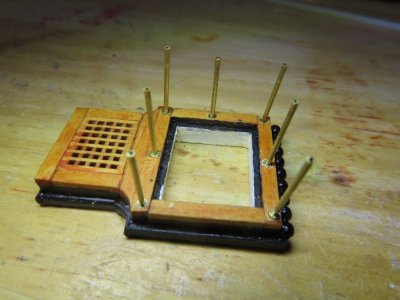
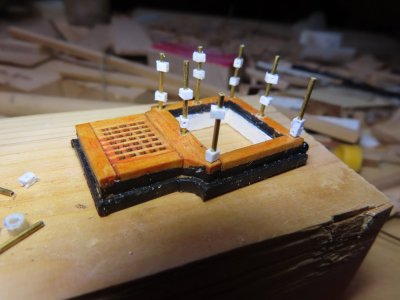
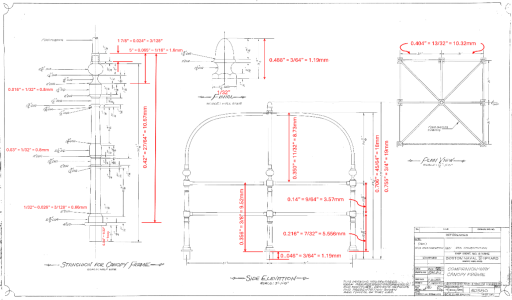
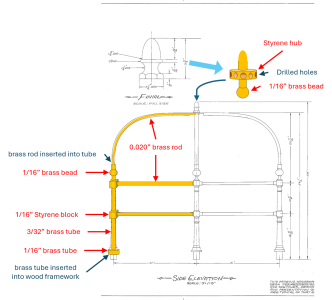
I am taking my canopy frame fabrication cues from several builders but am using 1/32” brass tube instead of 1/32” brass rod as many other builders have used for the vertical components. This allows me to use a continuous vertical component, passing through the junction blocks and decorative balls to just beyond the top railing. Then the overhead canopy support made of 0.02” brass rod can be inserted into the 1/32” tube creating a strong mechanical connection. The 0.06” blocks will only support the horizontal rails with no stress. The brass balls are strictly ornamental and provide no support. The tricky part is where the canopy arches all meet at the top. A hub piece will be used to connect all the arches plus the finial. The finial is to be comprised of a rod and tube configuration (TBD), and filed into its final shape and inserted into the hub. The vertical framework base will be inserted into rings made from 1/16” tubes, embedded into the grating wood frames. Here is a summary of the materials:
  • Base of vertical component: 1/16” brass tube – K&S Engineering No. 5125
  • Vertical component: 1/32” brass tube– K&S Engineering No. 815035
  • Horizontal component: 1/32” brass rod - K&S Engineering No.
  • Junction blocks: 0.06” Styrene square rod – Evergreen No. 223
  • Ornament: 1/32” brass balls – Tribal Desert from Etsy
  • Junction hub: 3/32” styrene tube – Evergreen No. 153
So here is my plan based on the US Navy plans and the trial prototypes of the vertical components and the canopy hub element to see if this would work. The prototype is purely concept, so it is not adjusted for proper dimensions or glued and yet it stands on its own. The final image shows the styrene painted brass. It appears it just might work.
Canopy Plan 01.png

Canopy Plan 02.png

IMG_2751.JPG

IMG_2752.JPG

IMG_2754.JPG

IMG_2755.JPG
 
It has been over a month since my last posting of the progress of my model. I have not been idle but working on it at my usual pace…slowly. I made very little progress considering the time I spent.
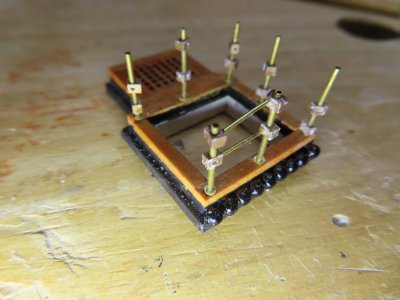
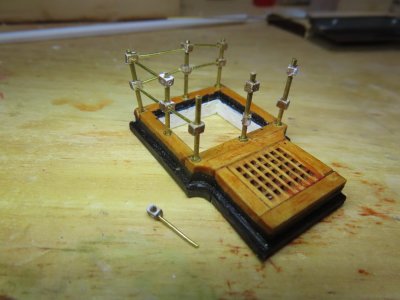
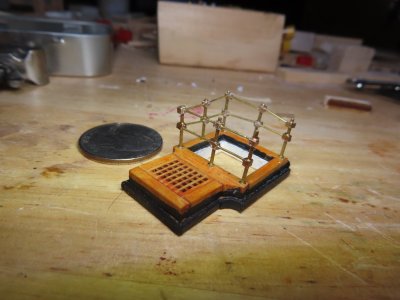
For the first railing and canopy structure I chose the companionway and skylight frame because it was large and looked like it was the easiest. I drilled seven 1/16” holes for the 1/16” base sleeves which were cut from a 1/16” brass tube. The stanchions were cut from 3/32” brass tube and inserted into the sleeves for fit.

IMG_2756.JPG

IMG_2757.JPG
 
Now the fun began. Making the connector blocks for the canopy stanchions was very delicate and tedious. My original plan required two to three drill press setups per block depending on whether it was for a corner, an open end or inner stanchion. Changing the setup was required because of the two different sized brass rod/tubes that needed to fit into the blocks. After a few haphazard starts, I realized that all that was necessary was to drill a 1/32” passthrough hole with the drill press for the 3/32” brass tube which will be the vertical stanchion. This hole left an opening with only a 1/64” wall outside of the hole. Precision was required. The other holes for the 0.020” rod (horizonal rails), were a little more forgiving and was done with a hand drill fairly quickly. Cutting the 1/16” cube from the 1/16” square styrene rod was done with my mini miter block with a properly set stop and a razor saw. However, a 1/16” cube of styrene with holes drilled through it almost to its edges created a very fragile component with very little surface area remaining for gluing. I slipped on the unpainted styrene blocks again for fit.

IMG_2758.JPG
 
I thought assembling the pieces was going to straight forward, so I painted the blocks with brass color paint which as it turned out, was a bit more copper in color than the actual brass parts. Attaching a block to the stanchions was basic, however attaching the horizontal rails was not.

IMG_2759.JPG
 
I had to work out the sequence of CA gluing a block to a rail and sliding the block and rail component down the stanchion to the bottom position and have the rail slip into the block on the other stanchion with precision. Then do it again for the top rail. Those rails lengths had to be precise which meant nipping the ends of the rail and filing to shorten the brass rod within thousands of an inch by trial and error. Then gluing the rail into the block so it didn’t protrude into the stanchion’s vertical hole, about 1/64”. Invariably, I broke glue joints, crushed blocks, lost the tiny pieces if I dropped them, and had to refabricate numerous parts

Now I must bring 7 arched 1/32” brass rods together into a styrene ring that is to hold them together at the center of the stairwell and add a yet to be fabricated ornament it its center. So, this is as far as I got in all this time.

IMG_2760.JPG

IMG_2761.JPG

IMG_2762.JPG
 
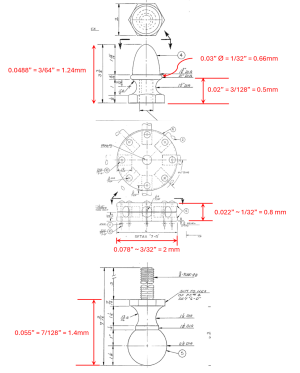
To fabricate the arched framework, I had to work out how to make the central ornament. If I had a metal lathe (and knew how to use it) it might have been relatively simple...I think, maybe. But I don’t, so this is how, why, and what I worked out, based on the US Navy plans.

Canopy Hub - US Navy Plans.png
 
First Attempt – Original Plan

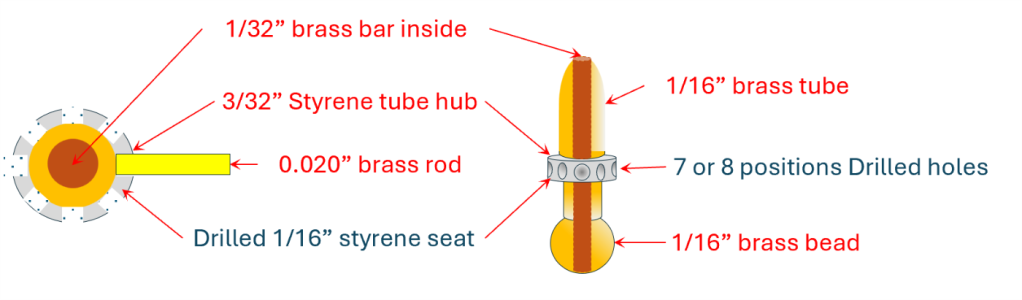
As mentioned in my earlier posts, I had to forgo using a brass hub because I had difficulty drilling holes in brass and thus substituted styrene. The styrene hub 8 circumferential support positions, of which 7 of them for this canopy support, were drilled with a hole to accept an arched support. Unfortunately, drilling these holes practically cut the styrene tube in half.

Canopy Hub - 1st Attempt.png
 
Second Attempt

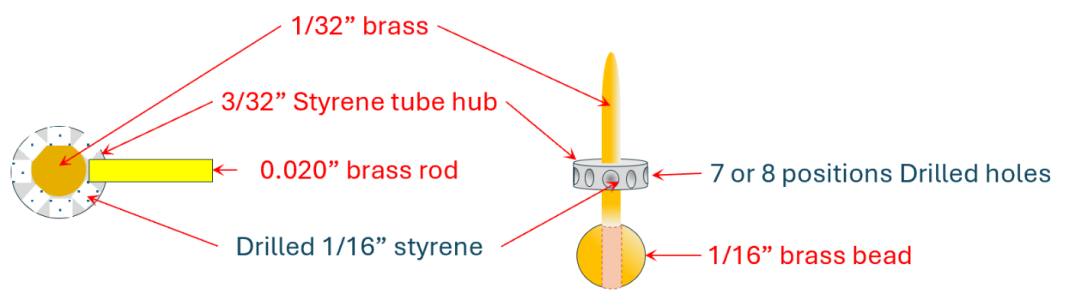
I was forced to make a small dimensional compromise. The top part of the full-scale ornament is 2” in diameter which scales down to 0.03” (1/32”). This had to be enlarged to 1/16”Ø due to fabrication practicality.

At the center of the hub, is the ornament which consists of a 1/32” brass rod which is inserted through a 1/16” brass tube. At the bottom of the tube, the 1/32” rod extends out into the 1/16” brass bead. At the opposite end, the rod and tube were to be filed into a rounded point.

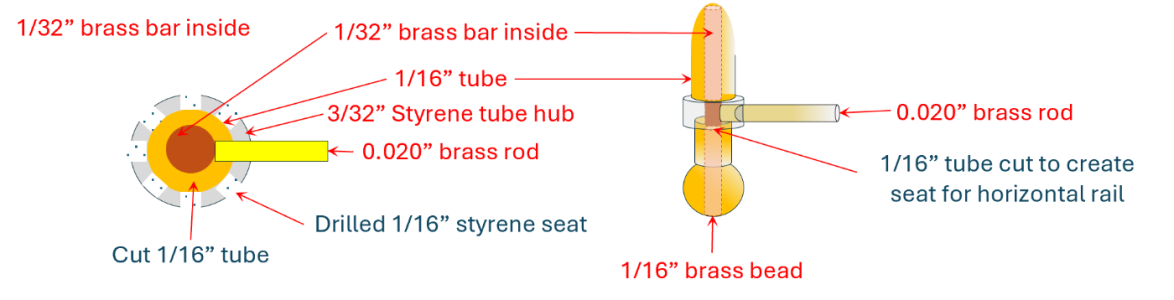
However, the enlargement forced me to remake the styrene hub component. The 3/32” Ø styrene tube’s inner diameter was about 1/64” was too narrow to allow the 1/16” Ø brass tube to pass through. It had to be drilled out with a 1/16” drill bit. This left a very shallow 1/64” tube wall rail seat for the 0.020” brass rod to rest on and glueing surface. Mechanically, this would be very fragile and would not secure the 0.020” brass rods.

Canopy Hub - 2nd Attempt.png
 
Third Attempt

My next idea would be to cut the 1/16” Ø brass tube leaving the 1/32” Ø rod alone uncut. Now there would be two 1/16” Ø brass tubes one on top of the other with a gap in between, wide enough to accept the 0.20” brass rods. This expose tube wall would extend the rail seat another 1/64”. Mechanically, it is slightly stronger than the previous idea, but still fragile. And how does one assemble 7 to 8 spokes into the hub and hold them in place precisely to glue them together with sufficient strength?

Canopy Hub - 3rd Attempt.png
 
Fourth Attempt

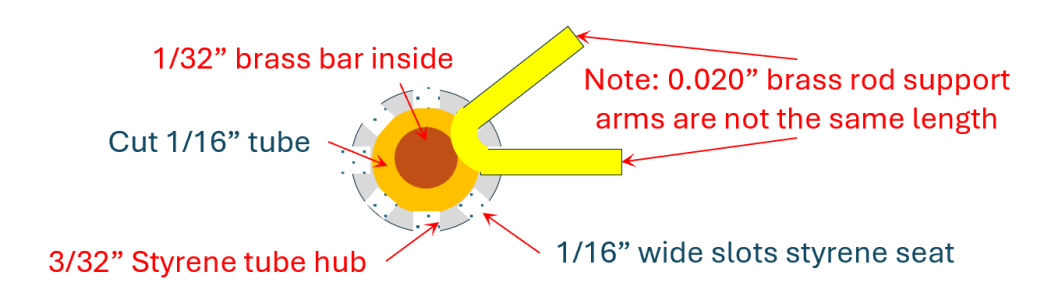
The next development was the idea to make a double support such that the brass rod would pass into the hub and back out through a difference opening as a second support. This would mechanically fasten the brass rod to the hub. To do this, I would have to change the drilled holes in the hub to vertical slots so the brass rod could be dropped into the openings. It’s not like the rod can act like a piece of string that can be threaded.

This introduced a new problem. Once the holes in the styrene hub were converted to vertical slots, the remaining vertical styrene material was now narrow, flexible, and weak and would break off should anything tug on them…like the brass canopy rods. Additionally, more room is needed to accommodate the bends.

Canopy Hub - 4th Attempt.png
 
Fifth Attempt

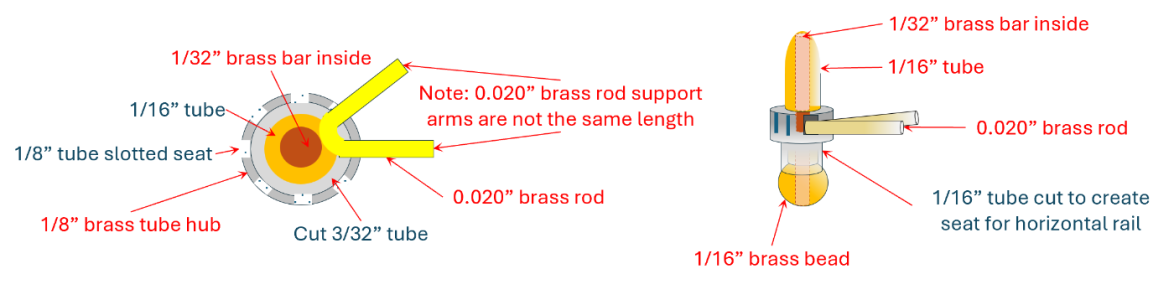
Ok, let’s be more pragmatic and increase the diameter of the hub to 1/8”Ø and sacrifice a bit of scale. If I’m going to do that, I can also discard the styrene for the hub material and come full circle and use brass tube once again. Since I won’t be drilling holes, (the reason for the plastic in the first place), but cutting slots, I’ve eliminated the brass holes problem.

Canopy Hub - 5th Attempt.png
 
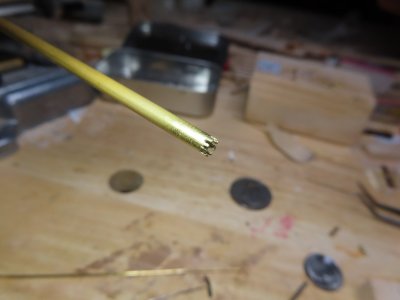
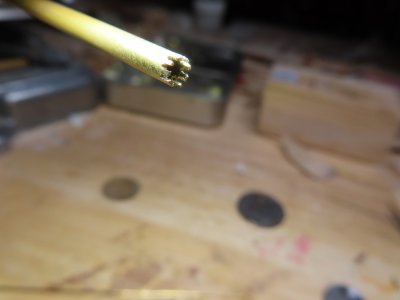
The trick here is cutting the brass slots to accept 0.020” Ø brass rod. My fine-tooth miter hand saw is 1/128” (0.008”) thick, cutting very narrow slots. The slots were 1/64” too narrow and my files were too thick to fit in the cut slots to widen them. Using various drill bits in my variable speed Dremel at the slowest setting, the slots were widened by sliding the spinning drill bit up and down the slot cutting with the bit’s side. Sorry, I could take a picture of this, as I needed both hands to perform this procedure.

IMG_2772.JPG

IMG_2773.JPG
 
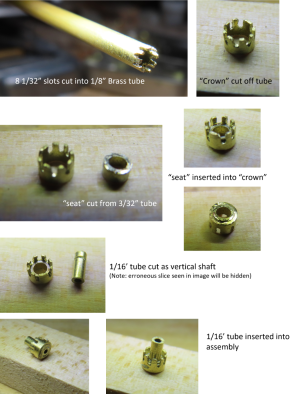
The end of the 1/8” tube was sawed off, producing a 1/8”Ø “crown” shaped component. Next, a slice of 3/32” tube was cut creating the seat ring, which was inserted into the bottom of the “crown.” Inside of that, a length of 1/16” tube was inserted creating the inner wall and axial of the hub assembly. Following the plan, additional pieces were added to create the hub.

Canopy Hub Fabrication.png
 
Back
Top