
-

SUBSCRIBE TO SHIPS IN SCALE TODAY!
The beloved Ships in Scale Magazine is back and charting a new course for 2026!
Discover new skills, new techniques, and new inspirations in every issue.
NOTE THAT OUR NEXT ISSUE WILL BE July/August 2026 -

Win a Free Custom Engraved Brass Coin!!!
As a way to introduce our brass coins to the community, we will raffle off a free coin during the month of August. Follow link ABOVE for instructions for entering.


You are using an out of date browser. It may not display this or other websites correctly.
You should upgrade or use an alternative browser.
You should upgrade or use an alternative browser.
USS Constitution - Model Shipways
- Thread starter Jack Sparrow
- Start date
- Watchers 40


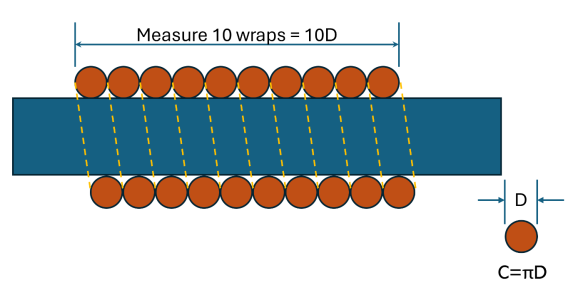
OK, one wrap of the rope around the dowel is one circumference of the dowel not the rope itself. So if you wrap the dowel 10 times, measure the length of the rope used, and dived by 10, you get an accurate measure of the dowel's circumference. Your equation "D=Cπ" is wrong.
C=πD is correct
Jon
C=πD is correct
Jon

OK Mark,
Perhaps this will make it a little clearer
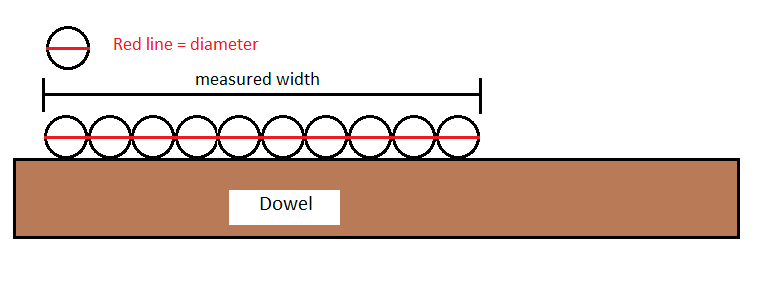
The circle is the rope and clearly the red line going across it is the diameter of the rope. As you wind the rope around the dowel and each turn is laying side by side, the red lines all line up. The measured width of those ten turns is equal to ten of those diameter lines, so if you divide the total width by 10, you get one diameter of the rope.
Hope that helps
Perhaps this will make it a little clearer
The circle is the rope and clearly the red line going across it is the diameter of the rope. As you wind the rope around the dowel and each turn is laying side by side, the red lines all line up. The measured width of those ten turns is equal to ten of those diameter lines, so if you divide the total width by 10, you get one diameter of the rope.
Hope that helps
Hi Mark, not sure I follow your logic. The amount of rope "consumed" to make a full loop would depend on how thick the dowel was.
Another way to look at the illustration above is instead of a dowel, you could have a flat surface. If you cut ten small pieces of rope, laid them side by side and measured the width, you would have 10 times the diameter. The dowel is just a convenient way to get the rope side by side.
Another way to look at the illustration above is instead of a dowel, you could have a flat surface. If you cut ten small pieces of rope, laid them side by side and measured the width, you would have 10 times the diameter. The dowel is just a convenient way to get the rope side by side.


The PURPOSE of the rope-around-pencil procedure is to measure the diameter of the rope. While you can measure that directly with a caliper, it's difficult to impossible to do accurately. So you wrap the rope around 10 times, press the rope loops close to each other, measure the length of the 10 pieces of rope, divide by 10 and you have a more accurate measurement for the rope. g8rfan99 diagrammed that well and accurately in post 509. The diameter of the "pencil" doesn't matter. It could be a tin can, and the procedure and result is the same.
I think the discussion of circumference has confused things here. Normally, full size rope on sailing ships is measured using its circumference; as someone else mentioned here, it is easier and more accurate to measure that way. Should you want to measure the circumference of the ROPE in the example above, you'd multiple the measured diameter by pi.
If you wanted to know the LENGTH of the rope in the pencil diameter, then yes, you'd need to know the circumference of each wrap of the rope, and it's easy enough to come up with a different formula for that, but very little reason to do that here, unless you're winding cable around a drum and want to calculate the length of cable required.
Those are facts. I've been using AI a lot, and it's quite helpful, but can easily give conflicting answers, depending on how you ask (and no doubt other things).
Hope this helps.
I think the discussion of circumference has confused things here. Normally, full size rope on sailing ships is measured using its circumference; as someone else mentioned here, it is easier and more accurate to measure that way. Should you want to measure the circumference of the ROPE in the example above, you'd multiple the measured diameter by pi.
If you wanted to know the LENGTH of the rope in the pencil diameter, then yes, you'd need to know the circumference of each wrap of the rope, and it's easy enough to come up with a different formula for that, but very little reason to do that here, unless you're winding cable around a drum and want to calculate the length of cable required.
Those are facts. I've been using AI a lot, and it's quite helpful, but can easily give conflicting answers, depending on how you ask (and no doubt other things).
Hope this helps.
Last edited:
I've corrected the rope-and-pencil thing elsewhere, but since this (Post 497) is considered a placeholder for information used by others, I felt it should be corrected.This is just a placeholder for the following information. I wanted to add it to my build log so that I don't forget about it:
All correct.This is what I know about measuring rope size:
- Choose a smooth dowel Any round dowel works — its diameter doesn’t matter because you’re measuring the rope, not the dowel.
- Wrap the rope around the dowel 10 times
- Measure the total width of the 10 wraps Use a ruler or calipers to measure the combined width of the wrapped section.
This is where things go wrong. You're measuring over 10 pieces of rope. Over the DIAMETERS of 10 pieces of rope. Dividing by 10 gives the diameter of a rope, more accurately, NOT the circumference.
- Divide by 10 This gives the rope’s circumference
We don't need the circumference of the rope here, but if you want to know it it's C = D * piD=C/π
- Convert circumference → diameter Apply the formula:
I assume here you're wanting to calculate the overall, or circumscribing, diameter of 3 or 4 strands of rope. I don't think your calculations are correct. In the case of 3 strands, we have:Then there is the following:
The three strands sit around a center like three circles touching each other.
If each strand has diameter d:
Drope≈2d
So:
Crope≈2πd
Four strands pack like a square of circles:
Drope≈dsqrt(2)
So:
Crope≈πdsqrt(2)
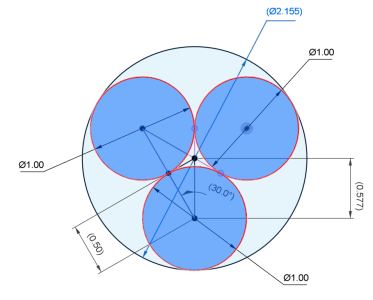
In this diagram, Ø1.00 represents the diameter of one rope (d). Here, the diameter of the circumscribing (outer) circle is (d/cos(30) +d) (2.155 above), or d(1/cos(30)+1). (In the above diagram, 0.577 represents 0.5/cos(30).) Not 2d as (I think) shown above. And of course the circumference of that circle would be (d/cos(30 +d) * pi
For 4 ropes packed into a square the diameter of the circumscribing circle would be:
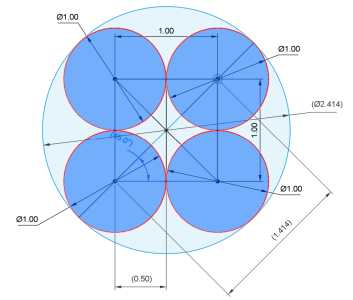
The circumscribing circle diameter would be d(sqrt(2)+1) (2.414 in the above diagram), not dsqrt(2). d(sqrt(2) (1.414 above) does represent the diameter of the circle that intersects the center of the 4 circles, however, so it would depend on what was desired. Normally, it would be the outer diameter.
All of this ignores the fact that the ropes can and will distort, when wound tightly, as in making cable. That would result in a somewhat smaller outer diameter. This effect would be greater on 4-strand ropes, as there is more room to pack material into the center.
I suggest that this information be corrected, lest other hobbyists calculate incorrect answers.
Hope this helps.
Think what you like, but facts are facts. From another retired engineer.
I'm curious how you are using the results, because that may explain what I think is probably a terminology or usage confusion. As to measuring ropes, if you wind ten 1mm diameter ropes around a pencil, you will measure a length of them of 10mm. Divide that by 10, and you have 1.0mm, the correct answer (for diameter). If you multiply that by pi, you will have the circumference of a rope. Not sure what you'd do with that.
I'm curious how you are using the results, because that may explain what I think is probably a terminology or usage confusion. As to measuring ropes, if you wind ten 1mm diameter ropes around a pencil, you will measure a length of them of 10mm. Divide that by 10, and you have 1.0mm, the correct answer (for diameter). If you multiply that by pi, you will have the circumference of a rope. Not sure what you'd do with that.
Yeah, why would you assume when measuring the 10mm that the /circumference/ would be 1? You're not measuring the distance around anything. You're just measuring a distance along 10 pieces of rope. g8rfan99 displayed it very well. No circumference is involved. If you want to know the circumference of the rope (for some reason), you can calculate it. If you want to know the circumference of the pencil, you'll need to know the diameter of the pencil, but we don't need that.so, I wind a rope around a dowel, 10 mm is the linear length that I measure? Therefore, the circumference will be 1 because you are dividing the 10 mm length by the number of wraps, which is 10. The diameter will be 1/pi. Or am I missing something?
I understand, and sympathize. But your placeholder notes were taken as gospel by some readers, and if they're not correct, that can cause a problem. Maybe use Notepad for placeholder notes? ;-)why did i start this discussion. I just wanted a placeholder for my notes...
Hi Mark,why did i start this discussion. I just wanted a placeholder for my notes...
First, it is a great discussion and it is good that you brought it up for it helps others to understand. It's a nice, easy technique for finding the diameter of a very small rope.
Might I make a suggestion that could clear this up. Do this exercise on a real scale rope. Get a rope that you know the diameter of (or can easily measure) something like 1/2" or 1/4", wrap it around a pipe, or a beer can and make the measurement. The answer will be what it is.
So, take ten 1" diameter balls, and lay them in a straight line. Measure their total line length (10"). Divide by 10, to get 1". The correct diameter of each ball. If you said instead that that was the circumference of the balls, then the balls would be 1/pi = 0.318" in diameter. But they're not, are they.
Yeah, I see that, but 1) we're not talking about ribbon, we're talking about rope, and 2) what are you trying to calculate or determine??that is not the situation we are dealing with.
LIke i mentioned, take a ribbon and wrap it around a random dowel. you will see that the ribbon does not line up like you mention. It is crooked. Maybe I should draw something. Hang on I'll put something together and attach it.
Forget the formulas for a minute. Please just state what you have, and what you are trying to determine. You're an engineer. We can't have different opinions on this, it must be terminology or not understanding what the other is trying to find out. Something like:
"I have some small thread, and I'm trying to find out what diameter it is, by wrapping it around a pencil."
or
"I need to know what length of rope it takes to wrap around a drum 10 times."
etc.
"I have some small thread, and I'm trying to find out what diameter it is, by wrapping it around a pencil."
or
"I need to know what length of rope it takes to wrap around a drum 10 times."
etc.
Actually, that's a good example. Wrapping ribbon around a dowel will look exactly like the threads of a bolt. If the ribbon is 1/10" wide, and you wrap it around the dowel so the edges just touch, you'll measure 1" for 10 turns. Resulting in a calculation of the ribbon width of 0.1". There is no circumference of the ribbon. There is for the dowel, but 1) we don't know it, and 2) it doesn't matter if the question is about the ribbon.that is not the situation we are dealing with.
LIke i mentioned, take a ribbon and wrap it around a random dowel. you will see that the ribbon does not line up like you mention. It is crooked. Maybe I should draw something. Hang on I'll put something together and attach it.
It's a shame to mess up this thread of your very nice Constitution build with our math chatterings, especially as that was not your original intention. Is it too late to take it this to PM? I'm not trying to prove myself right, I'm trying to understand the situation and be sure formulas or information available to you and the rest of us is correct.

- Joined
- Oct 9, 2020
- Messages
- 2,685
- Points
- 538

it's ok. I'll review your notes. I don't understand why the 2d is wrong. That's what is bothering me right now.It's a shame to mess up this thread of your very nice Constitution build with our math chatterings, especially as that was not your original intention. Is it too late to take it this to PM? I'm not trying to prove myself right, I'm trying to understand the situation and be sure formulas or information available to you and the rest of us is correct.
Not sure how that would work with a ribbon, but sure, if you have 3 strand rope and know the diameter of each strand, you can predict the rope diameter (measured by a circle or hole that the rope would have to go through) I've shown and calculated that on the previous page. It's (d/cos(30) +d). But if your just measure across any 2 strands, of course it's 2d.a ribbon is the same behavior that you would get from a rope. just a rope is not as exaggerated.
So lets say i have a 3 strand rope, and I know the diameter of each strand, I want to predict what will be the diameter of the rope.
Of course, that has nothing to do with the 10 thread wraps, and circumference is not necessary, but could be calculated.
My diagram shows that. I'm calculating the circumscribing, or outer, circle. This is the size of hole that would be necessary for the rope to go through, so I consider that the diameter. 2d is correct if you just measure across two strands, but the rope wouldn't go through a 2d diameter hole.it's ok. I'll review your notes. I don't understand why the 2d is wrong. That's what is bothering me right now.
- Joined
- Oct 9, 2020
- Messages
- 2,685
- Points
- 538
question. Are the following assumptions what you used in your 3 strand packing model:
- Each strand touches the other two.
- The centers of the three circles form an equilateral triangle.
- The side length of that triangle is d (because the circles touch).